
Last January, a PGY-1 I worked with pulled me aside in the workroom. “I think I picked the wrong field,” she said, eyes on the floor. She wasn’t burned out exactly—she was just very clearly in the wrong specialty, and the realization had landed late. Trouble was, she’d ranked programs assuming she’d be in that field forever.
If you’re staring down the Match (or already matched) and your brain is whispering, “What if I change my mind later?”, you’re not crazy. You’re smart. Let’s talk about how to pick programs that keep doors open instead of backing you into a corner.
Step 1: Get Honest About What Might Change
Before you can choose “flexible” programs, you need to know what kind of flexibility you’re actually shopping for. There are several flavors.
Here’s what typically shifts late for people:
Primary specialty choice
- Example: You’re applying internal medicine but suspect you might actually want anesthesia, EM, or neurology.
- Or you’re going into preliminary surgery but think maybe radiology or anesthesia is the long game.
Future fellowship interests
- You like internal medicine, but you’re not sure if you’ll want cards, GI, heme/onc, or just general IM.
- You like pediatrics, but PICU vs peds cards vs general peds is totally up in the air.
Procedural vs cognitive
- You thought you wanted to be hands-on all the time. Then you rotate on surgery and realize you hate the OR.
- Or you thought pure cognitive would be enough, but you light up when you get to do central lines or scopes.
Lifestyle vs prestige vs geography
- You say you care most about a top-name academic program… until you’re on your 17th hospital day in a row.
- Or you realize being closer to family (or in a certain city) matters more than you admitted to yourself.
Spend 15–20 minutes and write down, explicitly:
- What specialties are realistically still in play for you?
- Are you more likely to:
- switch to another field entirely?
- shift into or away from procedures?
- just want more/less research or academics?
Why this matters: a medicine resident considering cards vs GI needs different flexibility than someone who might jump ship from IM to radiology. The program type that protects you is different.
Step 2: Understand Which Program Types Are Naturally More Flexible
Some program structures are built to let you pivot. Others are basically concrete.
At a high level:
| Program Type | Flexibility Level | Typical Use Case |
|---|---|---|
| Categorical Internal Med | High (broad) | Unclear subspecialty, may stay general |
| Transitional Year (TY) | High (exploratory) | Unsure between several non-surgical fields |
| Preliminary Medicine | Medium | Confirming IM vs another field |
| Preliminary Surgery | Low–Medium | Path to surgical subspecialties |
| Categorical Small Fields | Low | EM, Rad, Anes, Neuro, etc. post-Match |
Categorical Internal Medicine, Pediatrics, FM: Generalist Paths
If there’s even a 20–30% chance you’ll stay generalist or bounce between multiple subspecialty ideas, broad-core specialties (IM, peds, FM) are your best hedge.
Why?
- Almost every organ system touches them.
- They’re feeder paths to tons of fellowships.
- They expose you to inpatient, outpatient, procedures, and consults.
If you’re not sure what you’ll love, a strong categorical IM or peds spot buys you time, options, and credibility.
Transitional Year (TY) and Preliminary Medicine: “Sampler” Years
These are often underrated.
TY and prelim medicine can be:
- A holding pattern while you figure it out.
- A chance to rotate widely and get letters in multiple fields.
- A backup when you applied to a small-field specialty (derm, rad onc, etc.) and may need to re-apply.
Caveat: They do not guarantee you a PGY-2 spot anywhere. So they’re flexible in exposure, but not secure in continuity. You must be comfortable with applying again.
Categorical in Smaller Fields (EM, Anesthesia, Neuro, Rads, etc.)
These get sticky. Once you’re in a categorical EM or anesthesia spot, you can switch—but:
- Positions to switch into mid-residency are limited.
- You’ll often need to re-enter the Match or scramble into open PGY-2/3 positions.
- Some program directors will not release residents early.
So if you’re applying to these but feel a nagging doubt, you must prioritize programs that:
- Have strong relationships with IM/FM/other departments.
- Have a history (real, not theoretical) of supporting residents who switch.
You’ll need to ask directly about this (we’ll get to how).
Step 3: What “Flexibility” Actually Looks Like in a Program
People throw the word “flexible” around without saying what they mean. Ignore vague branding. Look for these concrete features.
1. Breadth of Rotations and Electives
A flexible program lets you try different things early enough to matter.
Look for:
- Elective time in PGY-1 and early PGY-2—not only in PGY-3.
- Access to other departments: EM, anesthesia, radiology, ICU, subspecialties.
Red flags:
- Electives heavily backloaded into PGY-3.
- Very rigid rotation schedule with minimal choice.
Good sign on a website:
- “PGY-1 residents have 2–3 months of elective time, which can be used in other departments by arrangement.”
2. Clear Pathways Into Fellowships or Other Fields
You want institutional pathways, not heroic exceptions.
Ask / look for:
- How many residents go into fellowships? Which ones?
- Is there a track structure? (e.g., hospitalist, primary care, research, global health)
- Are there residents who went into something different than the program’s usual pipeline?
If a medicine program only ever sends people to cardiology and GI, and never hospitalist, palliative, or outpatient jobs, it’s probably not culturally flexible.
3. Support for Cross-Department Switching
Call this out directly in emails or on interview day:
- “Have you had residents switch into or out of your program? What did that process look like?”
- “If a resident decided they’re better suited for [another specialty], how would faculty respond?”
Green flags:
- They can name specific residents who switched and where they went.
- They describe a structured process: meetings, letters, coordination, timeline.
Red flags:
- “Well, that doesn’t really happen here.”
- Or worse: “We expect residents to know what they want before they get here.”
4. Culture: How They Handle Uncertainty
Residents who feel stuck late usually got the message early on: “Don’t rock the boat.”
You want the opposite.
Signs a program culture tolerates evolving interests:
- Residents openly talk about being unsure about fellowship.
- Faculty say things like, “We’ll help you figure out what fits you.”
- On interview day, when you say, “I’m interested in X and Y,” they don’t immediately push you to pick one.
If every third sentence is “We’re the top [specialty] pipeline program,” they probably care more about their match list than your existential crisis two years from now.
Step 4: Build a Rank List that Protects Future-You
Let me be blunt. You’re not just matching into a specialty. You’re matching into:
- A network of PDs who can open or close doors.
- A schedule that either lets you explore or locks you in.
- A culture that either tolerates or punishes changing your mind.
Here’s how I’d build a rank list if I were you and flexibility mattered.
Tier 1: Strong, Broad, Option-Rich Programs
These are programs where:
- You’d be okay staying in your current intended specialty long-term.
- You’d ALSO have solid options to pivot: fellowship, different subspecialty, or even switch fields.
They typically:
- Are medium-to-large academic or hybrid community-academic centers.
- Have multiple fellowships in-house.
- Have elective time early.
- Have residents going into a variety of careers.
Rank these high. They are your safest bet for future-you.
Tier 2: Niche-Strong but Less Flexible
These include:
- Super-heavy research powerhouses in one subspecialty.
- Very name-brand programs that mostly care about sending people to the same 3 big fellowships.
These may be fine if:
- You are fairly sure of the direction, and
- The training quality is excellent.
But if you’re 50/50 on your future goals, do not let prestige alone push these above more flexible mid-tier academic programs.
Tier 3: Programs with Rigid Schedules or Weak Departmental Ties
These are:
- Small community programs with minimal electives and no adjacent specialties.
- Programs with only one of your possible interests represented.
- Places where residents say, “We kinda had to figure out switching on our own.”
These belong lower on the list if flexibility is a core priority.
Step 5: Questions to Ask (Without Sounding Like You’re Already Leaving)
You don’t need to walk in saying, “Hey, I might hate this specialty.” There’s a more strategic way to get the information you need.
Ask current residents:
- “How easy is it to set up electives in other departments, like EM, anesthesia, or ICU?”
- “Do residents ever discover new interests during residency and change their fellowship or career plans?”
- “What happens if someone decides not to do a fellowship after all?”
Ask program leadership (PD, APD):
- “What kinds of careers do your graduates end up in? Both fellowship and non-fellowship.”
- “Have you had residents transition to different specialties or departments? How did you support them?”
- “If a resident developed a strong interest in [related specialty], would they have opportunities to explore that here?”
You’re listening less to the content and more to the tone:
- Do they sound proud of residents finding their path—even if it’s not what the program expected?
- Or do they sound mildly annoyed at any deviation from the default pipeline?
Step 6: Specific Scenarios and How to Choose
Let’s get concrete. Here’s how I’d handle some common “late switch” risks.
Scenario A: IM vs EM vs Anesthesia vs Critical Care Vibes
You love acutely sick patients, you like the ICU, but you’re not 100% sure if EM, IM-CC, or anesthesia is your future.
You should lean toward:
- A strong categorical internal medicine program with:
- Robust ICU exposure.
- Easy access to ED and anesthesia electives.
- A history of grads going into EM/CC/anesthesia or at least interacting with them heavily.
You should avoid:
- Small stand-alone EM programs at hospitals with weak IM and ICU presence, if you’re truly unsure about EM.
- Anesthesia programs with minimal ICU or peri-op medicine exposure if you’re half in love with the medicine side.
Scenario B: You Want a Narrow Specialty, But You’re Nervous (e.g., Derm, Rad Onc, ENT)
If you’re applying to a small-field specialty and you’re not 100% committed, your backup should not be a dead-end.
Better strategy:
- Rank categorical IM or TY programs that:
- Sit in institutions with your small-field specialty present.
- Give you face time with those departments.
- Let you generate strong letters if you end up reapplying.
You want colleagues who won’t treat your Plan B year as a failure. You’re not “just” the derm reject. You’re a legit intern building skills and options.
Scenario C: You Thought You Were Super Procedural, Now You’re Not So Sure
This comes up a lot with surgery.
You started med school sold on surgery; by application season it’s mixed feelings. You kind of like the OR, but the lifestyle and culture are giving you pause.
My advice if you’re truly 50/50:
- Lean toward categorical internal medicine at a hospital with strong procedural options (bronchs, lines, paracenteses, etc.) and:
- Surgical subspecialties,
- Interventional subspecialties (cards, GI, pulm),
- Possibly a prelim surgery year only if that program is known to help people pivot.
Be brutally honest here: a rigid surgical program with malignant culture is one of the hardest places to admit you want out. I’ve seen people stay years longer than they should because they were terrified of the fallout.
Step 7: Reducing Regret Now So You Don’t Panic Later
You can’t perfectly future-proof your choice. But you can stack the deck.
A few practical moves before rank day:
Talk to someone who switched late.
- Ask your school’s advising office, or email a few programs and ask if any resident is willing to share their experience.
- Someone who transferred IM→EM, or surgery→anesthesia, will give you a much clearer picture than generic advice.
Map your “Plan B” explicitly for each program. For every program on your list, answer:
- If I hated my intended specialty here, what would I do?
- Who would I talk to?
- What other departments and fellowships are realistically available?
- How many years would I likely “lose” in transition?
If you can’t answer those questions for a program, ask yourself why it’s ranked so high.
Pay less attention to name, more to fit and options. I’ve seen people at “mid-tier” programs pivot smoothly into new fields and top fellowships because their PD went to bat for them. I’ve seen people at big names feel completely trapped.
A supportive PD in a medium-name program beats a famous logo on your badge when you’re trying to change lanes.
One More Hard Truth
If you switch specialties late, there will be some cost.
- Maybe you repeat a PGY-1 year.
- Maybe you lose a year of attending salary.
- Maybe you explain your story on every future interview.
That’s fine.
It is still cheaper than practicing 30 years in a field that’s fundamentally wrong for you.
So as you choose programs, stop pretending you’ll magically have it all figured out by July 1. Choose places that assume you’ll evolve. That treat evolving as normal, not as a failure.
Future-you will thank present-you for protecting their options.
With those foundations laid, you’ll be able to build a rank list that doesn’t just match you—it gives you room to grow, change your mind, and still land on your feet. How you handle it if you do end up switching mid-residency? That’s the next chapter.
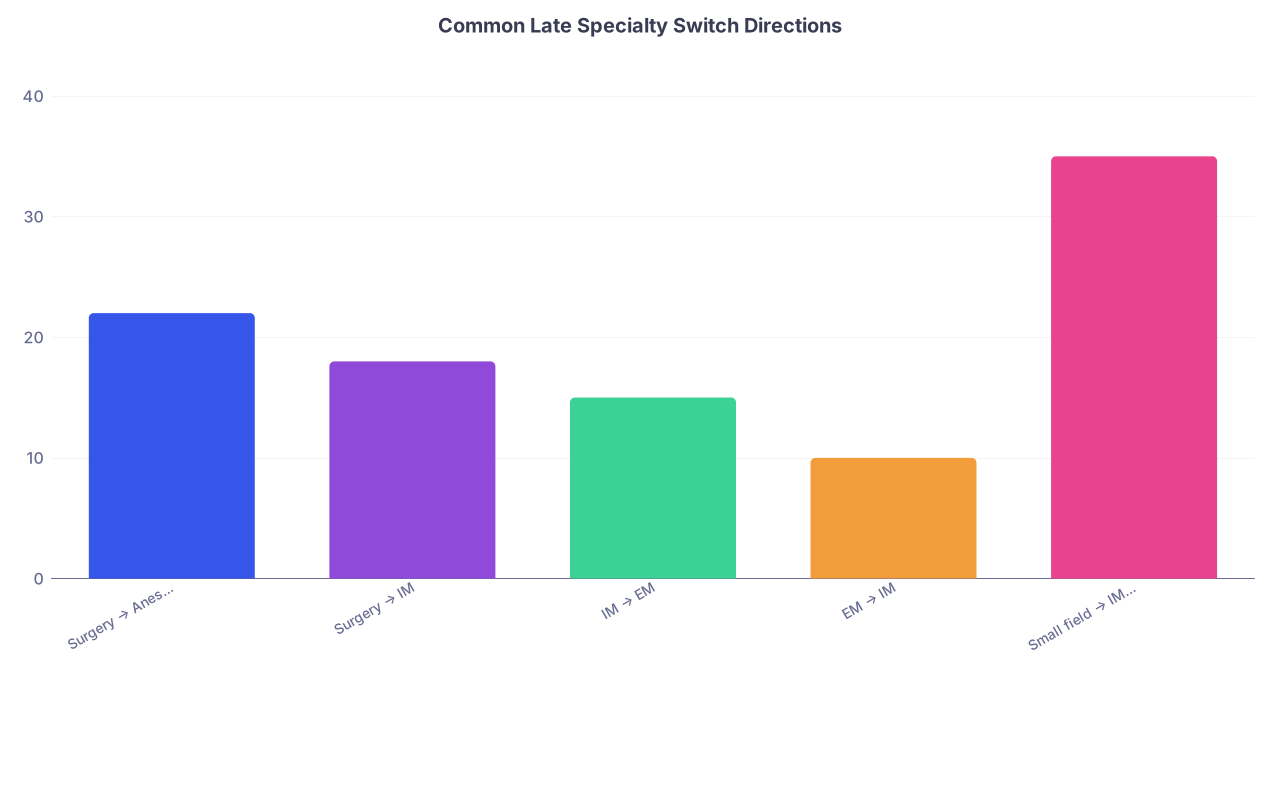
| Category | Value |
|---|---|
| Surgery → Anesthesia | 22 |
| Surgery → IM | 18 |
| IM → EM | 15 |
| EM → IM | 10 |
| Small field → IM/TY | 35 |

| Step | Description |
|---|---|
| Step 1 | Unsure about long term specialty |
| Step 2 | Prioritize academic programs with many fellowships |
| Step 3 | Rank categorical IM or TY backups at same institution |
| Step 4 | Seek programs with cross exposure to IM EM ICU |
| Step 5 | Check early electives and culture |
| Step 6 | Build rank list with flexibility as top filter |
| Step 7 | Current application field? |