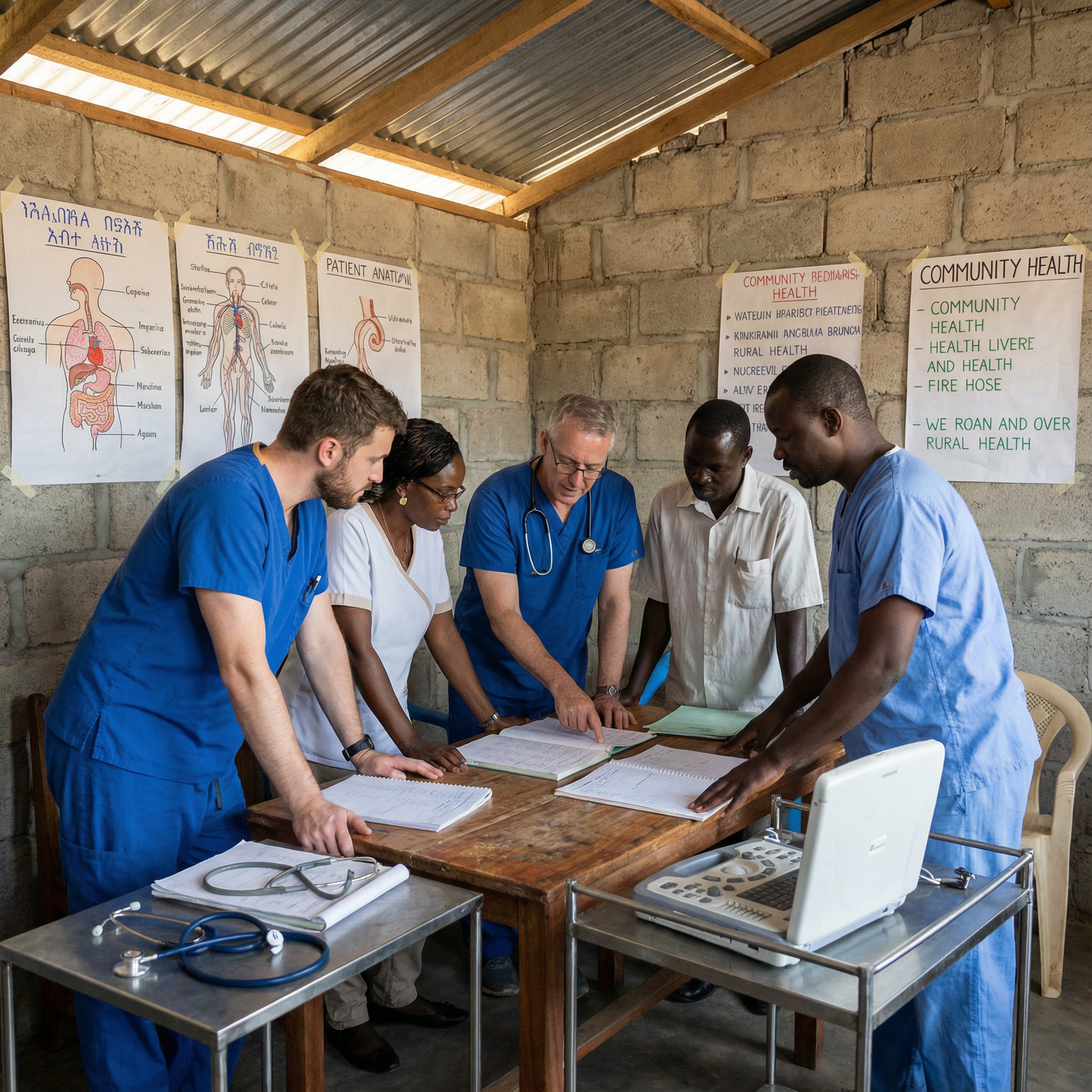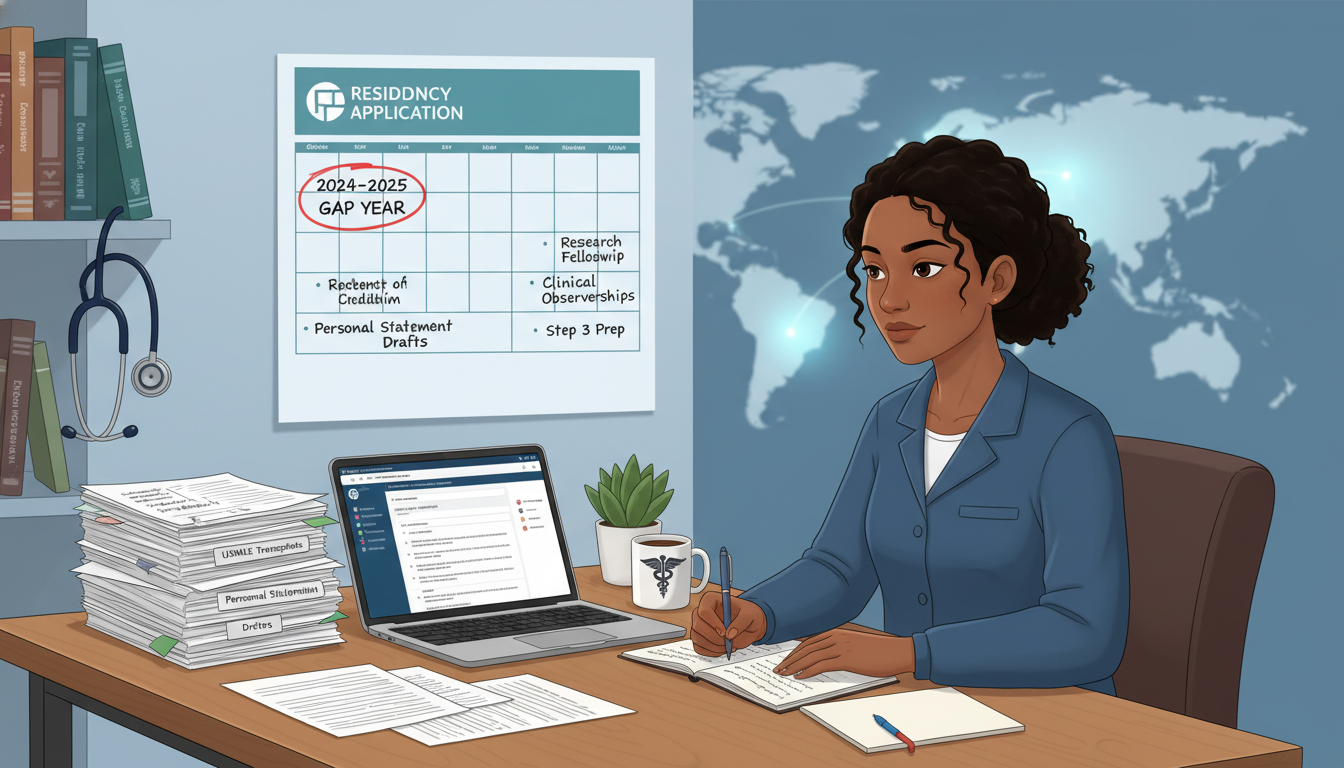
Understanding Gap Years as a Caribbean IMG
Taking a gap year—or having any time off medical school or between graduation and residency—is common, especially for international medical graduates. As a Caribbean IMG, you may worry that a gap will automatically hurt your chances at a U.S. residency. It doesn’t have to.
Program directors see gaps every cycle. What matters far more than the gap itself is:
- Why it happened
- What you did during that time
- How clearly and professionally you explain it
This article focuses specifically on gap year explanation strategies for Caribbean IMG applicants, including those from schools like SGU, AUC, Ross, Saba, and others. You’ll learn how to:
- Analyze your gap from a program director’s perspective
- Turn weak or “empty” time into a coherent, purposeful narrative
- Craft a strong gap year explanation letter and supporting answers for ERAS, interviews, and emails
- Avoid red flags and common mistakes that hurt Caribbean medical school residency prospects
Whether your gap was planned or unplanned, long or short, clinical or non-clinical, you can present it in a way that is honest, mature, and strategically framed.
How Program Directors View Gaps for Caribbean IMGs
Residency programs are used to seeing nonlinear paths, especially from IMGs. However, Caribbean IMGs are under closer scrutiny for several reasons:
- Variable clinical exposure quality
- Perceived differences in academic rigor across schools
- High applicant volume from certain schools (e.g., SGU, Ross, AUC)
This doesn’t mean you’re at a disadvantage automatically; it means your file is often reviewed with extra attention to consistency, professionalism, and reliability.
What Raises Concern About a Gap
Program directors are less worried about the fact that you took time off medical school or had a break before applying, and more concerned about unanswered questions:
Was this due to academic failure or professionalism problems?
- Unexplained failures, dismissals, or probations
- Sudden breaks with no documented activity
Did the applicant lose clinical momentum?
- No recent U.S. clinical experience, especially for older graduates
- No patient contact for years
Is the applicant hiding something?
- Vague, evasive answers to “What were you doing during this time?”
- Inconsistent timelines across CV, ERAS, and personal statement
Will this pattern repeat in residency?
- Multiple disjointed gaps
- Long stretches of inactivity without clear reasons
Your goal is to show them:
“Yes, I had a gap. Here’s why. Here’s what I did with that time. Here’s why I’m more prepared for residency now, not less.”
What Can Reassure Program Directors
Even with a gap, you can strengthen your Caribbean medical school residency application if you demonstrate:
Continued engagement with medicine
– U.S. clinical experience, observerships, research
– Volunteer work in healthcare settings
– Self-directed study and exam preparation (with results)Personal maturity and insight
– Honest, non-defensive explanation
– Reflection on what you learned and how you grewRecent, relevant performance
– Strong, recent letters of recommendation
– Upward academic trend (later scores > earlier scores)
– Clear connection between your activities and your chosen specialty

Step-by-Step Strategy: Turning Your Gap into a Coherent Story
Step 1: Define the Nature of Your Gap
Before you draft anything, categorize your gap honestly:
Academic or exam-related
- Took time off to study for USMLE Step 1/2
- Repeated coursework or clerkships
- Delayed graduation due to academic struggle
Career exploration or strategic planning
- Research year
- Extra clinical experience (U.S. or abroad)
- Exploring specialties before committing
Personal, family, or health reasons
- Serious personal illness or mental health treatment
- Caring for a sick family member
- Financial hardship requiring non-medical work
Administrative or logistical
- Visa or immigration delays
- Delayed ECFMG certification
- Waited a year to improve application (scores, experience)
Combination
- Example: First 3 months recovering from burnout; next 9 months doing research and observerships.
Write down:
- Exact dates (month/year start to month/year end)
- Primary reason(s)
- Concrete activities performed during that time
This will be the backbone of both your gap year explanation letter and your interview answers.
Step 2: Identify the “Value” of What You Did
Even if your gap looks empty at first glance, look for anything that shows effort, responsibility, and growth. For each gap period, ask:
- Did I learn new clinical or research skills?
- Did I strengthen my knowledge for exams (even if I didn’t pass right away)?
- Did I take on responsibility (job, caregiving, leadership)?
- Did I work on my resilience, mental health, or professionalism in a meaningful way?
Examples of activities that can be framed positively:
- USCE (observerships, externships, electives)
- Research assistant roles or publications/posters
- Step exam preparation that led to improved scores
- Part-time clinical work in your home country
- Teaching or tutoring (especially USMLE-focused)
- Structured language courses to improve clinical communication
- Non-clinical work that shows maturity and reliability (e.g., full-time job to support family during crisis)
Even if part of the time was genuinely inactive (e.g., burnout, depression, disorganized studying), you can still explain this honestly and focus on what changed and how you recovered.
Step 3: Create a Clear, Chronological Timeline
For Caribbean IMGs, especially those who finished school outside the typical U.S. timeline, a clear chronology is essential.
Create a simple document with:
- Graduation date (month/year)
- Date of each exam (Step 1, Step 2 CK, OET, etc.)
- Start/end dates of each clinical experience or job
- Periods of no formal activity (and your brief reason)
Your goal: No unexplained gaps of more than 3–4 months.
If something truly was empty time, explain that period briefly but honestly (e.g., mental health recovery, family crisis, relocation, visa challenges), then show how you transitioned back into structured activity.
Writing a Strong Gap Year Explanation Letter (and ERAS Content)
Many Caribbean IMGs with a gap need some form of written explanation, which may appear in:
- ERAS “Education” or “Experience” section descriptions
- The “Additional Information” section
- A separate gap year explanation letter e-mailed to programs or uploaded as an additional document
- Your personal statement (brief, not the main focus)
Principles of an Effective Explanation
Be honest but strategic
- Avoid lies or major omissions; they’re easily exposed.
- Share enough detail to be credible, but not so much that the explanation overshadows your strengths.
Be concise and specific
- One short paragraph is often enough for minor gaps.
- Up to 1 page max for a dedicated explanation letter for complex cases.
Take responsibility without self-sabotage
- Acknowledge missteps: “I underestimated the preparation needed for Step 1.”
- Then emphasize change and improvement: “I adjusted my approach, sought mentorship, and subsequently improved my performance.”
Show a clear turning point and growth
- What did you change? Study strategies, time management, mental health care, professional habits, etc.
- Tie your growth to skills that make you a better resident.
Sample Framework for a Gap Year Explanation Letter
You can adapt this structure:
Paragraph 1 – Brief Identification of the Gap
- State the dates and type of gap
- Clarify your status (e.g., graduated, awaiting ECFMG, etc.)
Between July 2021 and August 2022, after completing my core clinical rotations at a Caribbean medical school, I had a period of time off clinical training while preparing for and completing my USMLE examinations and addressing a personal family matter.
Paragraph 2 – Honest but Focused Reasoning
Initially, I underestimated the time needed to prepare for Step 1 and had to postpone my exam date. During this period, I also assumed increased responsibilities at home to support a close family member who was experiencing a serious health issue. Balancing these responsibilities with exam preparation was challenging, and I recognize that I could have sought guidance earlier.
Paragraph 3 – Concrete Activities and Improvement
Over the following months, I created a structured study schedule, engaged regularly with a faculty mentor from my medical school, and used performance data from NBME assessments to guide my preparation. I ultimately passed Step 1 and Step 2 CK and subsequently completed U.S. clinical observerships in internal medicine and family medicine, which helped me regain clinical momentum and keep my knowledge current.
Paragraph 4 – Reflection and Link to Residency
This period taught me the importance of seeking help early, setting realistic timelines, and maintaining open communication with supervisors—skills that I carry into clinical work. I am now fully focused on residency training and confident in my ability to manage responsibilities effectively and seek support when needed.
You can shorten or adapt this depending on your situation. For more sensitive issues (e.g., mental health), you can be general but truthful:
I experienced a significant health challenge that required evaluation and treatment, and I took time away from training on the advice of my physicians. I adhered to treatment, fully recovered, and have since demonstrated consistent performance in clinical and academic settings. I am cleared for full participation in residency training without restrictions.

Tailored Strategies by Gap Type (with Examples)
1. Exam-Related Gap (Common for Caribbean IMGs)
Scenario: You took 12–18 months after basic sciences or after graduation to focus on USMLE Step 1 and Step 2 CK.
Challenges:
- Looks like a long period with “just studying”
- If your scores are modest, programs may doubt the effectiveness of that time
Strategies:
- Emphasize structured, full-time study, not vague “I was reviewing.”
- Mention score improvement, NBME progress, or specific resources and methods.
- If relevant, include any teaching/tutoring or involvement in study groups.
Example Interview Answer:
After completing my core rotations at my Caribbean medical school, I took a dedicated year to focus on Step 1 and Step 2 CK. At first, my approach was unstructured and my practice scores were low. I realized I needed more accountability, so I joined a structured review course, took regular NBME exams, and tracked my performance. Over time, my scores improved significantly, and I passed both exams. That experience taught me how to self-assess honestly and adjust my strategy—skills I now apply when I receive feedback in the clinical setting.
Link this directly to your readiness for residency: ability to learn independently, respond to feedback, and manage time.
2. Clinical Experience Gap After Graduation
Scenario: You graduated from a Caribbean medical school, then had 1–2 years before applying, spent partially on observerships and partially inactive.
Challenges:
- Programs worry about “rusty” clinical skills
- Unstructured months look risky unless clearly explained
Strategies:
- Highlight any U.S. clinical or home-country clinical experience you did obtain.
- Clarify recent, hands-on or observership experience close to application cycle.
- For empty months, briefly explain (visa issues, waiting for exam scores, financial constraints) and then pivot to what you did next.
Example Explanation in ERAS Experience Section:
From March 2023 to June 2023, I experienced delays in my visa processing, which postponed my planned U.S. clinical observership. During this time, I remained engaged with medicine by reviewing internal medicine guidelines, participating in online case-based learning modules, and volunteering at a local health outreach program. Once my visa was approved, I immediately began my scheduled observership at [Hospital Name].
3. Personal or Family Health Gap
Scenario: You took 6–12 months away from clinical training due to serious illness or caregiving.
Challenges:
- Programs worry about long-term functional impact
- Sensitive disclosure issues (especially mental health)
Strategies:
- Maintain privacy while confirming that you are stable, treated, and cleared.
- Avoid dramatic or excessive details; focus on resolution and current stability.
- Emphasize any steps you took to maintain or refresh medical knowledge.
Example Letter Snippet:
In late 2021, I took a leave from training to care for a close family member who developed a life-threatening illness. This required my full-time involvement for several months. During this period, I maintained my medical knowledge through online CME activities and guideline review. Once my family member’s condition stabilized, I returned to full-time clinical engagement, completing observerships in internal medicine and gaining strong letters of recommendation. This experience deepened my empathy for patients and families navigating serious illness, and reinforced my commitment to internal medicine as my career path.
4. “Career Reassessment” or Specialty Change
Scenario: You initially explored one specialty (e.g., surgery) and later changed to another (e.g., internal medicine), with a gap during decision-making.
Challenges:
- Can look like indecision or lack of commitment
- Programs want certainty about your chosen specialty
Strategies:
- Show how exploration led to a thoughtful, well-informed decision.
- Emphasize recent, specialty-specific experiences aligned with your current choice.
- Clearly state: “This is the field I am committed to.”
Example Interview Answer:
After graduating, I spent several months exploring different specialties, including a research observership in general surgery. Although I appreciated the technical aspects, I realized I was more drawn to long-term patient relationships and complex medical decision-making. I then pursued observerships in internal medicine and found that this environment aligned much more closely with my strengths and interests. That period of exploration was valuable because it allowed me to make a clear, well-informed choice, and I am now fully committed to a career in internal medicine.
Putting It All Together for a Competitive Caribbean IMG Application
Whether you’re at SGU hoping to highlight a strong SGU residency match history, or you’re from a smaller Caribbean school trying to overcome limited name recognition, your gap narrative must integrate smoothly with the rest of your application.
Align Your Gap Explanation with Your Whole File
Check for consistency across:
CV / ERAS Application
- Dates match your explanation
- Experiences are labeled accurately (full-time vs part-time, observership vs externship)
Personal Statement
- Focuses on your motivation, specialty fit, and strengths
- Briefly acknowledges the gap only if relevant to your story (1–2 sentences)
Letters of Recommendation
- Prefer recent and U.S.-based letters, especially if your gap is older
- Ask letter writers to comment on your reliability, work ethic, and clinical readiness
Interview Answers
- Practice a 60–90 second response to: “Tell me about this gap in your training.”
- Same story, same emphasis on growth.
Example Integrated Narrative
Imagine you:
- Attended a Caribbean medical school
- Took 18 months after graduation with mixed exam prep, some family issues, and 4 months of observership
- Are now applying to internal medicine
Your integrated narrative might look like this:
ERAS: Clear dates, experiences listed, gap months accounted for as exam prep and family caregiving.
Personal Statement:
- Focus on why internal medicine fits you.
- One short paragraph: you experienced an unexpected delay after graduation due to underestimating exam prep and family illness, learned structured study and resilience, completed U.S. observerships, and are now fully engaged and ready for training.
Gap Year Explanation Letter:
- 3–4 paragraphs with clear, honest detail and reflection (as in earlier templates).
Interview:
After graduating from my Caribbean medical school, I faced two main challenges. First, I underestimated the preparation needed for Step 2 CK and had to adjust my study strategy. Second, a close family member became seriously ill, and I took on significant caregiving responsibilities for several months. During this time, I maintained my medical knowledge through structured study and, once the situation stabilized, completed U.S. observerships in internal medicine. These experiences taught me a lot about time management, resilience, and the patient-family perspective, and I now feel well-prepared and highly motivated to begin residency training.
This coherent message reduces the “mystery” around your gap and lets programs focus on your strengths.
FAQs: Gap Year Explanations for Caribbean IMGs
1. Does a gap automatically ruin my chances at a U.S. residency as a Caribbean IMG?
No. Many Caribbean IMGs with gaps successfully match each year, including those from well-known schools with strong Caribbean medical school residency outcomes and SGU residency match data. Your chances depend on the context of the gap, your overall application strength (scores, clinical experience, letters), and how clearly and professionally you explain the gap. Unexplained or poorly explained gaps are more damaging than the gap itself.
2. Should I address my gap in my personal statement or only in a separate explanation letter?
Use your personal statement mainly to highlight your passion for your specialty, key experiences, and strengths. If your gap is relatively short or straightforward, you can mention it briefly in 1–2 sentences. For more complex or sensitive situations, it’s often better to use a gap year explanation letter or the ERAS “Additional Information” section, and keep the personal statement focused on your motivation and fit.
3. How do I explain time off medical school if it was due to mental health?
You are not required to share every detail. You can say you experienced a significant health challenge, received appropriate treatment, took time away on medical advice, and have since fully recovered and been cleared for training. Emphasize your current stability, consistent recent performance, and what you learned (self-awareness, help-seeking, resilience) without going into deeply personal or stigmatizing specifics.
4. What if part of my gap year was genuinely unproductive?
Acknowledge it briefly, without self-attack, then focus on the turning point and what changed. For example:
Initially, I struggled to structure my time effectively and did not make the progress I expected. Recognizing this, I sought mentorship, created a formal schedule, and then began consistent exam preparation and clinical observerships.
Programs understand that people make mistakes; they want to see that you recognize them, take responsibility, and demonstrate improvement going forward.
Handled thoughtfully, a gap can become a story of growth rather than a permanent red flag. As a Caribbean IMG, your path may be less linear, but with clear explanations, recent clinical engagement, and a unified narrative, you can still build a compelling case for your readiness to start residency.