If You Lack USCE: Building a Path Using Friendly Community Programs
What do you actually do when your ERAS timeline is ticking, you have zero real US clinical experience, and every forum post says “No USCE = auto-reject”?
You use community programs. Strategically. And you stop pretending you’re competing head‑to‑head with US grads from big-name schools.
This is fixable. Hard, but fixable. Let’s walk through what to do if you’re an IMG/FMG with little or no USCE and you still want a real shot at the Match—using community programs that are actually willing to look at you.
Step 1: Be Honest About Your Starting Point
First, you need to know which “bucket” you’re in. Because the strategy is different if you have solid scores but no USCE versus weak scores and no USCE.
Use this rough breakdown:
| Profile Type | Step 2 CK | YOG | USCE | Match Chance (if smart) |
|---|---|---|---|---|
| A: Strong scores, recent grad | ≥ 240 | ≤ 3 years | 0–4 weeks | Good with right list |
| B: Average scores, recent grad | 220–239 | ≤ 5 years | 0 weeks | Possible but needs heavy volume |
| C: Lower scores and/or older grad | < 220 or > 5 years | > 5 years | 0 weeks | Tough, needs extra angles |
| D: Prior failed attempts | Any | Any | 0 weeks | Very hard, but some routes exist |
If you’re reading this, you’re probably B, C, or D. Maybe A but stuck outside the US with no visa and no USCE.
Fine. Your leverage won’t be “top academics and big‑name letters.” It’ll be:
- Volume (large number of targeted programs)
- Fit with community‑heavy, service‑heavy programs
- Strategic substitutes for USCE (observerships, tele-rotations, home country continuity)
- Smart storytelling in your application
Skip the denial phase. You’re not matching at Mayo without USCE. You’re trying to lock in a realistic, training-heavy community spot where IMGs are part of the backbone.
Step 2: Understand What “IMG‑Friendly Community Program” Really Means
People throw “IMG-friendly” around like it’s a personality trait. It’s not. It’s math and precedent.
Friendly usually means:
- Historically matches multiple IMGs each year
- Located in non-glamorous areas (Midwest, South, rural, small cities)
- Community or community‑university affiliated, not pure university flagships
- Less obsessed with “US clinical experience” if other parts of your file carry weight
Examples (NOT a guaranteed safe list, but the pattern):
- Internal Medicine at places like:
- BronxCare, Interfaith, Wyckoff, some HCA hospitals, St. John’s/Detroit, some community programs in Ohio, Pennsylvania, Texas, West Virginia
- Family Medicine in underserved areas, Midwest, rural South
- Psych and Peds at smaller community hospitals (still competitive but more open than big-name university programs)
What they actually care about more than the “USCE” checkbox:
- Can you function safely with limited supervision in July?
- Are you likely to sign a contract and stay, not leave after a year?
- Do your letters show that you can handle bread‑and‑butter inpatient medicine?
- Are you going to struggle with communication or basic EHR use?
So your whole plan is: convince them the answer to all those is “yes,” even without classic USCE.
Step 3: Replace “Perfect USCE” With a Stack of Imperfect but Real Things
If you don’t have 3–6 months of hands‑on USCE, you build a stack:
- Any US exposure you can still get
- Strong, detailed home‑country clinical letters
- Evidence that you’ve worked in a similar environment to community US hospitals
- Clear proof you can communicate and adapt
3.1. Squeezing Out Any US Exposure (Even Late)
You’re thinking: “Application season already started. Too late.” It’s not ideal, but it’s not useless either. You can still:
- Book 2–4 week observerships (yes, observerships still help if framed correctly)
- Do tele-rotations or US-based case discussion programs
- Volunteer in a clinical-adjacent role (free clinic, health fairs, refugee clinics)
Even 2–4 weeks at a US community hospital can let you say:
- You’ve seen US documentation style
- You’ve watched care transitions, discharge planning, multidisciplinary teams
- You’ve interacted with US patients and staff
You will never market this as “equivalent to sub‑internships.” It’s not. You frame it as: “I actively sought exposure to US systems and can hit the ground running faster than my ‘no exposure’ peers.”
3.2. Making Home-Country Experience Work For You
If you lack USCE but you’ve actually practiced medicine back home, that can be more convincing than 4 weeks of shadowing in New Jersey.
Community programs love to hear:
- “I carried a 15–20 patient inpatient census as a junior doctor.”
- “I did overnight calls, managed sepsis, DKA, COPD exacerbations.”
- “I’ve worked in a resource‑limited setting with high patient volume.”
You need letters that spell this out in concrete, American‑style detail:
Bad letter content: “She is hardworking and intelligent.”
Good letter content: “He independently managed 12–15 inpatients per day, including patients on vasopressors, BiPAP, and insulin drips, and consistently presented concise, organized assessments and plans.”
So you ask your letter writers directly:
- “Can you please comment specifically on my clinical volume, responsibility level, and how I compare to recent graduates?”
- “Can you describe any situations where I handled acute or complex cases?”
This starts to sound like “functional USCE” even though it’s geographically not in the US.
Step 4: Use Community Reality to Your Advantage
Community programs live and die by service. They don’t have 20 researchers on staff. They have 20 septic patients and not enough residents.
They need:
- Residents who show up
- Residents who don’t fall apart on Q4 or night float
- Residents who will finish all 3 years and not seek a transfer in month 3
You pitch yourself exactly like that.
Your Narrative Needs to Hit Three Angles:
- I know what community work looks like.
- I’ve done heavy service work before (even if in another country).
- I’m likely to stay and serve similar populations.
Examples of how this sounds in a Personal Statement / email:
“I’m drawn to community programs that serve uninsured and underinsured patients because my internship in [country/region] was in a hospital where most patients had no access to private care. I’m used to high patient volumes, limited resources, and a strong focus on continuity.”
“I’m particularly interested in your program’s role in caring for [local demographic group]. In [home city], I worked extensively with [similar demographic], including chronic disease management and patient education in [language].”
Programs are tired of generic “I love your emphasis on education and research.” They care if you can staff their floors and stay in town.
Step 5: Build a Targeted List: Volume + Fit
You can’t do this with 40 random applications. With no USCE, you’re usually looking at 120–200+ applications, but with a focused filter.
Broad strokes for IMGs without USCE:
- Internal Medicine: 80–140 programs, leaning heavily community/non-prestigious name
- Family Medicine: 60–100 programs, focus on underserved areas, rural tracks
- Pediatrics/Psych: Very selective; you will still need a spread, but do not fixate only on big cities
Use these filters when building your list:
- “Community-based” or “community-focused” in description
- History of matching multiple IMGs (look at current residents’ medical schools)
- States: Midwest, South, some East Coast community hospitals away from big academic centers
- Not ultra brand-name university programs, especially those with explicit “USCE required” lines
If a program says:
- “At least 1–2 months US clinical experience REQUIRED” — skip. Don’t waste the fee.
- “US clinical experience preferred” — that’s your zone. That “preferred” is code for “we will consider exceptions if the rest of the file is strong enough or we need more applicants.”
Step 6: Fix the Rest of Your File So They Can Overlook No USCE
Without USCE, every other weak area hurts double. You cannot also have a sloppy CV, vague experiences, and a forgettable personal statement.
6.1. Personal Statement: Stop Sounding Generic
For your situation, your PS must:
- Directly acknowledge your non‑US background without sounding apologetic
- Emphasize heavy clinical responsibility and adaptability
- Show specific alignment with community care
Example framework:
Paragraph 1: A specific patient or shift that shows you handling real responsibility in your home system.
Paragraph 2: What you learned about community-based, high-volume care.
Paragraph 3: How you’ve sought to understand US medicine (observerships, tele-rotations, guidelines, CME, US-based courses).
Paragraph 4: Why community programs suit your training goals long term.
You’re not hiding your lack of USCE. You’re offsetting it with a heavy-duty track record elsewhere.
6.2. CV and Experiences: Show Breadth and Depth
Do not write “Internal Medicine Resident – Hospital X” and then nothing.
You need bullets like:
- “Managed daily inpatient census of 10–15 patients with supervision, including acute coronary syndromes, sepsis, and COPD/asthma exacerbations.”
- “Led handover for night teams, organizing and prioritizing issues for cross-cover.”
- “Collaborated with nurses, pharmacists, and social workers to coordinate discharge plans.”
You want a US PD to think: “If this is all accurate, this person could adjust quickly to our system.”
6.3. Communication: Make It Obvious You Can Handle English
PDs worry a lot about communication when IMGs have no USCE.
So you stack evidence:
- Any USMLE Step 2 CS alternative-type OSCE if your country offered one
- Presentations in English (online conferences, webinars) listed with titles
- If possible, a US-based mentor or physician writing in a letter that your spoken English is clear and easily understood
- Absolutely clean grammar and structure in ERAS entries — no sloppy writing
Do not give them an excuse to say, “I’m not sure this person can communicate well enough.”
Step 7: Use Observerships and Tele-Things Correctly (Not As Magic Tickets)
Observerships are not golden keys. But they can tilt a borderline file into “okay, let’s take a look.”
How to avoid wasting them:
- Prefer observerships at hospitals that actually have residencies in your chosen specialty
- Ask early if their residents have ever come from their observership pipeline
- Focus your ask: “If you feel comfortable, I’d be grateful for a letter commenting on my clinical reasoning and communication, even though I understand this is observership.”
And then behave like an unofficial sub‑intern:
- Always be early
- Read about every patient you see
- Ask to present one or two patients informally to the attending or resident
- Offer to summarize the day’s list, write mock notes (for your own learning, respecting privacy/PHI rules)
If you can get even one US letter that says:
“Though he was officially an observer, he consistently presented cases succinctly, discussed differential diagnoses, and showed a clear understanding of US inpatient workflows.”
—that’s gold for someone with no prior USCE.
Tele-rotations: treat them as supplements, not anchors. They help show initiative and familiarity with US guidelines, not direct bedside capacity.
Step 8: Strategic Communication With Programs
You’re not spamming every program coordinator with “Please consider my application.” That’s ignored.
But you can be targeted and intentional:
Scenarios where it’s reasonable to email:
- You’ve completed an observership/tele-rotation with them or their affiliate
- You are from their local immigrant community and can serve their population’s language needs
- You have a direct link: alumni from your school there, faculty who know someone on their staff
Your email is short and specific:
- One sentence introducing yourself (IMG from X, YOG, specialty)
- One or two sentences on why their specific program fits (not “you have great teaching”)
- One line acknowledging your lack of USCE but connecting your existing clinical work to community needs
- One line politely expressing hope they’ll review your application
If you haven’t applied yet, you do NOT ask, “Should I apply?” You just apply and then maybe send a brief, respectful note.
Step 9: Protect Yourself Against Unrealistic Expectations
Some hard truth:
- If you’re > 5–7 years out of graduation + no USCE + mediocre scores, this is an uphill climb.
- If you’ve failed Steps and have no USCE, many programs simply won’t open the file.
- If you’re applying to only 30–40 programs because of money, your odds shrink sharply.
So you lock in a realistic multi-year plan:
Year 1: Apply broadly + aggressively improve your profile (observerships, tele, research, stronger letters).
If you don’t match:
Year 2: Apply again with better letters + US exposure, maybe targeting slightly different specialty or more FM.
Parallel: Seriously consider backup options (non-ACGME fellowships, research positions, or a different healthcare track) if your profile is extremely weak.
I’ve seen people match on second or third attempts after adding exactly 2–3 key things:
- One real US letter
- A few months of US-based clinical exposure
- A tightened, targeted program list focused on community-heavy, IMG-trusting hospitals
Step 10: When Interviews Come: Prove You Don’t Need Hand-Holding
If you get to the interview without USCE, someone fought for you in that committee room. Don’t make them regret it.
You need to show:
- You understand US inpatient flow: admission → daily rounds → orders → discharge
- You know basic US terminology (PCP, SNF, rehab, case manager, prior auth, etc.)
- You’re comfortable with EMR concepts, even if you haven’t used Epic/Cerner directly
So before interviews:
- Watch US hospital vlogs / resident day‑in‑the‑life videos just to absorb language and workflow
- Read a short EMR tutorial or watch Epic/Cerner overview videos online
- Practice case presentations in English with a US-based mentor or colleague abroad who knows US format (CC → HPI → PMH → Meds → Allergies → ROS → PE → Labs/Imaging → Assessment/Plan)
And you explicitly tackle the “no USCE” concern in your answers:
“When they ask: ‘You haven’t trained in the US system. How will you adapt?’”
A strong answer sounds like:
“I’ve worked for two years as a junior doctor in a public hospital with high patient volume and limited resources, so I’m used to learning fast and handling full responsibility. During my observership at [X], I saw how teams here structure rounds and documentation, and I’ve been studying US guidelines and typical order sets. I know I’ll need some orientation to the EMR, but I’m very comfortable with technology and I tend to pick up systems quickly. What I can bring from day one is disciplined work ethic, experience managing complex patients, and the willingness to ask for help early rather than risking patient safety.”
That’s what community PDs want to hear.
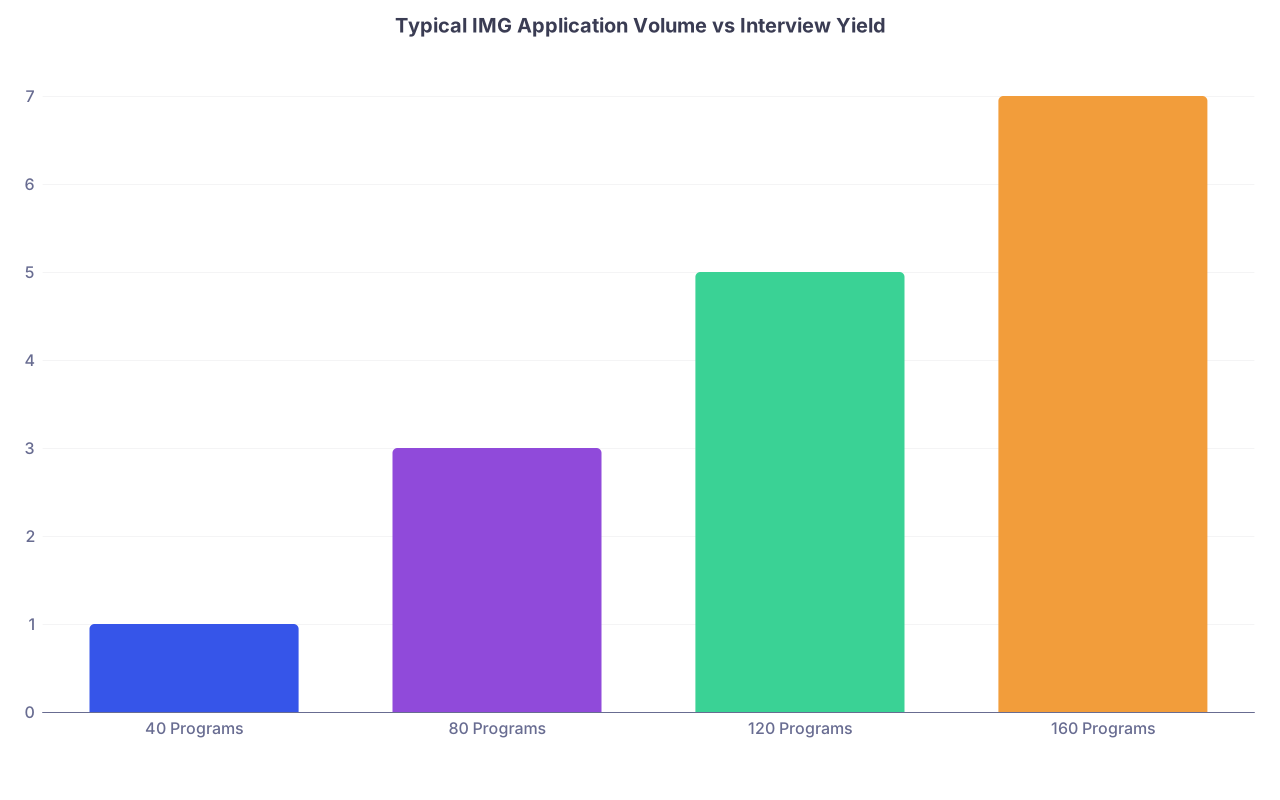
| Category | Value |
|---|---|
| 40 Programs | 1 |
| 80 Programs | 3 |
| 120 Programs | 5 |
| 160 Programs | 7 |

| Step | Description |
|---|---|
| Step 1 | No USCE IMG |
| Step 2 | Clarify Profile and Scores |
| Step 3 | Build Large Targeted List of Community Programs |
| Step 4 | Add Any US Exposure - Observerships, Tele |
| Step 5 | Strengthen Home Country Letters and CV |
| Step 6 | Apply Broadly to IMG Friendly Programs |
| Step 7 | Targeted Emails to Select Programs |
| Step 8 | Interview - Show Readiness and Fit |
| Step 9 | Start Community Residency |
| Step 10 | Add More US Exposure and Reapply |
| Step 11 | Match? |


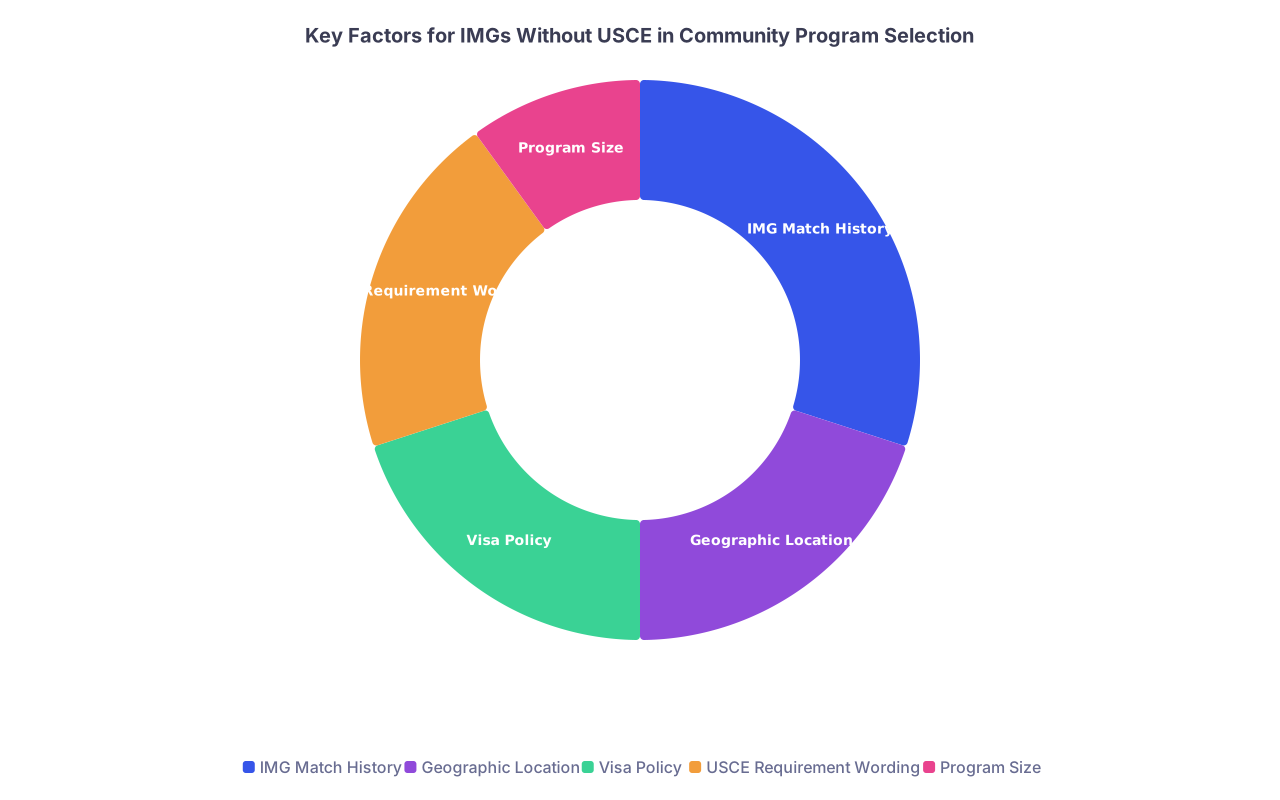
| Category | Value |
|---|---|
| IMG Match History | 30 |
| Geographic Location | 20 |
| Visa Policy | 20 |
| USCE Requirement Wording | 20 |
| Program Size | 10 |
FAQs
1. Is it even possible to match internal medicine without any USCE?
Yes, but not everywhere and not casually. You’ll rely heavily on:
- Strong Step scores (especially Step 2 CK)
- Heavy, well-documented home-country clinical work
- A large, intelligently built list of community‑heavy, IMG‑friendly programs
- At least some kind of US exposure (even short observerships or tele-rotations) before interviews
You’re unlikely to match a big-name academic IM program without USCE, but community programs in less competitive locations absolutely do take IMGs with minimal USCE if the rest of the file is strong.
2. Are observerships actually worth it, or are they a scam for IMGs?
Some are scams. Many are not. The key is what you get out of them:
Worth it when:
- You’re in real clinical spaces (wards, clinics) watching rounds, discussions, plans
- You get to interact with residents/attendings and maybe practice case presentations
- There’s a realistic chance of a solid letter
Questionable when:
- It’s 100% classroom / conference room, no real patient exposure
- No resident contact, no evaluation, no letter
- The “program” has zero connection to actual residencies
Even a modest, honest observership can help your narrative and comfort with US hospitals, especially when you lack any USCE at all.
3. Should I delay applying one year to get 3–6 months of USCE first?
If you’re a very recent grad (YOG 0–2) with decent scores, it can be smart to spend a year building real USCE instead of rushing a weak application. For older grads or those already with some work experience, the tradeoff is tougher: each additional year since graduation also hurts.
Rule of thumb:
- Recent grad, solid scores, can realistically secure good USCE → delaying one year might actually improve your odds
- Older grad, already several years since YOG → delaying might not help much unless you can get truly strong US letters and significant US clinical time
What you don’t do: lose another year and end up with the same weak, generic USCE plus a bigger YOG gap.
4. How many programs should I apply to as an IMG with no USCE?
If you can afford it and your scores are average or below, 120–200 applications in IM/FM/other less competitive specialties isn’t crazy. But the quality of your list matters more than raw number.
If money is tight, prioritize:
- Programs with multiple current IMG residents
- States known for more IMG intake (NY, NJ, MI, OH, PA, TX, some parts of the South)
- Community-based or community-university programs over purely academic
Applying to 40–50 programs with no USCE and no strategic targeting is basically asking for a blank season.
5. If I do not match once with no USCE, what should I change for the next cycle?
You do not just “try again” with the same application. Between cycles you should:
- Add at least 1–3 months of meaningful US exposure (observerships, hands-on if possible, tele-rotations tied to real hospitals)
- Secure at least one strong, specific new letter (preferably US-based or from a senior home-country physician who can detail your responsibilities)
- Rewrite your personal statement to clearly emphasize community fit and growth since last year
- Adjust your program list: more community programs, more IMG-heavy, fewer unrealistic academic reaches
Your second attempt should look like a different, stronger candidate—on paper and in reality.
Key points to walk away with:
- No USCE doesn’t kill your chances outright, but it absolutely dictates your lane: community-heavy, IMG‑friendly programs where service and reliability matter more than prestige.
- You replace “USCE” with a stack of other proof: serious home‑country responsibility, targeted observerships, smart letters, and a narrative that fits community work.
- You play the long game if needed—improve your profile, apply broadly and strategically, and if you have to reapply, you do it as a clearly upgraded version of yourself, not a rerun.