

Academic Job Myths New Doctors Believe—and What the Data Shows Instead
Did someone tell you that an academic job means less money, endless research pressure, and your evenings “protected” for life? Let’s tear that apart.
I’ve watched residents and fellows walk away from good academic offers because of stories passed down by burned‑out attendings from 2008. Or because a co‑resident’s cousin’s friend “made double in private practice.” The anecdotes are loud. The numbers are quieter. But the numbers are better guides.
Below are the biggest myths I hear repeatedly on wards and in fellow workrooms—and what the data and real contracts actually show.
Myth #1: “Academic Medicine Always Pays Way Less”
This one’s practically religion in some programs: “If you care about money at all, don’t go academic.” Conveniently ignores the variance. And the trend lines.
Here’s the actual landscape.
| Specialty (General) | Academic Median | Nonacademic Median |
|---|---|---|
| Internal Medicine | $230–260k | $280–320k |
| General Surgery | $420–460k | $470–520k |
| Pediatrics | $185–210k | $210–240k |
| Cardiology | $520–580k | $600–700k |
| Hem/Onc | $380–430k | $430–500k |
Ranges aggregated from MGMA/AAMC-style reports and major surveys from the last few years. Numbers shift yearly, but the pattern holds: yes, nonacademic pays more on average. But the gap is not the “half as much” legend people still quote from the 1990s.
The real picture:
- In many core specialties, the academic base is 10–25% lower than comparable nonacademic roles in the same region, not 50%.
- But academic centers increasingly add productivity and quality bonuses, leadership stipends, and extra pay for call/telehealth. I’ve seen first-year cards attendings at big university hospitals clear numbers that match or beat local “private” groups because of high RVU volumes plus incentive structures.
- Geographic differences are bigger than academic vs nonacademic differences. An “academic” hospital in the Midwest may out-pay a “private practice” job in a saturated coastal city.
The radical truth: the strongest predictor of your pay is not “academic vs private.” It’s: region, specialty, and how well you negotiate total comp, including incentives.
If you’re comparing offers and only looking at base salary, you’re already behind.
Myth #2: “Academic Jobs = Chill Lifestyle and Reasonable Hours”
The fantasy goes like this: community hospital = grind and nights; academic = teaching, some templates, home by 4 p.m.
I do not know what alternate universe that comes from.
Here’s what survey data and actual schedules look like.
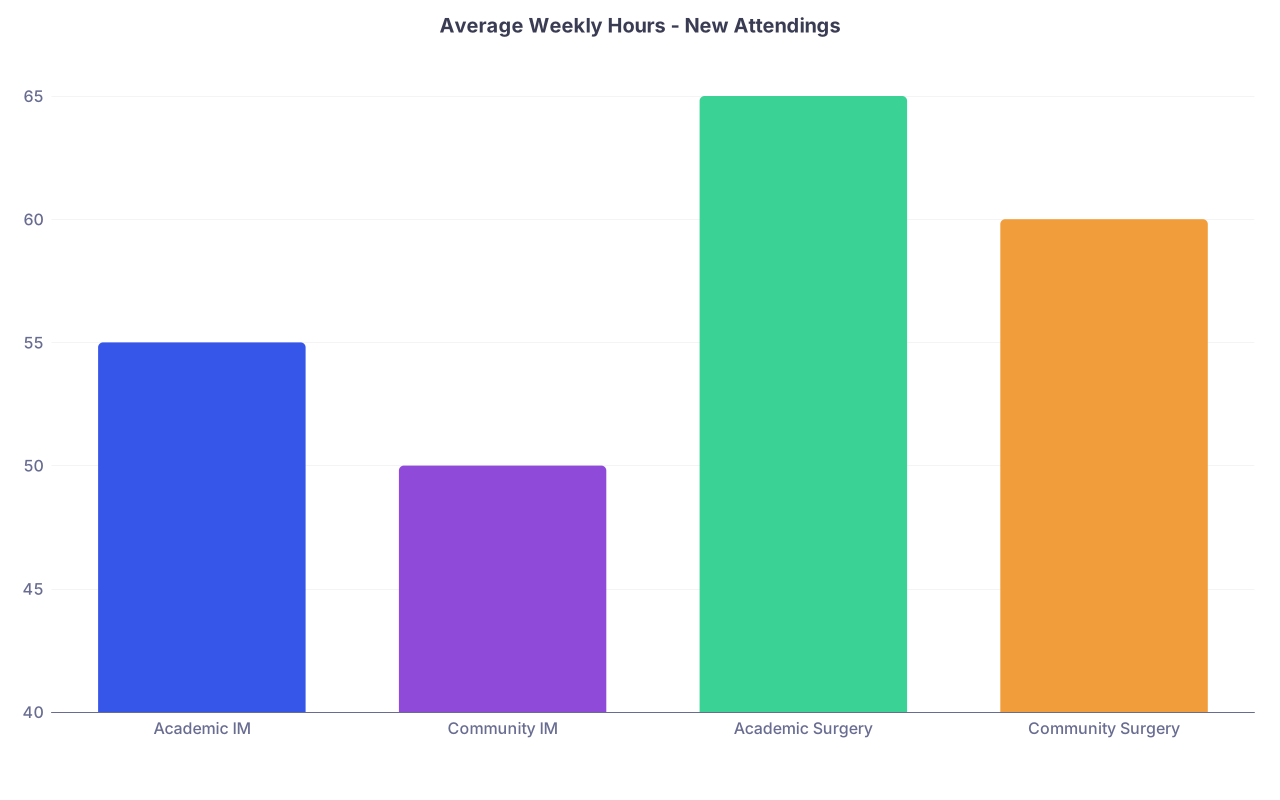
| Category | Value |
|---|---|
| Academic IM | 55 |
| Community IM | 50 |
| Academic Surgery | 65 |
| Community Surgery | 60 |
Rough composites, but they line up with repeated national surveys: academic clinicians often work as many or more hours—just sliced differently.
Typical early academic attending life (non-surgical medicine field):
- 7–8 half-day clinics or inpatient weeks with full service responsibility
- Residents and fellows who help—but also slow down throughput, need teaching, and pull you into meetings
- Committee work, conferences, grand rounds, trainee evaluations eating “office days”
- Charting and inbasket outside hours, just like everywhere else
The difference is not total hours. It’s content of hours.
You’re trading some pure RVU pressure for teaching, admin, and maybe scholarship time. For some people, that feels better. For others, worse. But this “academics clock out at 4” story is a myth that dies within your first month as faculty.
Also: the “protected time” line is oversold. Many new hires think that 0.2 FTE research or 0.1 admin means one day a week of no clinical chaos. In practice it often means: same overall hours, just some of it is grant-writing at 9 p.m. after kids are asleep.
Myth #3: “You Need Tons of Research to Get an Academic Job”
I see PGY‑3s and fellows spiral because they have “only three publications” and think they’re locked out of academic medicine. That’s not how hiring committees think—outside of a few ultra-elite places.
There are two different worlds, and people keep mixing them up:
- Research‑heavy tenure‑track roles where your grant portfolio is the whole game.
- Clinician‑educator or hospitalist/clinical specialist roles where the main question is: can you take good care of patients and not be a disaster to work with.
Most new doctors are aiming at #2, whether they realize it or not.
For those roles, the bar is much lower than med students imagine. I’ve sat in meetings where department chairs literally said: “We need someone solid clinically. If they have any interest in teaching or QI, even better.” Not: “Where is their first‑author NEJM?”
If you want a serious research career, yes, you need a record. Grants, fellowships, multi‑year plans. But confusing that with all academic jobs is how people unnecessarily self‑select out of good positions.
What matters more than raw publication count for most academic clinician jobs:
- A clear niche you can articulate in one sentence: “I’m focused on inpatient diabetes care and quality improvement” lands better than “I’m broadly interested in medicine.”
- Evidence that others have trusted you with responsibility: chief resident, key resident, lead fellow, curriculum projects.
- Some documented scholarly or education work: poster here, local QI project there, teaching award, master’s in education—lots of different paths.
If you’re not gunning for R01s, you do not need a mini‑PhD CV. You need to convince them you’re a safe bet who will show up, teach, and maybe grow into something more.
Myth #4: “Once You Go Academic, You’re Stuck There Forever”
This one is dangerous because it makes people treat early academic jobs as irreversible life sentences. Reality: there’s far more movement between “academic” and “private” than residents realize.
I’ve seen:
- An academic hospitalist jump to a community group after 3 years to cut night shifts and bump income.
- A community cardiologist move into an academic role as director of an imaging lab after building a strong clinical niche.
- A private practice oncologist return to a university center to lead a fellowship program.
The job market doesn’t care what label you had. It cares what you can do, who knows you, and whether you can plug into local systems.
Where the myth has a kernel of truth: some pure research‑heavy CVs are harder to move into heavy‑RVU private gigs quickly, and some high‑RVU private docs have to retool to get credible academic teaching/research roles. But most early career roles are hybrid enough that switching is very doable within the first 5–10 years.
If you’re PGY‑5 obsessing over “locking yourself in” with one academic offer, you’re giving that decision more permanence than it actually has.
Myth #5: “Academic Jobs Are More Secure”
Academic equals stable. University budget. Tenure. Pension. Safe forever. Right?
Not anymore.
Look at news from the last decade: large academic centers freezing hiring, shutting down lines, merging, cutting service lines. Tenure tracks shrinking. Many clinical tracks explicitly “at will” with 1‑year contracts and RVU targets.
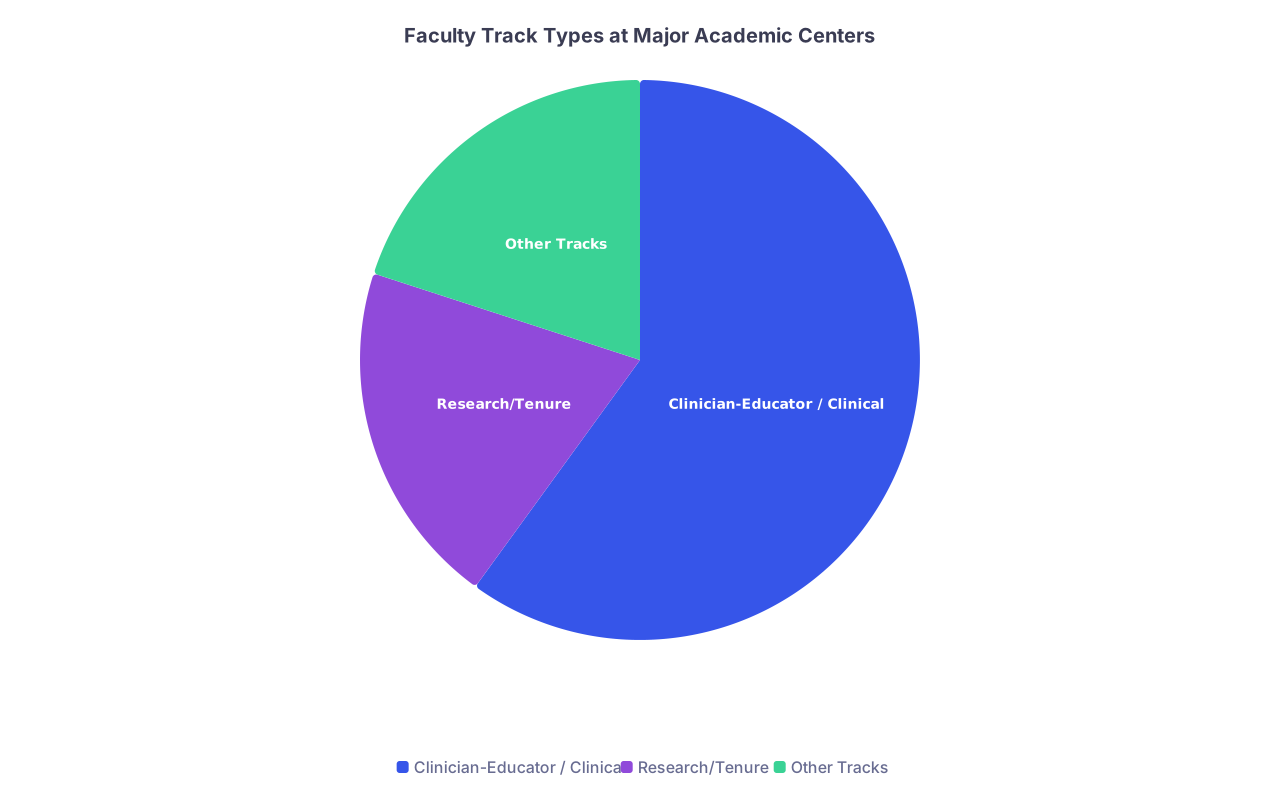
| Category | Value |
|---|---|
| Clinician-Educator / Clinical | 60 |
| Research/Tenure | 20 |
| Other Tracks | 20 |
Most new hires now land on non‑tenure “clinical” or “clinician‑educator” tracks. These have some protections—but they are fundamentally contingent on funding and strategic priorities.
Security in 2025 looks less like “I have tenure” and more like:
- I’m clinically competent in a needed niche.
- I can generate RVUs or value in some measurable way (patient care, leadership of a program, critical teaching).
- I’m not so specialized that no one else would hire me if this place implodes.
On the flip side, many large nonacademic health systems have aggressively standardized contracts and built long‑term needs for hospitalists, intensivists, outpatient generalists. They’re not magically safer, but they’re not inherently worse either.
The myth that “academic = safe forever” is decades out of date. Your security comes from your skills and versatility, not the letterhead.
Myth #6: “If I Love Teaching, Academic Is My Only Option”
This one is especially outdated.
Community programs are exploding. New residency programs, satellite fellowships, community sites of university departments, hybrid hospitals with academic appointments but community‑style work.
You can absolutely teach without being in a traditional ivory‑tower department.
Real examples I’ve seen:
- A community ED with a full EM residency where attendings are clinical faculty of a university, but they’re employed by a local group and paid at community rates.
- Hospitalists at a nonacademic system who work with IM residents from an affiliated university program and hold voluntary teaching titles.
- Specialists in private groups who precept residents in clinic half-day per week for CME credit and modest stipends.
If what you love is bedside teaching, you have more pathways now than ever. Academic titles are nice, but the question is: will there be learners where you work, and does the system value that enough to give you time for it?
Here’s the trade nobody tells you: in some classic academic jobs, your “teaching” time gets cannibalized by meetings and metrics, while a well‑run community program with residents may give you more pure clinical teaching with fewer extraneous committees.
Myth #7: “You’re Either Academic or Private Practice—Pick Your Side”
False dichotomy. Increasingly useless.
The job market is full of hybrids and gray zones:
- University‑affiliated groups that bill like private practice but function inside an academic department.
- Employed physician networks where your business card says “Assistant Professor” but your day looks like any other outpatient doc’s.
- Clinical tracks where 90–95% of your time is pure clinical care, just with some students in tow.
The question you should be asking is not: “Am I academic or private?” It’s:
- How much of my week do I want clinical vs teaching vs research vs leadership?
- How much do I want autonomy vs structure?
- How much comp risk (RVU heavy, partnership buy‑in, variable bonuses) am I willing to tolerate?
Labels are branding. Contracts are reality. Read the latter.
Myth #8: “New Grads Have No Negotiating Power in Academic Jobs”
Residents love to say, “academic offers are take‑it‑or‑leave‑it; you can’t negotiate.” That’s convenient for tired people who don’t want to push. It’s also wrong.
Can you double their salary? No. But you can move levers that matter more over five years than an extra $5–10k.
I’ve watched new faculty successfully negotiate:
- Fewer nights/weekends in exchange for slightly lower RVU expectations.
- Clearer and written protected time for a QI or education project, with named deliverables instead of vague promises.
- Start-up support for research: data analyst hours, small internal grant, research coordinator support.
- Early leadership roles (clinic director, rotation director) with small stipends and better CV positioning.
What you usually can’t move: the core base salary tier for your specialty and rank. What you absolutely can influence: structure of your job, time allocation, and often your first promotion timeline.
Departments are desperate for reliable, non‑toxic clinicians who can work well with trainees. You have more leverage than you think—as long as you’re specific about what you want and frame it in terms of value to the department, not just “I want Fridays off.”
So What Should You Actually Do?
Let me be blunt: most new doctors are making job decisions based on folklore and emotion, not data and fit.
Here are the core realities that cut through the myths:
“Academic vs private” is a lazy framing. The real variables are time mix (clinical/teaching/research), compensation structure, and culture. Many roles cross the academic–private line anyway.
Money gaps are real but smaller and more nuanced than the horror stories. Region and specialty trump the “academic” label. Total comp and your ability to negotiate structure matter more than the headline base.
Mobility is higher than you think. Your first job—academic or not—is not a life sentence. Skills, reputation, and developing a clear niche matter far more for your long‑term trajectory than your first business card title.


