

Last week a chief resident told me she’d accepted a job in a city she’d never even visited before the interview. Her voice dropped when she added, “I’m terrified I’m going to hate it and be trapped there for years.” And then she asked the question almost everyone asks in some form: once you sign that first attending contract… are you basically stuck?
Let me just say it out loud because it’s probably already screaming in your head:
“What if I pick wrong and ruin my life for five years?”
Let’s pull that apart. Honestly. No sugar-coating, but also no catastrophizing beyond what’s actually real.
How “trapped” are new doctors, really?
Short answer: you’re not as trapped as your 3 a.m. brain thinks—but you’re also not as free as non-physicians on LinkedIn who just “pivot” every 6 months.
You’re in this weird middle zone:
- You can leave almost any job.
- But it can cost you—money, time, reputation, immigration status (if you’re on a visa), and sometimes your sanity for a bit.
Here’s the part your anxiety probably isn’t letting you believe: the job market for physicians, in most specialties and most parts of the country, is actually way more in your favor than you realize. Even now. Yes, even with all the doom posts.
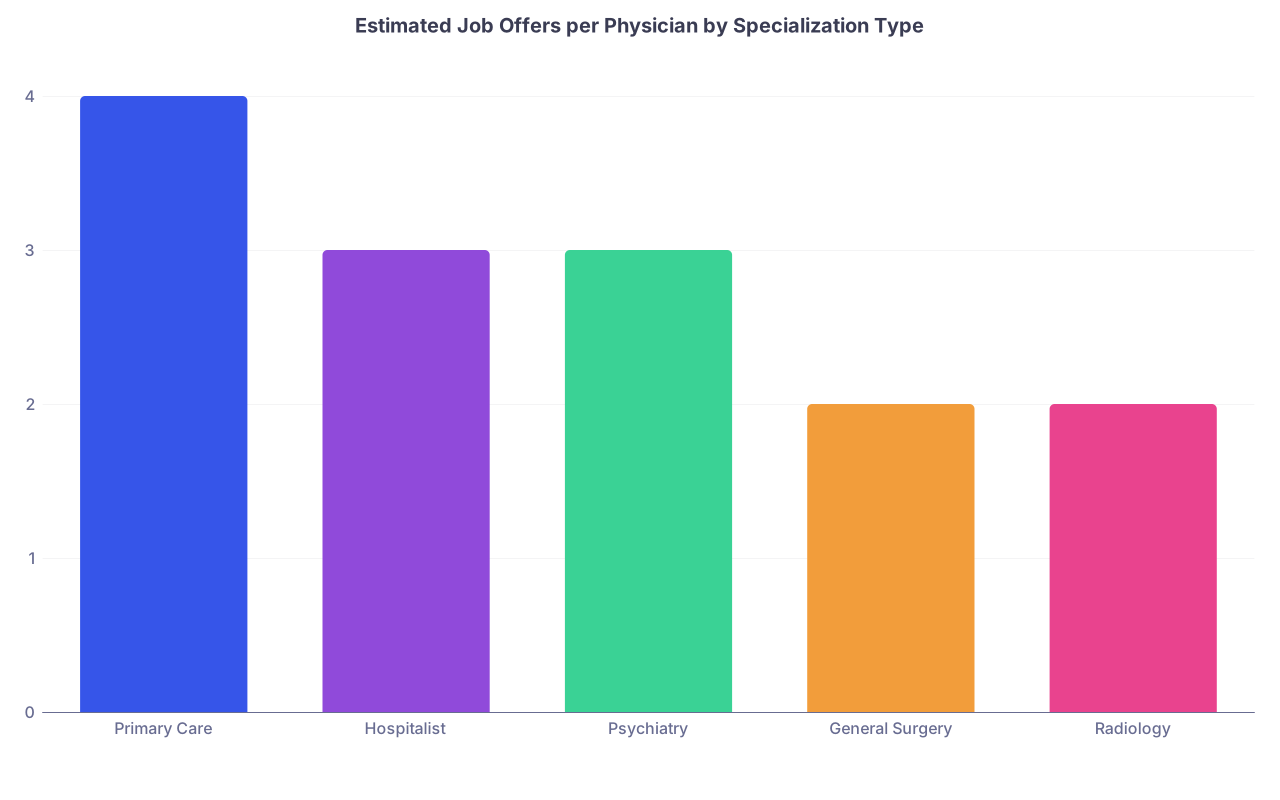
| Category | Value |
|---|---|
| Primary Care | 4 |
| Hospitalist | 3 |
| Psychiatry | 3 |
| General Surgery | 2 |
| Radiology | 2 |
Those aren’t “perfect” offers, obviously. But those are real numbers I’ve seen over and over: recruiters chasing residents, email inboxes full of badly formatted job ads, random phone calls on post-call days.
You’re not powerless. But contracts and location constraints do tighten the box a bit, especially early on. Let’s talk about what actually traps you, and what just feels like a trap.
The real traps: what actually limits your ability to move
You’re right to be worried about feeling stuck. There are things that can box you in. Let me walk through the big ones, because pretending they don’t exist just makes the anxiety worse.
1. Non-competes and restrictive covenants
Yeah, the boogeyman. And for good reason.
Typical scenario I keep seeing:
- 2-year non-compete
- 10–50 mile radius
- Applies to any practice site of the group/health system
- Sometimes includes “non-solicitation” clauses (you can’t take “their” patients or staff)
A contract that says “you can’t practice within 30 miles of any of our locations for 2 years” in a metro area with only a handful of health systems… yeah, that can effectively kick you out of the city if you leave.
But here’s the nuance your brain is skipping when it panics:
- Non-competes are state-dependent. Some states are much more physician-friendly.
- Even in strict states, a lot of groups don’t enforce aggressively unless you’re:
- Competing directly
- Taking a big patient panel
- Burning bridges on your way out
Is this a reason to panic? No.
Is this a reason to have a real attorney (not your cousin the divorce lawyer) look at your contract? Absolutely.
Because the non-compete doesn’t just trap you in a job. It can trap you in a geographic ring fence where the only way out is either:
- Waiting it out
- Moving farther away than you ever planned
- Negotiating your way out ($$)
But also: a lot of new docs leave their first job and successfully work in the same city after some negotiation. I’ve seen non-competes shortened on exit, radiuses shrunk, or both sides quietly agreeing not to go to war.
2. Visas and immigration status
If you’re on a J-1 waiver or H-1B, the trapped feeling is very real. It’s not in your head.
J-1 waiver folks: that 3-year service commitment in a specific site or underserved area? That’s a legit anchor. Leaving early is hard and often dangerous for your status.
H-1B folks: your job is your status. If you walk away without a backup plan, the clock starts ticking.
The awful part is that immigration stuff doesn’t care about your job satisfaction, your toxic coworker, or your impossible call schedule. It only cares whether you’re in status. So yeah, this can make you feel like your life is not really yours.
But even here, you’re not fully trapped:
- Some people transfer to another H-1B employer
- J-1 folks sometimes can switch sites, though it’s bureaucratic and painful
- Smart move is planning before you want to leave, not after you hand in your resignation
If this is you, you need an actual immigration attorney and a realistic Plan B before you sign that first contract in a rural nowhere-you-want-to-live forever job.
3. Financial handcuffs: bonuses, loans, and PSLF
The other trap is money. Or rather, the way they structure the money so you don’t want to leave.
Common games:
- Sign-on bonus with 2–3 year forgiveness schedule
- Relocation bonus that’s clawed back if you leave early
- Student loan assistance that only vests after X years
- PSLF-eligible jobs where leaving resets your 10-year clock at an uglier timeline
Let’s be blunt: they’re paying you to stick around. And it works. I’ve watched people stay in objectively miserable situations because they “only have 10 more months until the sign-on is forgiven” or “just 2 more years until this loan piece vests.”
That’s not always wrong. But it is a constraint.
The question you’ll eventually face if you hate the location is:
“Does my sanity/relationship/health cost more or less than the $XX,000 I’d have to pay back?”
And I’ve seen people leave and pay back $30k, $50k, even more. It hurt, but they didn’t regret it six months later.
What if you hate the location? How bad is “stuck” in reality?
Let’s separate three different things your brain is mashing together into one giant horror:
- Hating the job
- Hating the location
- Hating both at the same time
You’re imagining the worst combo: miserable job in a town you loathe, in a climate you hate, with no friends nearby, for multiple years, with no way out.
Could that happen? Yes. I’ve seen versions of it.
Is it a life sentence? No. But year 1 can feel like it.
Most people I’ve watched in that spot end up in one of these scenarios:
| Outcome | Rough Frequency (from real-world observation) |
|---|---|
| Stick it out full contract | ~40% |
| Leave early but stay in region | ~25% |
| Leave early and move states | ~20% |
| Pivot to different practice model | ~10% |
| Leave clinical medicine entirely | ~5% |
Those aren’t perfect stats from some huge study; they’re just what I keep seeing across different specialties.
Notice what’s missing: “Trapped forever.” Because that just doesn’t really happen.
I’ve seen:
- A hospitalist who moved 3 states away after 10 months, paid back her sign-on, and was fine 6 months later.
- A psychiatrist who switched from a soul-crushing CMHC in a dead town to tele-psych from a city he actually liked.
- A surgeon who fought his non-compete, negotiated the radius down, and started across town.
You will have friction. You will have to tolerate some period of discomfort. You probably won’t just ghost and glide to a perfect role. But your career is measured in decades. One bad 18–24 month stretch feels enormous right now. It won’t later.
How much flexibility do you actually have by specialty and setting?
Some specialties and job types are much more “mobile” than others. Your anxiety might be based on a worst-case that doesn’t fit your reality.
| Category | Location Flexibility | Comments |
|---|---|---|
| Outpatient IM/FM | High | Tons of openings almost everywhere |
| Hospitalist | High | Common to hop groups/regions |
| Psych | Very High | Tele + in-person options |
| EM | Medium | Groups/contracts can be sticky |
| Surgical subspec | Medium–Low | Market saturation in some cities |
| Radiology/Path | Medium | Mix of remote vs on-site |
Then add practice model:
- Employed by big system: more internal transfer options, bigger non-competes
- Private practice: more income upside, more tied to local referral patterns
- Telemedicine/hybrid: more geographic freedom, but regulatory/state-licensing hoops
If you’re in primary care, psych, hospitalist medicine? You are probably overestimating how stuck you’d be.
If you’re a hyper-niche subspecialist trying to live in one exact coastal city? You might actually have fewer realistic slots than you think.
Things that feel like traps but are mostly fear talking
Some stuff sounds terrifying but in practice doesn’t lock you down as much as your mind insists.
“If I leave my first job early, I’ll be blacklisted”
Every year, a huge chunk of new attendings leave their first job in under 2–3 years. Recruiters literally expect it. I’ve seen entire recruitment pitches built around it: “Not happy where you landed? Come talk to us.”
What matters more than “Did you leave?” is “How did you leave?”
If you:
- Give reasonable notice
- Don’t trash people publicly
- Don’t burn charts and storm out
You’re fine. People understand misalignment.
“If I change jobs, everyone will think I failed”
People will think… nothing. They’re too busy trying not to drown.
The senior doc you’re scared of judging you? They’ve probably left jobs before too. What they care about is whether you’re competent and not a disaster to work with.
“If I pick the wrong city, I’ll lose all my friends and support”
You will feel isolated for a while, especially if you’re single or moving far from family. That’s real. But people build new micro-communities over and over:
- Co-residents in the region
- Other attendings
- Church/temple/interest groups, rec sports, gym friends
- Online communities in your specialty
It’s not instant. But it’s also not “I will be alone forever in a frozen cornfield with no one who understands me.”
Concrete ways to avoid feeling trapped before you sign
Anxiety needs something to do. So here’s what you actually have control over when you’re staring at offers and imagining your future self sobbing in some random suburb.
1. Treat the location like a real decision, not a footnote
Don’t do the “I’ll just ignore the geography because the salary is shiny” thing. That’s how people end up three hours from any airport with a dying soul.
When evaluating a location, ask yourself:
- Can I actually imagine doing normal life here? Groceries, gym, friends, weekend stuff?
- What’s the dating/family situation really like for someone my age/stage?
- Is there any community here that feels like mine (or that I’m willing to grow into)?
If the answer to all of those is no, the salary better be obscene and/or the contract stupidly flexible—because you’re paying in quality of life.
2. Get a real contract review, not vibes
I know, lawyers are expensive. So is being trapped.
Have them look specifically at:
- Non-compete language: radius, duration, and where it applies
- Repayment obligations: bonuses, relocation, loan assistance
- Exit clauses: how much notice, what counts as “cause”
Think of it as buying an insurance policy on your future ability to leave.
3. Ask awkward questions before you accept
Your anxiety is scared to ask, but your future self will hate you if you don’t.
Things like:
- “How many attendings have left in the past 3 years, and why?”
- “What’s the usual tenure for new hires?”
- “Have you ever enforced your non-compete?” (and then confirm with people who left)
You’re not being rude. You’re trying not to get trapped.
If you already signed and you’re freaking out
Maybe you’re reading this after you signed. Or after you moved. Or mid-intern year at your first attending job and you’re thinking, “I’ve made a horrible mistake.”
You’re not screwed.
Here’s how people actually get out:

| Step | Description |
|---|---|
| Step 1 | Realize Job or Location is Wrong |
| Step 2 | Clarify Main Problem |
| Step 3 | Look for Same City New Role |
| Step 4 | Search New City Jobs |
| Step 5 | Consider Big Move |
| Step 6 | Review Contract and Noncompete |
| Step 7 | Talk to Lawyer Recruiter Mentor |
| Step 8 | Plan Exit Timeline and Money |
| Step 9 | Give Notice and Transition |
It’s rarely pretty. There’s usually a stretch that kind of sucks:
- You’re job-hunting while still working
- You’re second-guessing everything
- You’re running numbers on “Can I afford to pay this back?”
But then you land somewhere else. Your nervous system calms down. You learn from it for the next contract.
And honestly? That process makes you way more dangerous (in a good way) the next time. You stop being naive about:
- “We’re like a family here”
- Vague bonus structures
- Chair promises that never hit paper
That’s not failure. That’s leveling up.
The mental trap: believing this decision is irreversible
The worst part isn’t the contract or the non-compete. It’s the story in your head that says:
“If I don’t pick perfectly now, I’ve ruined everything.”
You’re picking your next 2–5 years, not your entire life. That doesn’t mean be reckless. It means hold the decision at its right size.
You will make tradeoffs:
- Maybe you accept a less exciting city for a more flexible contract
- Maybe you prioritize support system over prestige job
- Maybe you pick a job you’re 70% sure about, not 100%, because 100% doesn’t exist outside brochures
Does that guarantee you won’t be unhappy at some point? Of course not. Physicians in basically every setup have days where they Google “non clinical physician jobs remote” at 11:47 p.m.
But you are not a prisoner. You’re just operating in a system that has real frictions and real exit costs. And you’re allowed to leave, even if it’s messy.
One thing to do today
Open one job posting or existing contract (if you already have one) and find the exact section on non-compete and repayment terms. Read those lines like your future self might actually want to leave.
If that paragraph makes your stomach drop, that’s your signal:
not to panic, but to get clarity—ask questions, talk to a lawyer, or widen your job search before you sign something that really does make you feel trapped.


