

Noncompete clauses scare residents more than the actual job does. And honestly? They should.
You’re not crazy for obsessively zooming in on that one paragraph in the contract and thinking, “If I sign this, am I basically handcuffing my whole future?” Because that’s exactly how it feels.
Let me just say the thing you’re probably afraid to admit: you are worried you’ll pick the wrong first job, be miserable, and then be trapped by a noncompete in a city where you’ve already bought a house, put your kids in school, and told everyone you’re “finally done training.”
And you’re asking:
What happens if I need to leave?
Let’s walk through that—honestly, worst-case-scenario included—but with enough reality and strategy that you can actually sleep tonight.
What a Noncompete Usually Actually Means (Not the Horror Story Version)
Most physician noncompetes are not “you can never practice medicine again.” They’re more like, “you can’t practice your specialty within X miles for Y months after you leave.”
Typical patterns I’ve seen over and over:
- Radius: 5–25 miles from your main clinic or hospital sites
- Duration: 1–2 years
- Scope: your specialty (e.g., general IM, EM, ortho), not “anything related to health”
Of course, there are insane ones: 50–100-mile radii, multiple hospitals, 3-year restrictions, broad definitions like “any related services.” Those exist. And sometimes big systems push them just to see who will sign without blinking.
But here’s the piece nobody tells you clearly during residency: noncompetes are constraints, not necessarily death sentences. They shape your options. They don’t always erase them.
Still, your brain is probably jumping to:
“What if I sign and then hate my job? Or they’re toxic. Or they cut my pay. Or my spouse can’t find work nearby. Or they bait-and-switch my schedule. Then what?”
So let’s say the worst happens. You want out.
Scenario: You Hate Your First Job and Want to Leave
Picture this.
You’re 9 months into your first attending job. You’re working 60–70 hours despite “expected 45–50.” RVU targets keep moving. They added extra call. The administrator who recruited you is gone. The new one doesn’t care about your “work-life balance.”
You check your contract. There it is:
- 2-year noncompete
- 20-mile radius from any clinic or hospital you’ve worked at
- No buyout clause
Your chest tightens. “I’m screwed.”
You’re not. You’re constrained. Which is different.
Here’s how this usually plays out in the real world—not the panic spiral version.
The Actual Options When a Noncompete Is Hanging Over You
You basically have several levers. None of them are perfect. But you’re not without power.
1. Leave and move outside the radius
This is the blunt-force option.
If the noncompete is enforceable in your state and your employer is known for enforcing it, you go beyond the radius for the duration.
That might mean:
- Commuting further than you’d like
- Taking a job at a hospital 30–40 miles away
- Moving cities entirely
It’s painful, especially if your family is rooted. But tons of physicians do this for 1–2 years, then slide back when the restriction expires. It feels impossible when you’re staring at Zillow and your kids’ school schedule, but it’s a very real, very common path.
2. Negotiate your way out
Here’s what shocked me the first time I saw it: employers do sometimes let you go without enforcing the noncompete. Especially if:
- You’re leaving on decent terms
- You’re not walking across the street to their biggest competitor with their entire patient panel
- They’re not in a saturated, cutthroat market
Sometimes this is informal (“We don’t enforce them unless you’re doing something outrageous”). Sometimes it’s formal—an amendment or separation agreement that narrows the radius, duration, or specific locations.
Occasionally there’s a buyout—you pay, or your new employer pays, a fixed sum to release you from the noncompete. Not fun. But it turns “I’m trapped” into “this sucks, but it’s solvable.”
The key thing: you don’t walk in alone and ask nicely. You get a lawyer involved. A real physician-contract attorney, not your cousin who does real estate closings.
3. Challenge the noncompete’s enforceability
This is where state law matters painfully more than you wish it did.
- Some states heavily restrict physician noncompetes (e.g., they require reasonableness, narrow scope, or flat-out ban them in certain contexts).
- Some states just don’t care as long as the contract was signed knowingly.
- Some states are in flux and everything’s murky.
What typically happens if you push back legally:
- Your attorney sends a letter arguing the noncompete is overbroad or unenforceable.
- The employer either:
- backs off (very common in smaller groups or systems that hate legal fees), or
- digs in and threatens to sue if you violate it.
Most of the time, you don’t end up at a full-blown trial. The cost, mess, and PR are bad for everyone.
But let’s not sugarcoat it: this path is stressful, slow, and expensive. You need real risk tolerance and a lawyer who knows this territory cold.
4. Work in a different role that doesn’t trigger it
Sometimes the noncompete is specific: “You can’t practice as a gastroenterologist within 15 miles.” But what about:
- Telemedicine (for an out-of-area company)
- Research roles
- Nonclinical work (utilization review, informatics, medical writing, pharma, etc.)
- Working in a different but related field that isn’t explicitly restricted
Is this ideal? No. You trained forever to do your thing. But if you’re burned out or in a toxic place, a year in a slightly different lane can protect your sanity and your future.
You can wait out the noncompete clock while paying your bills and preserving your license.
5. Call their bluff (dangerous, but real)
Some groups threaten enforcement constantly but have never actually taken a doc to court. Others have a known pattern of aggressive enforcement.
If you’re in one of those “all bark, no bite” places, some physicians quietly violate the noncompete and see what happens.
I’m not telling you to do this. I’m saying it happens. A lot.
But this is gambling with:
- Your money (legal fees)
- Your reputation in the local community
- Your stress levels for months or years
You absolutely don’t do this based on vibes or Reddit threads. You do it only after talking to a lawyer who literally says, “Given this state, their history, this language, and the courts here—I’d rate the real risk as X.”

| Category | Value |
|---|---|
| 5 miles | 20 |
| 10 miles | 35 |
| 20 miles | 25 |
| 1 year | 40 |
| 2 years | 45 |
The Part That Really Terrifies You: Life Logistics If You Leave
This is what your 3 a.m. brain is actually doing:
- “What if I buy a house and then have to move because of the noncompete?”
- “What if my partner’s job is local and we literally can’t move?”
- “What if my kids are finally stable and then I uproot them because I signed something stupid?”
You’re not just worried about contracts. You’re worried about being the one who explodes the life you’re trying to finally build after a decade of training.
Here’s the harsh but honest truth: everything is a tradeoff.
If you insist on:
- Narrow noncompete
- Strict hours
- High salary
- Dream city
You’re competing with every other graduating resident who wants the exact same thing. You might still get it—but usually there’s a compromise somewhere.
Your actual strategy should be:
“How do I minimize the damage if I need to leave?”
That’s a much more realistic, less paralyzing question than “How do I avoid all risk?”
How to Set Yourself Up Before You Sign (So Leaving Isn’t Catastrophic)
Let me be blunt: the best time to deal with a noncompete is before you sign. After that, everything is damage control.
Here’s what I’d push for aggressively as a new attending:
Narrow the geography
Tie it to specific addresses, not “anywhere the employer conducts business.”
For example: “Within 10 miles of the primary clinic at [address].”Shorten the time
Push hard for 12 months. 18 at most. Anything beyond 2 years is absurd.Define the scope clearly
Limit it to your exact role. If you’re a hospitalist, it shouldn’t block you from working outpatient primary care or telemed, unless that’s explicitly part of what you’re doing now.Add or clarify a buyout if possible
Even if it’s painful, having a clear dollar amount makes it a solvable problem instead of a vague existential one.Ask the awkward question
In the interview (with someone who will answer honestly), say:
“Has this group ever actually enforced the noncompete in court?”
People talk. Partners know. The answer matters.

| Step | Description |
|---|---|
| Step 1 | Offered Job With Noncompete |
| Step 2 | Review Terms With Lawyer |
| Step 3 | Consider Other Factors |
| Step 4 | Request Changes |
| Step 5 | Sign Revised Contract |
| Step 6 | Decide - Sign Or Walk |
| Step 7 | Reasonable Radius and Duration |
| Step 8 | Employer Willing To Negotiate |
Is this annoying? Yes. Does it feel confrontational as a new grad? Absolutely. But the people who don’t push at all are the ones who end up stuck and panicked later.
What Actually Happens to Most People Who Leave Their First Job
This might be the part that calms you down a little.
Most physicians who leave their first job:
- Do not end up in court
- Do not get “blacklisted” from medicine
- Do not have their careers destroyed
They:
- Move outside the radius or commute longer than they’d like
- Take a job that’s slightly less ideal geographically but more sane emotionally
- Wait out the noncompete and then, if they want, circle back closer later
Is it messy? Sometimes. Does it feel like failing? Yeah, to a lot of people at the time. But if you talk to attendings 5–10 years out, you’ll hear the same line on repeat:
“My first job wasn’t forever. It was just my first job.”
Noncompetes make that transition more annoying and expensive. They rarely make it impossible.

When the Fear Is Bigger Than the Reality
Your anxiety is filling in all the unknown space with catastrophe. That’s normal. You’ve spent your whole life in a rigid, rule-based pathway—pre-med, med school, residency. Clear structure, clear steps, clear hoops.
Suddenly:
- No one is telling you what’s “right”
- You’re signing legal documents instead of logging duty hours
- There’s actual money and real family consequences involved
And someone hands you a contract with a paragraph that basically says, “If this goes bad, you might have to uproot your entire life.” Of course your brain is screaming.
But zooming out, this is how I’d frame it:
- You should respect noncompetes.
- You should not let them own your whole future in your head.
- You should absolutely spend money on a lawyer now so you don’t bleed far more later.
The goal isn’t to find the magical job with no risk. The goal is to know exactly what you’re signing, minimize the damage potential, and have a backup plan that doesn’t feel like the end of the world.
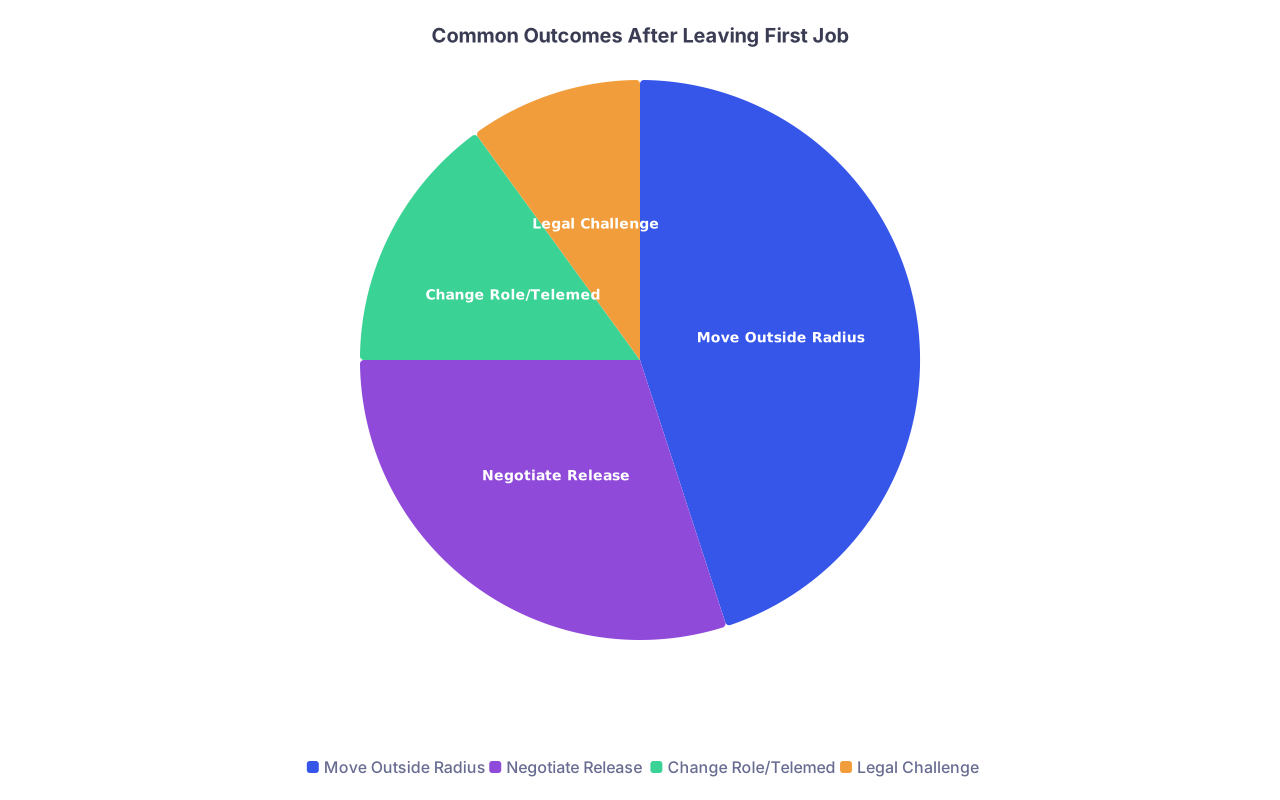
| Category | Value |
|---|---|
| Move Outside Radius | 45 |
| Negotiate Release | 30 |
| Change Role/Telemed | 15 |
| Legal Challenge | 10 |
Quick Reality Check Questions Before You Panic
Ask yourself these, honestly:
- Do I know for sure how my state treats physician noncompetes, or am I just assuming the worst from stories?
- Have I actually had a physician-contract lawyer review my offer, or am I trusting “it’s standard”?
- Am I catastrophizing a scenario I haven’t even tried to negotiate yet?
- If I had to move 20–30 miles away for a year or two, would that truly be impossible, or just very inconvenient?
- Am I comparing my first contract to some theoretical perfect unicorn job?
You’re allowed to be scared. But you’re also allowed to be strategic. Those two things can coexist.
| Option | Stress Level | Financial Risk | Common in Real Life |
|---|---|---|---|
| Move outside radius | Medium | Low–Medium | Very common |
| Negotiate narrower terms | Medium | Low | Very common |
| Buyout agreement | High | High | Occasional |
| Change to nonclinical role | Medium | Low–Medium | Occasional |
| Full legal challenge | Very High | Very High | Less common |

FAQ: Noncompetes and Leaving Your First Job
1. What actually happens if I violate a noncompete?
Worst-case, your former employer can sue for an injunction (court order telling you to stop working in the restricted area/role) and possibly damages. Realistically, many cases never get that far—they send cease-and-desist letters, threaten, and often settle or negotiate. But walking in blind and “hoping they don’t do anything” is risky and stressful. Always talk to a lawyer before making that choice.
2. Will I get reported to the medical board if I break a noncompete?
Usually no. Noncompetes are contract issues, not professional misconduct. Boards care about patient safety, criminal acts, impairment—not where you choose to practice. Employers don’t generally weaponize the board for noncompete disputes because it’s overkill and looks bad. Is it impossible? Nothing is. But it’s not the typical tool here.
3. Can my new employer help with the noncompete problem?
Yes, and they often do. Some will pay part or all of a buyout. Others will structure your role to avoid triggering the noncompete (different location, different scope). Big systems especially have seen this a hundred times and have playbooks. Just be upfront early—hiding it until the last second is how you scare them off.
4. Should I ever walk away from an otherwise good job just because of the noncompete?
Sometimes, yes. If it’s ridiculously broad (huge radius, multiple years, vague scope) and they refuse to budge, that’s a big red flag about how they see physicians: disposable, controllable labor. But if the noncompete is relatively standard, and everything else about the job is strong, you accept that there’s some risk. The question isn’t “no risk vs risk”—it’s “manageable risk vs career misery.”
5. How do I stop obsessing over this and actually choose a job?
Control what you can: get your contract reviewed, negotiate the terms, understand your state laws, ask blunt questions about past enforcement. Then decide based on the big picture—culture, schedule, support, long-term growth. At some point, you make a choice knowing it might not be forever. Years from now, you won’t remember the exact wording of your first noncompete. You’ll remember that you were scared, and you moved forward anyway.

Years from now, you won’t remember how many nights you sat there zooming in on the noncompete clause. You’ll remember that this was the moment you started treating your career like something you could actively shape—not just something that happened to you.


