

Last June, a chief resident texted me at 11:47 p.m.: “Everyone in my class has a job except me. I think I’ve completely screwed this up.” Her training was ending in three weeks. No contract. No start date. Just a growing pit in her stomach every time someone said “Congrats, where are you going next?”
If you’re staring down the end of residency and your answer to “What are your post-residency plans?” is basically “panic and vibes,” you’re not alone. And no, that doesn’t mean you’ve blown your career before it even started.
Let’s be blunt and specific about what happens next.
First: Are You Actually in Trouble, Or Just Behind?
There’s a difference between “I’m catastrophically unemployable” and “I’m late to the party.”
The problem is, when you’re anxious, those two feel exactly the same.
Here’s the reality most residents don’t see: a lot of docs don’t have a signed job when residency technically “ends.” People extend training, change paths late, walk away from bad offers during contract review, or simply mis-timed the job search. Programs don’t announce those stories at graduation dinner.
The danger zone is narrower than your brain is telling you. Things are concerning when:
- Your license and DEA aren’t in process yet
- You have no income plan for the 2–3 months after residency
- Your visa or loan situation makes “gap time” financially or legally dangerous
But “I don’t have a contract in hand by March” ≠ doomed.
I’ve seen people in internal medicine sign in August and start in October. Surgeons picking up locums for six months and then sliding into a permanent role in January. Psych folks siging late because they changed cities mid-search.
Still. Anxiety likes timelines, so here’s a rough one.
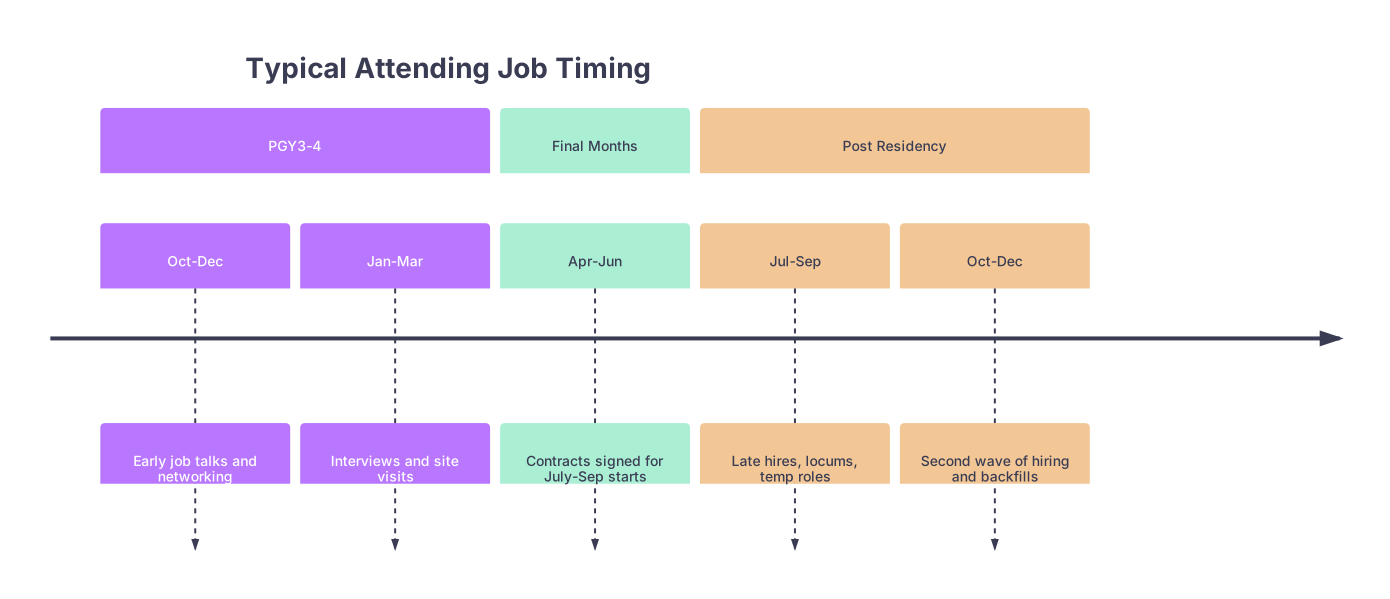
| Period | Event |
|---|---|
| PGY3-4 - Oct-Dec | Early job talks and networking |
| PGY3-4 - Jan-Mar | Interviews and site visits |
| Final Months - Apr-Jun | Contracts signed for July-Sep starts |
| Post Residency - Jul-Sep | Late hires, locums, temp roles |
| Post Residency - Oct-Dec | Second wave of hiring and backfills |
Notice that last part. July–December is basically a second hiring season. Because:
- Someone quits early
- A new clinic opens
- A partner backs out at contract signing
- Volumes spike more than predicted
Hospitals scramble. You’re not the only one unprepared.
Your Immediate 2–4 Week Plan (While Your Brain Is Screaming)
Anxiety wants to spin in circles. You need a short, ugly, practical list.
In the next two to four weeks, your job isn’t to magically manifest a dream attending position. It’s to stabilize your situation and get leverage.
1. Lock In Your Ability to Work
If you finish residency and you can’t legally practice, everything else becomes much harder.
You need answers to:
- State license: Applied yet? If no, start today. Don’t wait to have a job. Many states take 2–4 months.
- DEA: Some jobs want you to wait, but get clarity on timing and cost now.
- Board eligibility/registration: Are you registered for the boards? That line on your CV matters.
If you’re late on any of this, don’t spiral. Just start the applications and keep receipts/emails—you can tell employers, “License is in process, submitted on X date; the board says typical turnaround is Y weeks.”
Programs and employers hate uncertainty. “In process” is way better than “I haven’t started.”
2. Get Brutally Honest About Your Finances
This part feels awful, but skipping it makes the anxiety worse.
Sit down, ideally not at 1 a.m. after a night shift, and figure out:
- How many months of bare-bones living you can cover after your last paycheck
- What your loan servicers expect once the grace/residency forbearance ends
- Whether you can tolerate a 1–3 month gap with only moonlighting/locums income
This isn’t to torture yourself. It’s to define how desperate you actually are.
There’s a huge mental difference between “I have 6 months of runway if I’m frugal” vs “I need money in 4 weeks.” Different game. Different strategy.
If the number is terrifyingly small, we’ll talk about short-term options in a minute.
You’ve Got No Job. What Are Your Realistic Paths?
Let’s be honest about the menu. It’s not just “perfect job now or total failure forever.”
Broadly, you’re choosing among these tracks:
| Option | Speed to Income | Flexibility | Long-term CV Impact |
|---|---|---|---|
| Locums | Fast | High | Neutral/OK |
| Hospital employed | Medium | Medium | Solid |
| Private practice | Medium/Slow | Variable | Depends on fit |
| Extra fellowship | Slow | Low | Mixed (depends) |
| Nonclinical temp | Medium | High | Neutral if brief |
1. Locums: The “I Need Money and Time to Think” Option
If your main fear is, “I’ll be unemployed and broke,” then locums is your pressure valve.
Locums companies and hospitals love new grads more than they admit. You’re fresh, flexible, and often cheaper than seasoned docs. If you’ve got a license in any state, you have a shot.
What it looks like in real life:
- Recruiters email you 20 jobs that sound identical
- Half of them are in towns you’ve never heard of
- Rates vary a lot more than you think they should
- Credentialing is annoying but usually faster than full employment onboarding
The upside: quick income and low commitment. It also buys you something you don’t have right now—breathing room.
The downside: instability, travel, learning a new system every few months. And if you already have burnout simmering, constant adaptation can inflame it.
But if your fear is, “What if nobody will hire me,” taking a locums gig for a few months often proves your brain wrong.
2. Late-Cycle Employed Jobs: The Quiet Backfill Market
There’s the shiny, early recruiting season where everyone posts jobs and hosts dinners.
Then there’s the quieter second wave where hospital administrators are slightly panicked because their projected new FTE vanished or volumes are climbing.
You find these by:
- Talking to your program director and faculty: “Do you know any places that still need someone for this year?” (You’d be shocked how often the answer is yes.)
- Emailing hospital recruiters directly, even if there’s no fresh posting:
“Hi, I’m completing my IM residency at [Program] in June. I’m board eligible and interested in hospitalist work in [region]. Do you anticipate any backfill or late openings for 2025 starts?” - Checking regional health systems’ career pages weekly, not just the big national boards.
I’ve watched people sign perfectly decent jobs in August this way. No glossy recruitment dinner. Just, “We actually do need someone; can you start in October?”
You’ll feel behind. Fine. You are behind the idealized timeline. But hospitals hire off-timeline all the time.
3. Private Practice: Proceed Carefully If You’re Rushing
Private practice can be great.
It can also be the land of:
“Partnership track, but we won’t put it in writing,”
“Buy-in TBD,”
and “You’ll build quickly, trust us,” in a saturated market.
If you’re scrambling because it’s May and you just realized you need a job, I’d be careful about jumping into a complex PP structure without breathing space.
Red flags when you’re vulnerable:
- Compensation formulas that you don’t fully understand and they can’t explain simply
- No guaranteed base for year 1
- Vague answers about payer mix and volume
- “We had a partner leave, we’re still figuring things out”
Could a private group still be a good landing spot? Yes. But if you’re pressured, I’d rather see you take a 6–12 month hospitalist or urgent care role while you actually interview and study the PP options like an adult, not like a panicked PGY-3.
4. Another Fellowship or Extra Year: Escape Hatch or Trap?
This one hits the anxious brain hard: “Maybe I should just do more training. Buy myself time.”
Sometimes that’s smart. If you discovered late that you really do want heme/onc instead of general IM, or a pain fellowship instead of anesthesia, extra training can be strategic.
But I’ve also seen residents use “another fellowship” as a socially acceptable avoidance strategy because the job market scares them.
Questions to force yourself to answer:
- Would I still choose this fellowship if I had a signed, comfortable job offer today?
- Am I excited about the content of this training, or just relieved I’d have something to tell people?
- Does this fellowship actually improve my job prospects or just delay the same fear two years?
If you can’t say yes to the first question, pause.
5. Nonclinical or “Bridge” Work
This is the nuclear option in some people’s minds. “If I don’t get a clinical job, I guess I’ll do pharma/consulting/urgent care forever and my ‘real doctor career’ is over.”
Reality: I’ve seen people do a year of heavy urgent care, telemedicine, or hospital nocturnist work while they reset, then pivot into exactly the kind of job they wanted.
Short nonclinical stints—utilization review, medical writing, temporary industry roles—don’t erase your clinical training. If anything, they can make you more interesting to some employers.
Just don’t vanish from clinical medicine entirely for multiple years right out of training without a plan. That does get harder to explain.
The Visa, Debt, and “I Actually Can’t Have a Gap” Panic
There are some groups who really can’t casually drift for a few months:
J-1s, H-1Bs, people with crushing private loans, or folks supporting a family on a single income.
Let’s talk worst-case-scenario realism.
If you’re on a visa:
- Talk to an immigration attorney now, not “later when I have more info.” Even a one-hour consult can clarify your actual deadlines vs the ones you’ve invented in your head.
- Many underserved area jobs and some hospital-employed roles are extremely motivated to hire and sponsor quickly if you’re flexible about location.
If you’re drowning in debt:
- Call your loan servicer and a financial counselor who understands physician loans. Do this before you default emotionally to “I must take the first job I see at any cost.”
- Some jobs offer sign-on bonuses and loan repayment that can genuinely change your options. Others dangle small bonuses to distract from garbage salaries. Learn the difference.
The instinct when you’re terrified is to grab the nearest contract and hang on. Sometimes that’s necessary. But even in high-pressure situations, you have a bit more room than your 3 a.m. catastrophizing suggests.
Fixing the Psychology: Why This Feels Like Failure
Here’s the quiet part no one says out loud: not having a job when everyone else is signing makes you feel…defective.
Like everyone else passed some secret adulthood test and you’re the kid repeating a grade.
But your classmates’ timelines say more about their specialty, geography, and life constraints than about their worth. Derm residents sign early partly because the market’s weird. Some IM hospitalists sign late because hospital systems are slow-moving and only realize they need more coverage after fiscal reports.
And a lot of those “I signed!” announcements? Some of those contracts get torn up after lawyers review them. Or people back out before their start date. It’s not as linear as it looks in the group chat.
You’re not broken. You’re in a messy, opaque system that never gave you a syllabus for this part.
You will get a job. Honestly, that part is almost guaranteed for a board-eligible US-trained doc willing to compromise on at least one of: location, schedule, or starting salary.
The real risk isn’t “never employed.” It’s getting rushed into a job that burns you so badly you want out of medicine by 35.
A Concrete 6–8 Week Action Plan
Let’s stitch this into something that feels less like doomscrolling and more like a plan.
Weeks 1–2:
- Submit or finalize license applications
- Get precise on your financial runway
- Update your CV and a basic cover email tailored by specialty
- Tell your PD and 2–3 trusted attendings: “I don’t have anything signed yet; I’m actively looking and open to [X/Y/Z]. Any leads?”
Weeks 3–4:
- Reach out to hospital systems and recruiters in your preferred region(s)
- Start parallel locums conversations so there’s a backup income path
- Do at least 2–3 virtual interviews, even with “meh” jobs, just to sharpen your narrative and negotiation
Weeks 5–8:
- Narrow to the most promising options
- If nothing permanent feels right, line up a locums or short-term gig to start 4–8 weeks after graduation
- Keep scanning for backfill roles while you’re earning and stabilizing
Somewhere in there you’ll have at least one “wait, this might be decent” conversation. Not dream job maybe. But solid. And that’s often enough of a first step.
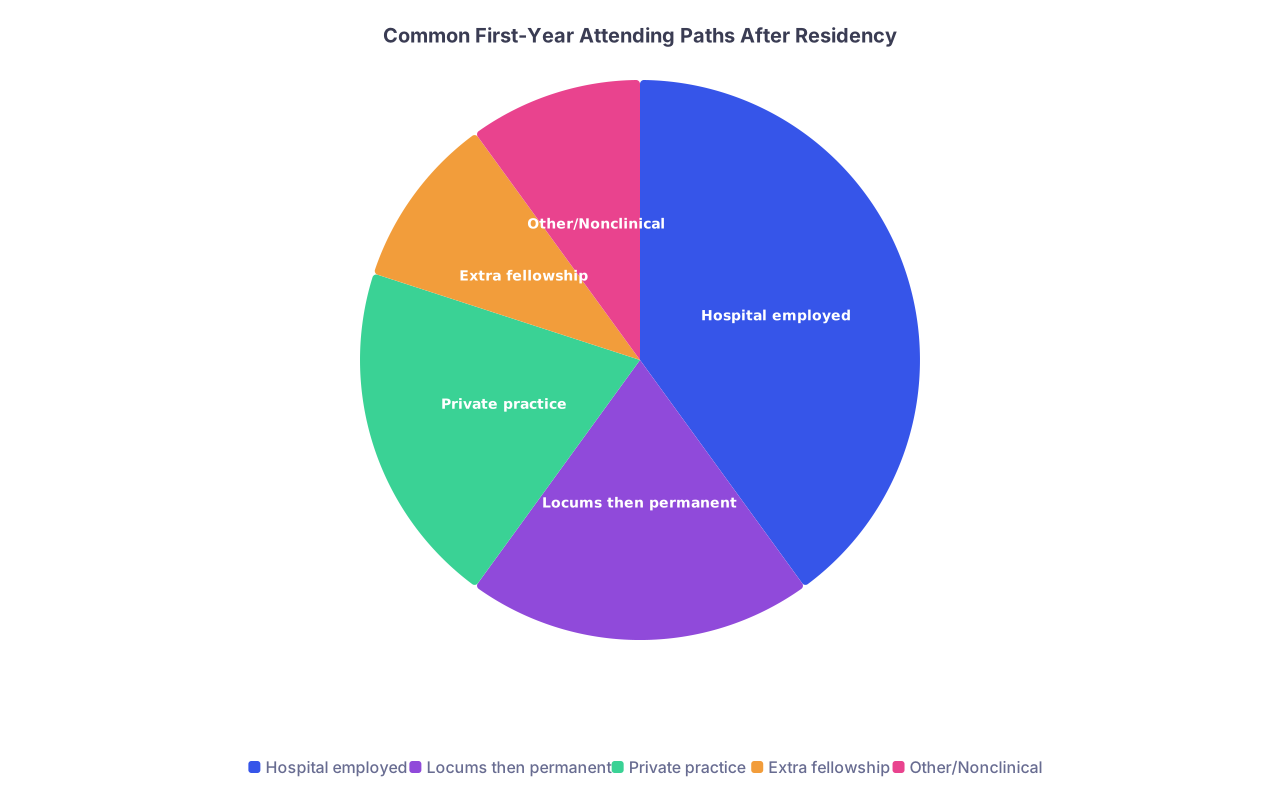
| Category | Value |
|---|---|
| Hospital employed | 40 |
| Locums then permanent | 20 |
| Private practice | 20 |
| Extra fellowship | 10 |
| Other/Nonclinical | 10 |
What Actually Matters Long-Term (And What Doesn’t)
Five years from now, almost nobody will care whether you signed your first job in January or August. They’ll care about:
- Your reputation: Do nurses, colleagues, and patients like working with you?
- Your skills: Did you keep learning or stagnate?
- Your boundaries: Did you burn yourself out to ashes right away?
What won’t matter:
- Whether you did a random 6–12 months of hospitalist or urgent care work before settling
- Whether your first job was “beneath” what you thought you’d do in med school
- Whether you changed jobs once or twice early on
I’ve seen cardiologists who started as general IM hospitalists for two years because they missed the fellowship boat the first time. They’re fine. No one at their current job cares. They barely remember the panic they felt back then.
The Short Version
Three points to hang onto when your brain is yelling that everything is ruined:
- Not having a signed job at the end of residency is way more common—and less catastrophic—than it feels from the inside.
- Your immediate priorities are boring but fixable: legal ability to work, short-term income options, and a realistic sense of your financial runway.
- Your first attending role is a first draft, not your permanent label. The real hazard is rushing into a terrible fit out of panic, not being “late” to sign.
You’re behind the Instagram version of the timeline. Not the real one. And you still have moves.


