

Your first attending job can feel less like a victory lap and more like walking into an execution chamber with your program director holding the lever.
Let me be blunt: the idea that your PD’s reference can make or break your entire career is wildly overstated. But the fear of it? Very real. I’ve seen residents lose sleep, lose weight, and almost lose offers over what they think their PD might write—or not write.
You’re not crazy for spiraling over this. But you’re probably imagining a worse scenario than what’s actually likely.
Let’s pull this apart.
First: How Bad Is “Bad,” Actually?
Everybody lumps “bad reference” into one big terrifying bucket, but there are levels:
| Type of Reference | Typical Wording | Impact on Jobs |
|---|---|---|
| Strong | Enthusiastic, specific praise | Opens doors, especially academic |
| Solid/Neutral-Positive | “Meets expectations”, reliable | Usually totally fine |
| Lukewarm | Generic, vague, no details | Mild concern, but not fatal |
| Red-Flag | Mentions professionalism/behavior issues | Serious problem |
| Refusal to Comment | “Prefer not to provide reference” | Major red flag |
You’re probably not dealing with the last two. Those are rare and usually reserved for truly serious professionalism or safety issues—things that were documented, escalated, and talked about multiple times.
Most terrified residents I talk to are actually in this category: “My PD doesn’t love me, we had a conflict, I’m not their golden child, and I’m scared they’ll only say ‘meets expectations.’”
That’s not a career-ender. That’s… normal.
Many PDs are conservative in letters. Some are almost pathologically bland. They don’t gush. They don’t flowery-language anyone. They just state facts.
You read that as “they hate me.” The hiring committee often reads that as “okay, seems fine.”
Is a glowing letter better? Of course. But a not-glowing one isn’t the same as a negative one.
The Worst-Case Scenarios You’re Imagining (And How Real They Are)
Let’s walk through what’s probably keeping you up at 2 a.m.
Fear #1: “They’ll secretly tank me and I’ll never get a job.”
Reality: Most PDs are more scared of you than you are of them—legally speaking.
They know they can’t just unload personal grudges into a reference. Most institutions have policies, HR oversight, and templates. A lot of letters end up factual to the point of boring:
- Dates of training
- Completion status
- Whether you met requirements
- Occasionally: “No significant professionalism concerns” or “progressed appropriately”
Could a PD slip in a line that subtly undermines you? Sure. Something like:
- “Required closer supervision than typical for level of training”
- “Performance was variable”
- “Ultimately able to meet graduation requirements”
That kind of language can make programs nervous.
But here’s the key: if they’re going that route, you usually already know you’ve had substantial issues during training—formal remediation, written warnings, big meetings, that kind of thing. It doesn’t come out of nowhere.
If you haven’t had that level of drama, you’re probably spiraling about something that’s not actually happening.
Fear #2: “If my PD doesn’t write me a strong letter, I’m done in this specialty.”
No. You’re not.
Community groups, private practices, and many hospitalist groups care far more about:
- Your ability to show up reliably
- Your volume/productivity potential
- Whether you’ll play nice with staff
- Whether you’ll stay at the job for more than 6 months
Yes, they want to know you’re not a disaster clinically. But they don’t necessarily need a Shakespearean sonnet from your PD to believe that.
Plenty of first jobs get filled with:
- A short credentialing confirmation from GME
- Two attending references who like you
- A PD form that’s basically “yes, they graduated”
That combo gets people hired every cycle.
Fear #3: “If my PD doesn’t love me, every recruiter will smell it.”
Recruiters aren’t psychics. They see what’s on paper and what people answer when they call.
A lot of them never speak directly to your PD. They call the references you list (which you can choose strategically), then they send a standard form to your program for verification. Half the time it’s HR, not the PD, who fills out the practical stuff.
So no, there isn’t some flashing red banner on your file that says “UNLOVED BY PD.”
What Programs Actually Do When They’re Worried About a Reference
They don’t usually just quietly blacklist you forever. They try to triangulate.
Here’s the usual pattern if someone senses weakness in a PD reference:
- They read the PD form/letter and think, “Hmm, that’s… underwhelming.”
- They check your other references. Are they stronger? More detailed? Do they sound genuinely enthusiastic?
- They look at your CV: any big gaps, leaves, or major exam drama?
- Sometimes they pick up the phone and call another faculty member from your program. “Off the record, would you hire them?”
That’s why it’s critical you don’t put all your self-worth into one PD letter. You build a portfolio of people who actually like working with you.
You’re not being judged by one human. You’re being seen through multiple lenses. That cuts both ways—but it definitely helps if your PD isn’t your #1 fan.
Step One: Find Out What You’re Actually Dealing With
Speculation is the anxiety engine. Information shuts it down.
You need to get out of the “I just know they’re going to destroy me” loop and into “okay, what’s realistic here?”
Questions to ask yourself honestly:
- Have I ever been formally remediated?
- Were there any written warnings about professionalism or patient safety?
- Did I fail multiple rotations with documentation?
- Did the CCC flag me more than once?
If none of that happened, it makes a full-on red-flag reference very unlikely.
Then, if you can stomach it, have a direct but non-confrontational conversation with your PD. Something like:
“I’m starting to apply for jobs and I wanted to ask candidly—do you feel comfortable supporting me with a positive reference, or would you prefer I rely more on other faculty who know my work better?”
You’re not demanding a love letter. You’re asking if they feel they can support you.
Three benefits to this:
- If they are supportive, your anxiety drops.
- If they’re hesitant, at least you know, and you can plan around it.
- It sometimes nudges them to be more thoughtful, because now they know you actually care about what they say.
Is that conversation pleasant? No. It’s miserable. But it’s better than living in nightmare-unknown territory.
Building a Safety Net: Other References That Actually Matter
Your PD is not the only voice that counts. You need to deliberately stack the deck.
Think about:
- Core faculty who’ve seen your day-to-day work
- Site directors at your main training hospitals
- Attendings who’ve watched you handle nights, high-acuity cases, or difficult families
- Fellows or junior attendings who worked closely with you and are now faculty
Pick people who:
- Have actually seen you handle bad nights and keep functioning
- Have seen you improve after feedback (this matters)
- Use concrete examples when they talk about you
You want them to be able to say things like:
- “I’ve seen them manage complex patients independently and appropriately ask for help when needed.”
- “They’re calm under pressure and good with nurses.”
- “We trusted them with higher responsibility as a senior resident.”
Those lines carry weight. A lot of weight.
Job Type Matters More Than You Think
Where you’re applying changes how much a PD reference matters.
| Job Type | How Much PD Letter Matters | Why |
|---|---|---|
| Academic faculty | High | Culture, teaching, politics |
| Competitive specialty groups | High | Small circles, reputation-heavy |
| Community hospital | Moderate | They care but look at whole package |
| Rural/underserved | Low to moderate | Desperate for warm bodies, frankly |
| Locums/telemedicine | Low | Credentialing-focused |
If your PD is lukewarm and you’re gunning for a hyper-competitive academic spot in the same region? Yeah, that’s trickier. Not impossible, but trickier.
If you’re looking at community jobs, hospitalist roles, or rural positions, a non-glowing PD reference is way less of an obstacle.
This is where strategy enters: maybe your first job doesn’t need to be ultra-prestigious. Maybe your first job is the one that gets you experience and a future supervisor who will rave about you, so your next move is much easier.
First job = foothold. Not final destination.
What If Your PD Is Actually Hostile?
Let’s not sugarcoat it. Sometimes personalities clash. Sometimes you ended up on the wrong side of department politics. Sometimes you had a rough early year and never shook the reputation.
Signs your PD might be actively unhelpful:
- They’ve openly said they “can’t recommend” you.
- They’ve refused to advocate for you in fellowship.
- You’ve had recurring conflict that involved chiefs, GME, or HR.
If that’s you, a few options:
Use other official program leadership.
Associate PDs, site directors, or chair can sometimes write on your behalf. I’ve seen residents list the site director as the main program contact on applications and it worked fine.Keep things factual and neutral.
Most institutions have standard verification forms. Make sure what must be filled by the PD is basic and factual (dates, completion, privileges). Then lean heavily on other recommenders.Address it carefully in interviews—if asked.
If someone directly probes: “We noticed your PD letter was a bit generic,” you keep it calm and boring:“Our program tends to use fairly standardized language for PD letters, but I’d be happy to connect you with Dr. X and Dr. Y, who worked most closely with me clinically.”
Do not launch into a rant about how your PD ruined your life. That’s the fastest way to confirm their worst fears.
Widen your job search.
Look at community, rural, or even locums positions to get that first attending year under your belt. Once you have a department chair at your first job who likes you, the PD fades in importance very quickly.
Red-Flag Reality Check: When It Is Serious
There are cases where you do have to be more calculated:
- Repeated professionalism write-ups
- Big patient safety incidents clearly documented
- Failure to complete residency on time due to performance
- Formal remediation plans that never fully resolved
If that’s your history, then yes, your PD letter might be cautious or even negative. That doesn’t mean you’re banned from working forever, but it means you need:
- Programs that are explicitly open to “non-traditional” or “second chance” candidates
- Radical honesty about what happened, framed with growth and ownership
- Mentors who can strongly attest to your improvement over time
It’s harder, no question. But I’ve seen people with remediation histories get hired as attendings—sometimes in smaller or more desperate markets first, then gradually move.
The myth that one negative line = permanent exile from medicine is… a myth.
Concrete Moves You Can Make Right Now
You’re probably reading this with your stomach in your throat. So here’s what I’d actually do if I were in your shoes:
Identify your 3 strongest faculty supporters.
Not “biggest names.” People who actually like and trust you. Ask them plainly: “Would you feel comfortable being a strong reference for me for attending jobs?” If they say yes without hesitation, that’s gold.Have the dreaded PD conversation.
Short, professional, no drama. Ask if they feel they can support you positively. Whatever the answer, you now have data.Target job types strategically.
If you’re very anxious about references, prioritize:- Community hospitals
- Rural/regional systems
- Large hospitalist groups
You can still apply to the dream academic job, but don’t bet everything on it.
Prepare a calm, non-defensive script.
For any potential questions about training issues, have a 2–3 sentence explanation that:- Owns what happened
- Shows what you changed
- Reassures them it’s not ongoing
No oversharing. No venting.
Remember your PD is not your final boss.
Once you have 1–2 years as an attending, most future jobs will care far more about:- Your current department’s letter
- Your case logs/productivity
- Whether you’ve been privileged anywhere else without problems
The PD holds power now. That power decays fast once you’re out.
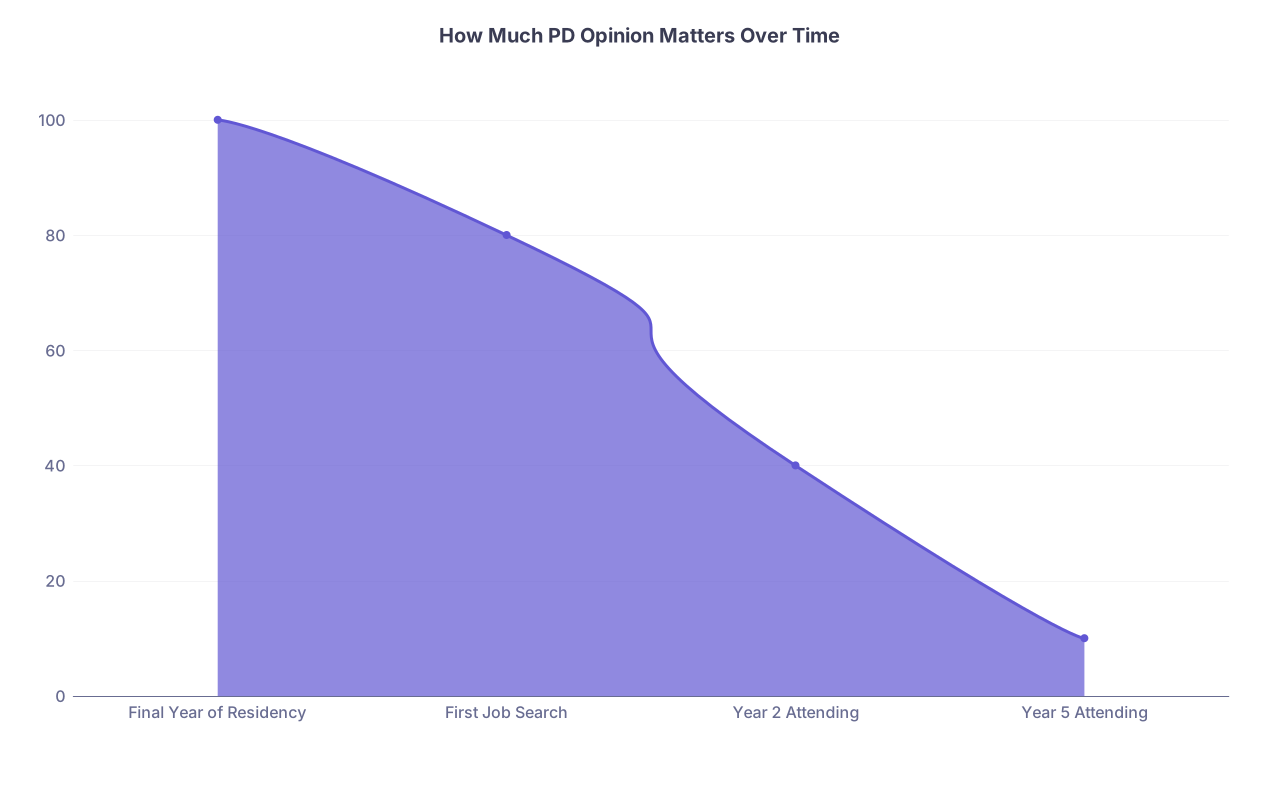
| Category | Value |
|---|---|
| Final Year of Residency | 100 |
| First Job Search | 80 |
| Year 2 Attending | 40 |
| Year 5 Attending | 10 |
Perspective You Don’t Feel Yet (But Need to Hear)
Right now it feels like your entire career is trapped in the head of one person who may or may not really like you. It feels unfair, unbalanced, and scary.
And yeah, that dynamic is kind of broken.
But here’s what actually happens to most people:
- They obsess over PD letters.
- They get a job—maybe not their first-choice city or the fanciest hospital, but a real job.
- Within a year, their reference anxiety shifts to “What does my new chair think of me?”
- Within a few years, residency drama is background noise no one asks about.
Years from now, you won’t be replaying the email where you begged your PD for a reference. You’ll be remembering the first time you signed a contract with your name followed by “Attending Physician” and realized that, somehow, you got through all of this anyway.


