

It’s your third month as an attending. You’re sitting in the call room, scrolling through LinkedIn and group chats between admissions, and it feels like everyone you trained with is suddenly a “Fellow in X at Big-Name Program” while you’re…just at work. Staff. Revenue generator. You signed a contract instead of a fellowship letter and now the panic is setting in:
“Did I screw up my whole career?”
“Is it too late to go back?”
“Will fellowship programs judge me for working first?”
Let me say this bluntly: you are not the first person to wake up post-residency, badge clipped to your white coat, and think, “Oh no. I picked wrong.” I’ve seen residents swear up and down they’d never subspecialize…then hit month 4 of being an attending and suddenly they’re asking about fellowship applications on their lunch break.
Let’s walk through what your actual options are, not the catastrophes your 2 a.m. brain is inventing.
First: Are You Actually Regretting Skipping Fellowship…Or Something Else?
Before you blow up your life, you have to figure out if you’re regretting not doing fellowship, or regretting being overwhelmed, under-supported, and burned out in a new attending job.
Those are not the same.
Classic “new attending” misery that masquerades as fellowship regret:
- You’re drowning in RVUs and admin tasks and feel like a cog, not a doctor.
- You miss the academic environment, teaching, conferences, journals that aren’t pharma-sponsored.
- Your schedule is brutal, your support staff is thin, and you’re doing work that could easily be done by an NP/PA or urgent care.
- You expected to feel more competent as an attending and instead you feel exposed and alone.
None of that requires a fellowship to fix. It might require:
- A different job (hospital-employed vs private, academic vs community, etc.).
- Better mentorship. - Negotiating for protected time.
- More structured learning/CMEs.
True “I actually want to subspecialize” regret has a different flavor. You find yourself:
- Reading subspecialty articles for fun.
- Gravitate to certain consults and cases on shift.
- Feeling jealous (not just vaguely sad) when co-residents talk about their fellowship experiences.
- Imagining yourself doing only that niche work 5–10 years from now and it feels right.
If that last list hits you in the gut—okay. Then we’re talking real fellowship regret, not just “I hate this job” regret.
Can You Still Do Fellowship After Starting a Job? Yes. But…
Let’s tackle the anxiety head-on: Is the door closed because you worked first?
No. It is absolutely not closed.
But there are tradeoffs and realities you need to understand so you don’t build fantasy scenarios in your head.
| Path | Pros | Cons |
|---|---|---|
| Direct to Fellowship | Momentum, strong faculty connections | Less real-world perspective, more burnout risk |
| Work Then Fellowship | Real attending experience, financial cushion | Harder letters, explaining the gap, pay cut |
| Never Fellowship | Income stability, simpler life | May limit niche roles and academic tracks |
I’ve seen people do fellowship after:
- 1–2 years of community hospitalist work, then PCCM or cards.
- 3 years of outpatient IM, then GI or endo.
- Several years of EM, then peds EM, ultrasound, admin, or critical care.
- FM to sports medicine after working as a full-scope FM doc.
Programs won’t automatically blacklist you for having worked. Some actually like it. But they will want to know:
- Why now?
- What changed?
- Are you running from something or to something?
If your story is a muddled “I dunno, fellowship seems nicer than this job”…that’s weak. If it’s, “After working as an attending, I realized my favorite and strongest work is in [subspecialty], and I want to build a career focused on X and Y” – that’s a lot stronger.
What Does the Timeline Look Like If You Decide to Apply Now?
Here’s where people freak out: the timing. It feels like if you missed the direct-match train, you’re done. That’s not how this works.
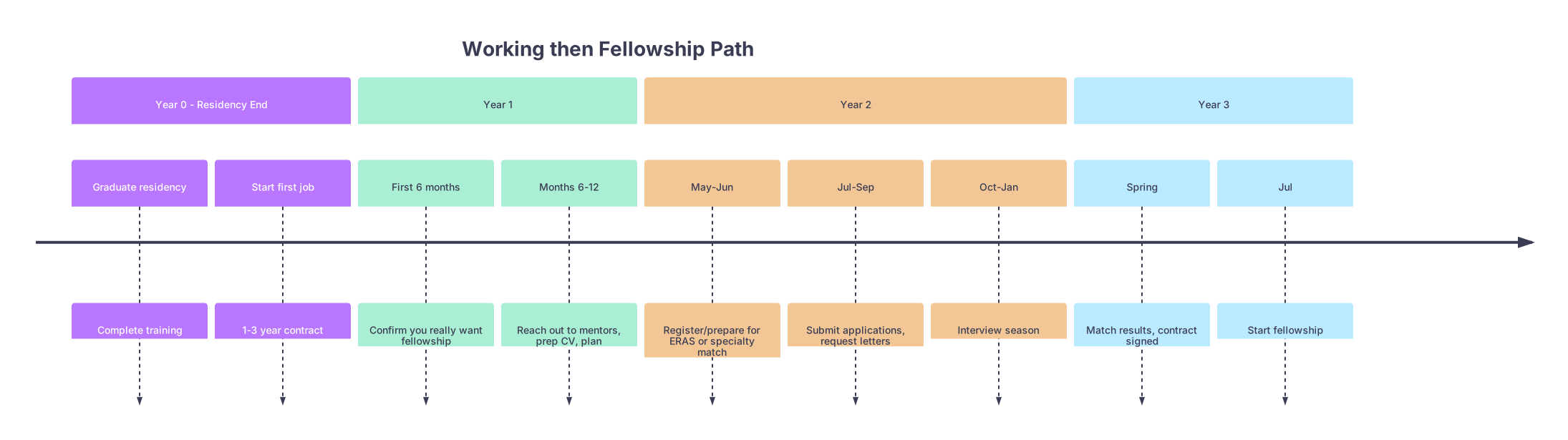
| Period | Event |
|---|---|
| Year 0 - Residency End - Graduate residency | Complete training |
| Year 0 - Residency End - Start first job | 1-3 year contract |
| Year 1 - First 6 months | Confirm you really want fellowship |
| Year 1 - Months 6-12 | Reach out to mentors, prep CV, plan |
| Year 2 - May-Jun | Register/prepare for ERAS or specialty match |
| Year 2 - Jul-Sep | Submit applications, request letters |
| Year 2 - Oct-Jan | Interview season |
| Year 3 - Spring | Match results, contract signed |
| Year 3 - Jul | Start fellowship |
Realistically:
- If you’re in your first attending year now and decide to go for fellowship, you’re 1–2 years away from actually starting it.
- You’ll probably overlap with your current job contract. That can mean awkward conversations and early resignation.
- There will be a time where you go from attending salary back to trainee salary. That whiplash is real.
So no, it’s not too late. But it’s not a quick pivot either. You’re signing up for a multi-year course correction, not a 3-month tweak.
What You Need to Apply After You’ve Already Been Working
Here comes another set of fears: “My letters are stale.” “I’ve lost my faculty connections.” “My CV is just ‘worked at community hospital’ and nothing else.”
Let’s unpack what actually matters.
You still need:
- A clear story for why this fellowship, why now.
- Recent letters of recommendation that speak to your clinical ability, work ethic, and potential in that field.
- Some evidence that you’re connected to the subspecialty world: CME, case reports, QI, research, leadership, whatever you can reasonably build.
Who can write your letters?
- Former residency program director or APD. Even if you haven’t talked in a year, email them. They do this all the time.
- Subspecialty faculty from residency who remember you well.
- Current subspecialists at your job (cards, GI, ID, ICU, etc.) who see your work ethic and interest, even if your job isn’t “academic.”
What scares people is this: “But my current job isn’t academic. I’m just grinding RVUs.”
That’s not a death sentence. But you’ll have to be a little more intentional about creating something fellowship-worthy.
That might mean:
- Volunteering to lead a QI project on your unit and later presenting it.
- Writing up interesting cases with a subspecialist colleague.
- Getting involved in hospital committees relevant to your target field (sepsis, stroke, heart failure, etc.).
- Using your CME and days off to go to relevant conferences, courses, or workshops.
Fellowship directors want to see that you didn’t just wake up bored and spin a wheel. They want to see pattern: you’ve been leaning into this subspecialty, step by step.
Money, Lifestyle, and the Ugly Practical Stuff
This is the part nobody talks about in those rosy “follow your passion” posts.
If you go from attending back to fellowship:
- Your salary might drop by 50–70%.
- If you have a mortgage, kids, loans, dependents—this isn’t trivial.
- You lose some autonomy and go back into a training hierarchy.
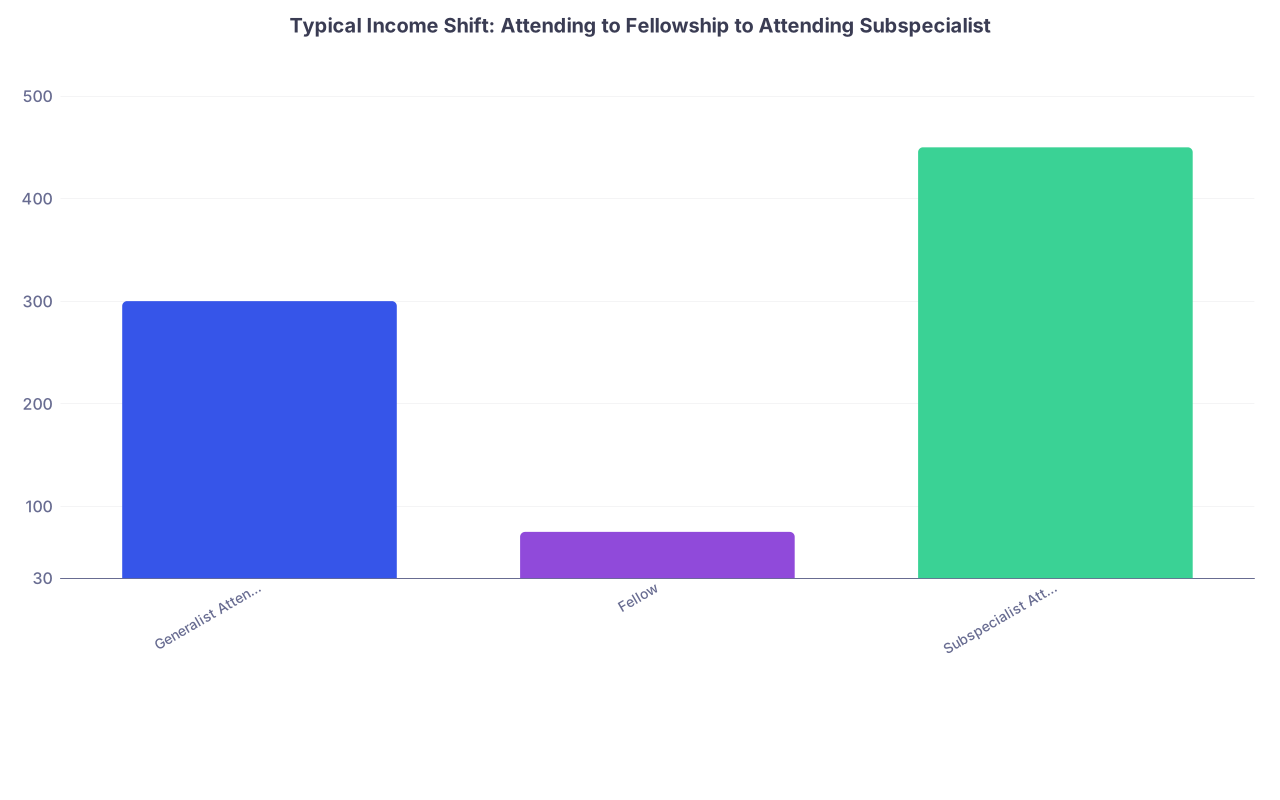
| Category | Value |
|---|---|
| Generalist Attending | 300 |
| Fellow | 75 |
| Subspecialist Attending | 450 |
Those are rough numbers, obviously, and vary a lot by specialty and region. But the direction is real.
So you have to ask yourself, honestly:
- Can I tolerate 2–3 years of lower pay and higher hours again?
- Is the long-term benefit (financial, career satisfaction, schedule, type of work) worth that short-term step back?
- Am I making this decision because I hate my current job or because I genuinely want that subspecialty life 10–20 years from now?
If it’s pure escape from a toxic job, changing jobs might fix 80% of what you’re suffering through—without three more years of training.
What If I Don’t Do Formal Fellowship—Are There Other Paths?
Yes. And this is where the anxiety brain tends to catastrophize: “No fellowship = stuck forever in this exact job until I die.”
That’s just false.
You can often get part of what you think fellowship will give you through other routes:
- Job change: Academic center, hybrid positions, VA, multispecialty group with more niche clinics or procedures.
- Niche development without formal fellowship:
- Hospitalists focusing on oncology co-management, transplant med, peri-op, palliative, addiction.
- EM docs doing ultrasound, admin, EMS, tele, event medicine.
- FM/IM docs building women’s health clinics, obesity medicine, HIV care, etc.
- Certificates / additional training:
- Sleep, obesity medicine, palliative, addiction, clinical informatics, some admin roles—all can be built via board pathways + mentorship + experience rather than fellowship (depending on specialty).
Sometimes what you actually want is:
- Less nights/weekends.
- More teaching.
- More complex, challenging cases but not necessarily a board-certified subspecialty.
That can be achieved with strategic job moves and local mentorship rather than uprooting your whole life for fellowship.
How Programs View Applicants Who Worked First
You’re probably running horror stories in your head like, “They’ll think I washed out,” or, “They’ll think I just want to dodge work for a few years.”
In reality, I’ve heard fellowship faculty say:
- “I like people who’ve been attendings. They know what real medicine looks like.”
- “They’re often more confident and better at managing the floor/ICU than straight-through trainees.”
- “They usually have a clearer sense of what they want and why.”
Red flags they actually care about:
- Huge unexplained gaps with no clinical work.
- A job history that looks chaotic: 3 jobs in 3 years with no clear reason.
- Burned bridges: poor letters from your PD or current supervisors.
- A vague or flimsy story: “I’m just bored and fellowship seemed interesting.”
If you can show:
- Continuous clinical work.
- Solid references.
- A narrative that makes sense (worked, discovered X, took steps Y and Z to explore it, now applying).
You’re fine. Not doomed. Not “behind.”
How to Decide If You Should Actually Apply
If you’re still reading, you’re probably in that torturous middle—maybe fellowship, maybe not, and it’s eating you alive.
I’d do this:
- Write the brutally honest email you’d send a mentor: “Here’s my job, what I like, what I hate, what I’m drawn to, what scares me about fellowship.” You don’t have to send it. Just get it out of your head.
- Talk to 3 people actually living the life you think you want. Not glossy conference speakers. Real fellows or early-career subspecialists. Ask:
- What sucks about your day-to-day?
- What would you do differently?
- Would you do this again?
- Run the 10-year thought experiment: In 10 years:
- Version A: You stayed generalist, found a better job, maybe a niche, no fellowship.
- Version B: You did fellowship and are now a subspecialist. Which version feels more like relief and less like regret?
If you’d feel a pit in your stomach imagining never doing that subspecialty…that’s your answer.
FAQs
1. Did I ruin my chances at fellowship by working first?
No. You did not ruin your chances. You made a decision with the information and exhaustion level you had at the end of residency. Programs see people apply from attending jobs every year. The key is to show growth, purpose, and a coherent story—not shame and panic. Your chances depend more on your letters, your fit, and how serious you are about the field than the fact that you worked first.
2. How long can I work as an attending before it’s “too late” to apply?
There isn’t a magical cut-off where the door slams shut. I’ve seen people go back after 1 year and after 5+ years. The longer you’re out, the more you need:
- Recent clinical work.
- Up-to-date references.
- Some evidence of ongoing engagement with the field (CME, projects, committees, etc.). At 10–15 years out, it’s harder but still not impossible in some fields, especially less competitive ones. But the real question isn’t “too late?” It’s “Do I still want this enough to justify the reset?”
3. Will programs judge me for leaving my current attending job to go do fellowship?
They will absolutely ask about it. That doesn’t mean they’ll judge you harshly if your answer makes sense. “I realized that my long-term career satisfaction lies in [subspecialty] and I want to deepen my skills and focus my practice there” is fine. Just don’t trash your current job or blame everyone else. Also, handle your current contract professionally—reasonable notice, minimal burning of bridges. People talk.
4. My residency letters are old. Do I need all new letters?
You’ll want at least one letter that’s relatively current (within the last 1–2 years) and ideally from someone in or adjacent to your target field. A strong old letter from a PD or subspecialty mentor can still be helpful, especially if it speaks to your potential. But if everything is three years old and no one has seen you clinically since, that’s a problem. Start building relationships now—on your current job—so you have letter writers who can vouch for who you are as a physician today.
5. What if I apply and don’t match—did I just wreck my life?
No. It will sting. Your ego will scream. But you’ll still have your attending job or the ability to get another one. People reapply, sometimes with a stronger application and a clearer story. Or they decide during the process that they can build a satisfying career without formal fellowship and pivot to a different job or niche. Applying doesn’t permanently tattoo “failed” on your CV. It just becomes part of your story.
6. I’m scared I’ll regret either choice—doing fellowship or not. How do I live with that?
Welcome to adulthood in medicine: every path has regret baked in somewhere. Your goal isn’t to find the path with zero regret. It’s to choose the regret you can live with. Would you rather risk regretting three more years of training and lower pay? Or regret never giving yourself the chance to try the subspecialty you can’t stop thinking about? Neither answer is painless. But silence and paralysis—doing nothing out of fear—that’s the one that almost always leads to the worst kind of regret.
Open a blank document or notes app today and write one page titled: “Ten Years From Now, I’ll Be Glad I…” Don’t overthink it. Just write. See which version of you shows up more: the one who stayed generalist and found a better-fit job, or the one who went back for fellowship. That’s your starting point.


