

The job market you thought you were training for does not exist anymore.
If you’re graduating into a soft physician job market, you cannot run a “normal” job search. You will get out-competed, lowballed, or stuck accepting a bad fit out of panic. You have to treat this like what it is: a constrained, competitive, imperfect market—and act accordingly.
I’m going to walk you through exactly how to adapt your search if you’re finishing residency or fellowship into a weaker market: fewer offers, slower callbacks, more candidate competition, hospital systems tightening budgets, private groups getting eaten by corporate, visa issues magnified. I’m assuming you already know your specialty is not anesthesia-in-2005 or derm-in-a-rural-state. You’re feeling friction.
Good. That awareness is your competitive edge if you act on it.
Step 1: Get a Ruthlessly Accurate Read on Your Market
Most graduating residents are flying blind. They vaguely hear “hospitalist jobs are always there” or “primary care is in demand” and assume that means for them, right now, in their preferred city, with their visa, schedule, and salary needs. It does not.
You need hard data, fast.
Here’s the minimum to figure out in the next week:
Regional health system reality
- Pull up the major systems within a 2–3 state radius.
- Look at open positions on:
- Their own career sites
- Physician-only job boards (PracticeLink, NEJM, AAFP/ACP/ACEP job boards depending on specialty)
- Recruiter postings
- Count how many jobs actually exist that match:
- Your specialty
- Your visa status
- Your board status (board eligible vs certified)
- Your start date
Comp trend check
- Talk to at least 3–5 recent grads in your specialty (PGY-3 from last year / last fellow class).
- Ask them bluntly:
- “What are you making, ballpark?”
- “Base vs wRVU? Sign-on? Loan repayment?”
- “How many serious offers did you have?”
- Cross-check with MGMA or specialty society data—but assume current offers are 5–20% below glossy historical numbers in a soft market.
Time-to-offer reality
- Ask grads: “When did you start looking and when did you sign?”
- When recruiters email you, ask: “What’s your typical timeline from first contact to signed contract?”
- Expect everything to be slower when systems are cautious.
Now put this into something real:
| Factor | Your Data (Example) |
|---|---|
| Region | Midwest, 3-state radius |
| Jobs matching you | 9 total (5 hospital, 4 outpatient) |
| Typical base pay | $230–260k |
| Sign-on range | $10k–$30k |
| Time to offer | 6–12 weeks from first interview |
If those numbers look thin or sluggish, you are in a soft market and need to play differently.
Step 2: Widen vs. Tighten – Decide What You’re Willing to Bend On
In a tight market, you can be picky about location, schedule, and practice style. In a soft market, you have to decide which levers you’re actually willing to move, and which are non-negotiable.
You don’t have to say yes to anything. But you do have to pick where you’ll give.
The levers:
Geography
- This is the biggest one.
- If you’re locked into:
- One city
- Near a partner’s job
- Kids’ school
- Expect fewer options and lower negotiating power. That isn’t pessimism, it’s just arithmetic.
Practice type
- Academic vs community
- Employed by large system vs private group vs FQHC
- Pure outpatient vs mixed vs inpatient
- In a soft market, you expand practice types before you expand your morals (do not suddenly “love” high-volume pill mill work—walk away).
Compensation
- You might not hit the Instagram-attending number year one.
- You can trade:
- Slightly lower base for a sane schedule
- RVU-heavy comp if you know there’s demand
- Lower initial pay for a short partnership track with actual transparency
Lifestyle specifics
- Nights/weekends
- Call burden
- Telehealth vs in person
- 4-day vs 5-day week (hot take: in a soft market, locking yourself to a 4-day week only job can be self-sabotage in year one)
Write this down. Literally. What are your “must haves” vs “willing to bend” vs “absolutely not”?
If you cannot say those in one paragraph, you’re not ready to approach this market.
Step 3: Change How You Source Jobs (Stop Relying on Just Posted Ads)
In a soft market, the best roles often never hit public job boards. They get filled by:
- The graduating fellow who rotates at that site
- The person who cold-emailed the department chair six months earlier
- The resident who impressed the community rotation and asked early
So if your entire strategy is “refresh PracticeLink and respond to recruiter spam,” you’re missing half the game.
Here’s how to adapt.
1. Direct outreach to decision-makers
You want to get in front of:
- Department chairs
- Service line leaders
- Practice owners
- Medical directors
Not just the recruiter whose inbox has 200 résumés.
Example email script you can actually use:
Subject: Graduating [Specialty] – Interested in Joining [Group/Hospital Name]
Dr. [Last Name],
I’m a PGY-[X] in [specialty] at [your program], graduating [month, year], and planning to stay in [broad region/city if specific].
I’ve been following [their hospital/group] because of [1 specific reason – patient population, service line, reputation, something that shows you’re not blasting this to 100 people].
I’m interested in a position focused on [core interest – inpatient/outpatient/procedure mix], starting [start date]. Do you anticipate any openings or upcoming needs where someone with my background might be a fit?
CV attached. Happy to schedule a quick call at your convenience.
Thanks,
[Name, credentials]
[Phone]
[LinkedIn or professional site if you have one]
Most will ignore you. You don’t need most. You need 5–10 who don’t.
2. Use your rotations and attendings like currency
You trained somewhere. People know you.
Ask:
- “Who do you know in [city/state/system] who’s reasonable to work with?”
- “Can I use your name when I reach out to Dr. X?”
- “Are there any groups around here that aren’t advertising but might need help in the next year?”
Then actually name drop: “Dr. Smith suggested I reach out to you.”
That line moves emails from “trash” to “maybe read this.”
3. Don’t ignore “soft” or partial postings
Sometimes a group will say:
- “We’re not hiring now but maybe next year”
- “We might have an opening if someone retires”
- “We’re budget constrained till Q4”
In a soft market, those maybe’s are gold. Stay in their orbit. Quarterly ping. Share updated timeline. Offer locums coverage or per diem if possible.
Step 4: Treat Interviews Like Auditions in a Tight Casting Call
In a weak market, they’ll get more good candidates for fewer spots. That means:
- Sloppy interviewing sinks you
- Lukewarm follow-up loses offers
- Unclear answers about your goals make you look risky
You’re not just “seeing if you like them.” You’re proving three things:
- You’re low drama.
- You’re clinically solid and safe.
- You’ll stay long enough to be worth onboarding.
You need to signal stability in every answer.
Examples of what to say and avoid:
Instead of:
“I’m really hoping to stay near family, but we’ll see what works out.”
Try:
“My goal is to find a position where I can stay 3–5+ years. My partner’s job and family are here, and we’re planning to build long-term in this area.”Instead of:
“I’m open to anything, honestly.”
Try:
“I’m most effective in [describe realistic practice style based on their setting: high-volume clinic / consult heavy inpatient / procedural outpatient]. I’m open within that framework, but I know that’s where I bring the most value.”
Have 3–4 specific clinical stories ready:
- A difficult patient you managed well
- A time you handled high volume safely
- A conflict you navigated with staff or colleagues
- A time you stepped up to cover or problem-solve
They’re not hiring your dream; they’re hiring your track record.
After every serious interview, send a short, specific email:
“Thank you for the chance to talk yesterday. I was especially interested in [X aspect of their practice]. I’d be enthusiastic about working with your team if we’re a good mutual fit.”
In a soft market, small professionalism signals matter more because they’re sorting a larger pile.
Step 5: Adjust Your Negotiation Mindset (You’re Not Powerless—but You’re Not Holding All the Cards)
This is where a lot of residents screw up. They read a blog about “always negotiate everything” and walk into a soft market like they’re a unicorn candidate.
Reality:
- Yes, you should negotiate.
- No, you’re not going to turn a $230k offer into $300k and a Tesla.
- Overplaying your hand can absolutely cost you the job in a cautious hiring environment.
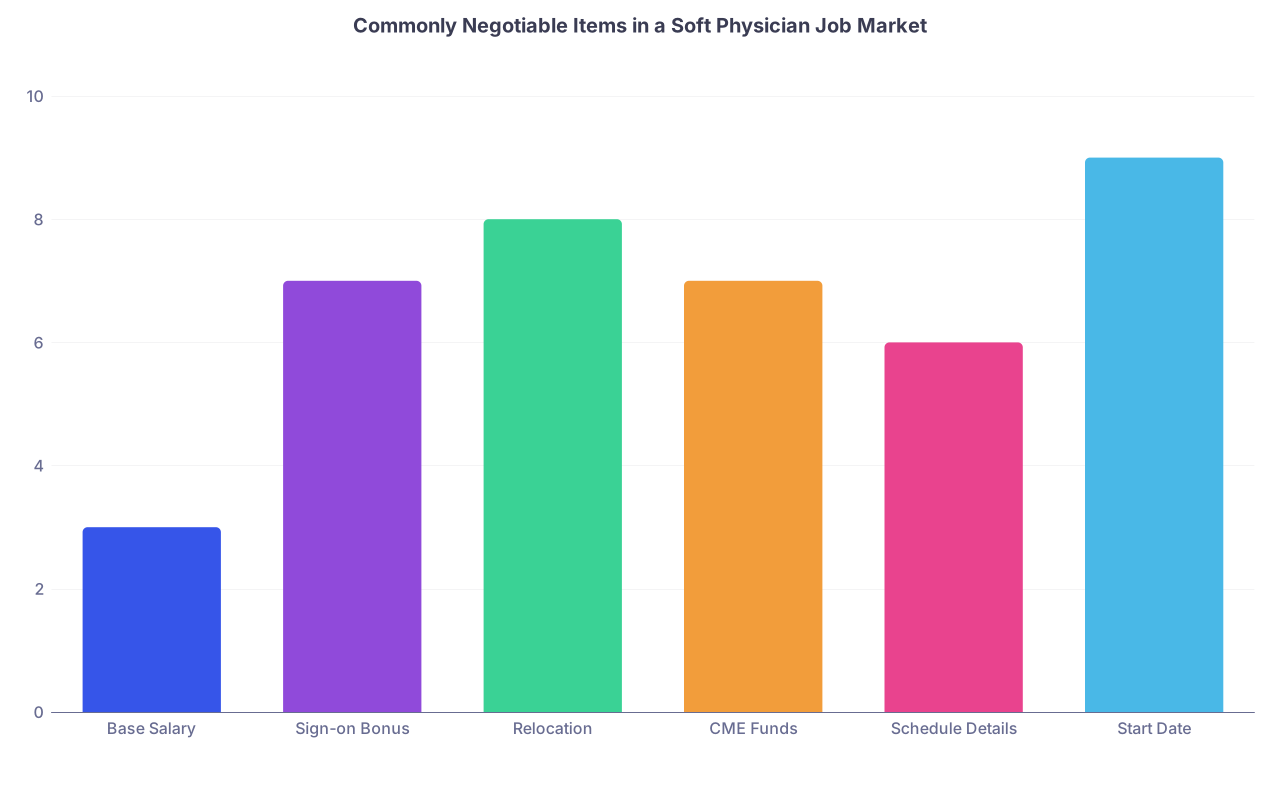
What you can often move, even in a soft market:
- Start date
- Sign-on bonus structure (paid in parts vs all after one year)
- Relocation allowance
- CME money
- Schedule nuances (1:4 vs 1:3 weekends; 4.5 vs 5 clinic days)
- Early review of compensation after year 1 with written criteria
| Category | Value |
|---|---|
| Base Salary | 3 |
| Sign-on Bonus | 7 |
| Relocation | 8 |
| CME Funds | 7 |
| Schedule Details | 6 |
| Start Date | 9 |
(Scale 1–10: how negotiable these usually are in a soft market)
Base salary is the hardest to move much right now. You might get 3–5% bump if they’re motivated. Don’t die on that hill, especially if everything else is solid.
Where you must stay firm:
- Non-compete clauses that lock you out of your entire metro area for 2 years
- Clearly unsafe workloads (ED seeing 3.5–4.0 pts/hr with 12-hour shifts back-to-back, etc.)
- Call schedules that are objectively abusive and not compensated
- RVU targets that existing docs quietly tell you are unachievable
You may accept less money for a safer, saner job. But don’t accept a job that will burn your license, your sanity, or both.
Step 6: Build a Plan B That Doesn’t Destroy Your Future
Soft market means some of you won’t land your “main” job on your ideal timeline. That doesn’t mean you failed. It means you need a deliberate interim plan that:
- Pays your bills
- Keeps your skills sharp
- Does not trap you in something hard to exit
The common options:
Locums
- Good when:
- You’re flexible geographically
- You want to sample different practice settings
- You need income while waiting for the right permanent job
- Watch for:
- Malpractice coverage (tail vs occurrence)
- Travel fatigue
- Gaps in training-specific skills (e.g., complex procedures you won’t see in small community gigs)
- Good when:
Per diem / PRN with local systems
- Can help you:
- Get a foot in the door
- Demonstrate value to a group that “doesn’t have FTE right now”
- Make sure you:
- Understand how often they actually use PRN docs
- Keep interviewing elsewhere unless they explicitly signal they’re opening a slot
- Can help you:
Short-term or bridge fellowships
- For some specialties, an extra year (e.g., a niche fellowship) can reposition you into a better market cycle or new geography.
- Bad idea if:
- They’re unpaid or low-paid and you’re already drowning in loans
- The fellowship doesn’t actually improve your marketability
Academic or research-heavy roles
- Sometimes a 1–2 year clinical+research position at your institution can serve as a landing pad.
- Ask explicitly:
- “What are past people in this role doing now?”
- “Has anyone converted this position into a long-term attending role here?”

| Step | Description |
|---|---|
| Step 1 | Graduating From Residency |
| Step 2 | Prepare To Start Job |
| Step 3 | Expand Search Region |
| Step 4 | Consider Locums or PRN Locally |
| Step 5 | Interview and Negotiate |
| Step 6 | Consider Fellowship or Bridge Role |
| Step 7 | Maintain Skills and Keep Searching |
| Step 8 | Reassess Market in 6-12 Months |
| Step 9 | Signed Offer? |
| Step 10 | Geography Flexible? |
| Step 11 | Any Solid Leads? |
The key: make your Plan B a choice, not a passive slide into “doing a little of everything and committing to nothing.”
Step 7: Use Time Like a Lever, Not a Trap
In a soft market, two time traps kill people:
Starting way too late
- If you’re in your final year and just now planning to “see what’s out there,” you’re behind. You can recover, but you can’t pretend it’s fine.
- Fix: compress the timeline with intensity: direct outreach, multiple parallel interview tracks, weekly follow-ups.
Dragging out decisions so long you lose offers
- Systems in a cautious market will move slowly—until they don’t.
- When they decide you’re their pick, they will want a yes/no in a reasonable timeframe (1–2 weeks).
- Collect as many data points as possible upfront:
- Put all questions about schedule, comp, call, and expectations on the table before the written offer if you can.
- Ask to talk to 2–3 current physicians in the group before you disappear to “think on it.”
You’re trying to hit a balance:
- Don’t sign the first halfway-decent thing in panic.
- Don’t hold out for something mythical that may not exist in this market.
I’ve watched graduates lose solid offers trying to squeeze an extra $10k, only to end up six months later taking a worse job because everything else dried up. That’s not strategic. That’s ego.
Step 8: Visa, Board Status, and Other Landmines—Handle Them Upfront
If you have any constraint that shrinks your employer pool—visa, failed boards once, gap in training—you cannot hide it and hope it “works out.”
You bring it up early, matter-of-factly, with a solution-ready attitude.
Visa (J-1 / H-1B)
- Start your search earlier than your peers. A full 18–24 months ahead if possible.
- Target:
- Systems and groups with a history of hiring IMGs
- Areas with physician shortage (for waiver positions)
- Ask directly:
- “Do you sponsor [visa type]?”
- “Have you successfully done this for other physicians in the past 3–5 years?”
Soft market reality: some groups who could sponsor just won’t, because they don’t feel pressure to. Don’t waste your time there.
Board exams
If you had a stumble:
- Don’t lead with it. But don’t dodge it when asked.
- Script something like:
- “I had a setback with the [exam] on my first attempt; I passed on my second. I adjusted my approach, built in dedicated time, and since then my in-service scores and clinical feedback have been strong.”
You frame it as a solved problem, not ongoing drama.
Step 9: Protect Your Mental Game (Because Desperation Leaks Out)
Long, uncertain job searches crush confidence. I’ve seen PGY-3s who look like rockstars in clinic sound like apologetic interns on the phone with recruiters after three months of silence and rejections.
You’ll make worse decisions from that headspace.
You need structure.
Set yourself a weekly rhythm:
- X number of applications or outreach emails (e.g., 5–10)
- Y number of follow-up messages on prior leads (e.g., 3–5)
- One hour of talking to mentors/peers instead of doom-scrolling job sites
- One concrete rest activity that’s not medicine
Track it. On paper or a spreadsheet. Not because you’re a productivity nerd, but because in a sluggish market it’s easy to feel like “nothing is happening” and start spiraling.
You also need a line you will not cross: “I will not take a job that is unsafe or clearly exploitative purely because I’m tired of searching.”
Write that down now, before you’re exhausted, and have a trusted person (mentor, partner, senior coworker) who will remind you of it later.
Step 10: Make One Small but Serious Move Today
Soft markets reward the people who move early, think clearly, and play the whole board—not just the job boards.
Do this before you go to bed tonight:
- Open a blank document.
- Write three headings:
- “Non-negotiables”
- “Nice-to-haves”
- “Willing to bend”
- Force yourself to fill each with 3–7 bullet points about your first attending job.
- Then send one direct outreach email to a real decision-maker (chair, director, practice owner) using the template above, attaching your CV.
Not tomorrow. Not “after I tweak my CV for 3 hours.” Today.
That single email, in this kind of market, could be the difference between drifting into a mediocre default and stepping into a role that actually pushes your career forward.


