

When Your Spouse’s Career Limits Where You Can Work: Physician Solutions
What do you actually do when the only viable jobs for your spouse are in exactly three cities—and none of your dream physician jobs are in any of them?
If you’re post-residency and on the job market, this is not hypothetical. I see this all the time:
- Your partner is a software engineer who basically has to be in Seattle, SF, or NYC.
- Your spouse is tenure-track faculty and pinned to one university.
- Your partner is in finance, aerospace, or entertainment, and those jobs live in 4–5 metro areas, not “wherever you match.”
You, meanwhile, have a medical degree and a specialty that could technically work almost anywhere. But not necessarily with the exact job, call structure, pay, or practice type you wanted.
So you’re here: you cannot just “apply everywhere and see what happens.” Your spouse’s career is the hard constraint, and yours has to flex. Let’s deal with it like adults.
Step 1: Define Your Real Constraints (Not the Ones You Complain About)
You cannot solve this until you get brutally clear on what’s truly non‑negotiable vs. what you just dislike.
Sit down with your spouse and answer, out loud, in writing:
What exactly limits their geography?
- Employer has 2–3 hubs only.
- Industry only exists in a few cities.
- Union rules, licensure, or specific facility.
- Tenure track or unique role (e.g., orchestra musician, federal job).
What is the radius?
- Can you be 45–60 minutes outside the city?
- Would they accept remote 3 days/week with occasional travel?
- Is “adjacent state with easy commute/flight” on the table?
What’s the time horizon?
- Is this a 2-year constraint or a 10-year constraint?
- Are they actively looking for a remote‑friendly or transferable role?
- Are kids/schools locking you in extra tight for a while?
You need a clear map: “These 3 metro areas plus a 1‑hour radius” is a real constraint. “We like the East Coast better” is not a constraint, that’s a preference.
Now flip the spotlight onto you. Within those real constraints, identify your range:
- Which specialties and practice types in your field can exist almost anywhere? (Hospitalist, primary care, EM, general IM, general psych, anesthesia—usually widely needed.)
- Which require big centers or academic hubs? (Surgical subspecialties, transplant, advanced heart failure, many peds subspecialties, heme/onc with niche focus.)
If your spouse’s job pins you to mid‑sized cities with no tertiary center and you’re a liver transplant surgeon, let’s not pretend this is a trivial puzzle.
You’re not choosing among 200 jobs. You might be choosing among 3 viable ones. That changes your strategy.
Step 2: Decide Who Is “Anchor” and Who Is “Portable” (and Be Honest)
In most dual‑career households, one career is the anchor and one is portable at any given time. That can change across seasons of life, but you can’t both be anchor all the time. That’s how you get stalemates and resentment.
Ask bluntly: for the next 3–5 years, whose career is:
- Less geographically flexible?
- Harder to rebuild if interrupted?
- Closer to a critical inflection point (tenure clock, partnership track, promotion window)?
Sometimes, medicine is the anchor. For you, it may not be.
If your spouse:
- Is one of very few people in a niche role at their company or institution
- Would take a massive career or income hit by moving
- Is locked into a multi‑year research grant or tenure timeline
…then you are probably the portable one right now.
That means your mindset shifts from: “How do we find my perfect dream job?” to “How do I optimize within this narrow band of options?”
That’s not defeatist. That’s being strategic. Plenty of physicians build outstanding careers starting from constraint.
Step 3: Actually Map the Market for Your Allowed Cities
This is where most people get lazy. They say, “There are no jobs here,” based on 15 minutes on PracticeLink.
Do a real scan of your constrained geography:
- List every hospital, large clinic, and major practice group within the viable radius.
- Note which systems dominate (e.g., Providence, HCA, Kaiser, academic centers).
- Check:
- System career pages
- Specialty society job boards
- Recruiter platforms
- LinkedIn (and yes, actually message people)
Then go beyond posted jobs. Because many roles never hit a job board.
You want to get to something like this:
| City/Area | System/Group | Type | Status |
|---|---|---|---|
| Metro Core | Big Academic Ctr | Academic Heme/Onc | No posting, but hiring yearly |
| West Suburb | Community Hospital | Employed Heme/Onc | Recruiter-driven, open |
| East Suburb | Large Private Group | Partnership track | No current posting, turnover q2–3 yrs |
| Adjacent City | Cancer Center | Hybrid academic | Recently filled, likely open in 1–2 yrs |
Now you’re dealing with specifics instead of the emotional story: “There are literally no jobs for me here.”
Often there are. They’re just not exactly the flavor you wanted.
Step 4: Understand Which Levers You Can Pull (and Which You Can’t)
You do not control:
- Where your spouse’s employer builds offices.
- Whether your exact subspecialty is in high demand in that city.
- The hospital’s need for a 0.8 FTE nocturnist vs a full‑time days-only role.
You do control:
- How early you start talking to people.
- Whether you’re willing to flex on practice type, call, or FTE.
- Your openness to “good enough for now” vs “perfect immediately.”
Here are the levers I’ve seen work in constrained-location marriages:
Practice type flexibility
You may have wanted pure academic. In your allowed cities, maybe it’s mostly large community hospitals. Can you do:- Community job with an academic affiliate title?
- Hybrid model (community volume, one day/week teaching)?
FTE and schedule creativity
You might get your foot in the door with:- 0.6–0.8 FTE + telehealth/locums for extra income
- Nights/weekends with more days off
- Shorter contract or “trial” year
Telemedicine and remote work
For many non‑procedural specialties (psych, endocrine, rheum, derm follow‑ups, sleep, IM subspecialties):- In‑person clinic 1–2 days/week at a drivable site
- Tele visits the rest of the time
- Or fully remote roles, licensed in multiple states
Time‑bound compromises
You can explicitly say: “We’re prioritizing your career for 3 years. After that, we re‑open the map for mine.”
Put that in writing between the two of you. Otherwise “temporary” arrangements quietly become permanent and resentment builds.
Step 5: Tactical Job Search When Your Radius Is Small
You can’t play the numbers game other people do (“I applied to 60 jobs; let’s see who bites”). You have to treat this more like targeted business development.
Here’s the playbook I’d use:
1. Start 12–18 months before you need the job
Even if everyone tells you, “Most hiring happens 6–9 months out.” In constrained cities, jobs open slowly and unpredictably. The extra lead time lets you:
- Tell division chiefs “If you have any turnover next year, I’d like to be on your radar.”
- Learn who’s about to retire.
- Time your move around known expansions.
2. Skip the generic recruiter spam
Blindly waiting for recruiters to magically find a position in your one metro area is stupid. Most are commission‑driven and will try to pull you to where the demand is, not where your spouse’s job is.
Instead:
- Identify 2–3 recruiters who regularly place in your target city/region.
- Be blunt: “I will not move outside [X metro + radius] due to spouse career. If you do not have anything there, please say so.”
3. Go peer‑to‑peer early
- The division chief for your specialty at every relevant hospital
- 1–2 midcareer attendings at each site
- Private group partners if relevant
Your message is simple:
“I’m finishing [specialty/fellowship] in [month/year]. My spouse is locked to [company/city] for at least the next 5 years, so I’m focused on this area only. I’m very interested in any current or upcoming opportunities in [X scope—e.g., general GI with interest in IBD]. Would you be open to a brief call to share how hiring typically works in your group?”
You’re not begging for a job. You’re gathering intel and planting seeds.
Step 6: Income, Lifestyle, and the “Trade” You’re Making
Let me be blunt: sometimes, the cost of honoring your spouse’s career constraints is that you earn less or work a less “prestige” job than you otherwise could.
This is not failure. It’s an explicit trade. The mistake is pretending otherwise.
You need to do the math:

| Category | Value |
|---|---|
| Ideal Region | 450000 |
| Spouse-Limited City | 320000 |
If you could make $450k in your dream rural/suburban job but the best realistic job near your spouse pays $320k with heavier call, you’re “spending” $130k/year to keep your spouse in their optimal career setting.
Is that worth it? Only you two can answer. But answer it on purpose.
Then fix your financial plan accordingly:
- Maybe you rent instead of buy initially.
- Maybe you keep driving your beater car for 3 more years.
- Maybe you scale back 529 contributions early.
You can absolutely still hit long‑term goals with a lower physician income, especially if your spouse’s career is strong. But do not pretend you make $450k if you make $320k. Align your life and savings with your actual combined earning power.
Step 7: When the Only Local Options Are Bad
Sometimes the answer isn’t “less ideal,” it’s “actually toxic.” I’ve seen this:
- Only group in town has a reputation for burning out new hires.
- The hospital is hemorrhaging staff and cutting corners on safety.
- The compensation model is predatory (RVU targets no one meets, partnership that never materializes, etc.)
Then what?
You have a few choices. None are perfect.
Short‑term sacrifice job with an exit plan
Take the job, but:- Negotiate the shortest contract term and fair restrictive covenants.
- Set a strict mental end date (12–24 months).
- Save aggressively so you’re not trapped if it goes bad.
- Keep networking for your Plan B from day one.
Expand the radius with commute‑heavy solutions
Example:- Live near your spouse’s work.
- You commute 45–90 minutes to a better hospital or group.
- Consider 3–4 day workweeks to reduce total commute days.
Honest truth: many physicians would rather commute an hour than work in a malignant environment 10 minutes away.
Hybrid: Locums/telemedicine + partial local presence
Sometimes you can:- Take 0.5 FTE local role (just enough to maintain local ties and benefits).
- Do telemedicine or locums elsewhere to improve income and variety.
Reassess the “non‑movable” spouse job
This is uncomfortable, but in a truly bad market:- Is your spouse’s role really immovable, or is it just scary to move?
- Could they target a transfer to a different city in the same company within 2–3 years?
- Can they build a path to remote work?
I have seen couples torture themselves for five years preserving a spouse’s “great job” in a city that made the physician miserable every single day. Eventually they moved, and both said, “We should have done this three years earlier.”
Step 8: The Academic vs. Industry vs. Community Triangle
If you’re academic‑minded and your spouse is geographically locked, read this carefully.
There are three broad “buckets” you can blend:
- Classic academia: big center, research, teaching, grants.
- Community practice: clinical volume, some teaching maybe, little research.
- Industry/other: pharma, biotech, consulting, admin, telehealth companies.
In cities where your spouse’s industry clusters (tech, biotech, finance, etc.), there are often non‑traditional roles for physicians that can actually fit constraints better than a perfect academic post:
- Medical director roles at pharma/biotech.
- Health tech clinical lead positions.
- Utilization management, insurance medical director.
- Hospital quality/administration roles.
These might give you:
- Stable hours.
- Big‑city salary plus spouse income.
- Flexibility (hybrid/remote) that solves a lot of childcare and burnout problems.
Do they replace the dream of being a division chief at a top‑10 academic center? No. But sometimes the total life equation is better:
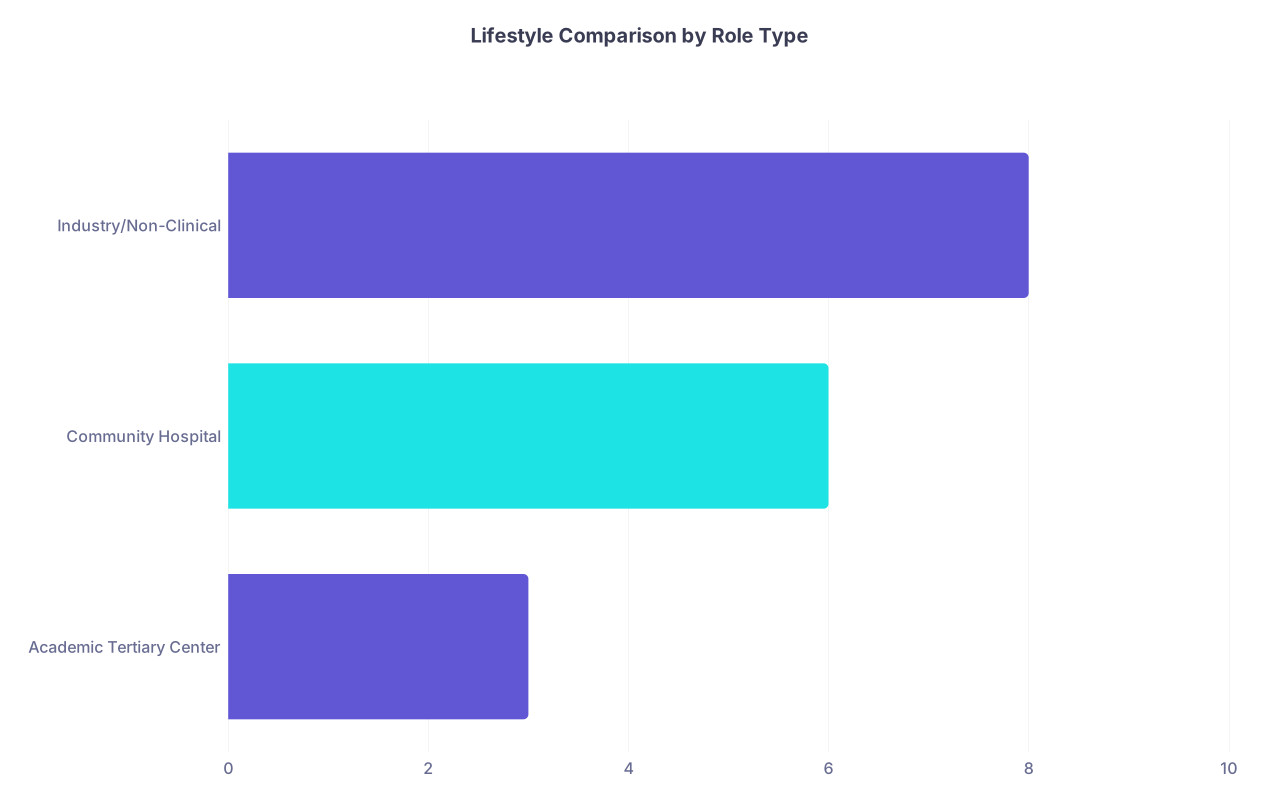
| Category | Value |
|---|---|
| Academic Tertiary Center | 3 |
| Community Hospital | 6 |
| Industry/Non-Clinical | 8 |
(Think of values as “schedule flexibility” on a 1–10 scale.)
Point is: in spouse‑limited cities, do not ignore hybrid or non‑clinical roles, especially if they buy you geographic alignment and sanity.
Step 9: Contracts, Covenants, and Avoiding Getting Trapped
When your geographic radius is already tiny, a bad non‑compete can corner you hard. You cannot afford to be careless here.
Watch for:
- Non‑compete radius that basically covers the whole metro area.
- Multi‑year restrictions on working in your specialty within X miles.
- Clauses that activate even if they terminate you without cause.
If your whole universe is a single metro and its suburbs, a 20‑mile non‑compete could effectively mean: “If this job goes badly, you either leave medicine locally or your spouse quits their job and you both move.”
That’s insane leverage for the employer to have.
You push back:
- Ask to shrink radius or limit it to specific clinics/hospital sites.
- Ask that non‑compete not apply if they terminate you without cause.
- At minimum, understand exactly what you’re agreeing to and have a plan if you need to leave.
Pay the lawyer. I’m serious. A few thousand dollars on contract review is nothing compared to being locked out of your entire city for two years.
Step 10: Protect the Marriage While You’re Solving the Medicine
This is Situation Handler, not Couples Therapist, but I’ve seen enough households blow up over this to be direct.
If you constantly say things like:
- “I could be making way more if we didn’t have to stay here.”
- “You’re the reason I’m stuck in this job.”
- “Your career always comes first.”
…you’re building a case file for future resentment and possibly divorce.
Instead, do this:
Make the trade explicit and mutual.
“We’re choosing to prioritize your location‑locked job for the next 3 years. I’m willing to take a less‑than‑ideal job for that period. After that, we revisit and may prioritize my career next.”Keep a shared scoreboard.
Not to weaponize, but to remember decisions were mutual:- “Years we prioritized your career: 2024–2027.”
- “Years we prioritized mine: TBD after 2027.”
Revisit annually.
Real life changes. Employers change policies. New roles appear. Kids’ needs evolve. Once a year, sit down and re‑ask:- “If we were starting fresh today, would we still choose this configuration?”
- “Does anything need to shift for next year?”
The goal isn’t perfect fairness every month. It’s long‑term mutuality.
Step 11: A Realistic Example
Take this out of theory.
You’re:
- A cardiology fellow, finishing advanced imaging.
- Your spouse: mid‑level manager at a major tech company with office hubs in Seattle, Austin, and NYC. They’re on a promotion track and can’t go fully remote.
Constraints:
- Kids in elementary school.
- Their role realistically stuck to those 3 cities for at least 4–5 years.
You:
- Want big academic cardiology initially, but you’re open.
- Would like strong imaging volume, some teaching.
Here’s what a smart path might look like:
- Decide anchor: For the next 5 years, spouse is anchor, you’re portable.
- Pick 1–2 top cities, not 3. Maybe spouse’s company has real leadership opportunities in Seattle and Austin, but NYC hub is smaller. Narrow to Seattle + 1 hour radius.
- Map every cardiology group/system in that radius. Reach out during your final year of fellowship.
- Discover:
- Pure academic imaging role at big university usually requires NIH‑track research (not you).
- Large private group in a Seattle suburb has good imaging volume, some teaching at community programs, solid compensation.
- You take the large private group job. It’s not your early dream of pure academics, but:
- Your spouse keeps their upward trajectory.
- You get strong clinical volume, imaging proficiency, and some teaching.
- You revisit academic transitions later once your spouse can be more flexible or you’ve built a regional rep.
Is it perfect? No. Is it a smart way to respect both careers and still build a strong professional identity? Yes.
Your Next Move—Today
Open a blank page and write down:
- The exact cities/regions you are truly limited to because of your spouse’s career. Not “want,” not “prefer.” Limited.
- For each, list every major hospital system and large group that could conceivably employ your specialty.
- Circle two names from that list and find the division chief or group lead on their websites.
Then send one email today to one real person in one of those places. Not asking for a job. Asking for 15 minutes to understand the landscape and how hiring works there.
Do that once this week, once next week, and once the week after. You’ll stop feeling trapped and start actually building options—inside the real constraints you’ve got.


