

The biggest myth about changing specialties after residency is that it is “basically impossible.” It is not. But the pathways are narrow, political, and brutally unforgiving of vague plans.
This is for you if you’re already trained, board-eligible or certified in one field, and now you’re staring at your career thinking: “I chose wrong. Now what?”
Let’s walk through what you can actually do. Not theoretical. The real-world routes physicians use when they want out of their original specialty.
Step 1: Get Honest About What You’re Actually Trying To Change
Most people say “I want to switch specialties” when what they really want is one of three things:
- Different day-to-day work (clinic vs procedures vs consults vs inpatient)
- Different lifestyle (nights/weekends/call/EMR load)
- Different culture and power structure (how you’re treated, autonomy, politics)
Those are not all solved by doing another residency. In fact, a second residency is the most expensive, disruptive, and risky way to solve them.
Here’s the first hard rule:
You only consider a second residency or formal specialty change if:
- You want to fundamentally change the clinical work you do
- You are willing to reset seniority and income for several years
- You can emotionally tolerate being a trainee again while your co-residents are 5–10 years younger
If you mainly hate:
- Your current employer
- Your call schedule
- Your documentation burden
- Your leadership
- Your RVU pressure
…you probably need a job change, not a specialty change.
So before we go into pathways, you answer this for yourself on paper:
“What do I actually want my day to look like five years from now?”
Not title. Not prestige. Describe the day. Wake time, commute or not, clinic vs procedures, patient complexity, how many patients, how often you’re on call.
You’ll use that to choose which path below even makes sense.
Step 2: Understand the Four Main Pathways to “Switch” After Residency
There are essentially four categories of moves:
- True specialty switch with new training
- Subspecialty or focused practice pivot within/adjacent to your field
- Non-residency clinical pivot (urgent care, hospitalist, outpatient, locums, etc.)
- Partial or complete exit from clinical medicine
Let’s lay them out side by side first.
| Pathway Type | Training Needed | Time Cost | Income Hit | Common Examples |
|---|---|---|---|---|
| New residency (true specialty) | Full residency | 3–7 yrs | Major | IM → Derm, FM → Anesthesia |
| Subspecialty / focused practice | Fellowship/other | 1–3 yrs | Moderate | IM → Cards, Psych → Pain |
| Non-residency clinical pivot | Minimal/none | 0–6 mo | Mild/None | EM → Urgent Care, IM → SNFist |
| Partial/complete exit from clinical | Certificates/none | 0–2 yrs | Variable | Utilization review, pharma, admin |
If you try to do all of them at once mentally, you’ll paralyze yourself. So pick the one that matches your pain point.
Pathway 1: Doing a Second Residency (True Specialty Switch)
Let me be blunt: this is the hardest path. Programs take relatively few people who’ve already completed a residency in another specialty. It happens—but you need to be strategic.
Who actually pulls this off?
- IM → Anesthesia
- FM → EM (though this is now much tighter)
- IM/FM → Psych
- Any core → Pathology, PM&R, Occ Med, Preventive Med
- Surgery → Radiology or Anesthesia
- EM → Anesthesia, Critical Care (via fellowship, sometimes)
You do see rare jumps like IM → Derm or Surgery → Radiology, but these are unicorn cases and usually come with strong connections and stellar academic profiles.
The brutal realities
If you want a second residency, you have to accept:
You’re starting over financially.
Your co-residents will be 28. You will be the 35–45-year-old PGY-1 with kids and a mortgage making $60–70k. That’s not theoretical; I’ve seen people sell houses to make it work.Programs will question your commitment.
PDs worry you’ll bail again. You need a compelling story and coherent paper trail: personal statement, LORs, and your past experience all pointing to one clear direction.You’re fighting the “Why should I train you instead of a fresh grad?” battle.
So your application must offer something extra: teaching skills, leadership, prior board-certification, procedural competence, or niche experience.
Concrete steps if you’re serious about another residency
Lock down your timeline.
Are you willing to work 1–2 years in your current specialty while applying? Or are you jumping straight from residency/fellowship to second residency? This changes your messaging.Get relevant exposure in the new field.
Shadowing and moonlighting that actually shows up in your CV:- IM wanting anesthesia? Get OR time, pre-op clinics, SICU exposure.
- FM wanting psych? Integrated behavioral health clinic, tele-psych collaborations.
Talk to at least two PDs in the target specialty.
One academic, one community. Ask them directly:- “Have you ever taken a prior-trained physician?”
- “What made their application work?”
- “What would make my application a waste of everyone’s time?”
Clean up your board and malpractice record.
Failed Step/COMLEX attempts? Gaps? Lawsuits? You must know what’s on there and have clear, concise explanations ready. PDs hate surprises.Build letters from the new field.
Not just “this doctor is nice.” You need letters saying: “I have worked with Dr. X in [target specialty setting]. They function at the level of a strong incoming resident in our field because…”Prepare for income gap.
If you’re supporting a family, you need a detailed budget. Where will you live? What will you cut? You cannot wing this.
Pathway 2: Subspecialty or Focused Practice Pivot
This is underused and way more realistic than a full specialty change.
You keep your base specialty but morph your practice pattern so radically that your career feels completely different.
Examples:
- IM → Cardiology / GI / Endocrine / Critical Care
- Psych → Addiction / CL Psych / Pain
- FM → Sports Med / Palliative / Geriatrics / Hospitalist-only work
- EM → Ultrasound / Critical Care / Admin-heavy EM with far fewer shifts
- Surgery → Minimally Invasive / Onc / Breast / Palliative-surgical niche
Also: some fields have Focused Practice or Certificates of Added Qualification (CAQ) that function as mini-pivots.
Why this path works better than a total reset
You keep:
- Your base board certification
- Your seniority in many systems (especially if you stay in same hospital)
- Your ability to fall back to general practice if needed
The job market often sees subspecialists as “value-add,” not “starting over.” Your income may temporarily dip during fellowship, but long term it often rises or stabilizes with more control over your job.
If you’re pursuing a subspecialty pivot:
Check eligibility carefully.
Some fellowships welcome multiple cores (e.g., palliative from IM, FM, psych), others are strict (cards usually wants IM). Preventive medicine and occ med are surprisingly flexible.Decide: full fellowship vs informal niche-building.
- Fellowship: formal, credentialed, widely recognized; time + pay cut.
- Niche-building: CME, mini-sabbaticals, mentorship, targeted job search (e.g., an IM doc becoming a “wound care” or “SNFist” expert without new board cert).
Align your current job with your future niche.
You ask for:- More of the kind of patients you want in the future
- Committee work, QI projects, or program building in that area
- Teaching or curriculum design in that domain for residents/med students
Start branding yourself early.
If you want to be “the palliative care person,” your email signature, hospital committees, and CV should all lean that way. Not in 3 years. Now.
Pathway 3: Non-Residency Clinical Pivot (Same License, Different World)
This is where most people should start. You change how and where you practice—not your specialty.
There is a massive difference between:
- EM in a community level-1 trauma center
- EM in low-acuity urgent care chain
- EM working 0.7 FTE plus telemedicine
Same board certification. Completely different life.
Common real-world pivots
- EM → Urgent care, tele-urgent care, low-volume ED
- IM → Hospitalist-only (no clinic), SNFist, LTAC, telehospitalist, nocturnist (for fewer day meetings)
- FM → Direct primary care, corporate occupational medicine, telehealth chronic care, concierge
- Psych → Fully tele-psych, interventional psych (TMS/esketamine), correctional psych
- Anesthesia → Office-based anesthesia, pain clinic, GI centers, ambulatory only
For many of you, this alone will fix 80% of your misery.
Concrete steps for a clinical pivot
Define your “non-negotiables.”
Instead of searching by job title, write:- Max shifts per month
- Max nights/weekends
- Required salary floor
- Commute or remote
- Procedure vs no procedure
Use locums strategically.
Locums is not just about money. It’s a test drive:- Try rural vs suburban vs academic
- Try high vs low volume
- Try different EMR and admin cultures
After 6–12 months of selective locums, you’ll know what you want.
Network with people who actually do the job you want.
Not recruiters. Real physicians working in:- SNF-only roles
- Tele-ICU
- Contract management urgent cares
Ask them:
“If you were leaving your job today, where would you go?”
Those answers are better than anything on Indeed.
Be realistic on pay vs lifestyle.
You can’t usually keep top 10% income and cut call, nights, admin, and volume. Something gives. Decide what you’re willing to trade.
Pathway 4: Partial or Full Exit from Clinical Medicine
Sometimes the honest truth is: you’re done. Burned out. Hopeless about clinical work. Or you’re drawn more strongly to systems, money, policy, or tech.
You’re not broken for wanting out. You’re just not going to fix that by gritting your teeth for 20 more years.
Non-clinical doesn’t mean “failed doctor.” But it does require a structured transition, not a rage-quit.
Typical moves:
- Utilization review / chart review / case management (payer side)
- Medical director roles in insurers, nursing homes, telehealth companies
- Pharma / biotech: MSL, clinical scientist, safety, medical affairs
- Health tech: clinical informatics, product, clinical strategy
- Quality, safety, and administration: hospital-level leadership
- Expert witness / medicolegal consulting
How to not blow up your career while pivoting out
Stabilize your income first.
Non-clinical jobs rarely match full attending pay immediately. Many physicians:- Drop to 0.6–0.8 FTE clinically
- Add 0.2–0.4 FTE non-clinical
- Gradually shift the ratio over 1–3 years
Pick one or two target sectors, not six.
“Pharma or consulting or admin or health tech” is not a plan. Each world has its own language, players, and expectations. Choose.Build “translatable” bullets on your CV.
Raw clinical work doesn’t speak their language. You reframe:- “Led QI project reducing readmissions by 15%”
- “Designed and implemented new EMR order set”
- “Supervised and trained 20+ residents annually”
These sound like product, ops, leadership.
Informational interviews are your new residency interviews.
You should do 20–40 short calls with people:- In roles you want
- One or two steps ahead of you
Ask what they actually do in a given week and what backgrounds their employer likes.
Reality Check: What the Job Market Actually Cares About
Programs think in terms of “Can we train this person?”
Employers think in terms of “Will this person make our lives easier or harder?”
Here’s how they evaluate you when you’re switching paths:
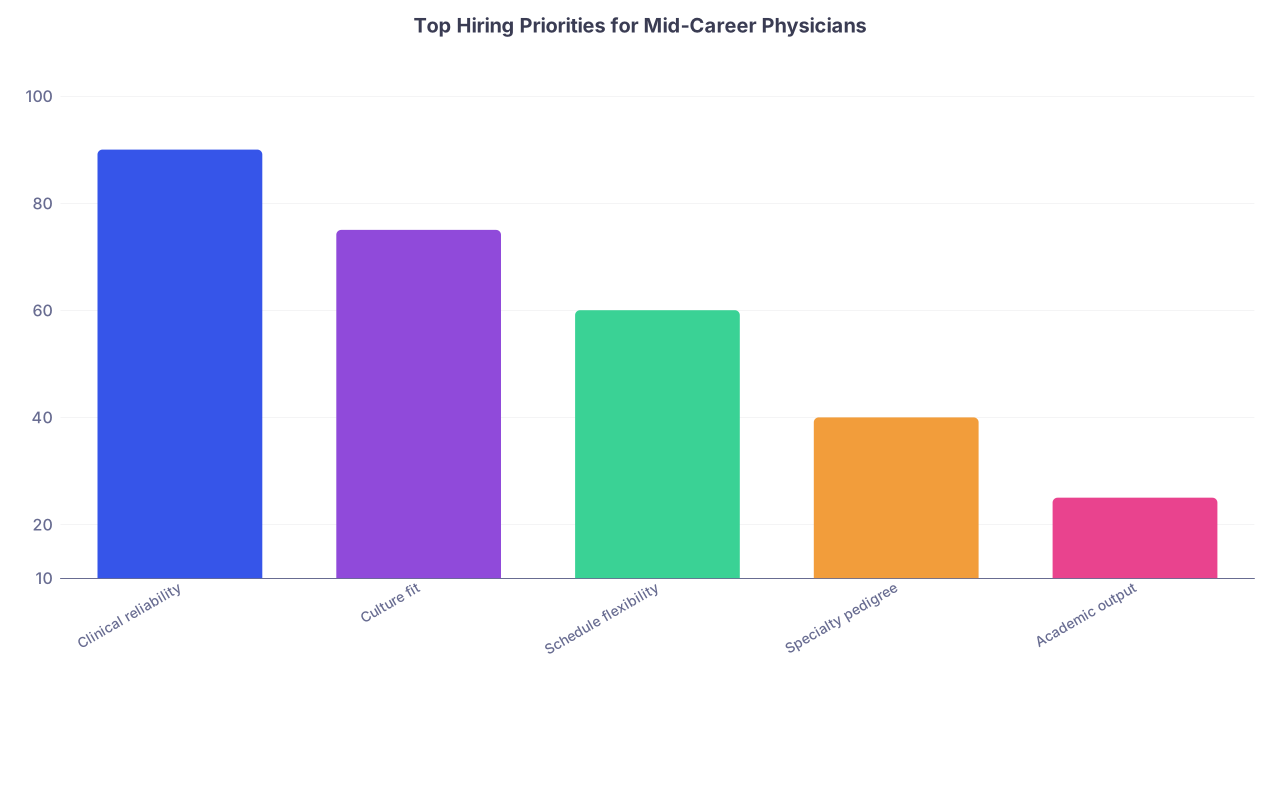
| Category | Value |
|---|---|
| Clinical reliability | 90 |
| Culture fit | 75 |
| Schedule flexibility | 60 |
| Specialty pedigree | 40 |
| Academic output | 25 |
Translation:
- If you show up on time, are not a diva, and handle a reasonable workload safely, you’re already ahead.
- A glowing reputation from your last few jobs beats the name of your residency.
- They want people who will fill their actual need:
- Night coverage
- SNF rounding
- Rural ED
- Tele coverage nobody else wants
When you’re changing direction, you must make it obvious how you solve their problem, not just how miserable you are in your current specialty.
Step-by-Step Decision Flow: What You Should Do Next
Here’s the condensed version of “If you’re in this situation, here’s what to do.”

| Step | Description |
|---|---|
| Step 1 | Unhappy in current specialty |
| Step 2 | Targeted job change in same specialty |
| Step 3 | Explore second residency or major fellowship |
| Step 4 | Subspecialty or niche focus |
| Step 5 | Plan partial/complete exit |
| Step 6 | Use locums and networking |
| Step 7 | Talk to PDs and assess feasibility |
| Step 8 | Nonclinical networking and skill mapping |
| Step 9 | Hate medicine or just this job? |
| Step 10 | Totally different work or adjacent? |
If you just hate your current job
Your next steps in the next 3 months should be:
- Update CV emphasizing what you actually like doing.
- Email recruiters with specific constraints: “Hospitalist, no nights, suburban Midwest, 15–18 encounters/day target.”
- Line up 1–2 locums stints to compare environments before signing anything long-term.
If the core work feels wrong but you still like medicine
Next 3–6 months:
- Shadow or moonlight in the target specialty/niche.
- Meet at least two leaders (PDs or department heads) in that area.
- Decide: fellowship vs second residency vs niche job change.
If you’re honestly done with clinical
Next 6–12 months:
- Cut back to sustainable FTE clinically if possible (0.6–0.8).
- Start structured nonclinical job search: 2–3 informational interviews/week.
- Take one concrete skill step (certificate, short course, side role) that moves you toward pharma/tech/admin/whatever you picked.
Common Specialty-Switch Scenarios (And What Actually Works)
Scenario 1: EM doc, 7–10 years out, totally fried
You say: “I can’t do this for 20 more years. I want out of EM.”
What usually works:
- Move first to lower acuity EM or urgent care with fewer nights.
- Layer in telemedicine to offload some shifts.
- Start exploring nonclinical: utilization review, telehealth medical director, health tech roles.
Second residency? Rarely necessary. Your EM skills are flexible. Use them.
Scenario 2: IM hospitalist wants more procedures, more acute care
You say: “I love the ICU and procedures, hate clinic, and rounding-only life is wearing me out.”
Options:
- Critical care fellowship (if your training pathway allows it)
- Strategically find a hospitalist job with open ICU + procedures and maybe step into a “hybrid intensivist” role over a few years
- Certain anesthesia/crit care or EM/crit care hybrids—depends on board rules
Don’t jump to a second residency without exploring crit care or procedural niches first.
Scenario 3: FM doc tired of 20+ patients/day, chronic disease grind
You say: “I still like patients. I just can’t do treadmill primary care.”
Likely moves:
- Sports medicine fellowship, palliative, geriatrics, or addiction
- Direct primary care / concierge practice (low volume, cash-based)
- Occupational medicine, corporate health, student health
You almost never need a full new residency here. You need a smarter job and maybe a 1-year fellowship.
Quick Reality Map: How “Hard” Is Your Desired Move?
| Move Type | Difficulty | Typical Time to Execute |
|---|---|---|
| Same specialty, new employer | Low | 3–9 months |
| Same specialty, different practice style | Low-Med | 3–12 months |
| Subspecialty fellowship pivot | Medium | 1–4 years |
| Exit to nonclinical with partial overlap | Medium | 1–3 years |
| Second residency, competitive field | High | 4–8 years |
This is why you don’t lead with “second residency” unless you’re absolutely sure.
FAQs
1. Is it “too late” to switch specialties if I’m 40+?
No, it’s not “too late.” But the cost-benefit changes. A second residency starting at 42 with three kids is very different from a pivot at 32. Over 40, I usually tell people:
- Max out what you can do within your current training first (niche jobs, subspecialty-like roles).
- If you still want a radical change, look at fellowships or nonclinical paths before a new residency.
2. Will a second residency hurt me financially forever?
Not necessarily, but it will hit hard for a few years. If your new specialty pays significantly more or lets you work longer without burning out, you may come out ahead in total lifetime income. If the second specialty pays the same or less and you delay attending-level income another 3–5 years, yes, that may be a permanent financial hit. You need to model this with rough numbers, not vibes.
3. How do I explain a big specialty change in interviews without sounding flaky?
You tell a coherent story anchored in specific exposures:
“I realized during X and Y rotations that the parts of medicine that energize me are A and B. I tried to shape my current job around that by doing C and D, but the core work of [current specialty] still doesn’t align. Over the past 2 years I’ve done E and F to confirm that [new specialty] is the right long-term fit.”
No “I just burned out” as the headline. Burnout can be part of the story, but the main narrative must be about fit and what you’ve done to confirm it.
4. Can I work in another specialty without formal retraining if there’s a shortage?
You’ll see rumors: IMs working in EDs, FM covering inpatient, etc. In reality, this is heavily dependent on local laws, hospital bylaws, and malpractice carriers. Sometimes rural or critical access hospitals will stretch roles in a shortage, but this is not a stable, long-term plan and can be risky. If you want sustainable work in another specialty, aim for formal credentialing (fellowship, additional training, or defined job structures like “hospitalist in open ICU with intensivist backup”).
5. How far in advance should I start planning a big pivot?
For small pivots (new employer, slightly different role), 6–12 months is enough. For major changes (fellowship, second residency, nonclinical transition), you should be thinking 2–3 years ahead. That gives you time to build experience, clean up your CV, build references, and stabilize your personal finances so you are not making desperate decisions.
Key takeaways:
- Don’t jump straight to “I need a second residency” when a smarter job or subspecialty pivot could fix 90% of your problem.
- Every pathway—second residency, fellowship, niche clinical job, nonclinical work—has a real, concrete playbook. Follow it on purpose, not emotionally.
- Talk to people already doing the job you think you want, then move one step at a time: stabilize your income, narrow your target, and execute with a clear story of where you’re going and why.


