
The idea that “you start rural, then move to your real job later” is wrong for a lot of physicians—and dangerously simplistic for the rest.
Rural practice is not automatically a stepping stone. For many people it becomes the final destination, for some it’s a career trap, and for a minority it’s actually a launchpad. Which of those buckets you fall into has much less to do with your intentions and much more to do with specialty, visa status, contract terms, and actual workforce data.
Let’s tear apart the pretty story recruiters tell you and look at what actually happens.
The Myth: “Just Do Rural for a Few Years”
The script is familiar:
- “Take this rural job for 2–3 years, pay off your loans, then you can move back to the city.”
- “Programs love to see rural experience.”
- “It’ll be easy to come back once you’ve got ‘real-world’ time under your belt.”
I’ve heard that speech verbatim from recruiters in family medicine, hospitalist gigs, and even some surgical positions. It sounds logical. The problem is, the numbers and actual career trajectories don’t back it up as a universal truth.
There are at least four distinct realities hiding under that myth:
- For some, rural really does become permanent—even when they never planned that.
- For many, the “easy move back” is a lot harder and slower than advertised.
- For certain specialists, rural can actually weaken your competitiveness over time.
- For a specific subset (especially in primary care), a well-chosen rural job can be a strong springboard—if you know what you’re doing.
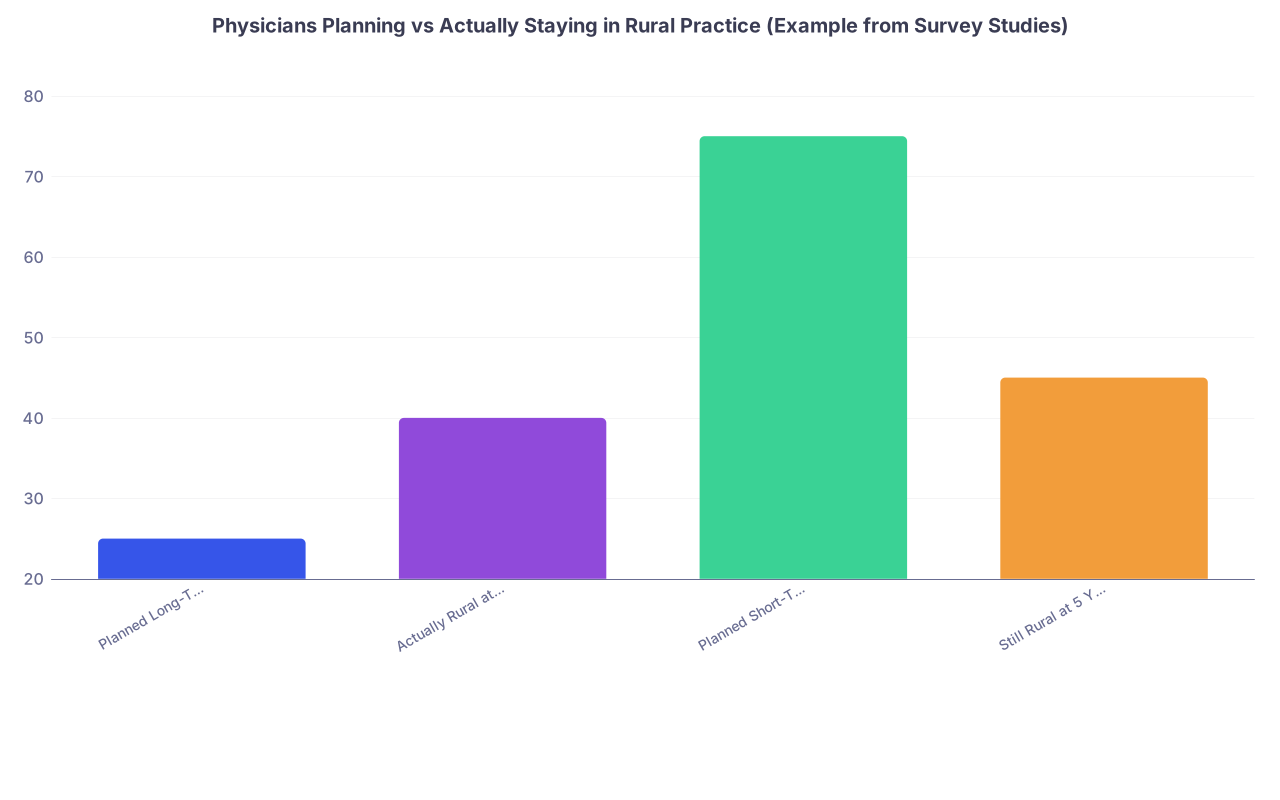
Let’s quantify this a bit.
| Category | Value |
|---|---|
| Planned Long-Term Rural | 25 |
| Actually Rural at 5 Years | 40 |
| Planned Short-Term Rural | 75 |
| Still Rural at 5 Years | 45 |
Across several workforce studies in the US, Canada, and Australia, a consistent pattern shows up: a sizeable fraction of people who intended to do short-term rural work are still rural 5+ years later. Not because they fell in love with it. Sometimes because the “temporary” gig quietly became their only practical option.
What the Evidence Actually Shows About Rural Retention
Let’s talk facts, not brochure language.
Different studies have different numbers, but the patterns are surprisingly stable:
- Rural retention at 5 years is often above 40–50% for physicians who start rural after training.
- People with a rural upbringing are much more likely to stay long-term.
- IMGs on visas and physicians with large loan-repayment obligations have the lowest mobility.
Here’s a simplified comparison based on typical patterns from US and Australian data (rounded to keep it readable, not to pass peer review):
| Group | Still in Rural Practice at ~5 Years |
|---|---|
| Rural-origin primary care | 60–70% |
| Urban-origin primary care | 35–50% |
| Hospitalists (US) | 40–55% |
| Specialists (surgery, OB, etc.) | 30–45% |
| IMGs on visa waivers | 50–70% |
So no, rural practice is not inherently “just a stepping stone” for the majority. A lot of people stay—sometimes because they want to, sometimes because their exit ramps are narrower than they expected.
And here’s the more uncomfortable truth: the more constraints you have (visa, debt, niche specialty, family considerations), the less “stepping stone” and the more “path dependency” you get.
Once you spend 3–5 years in a rural generalist-style role, some urban groups do not see that as neutral experience. They see it as a signal: lower-volume procedures, less subspecialty exposure, fewer academic ties. Fair or not, it happens.
When Rural Practice Becomes a Career Trap
Let me be blunt: the biggest myths are pushed hardest at the most vulnerable physicians—new grads, IMGs, and those under financial or immigration pressure.
1. Visa-dependent physicians (J‑1, H‑1B)
If you’re on a J‑1 waiver or similar, “I’ll just do three years rural then move” is not a plan. It’s wishful thinking unless you’ve already mapped out the second job.
Common traps I’ve seen:
- You do 3 years in a county hospital no one has heard of.
- You’re working broad-scope IM, FM, or hospitalist with minimal subspecialty collaboration.
- When you apply to a competitive urban system later, they quietly prefer someone coming straight out of residency or from a known institution.
Are there success stories? Yes. The ones that work usually share traits:
- The rural job maintains robust ties with a regional or academic center.
- You keep up to date with guideline-level care, procedures, and CME.
- You actively network—conferences, virtual tumor boards, specialty collaborations.
But if your rural hospital is essentially an isolated “do everything yourself” outpost with aging equipment and no structured CME, your transition back becomes harder the longer you stay.
2. Procedural and surgical specialties
Here’s where the “stepping stone” narrative is flat-out dangerous.
If you’re a:
- General surgeon
- OB/GYN
- Orthopedic surgeon
- Cardiologist / interventionalist
- GI doing advanced procedures
Volume matters. Case mix matters. Technology matters.
I’ve seen surgeons sell themselves this story: “I’ll start in a rural critical access hospital, build up my experience, and then I’ll move to a big center.”
What often happens instead:
- You do a ton of bread-and-butter cases, but almost no complex ones.
- Your case logs look “broad but basic” compared with subspecialists in big centers.
- When you apply back to urban jobs, you’re competing against people with newer fellowship training and more recent exposure to complex cases and tech.
If you’re in a high-tech, rapidly advancing field (structural heart, advanced endoscopy, minimally invasive gyn, etc.), being parked in a low-volume, low-tech environment for 5 years is not a stepping stone. It’s a career freeze.
When Rural Jobs Really Can Be Strategic
Let’s not swing to the opposite extreme. Rural can absolutely be a smart move for some physicians—if you stop believing the generic sales pitch and start being specific.
Three situations where rural practice genuinely functions as a stepping stone:
1. Primary care with clear financial and timeline boundaries
Family medicine and general internal medicine are where rural can shine—if you treat the contract like a serious business decision, not a vague “I’ll see how it goes.”
What works:
- Defined time horizon: “I am here for 3 years, max 4.”
- Aggressive use of loan repayment (NHSC, state programs, hospital repayment) with clear milestones.
- Absolute clarity about buy-out clauses, non-competes, and tail coverage.
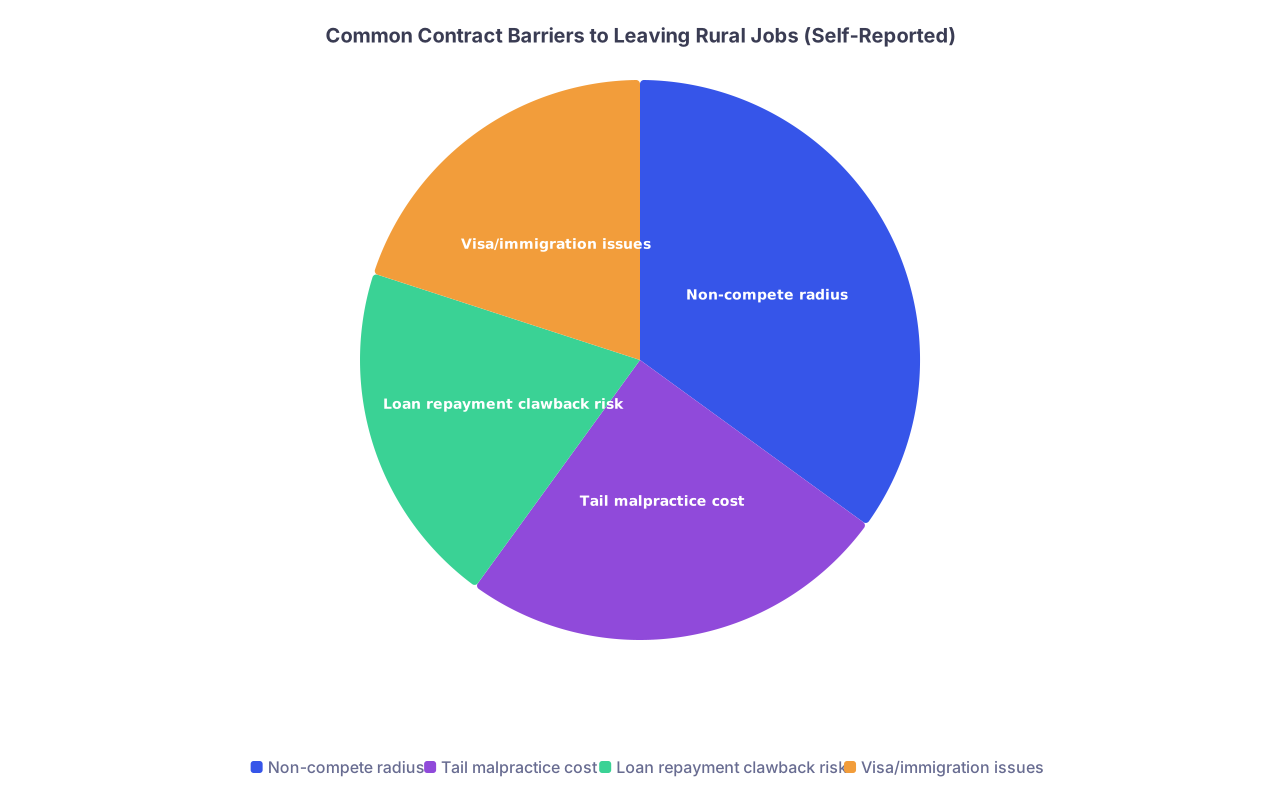
You’d be surprised how many people never read the non-compete carefully, then discover they cannot work within 50–100 miles of their “temporary” town without sitting out or paying a painful buy-out. That alone can block the “easy move” narrative.
| Category | Value |
|---|---|
| Non-compete radius | 35 |
| Tail malpractice cost | 25 |
| Loan repayment clawback risk | 20 |
| Visa/immigration issues | 20 |
If your goal is debt attack + experience, rural FM/IM can absolutely be a strong first move—provided your contract allows you to walk away clean and your clinical work keeps you aligned with the kind of job you want later (chronic disease management, outpatient continuity, maybe some inpatient if you want hospitalist work).
2. Building leadership and admin experience
Small hospitals and rural systems are desperate for people willing to take on leadership:
- Medical director
- ED director
- Chief of staff
- Quality improvement lead
- EHR or clinical operations roles
These roles are much harder to get straight out of residency in a big urban system where the hierarchy is already stacked. In rural environments, you can genuinely become the go-to person for system-level work in your early 30s.
That can translate later into:
- System-level jobs in larger health organizations
- Medical director roles in insurance, quality organizations, or telehealth companies
- Non-clinical transitions (CMO-track, quality leadership, etc.)
But only if you actually get the titles, document outcomes (readmission reduction, throughput improvements, protocol changes), and stay connected to people outside your little bubble.
3. Future academic or teaching focus—with a plan
No, “I worked rural” doesn’t magically make you more desirable to every academic program. But it can be very attractive if you:
- Choose a rural site that’s a teaching affiliate (students, residents, NP/PA learners).
- Build a clear niche: rural health, addiction, chronic disease management, telemedicine, or quality improvement.
- Actually produce something: a QI project, a poster, a small study, or a rural-health-related initiative.
Academic departments care about:
- What you can teach
- What you can lead
- How you fit their strategic goals (population health, rural outreach, underserved care)
Random rural experience with no narrative is just that: random. Structured rural experience tied to a coherent professional story can absolutely be a recruiting asset.
The Lifestyle and Family Reality No One Puts in the Brochure
One more piece people gloss over: once you move your life to a rural area, the “we’ll just pick up and go back later” story stops being just about you.
Things that quietly anchor people:
- Spouse/partner finds the only reasonable job in a 60-mile radius and doesn’t want to restart from zero.
- Kids are happy in smaller schools, sports teams, and stable social circles.
- Cost of living is low and the idea of a $3,000 urban rent bill is… unappealing.
- You get accustomed to short commutes, low crime, and knowing your patients in the grocery store.
That can be good or bad. For some it’s exactly what they want. For others it becomes an uncomfortable trade: better professional options in the city versus a calmer family life in the small town. But it’s not neutral, and it isn’t easily reversible.
How to Decide if Rural Is a Stepping Stone For You
Ignore the generic advice. Here’s the more honest decision tree.

| Step | Description |
|---|---|
| Step 1 | New attending considering rural job |
| Step 2 | Potentially good stepping stone |
| Step 3 | High risk of getting stuck |
| Step 4 | Can be strategic but needs careful vetting |
| Step 5 | Bad idea as stepping stone |
| Step 6 | Plan must include immigration and debt details |
| Step 7 | Focus on long term fit and family priorities |
| Step 8 | Specialty mainly outpatient primary care |
| Step 9 | Clear 3 to 5 year plan and contract exit |
| Step 10 | Procedural or surgical field |
| Step 11 | Will you maintain case volume and tech level |
| Step 12 | Visa or big loan constraints |
Ask yourself:
- Is my specialty one where volume/complexity and tech matter for future jobs?
- Does this specific rural job maintain my competitiveness or erode it?
- Do I have real contractual exit options (non-compete, tail, loan clawback, visa)?
- Can I tell a coherent future story using this job (leadership, rural health niche, teaching, QI)?
If you cannot answer those in detail, it’s not a “stepping stone.” It’s a coin flip with your career.
The Bottom Line: Rural Practice Is a Path, Not a Pause Button
Let’s kill the comforting lie:
Rural practice is not automatically a short-term, low-risk trial. It shapes your skillset, your CV, your family life, and your future options—sometimes irreversibly.
Three takeaways to keep straight:
- Rural jobs can be excellent if you treat them as a deliberate career move with clear exit ramps—not a vague holding pattern you’ll “figure out later.”
- For many physicians—especially on visas, in procedural specialties, or with restrictive contracts—rural practice is more likely to be a long-term trajectory than a tidy stepping stone.
- The people who truly use rural work as a launchpad are the ones who choose the right site, guard their clinical relevance, engineer leadership/teaching opportunities, and keep their next move in sharp focus from day one.
Romantic narratives aside, rural practice is neither saintly sacrifice nor guaranteed shortcut. It is just another part of the job market—with its own power dynamics, traps, and opportunities. Treat it that way.