The way “physician shortage” gets thrown around in headlines is misleading bordering on dishonest. Yes, there are shortages. But they’re not where and what you think—and they’re not the reason some new doctors are stuck under‑employed or unemployed after residency.
Let me be blunt: you can absolutely finish residency today and fail to land a tolerable job for months. Or only get offers for RVU sweatshops you’d be stupid to sign. That reality coexists with “we’re short 40,000 physicians” press releases. Both are true. Because the job market isn’t one big national pool. It’s a patchwork of micro‑markets, perverse incentives, and geography problems.
Let’s pull this apart like adults instead of PR departments.
The “Physician Shortage” Numbers Are Not What You Think
When people quote huge shortage numbers, they’re usually citing AAMC or similar workforce projections. Those models have assumptions baked in that would never pass a decent journal club.
Common issues:
- They count any unmet demand as “shortage,” even if no payer will actually reimburse for it.
- They assume current care models, not realistic changes in team-based care, technology, or productivity.
- They rarely confront the reality that Medicare, Medicaid, and insurers simply won’t pay for the level of coverage they’re implying.
Even with those flaws, the data are still useful—if you read them like a skeptic.
Here’s what they actually show:
- Strong demand for:
- Primary care in rural and some underserved urban areas
- Certain cognitive specialties in under-resourced regions
- Hospitalist and ED coverage in less desirable locations
- Tight or saturated markets for:
- Competitive specialties in desirable metros (derm, optho, ortho, plastics, rad onc, some subspecialties)
- Academic positions in big-name systems
- Lifestyle-heavy, part-time, or mostly-telemedicine roles in top cities
In other words: we’re not “short physicians” in some simple, unified way. We’re short physicians willing to work under current pay/conditions in certain locations and practice models.
That nuance matters a lot when you’re a PGY-3 or PGY-6 trying to understand why your job search feels like uphill mud.
Why New Docs Still Struggle: Micro-Markets, Not Macro-Shortages
I’ve watched residents in the same graduating class have completely different realities:
- One hospitalist resident signs an offer in September of their final year with a community group three hours away from any major airport—200k base plus RVU. They get a signing bonus and relocation.
- Another in the same class, same program, wants to be a hospitalist in a coastal metro with good schools and short commute. Six months out and they’re still chasing leads, getting lowball offers, or being told, “We’re not hiring this year.”
Both are “in demand” on paper. One actually is. The other is in a hyper-competitive local market where every burned-out doc from three states wants to move.
The job market is fragmented by three main axes:
- Geography
- Specialty and subspecialty
- Employment model and lifestyle
If you want to understand your real prospects, those three matter more than any national “shortage” headline.
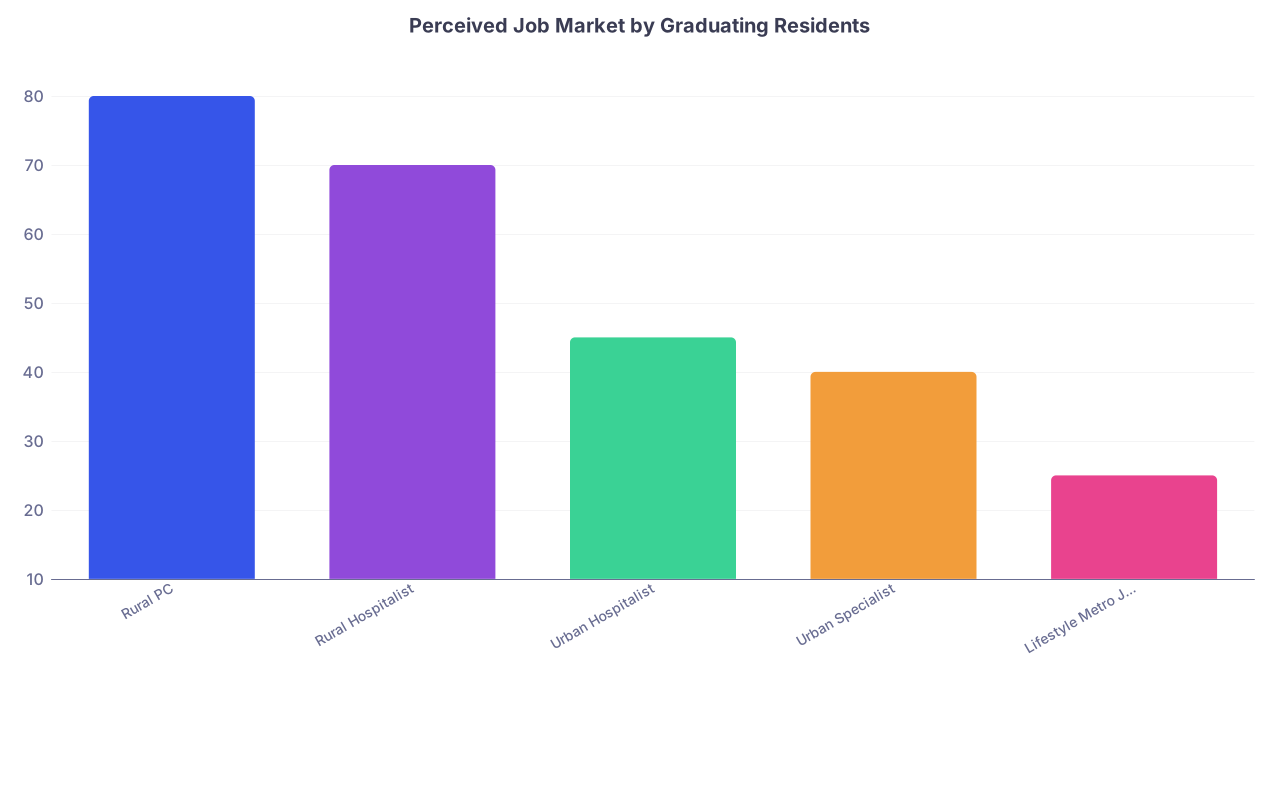
| Category | Value |
|---|---|
| Rural PC | 80 |
| Rural Hospitalist | 70 |
| Urban Hospitalist | 45 |
| Urban Specialist | 40 |
| Lifestyle Metro Jobs | 25 |
(Pretend those numbers reflect the percentage of grads who say “I had multiple good offers in that category.” They track disturbingly close to reality.)
Geography: The Job Market’s First Gatekeeper
Here’s the part no one likes to say out loud: the “shortage” is often 80 miles away from where you want to live.
Urban and suburban, “good school district,” safe, coastal, large academic center, spouse with a career… combine those, and you’re not in shortage-land. You’re in oversupply-land.
Common patterns I’ve seen:
- Rural and exurban: Primary care, hospitalist, EM, anesthesia, general surgery, psych—often multiple open positions. They’ll call you back. They’ll negotiate.
- Mid-size cities (especially non-coastal): Mixed. Usually solid options in hospital medicine, primary care, and several specialties, but less abundant in super niche subspecialties.
- Top metros (Boston, SF Bay, NYC, Seattle, San Diego, Denver, Austin, etc.): Totally different world. High competition for stable, decently paid, reasonably scheduled jobs. Systems can be picky because they have a line of applicants.
This is why you’ll hear a family medicine resident in a Midwestern program say, “I signed an offer after two interviews,” while another in LA is complaining, “All the outpatient jobs are 15-min visits with insane panel sizes and 190k base.”
Same specialty. Different geography. Very different power dynamics.
Specialty Mismatch: Shortages in the Wrong Places, Surpluses in the Hot Ones
Let’s walk through the broad categories.
Primary Care (FM, IM, some Med-Peds)
Real shortages—but heavily location-dependent.- Community/rural systems often desperate. Loan repayment, signing bonuses, flexible schedules are on the table.
- Affluent suburbs and big academic centers? Suddenly it’s “We’d like 2+ years experience” and “We’re not expanding this year.”
Hospitalist Medicine
Everyone was told: “Hospitalist jobs are everywhere.” That was true. Then:- Systems learned they could push RVUs, nights, cross-coverage, and still fill spots.
- Desirable locations now have plenty of applicants; less-desirable locations still recruit aggressively. So yes, there are hospitalist jobs. The question is: are there hospitalist jobs you actually want.
Procedural Specialties (ortho, GI, cards, anesthesia, etc.)
Mostly okay nationally, but:- New grads in popular metros may find that the only thing open is 100% call, low partnership track, or weak pay.
- Private groups have become more conservative after years of consolidation and private equity churn. They’re not hiring “just in case” like they did a decade ago.
Overproduced / Vulnerable Specialties (rad onc, some fellowship-heavy niches)
These are where the word “shortage” becomes almost offensive. In some of these fields, we have:- Fellowship programs still pumping out graduates
- Flat or decreasing demand due to tech changes, practice consolidation, or guidelines
- Graduates moving states just to find one minimally acceptable job
If you’re in a specialty that’s already tight, and you’re aiming only at saturated metros, your problem is not the “myth” of shortage; it’s the reality of oversupply for your exact niche in your exact location band.

The Employer Side: Why They Act Like There’s No Shortage
If there’s a massive shortage, why do hospital HR departments act like they’re doing you a favor just to email you back?
Because they don’t feel the shortage the way you think.
Several forces change their behavior:
Payer Pressure and Margins
Hospitals and groups live and die on reimbursement rates and payer mix. If 60% of their patients are Medicare/Medicaid, they’re not going to expand physician headcount just because there’s community “need.” They’ll staff to what the spreadsheet says they can afford, not to what the population actually requires.NP/PA Substitution
Whether you like it or not, many systems address “shortage” by hiring more advanced practice providers and fewer physicians. So the community may lack adequate physician-level care, but from the CFO’s perspective, they’ve “covered the service line.”Consolidation and Corporate Medicine
The old model—small and mid-size groups hiring partners-in-training—has been crushed in many regions by hospital buyouts and private equity. Large employers:- Can afford to be picky
- Standardize comp at “market minimum” locally
- Slow-walk hiring because administrators don’t feel the clinical pain the way frontline docs do
Risk Aversion to New Grads
I’ve heard this directly from medical directors: “We prefer someone with 2–3 years post-training experience; less onboarding, fewer surprises.”
When they have a stack of CVs, the new grad gets pushed down even if there’s a “shortage” in the region.
So yes, the community may desperately need faster access, more specialists, and better coverage. But the entity you’re applying to—the one that actually writes paychecks—is not in the business of solving public health; it’s in the business of not going broke under current reimbursement.
Training Pipelines and the Fellowship Trap
Another reason new physicians struggle is that the pipeline is misaligned with the real market.
We have:
- Med schools expanding classes
- GME bottlenecked by Medicare cap (slowly loosening, but still)
- Fellowships proliferating in some oversupplied niches because departments like cheap labor and academic prestige
The result is an almost predictable pattern:
- Residents are told: “Everyone sub-specializes now; general X is dead, you need a fellowship.”
- They subspecialize into something very narrow.
- On graduation: “Oh, jobs are tight in pure [niche], but we need you to also do general [base specialty], take heavy call, and accept starter-level pay.”
I’ve watched cardiology subspecialists who trained at big-name centers realize, late in the game, that real jobs in just their favorite niche (say, EP in a major metro with 1:5 call) are scarce. Cue the scramble, the cross-state moves, the long commutes.
The shortage discourse rarely mentions this structural insanity.
| Category | New Grads vs Jobs (desirable locations) |
|---|---|
| Rural Primary Care | Jobs > Grads |
| Urban Primary Care | Roughly Balanced |
| Hospitalist (metros) | Grads ≥ Jobs |
| Competitive Subspec | Grads > Good Jobs |
| Academic Positions | Grads >> Jobs |
Visa, Contracts, and Other Non-Clinical Landmines
For many international medical graduates (IMGs), the “shortage” rhetoric is especially hollow.
Real-world barriers:
- Visa restrictions: Some employers simply will not touch H-1B or J-1 waivers, even in “shortage” areas, because they don’t want the legal/administrative hassle.
- Contract games: “Partnership track” that’s basically a mirage, non-competes that lock you out of an entire region, call expectations that were never mentioned until the final draft.
- Insane productivity expectations: Outpatient panels 2,200+, hospitalist targets that are unsafe, all wrapped in “this is standard in our market.”
New docs are often desperate enough to accept bad terms. Then, a year or two later, they’re back on the market—burned out, geographically tied down, and facing an even narrower set of options.
So no, you are not crazy if you feel like the cheerful “doctor shortage” narrative doesn’t match what you’re experiencing when 3 out of 5 recruiters ghost you.

| Step | Description |
|---|---|
| Step 1 | Finishing Residency |
| Step 2 | Define Location Limits |
| Step 3 | Filter by Specialty Demand |
| Step 4 | Send Applications |
| Step 5 | Interview Offers |
| Step 6 | Acceptable Contracts |
| Step 7 | Signed Job |
| Step 8 | Ghosted or No Response |
| Step 9 | Terrible Offers |
What Actually Helps: Matching Reality, Not Myths
You cannot fix systemic workforce planning as a graduating resident. You can, however, avoid being collateral damage.
Concrete, data-aligned moves I’ve seen help:
Treat location like a lever, not a fixed identity.
Every mile you’re willing to expand from a top metro meaningfully improves your odds of a good job. A 60–90 minute radius is often the difference between “no offers” and “three decent ones.”Get very specific on what’s a deal-breaker vs preference.
Is it:- No more than 1:4 weekends?
- Base salary floor?
- Must-have for spouse’s job or kids’ school?
If everything is a must, you’ve basically chosen to operate in a pseudo-oversupply market.
Network like a grown-up, not a student.
The jobs you want often never hit the major job boards. They’re:- “Our senior partner is quietly retiring next year; know anyone?”
- “We’re thinking about expanding to a second site if we can find the right person.”
That intel comes from mentors, alumni, conferences, and straight-up cold outreach to groups in your target areas.
Understand the real comp landscape.
MGMA numbers get abused. “Median” for one region and one practice type is not a universal benchmark. Talk to multiple recent grads in your specialty and state.
Once you understand the real range, you recognize when a “shortage” employer is still lowballing you.Have a Plan B that isn’t panic.
For some, that’s:- Locums for 6–12 months in less desirable areas
- Short-term hospitalist work while looking for the right subspecialty fit
- Extra procedural or skill development that makes you more marketable next cycle
Not glamorous, but it beats signing a five-year non-compete you’ll regret in month three.
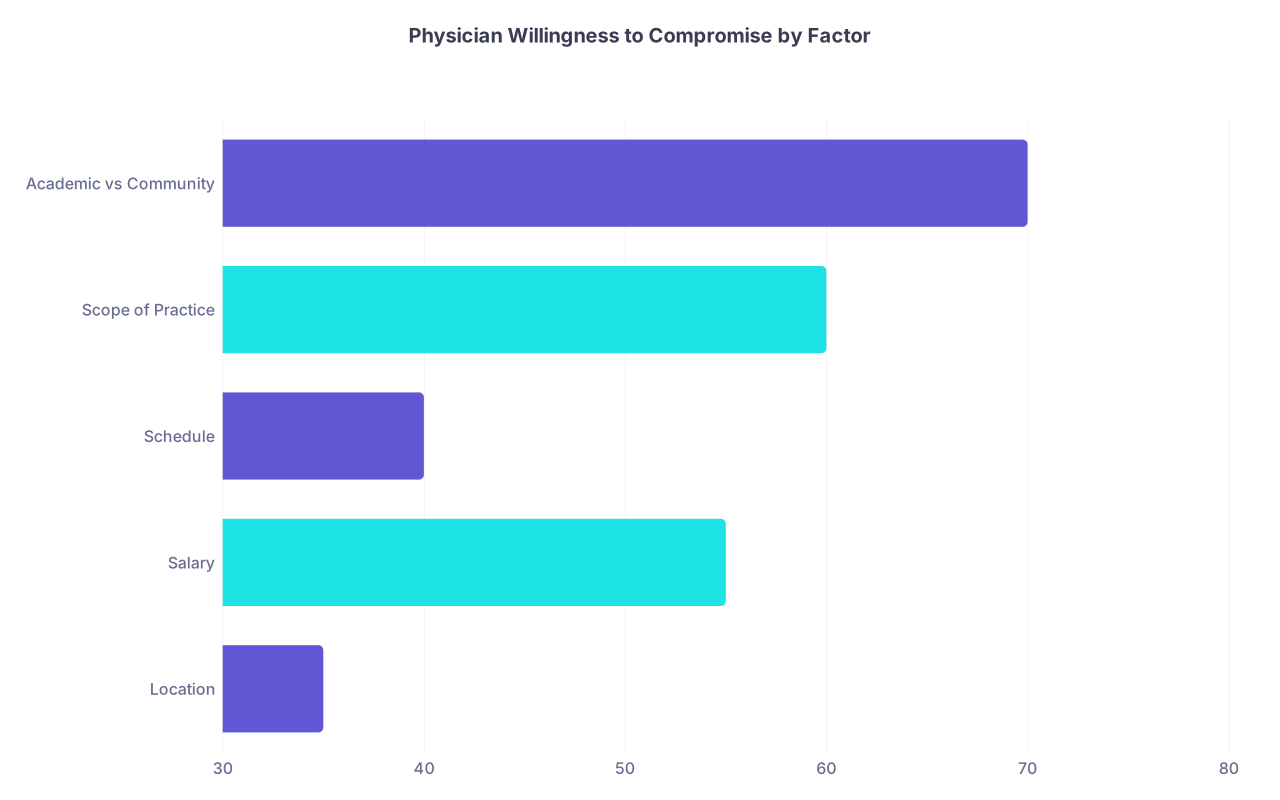
| Category | Value |
|---|---|
| Location | 35 |
| Salary | 55 |
| Schedule | 40 |
| Scope of Practice | 60 |
| Academic vs Community | 70 |
The Real Myth
The real myth isn’t just “there’s a physician shortage.” The real myth is:
“Because there’s a physician shortage, any competent new doctor will easily find a good job where they want, how they want, on their terms.”
That’s fantasy.
The truth looks more like this:
- We have maldistribution, not simple shortage.
- We have payment constraints and corporate strategies, not blank checks to hire everyone we “need.”
- We have training pipelines that crank out over-subspecialized grads for glamorous niches that do not exist in the numbers advertised.
- We have physician job seekers who were sold a story that doesn’t match the current labor market.
If you’re post-residency and struggling, it is not because you are a bad physician. It’s because you are playing a rigged game with a marketing brochure as your rulebook.
Stop reading headlines about national shortages. Start studying your actual micro-market: your specialty, your region, your acceptable range of practice models.
That’s where the truth lives.