The belief that “hospital-employed jobs are safer for new doctors” is mostly wrong. Not entirely. But mostly.
The safety you think you’re buying—job security, predictable income, less risk—is a lot more illusion than reality once you look at contracts, revenue data, and what actually happens in real markets when margins get tight.
Let’s dissect the myth, then walk through what the data and real-world patterns actually show.
The Core Myth: Employment = Safety, Private Practice = Risk
The standard narrative on the interview trail sounds like this:
- “I’m just going to take a hospital-employed job for a few years. It’s safer.”
- “Private practice is too risky now. Reimbursements are falling, overhead is brutal.”
- “Hospitals don’t fire doctors. Worst case, they just move you around.”
This story was sort of defensible 15–20 years ago when employed positions were heavily subsidized and used as loss-leaders to capture downstream revenue (imaging, surgery, admissions).
But health systems have changed. They now run physicians as P&L lines, not as strategic loss centers. If your compensation and support costs outstrip the revenue you bring in for too long, you are not “safe.” You are a problem line item.
Let me show you how that actually plays out.
What The Numbers Say About “Security”
First, some context. Over the last decade:
- Most new grads are now employed by hospitals/health systems or large groups.
- Private practice ownership among physicians has dropped below 50% in many specialties.
- Consolidation has accelerated; more doctors in bigger systems, fewer in small independent groups.
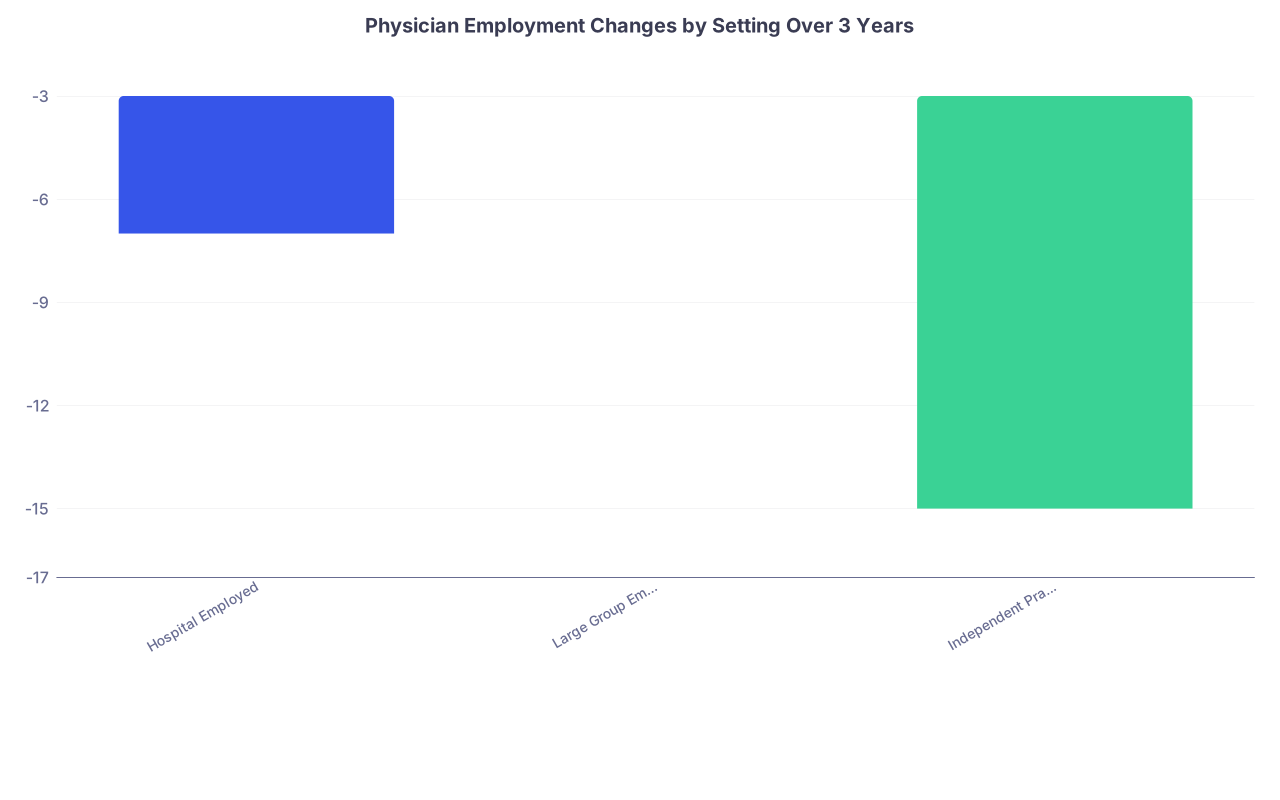
Now layer in what’s happening inside those systems:
| Category | Value |
|---|---|
| Hospital Employed | -7 |
| Large Group Employed | -3 |
| Independent Practice | -15 |
Rough interpretation of patterns from workforce and health economics reports (exact numbers vary by dataset and region, but the direction is consistent):
- Hospital-employed physicians see contract restructuring, productivity ratcheting, and “non-renewals” grow when hospital margins tighten.
- Independent practices see more closures and forced mergers.
- Large multispecialty or mega-groups sit in the middle—less exposed than solo practices, less political than hospitals.
The key point: employment doesn’t magically eliminate risk. It changes the type of risk:
- Independent practice: higher financial/overhead risk, more autonomy.
- Hospital employment: higher political and structural risk, less control.
You’re trading market risk for corporate risk. That’s all.
How Hospital Contracts Quietly Shift Risk Onto You
Here’s where the myth really falls apart: the actual contract terms.
Most “safe” hospital jobs for new grads have three pillars:
- A base salary (often “guaranteed” for 1–3 years)
- RVU or productivity component (either immediately or after the guarantee)
- Lots of language that lets the hospital walk away cleanly
Read enough contracts and a pattern emerges: the risk is still there; it’s just been hidden in fine print and future phases.
The RVU Trap
The classic pitch:
“We’ll give you a guaranteed base for two years so you can build your panel, then you transition to RVU-based comp like everyone else. Totally standard.”
What actually happens in many markets:
| Year | Base Salary | RVU Target/year | Penalty for Missing Target |
|---|---|---|---|
| 1 | $275,000 | 4,500 | None (guaranteed) |
| 2 | $275,000 | 5,000 | None (guaranteed) |
| 3 | $240,000 | 6,000 | Reduced bonus / warnings |
| 4+ | $210,000 | 7,000 | Base reduction / non-renewal |
The guarantee period is sold as “security.” In reality, it’s a teaser rate.
By the time you switch to strict RVU comp:
- Your panel may still not be full (especially in saturated or mismanaged markets)
- Call burden and admin work have increased
- Support staff may have been “optimized” (meaning fewer MAs, less help)
- The hospital has data on your productivity and can claim “misalignment” if you don’t hit targets
So the “safe” job for a new doctor becomes: hit ever-rising metrics in a system you don’t control, or watch your comp and leverage evaporate.
Non-Renewal: The Clean Exit (For Them)
Another quiet piece of risk reallocation: the non-renewal clause.
Typical language:
- 1–3 year initial term
- Automatically renews yearly
- Either party can choose non-renewal with 60–180 days’ notice
- No cause required
Translation: you are not “permanent.” You’re on a rolling audition.
You will not see “we reserve the right to quietly non-renew you if your service line underperforms, we change strategic direction, or we decide to replace you with someone cheaper” written in the contract. But that’s exactly how it functions in practice.
I’ve watched this happen:
- Hospital builds out a cardiology group, hires aggressively, overestimates volume.
- Two years later, volumes are flat, margins are bad.
- The lowest producing or politically weakest cardiologists are told, “We’re not renewing your contract.” Not “fired,” technically. Just… done here.
That’s your “safe” employed job.
The Real Job Security: Control vs Dependence
You’ll notice something if you talk to docs in both settings across 5–10 years out of training:
Independent practice physicians:
- Worry more about payer mix, rent, staff costs
- Often have lower income early, higher upside later
- Rarely “laid off” in the traditional sense; if they fail, it’s a slow bleed, not a pink slip
- Have real control over their schedule, referrals, and cost structure (within payer limits)
Hospital-employed physicians:
- Worry more about RVU quotas, service line priorities, and admin politics
- Get more predictable checks early, compressed comp after “stabilization”
- Face real risk of non-renewal, forced practice moves, or mergers
- Have very little control over staffing, scheduling, or system decisions
Neither is “safe.” They are different games.
But for new grads, here’s the part no one tells you clearly: long-term security usually comes from leverage—your skills, your patient base, your portability—not from the hospital logo on your badge.
Where Hospital Employment Is Relatively Safer
I’m not going to pretend hospital employment has no advantages. It does—especially early, and especially in certain specialties.
The hospital-employed route tends to be comparatively safer in these situations:
High capital or infrastructure specialties
Think cardiothoracic surgery, interventional cardiology, radiation oncology, neurosurgery. You’re not starting a solo neurosurgery practice with your own MRI and call panel right out of fellowship. You are functionally dependent on a hospital or very large group.Niche subspecialties with referral dependence
EP cardiology in a small city. Pediatric subspecialties. Complex GI. These jobs rely heavily on system referrals and employed primary care feeders. Hospitals own the pipeline.Geographically constrained markets
One dominant health system, maybe two. No robust independent ecosystem. In many mid-size cities, “independent” practice is mostly gone. You can’t be secure in a model that doesn’t exist.First 1–3 years out when you’re clueless about business
A hospital salary can buy you time, mentorship, and a soft landing while you learn how work RVUs, payer mixes, and local referral games actually function.
But even in these cases, the right way to think about it is: “Hospital employment is the most functional platform in this market for this specialty”—not “I am safe because the hospital employs me.”
Those are very different statements.
Where Hospital Jobs Are Quietly Risky For New Docs
Now let’s flip it and talk about the scenarios where hospital employment is absolutely not the “safe” option, despite what everyone keeps repeating.
1. Markets With Aggressive Expansion Then Retrenchment
Pattern I’ve seen repeatedly:
- Hospital system tries to “capture market share”
- Hires a wave of new docs with strong guarantees
- Overbuilds clinics, underestimates time to ramp up
- Margin pressure hits; CFO panics
- Quiet wave of contract restructuring, non-renewals, or pressure to leave
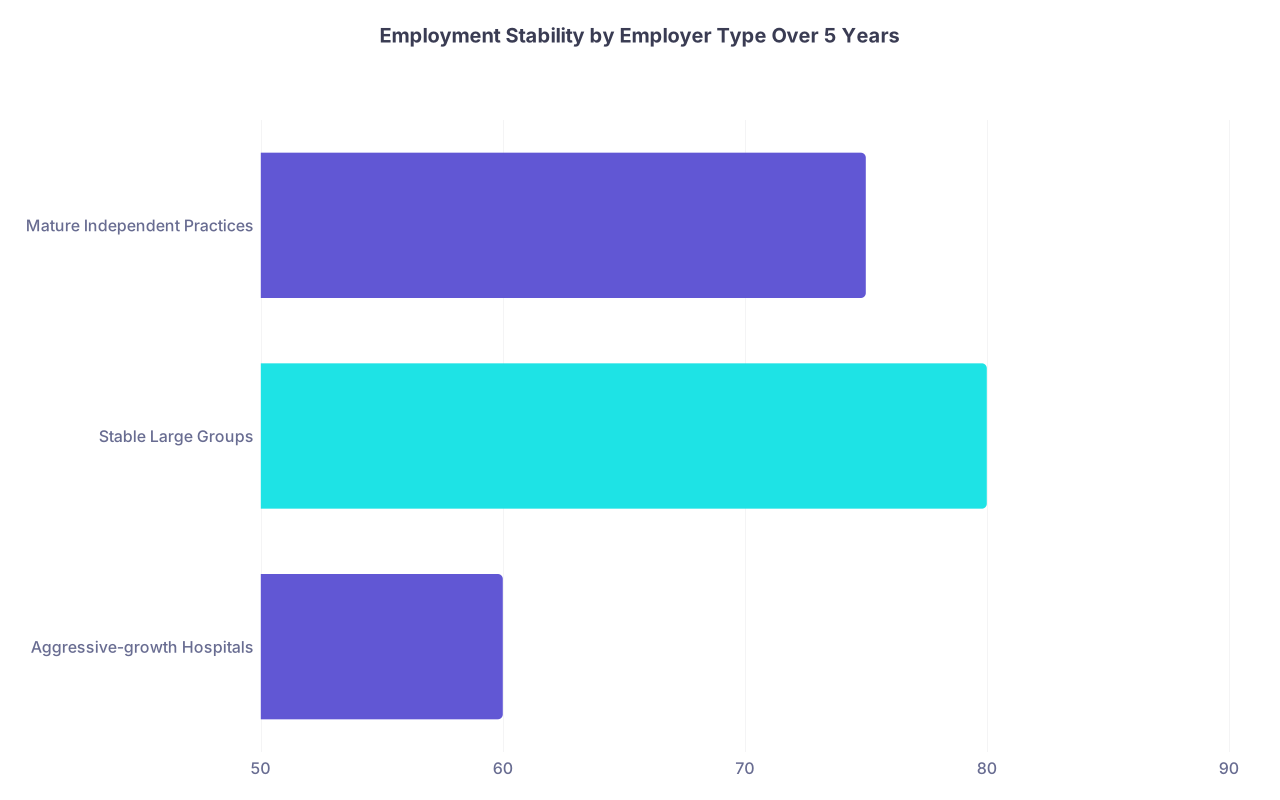
If you match into a city where one system has aggressively consolidated primary care and a second system is “catching up,” you are walking into precisely this boom–bust cycle.
| Category | Value |
|---|---|
| Aggressive-growth Hospitals | 60 |
| Stable Large Groups | 80 |
| Mature Independent Practices | 75 |
Think of that 60% as “still in the same or equivalent position 5 years later.” That’s not catastrophic—but it’s a far cry from “safe.”
2. Service Lines With Shifting Hospital Strategy
OB, trauma, inpatient psychiatry, elective surgery lines in competitive markets—these are highly sensitive to hospital strategy.
If the system decides:
- to close L&D at one campus,
- to centralize all orthopedics at another site,
- or to spin off low-margin lines,
your “secure” job becomes either a multi-site grind or a relocation problem. You don’t control the service line; the service line controls you.
3. GME-Heavy Institutions
Teaching hospitals that crank out their own residents and fellows every year have a built-in cheap labor pipeline. That’s great for them. Awkward for your job security.
You can be replaced by:
- hiring a fellow at a lower salary,
- reshuffling service coverage to residents,
- or using midlevels under a few supervisory physicians.
Again, this doesn’t mean doom. It means: don’t confuse “we love training people like you” with “we’re committed to employing you long term at a high salary.”
The One Thing New Docs Underestimate: Negotiation Power Shifts Fast
The biggest employment myth isn’t just that hospital jobs are safer.
It’s that the first offer you see is your destiny.
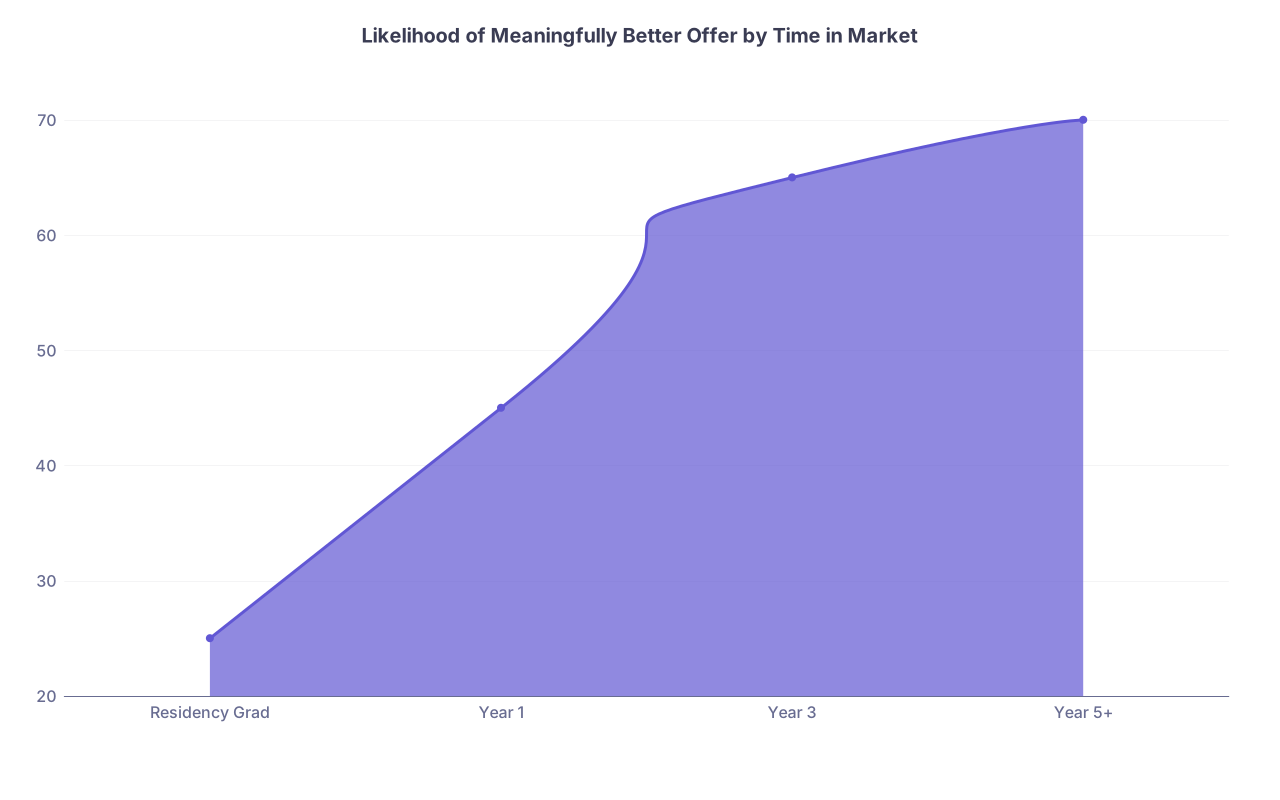
Here’s the part that’s actually backed by outcomes:
| Category | Value |
|---|---|
| Residency Grad | 25 |
| Year 1 | 45 |
| Year 3 | 65 |
| Year 5+ | 70 |
Why does your leverage increase after you’ve been out a few years?
Because:
- You have a track record of productivity (RVUs, surgical volumes, outcomes)
- You know the local referral patterns and politics
- You’ve figured out what you will and will not tolerate
- Recruiters and competing groups can literally look at your CV and see stable practice, not “brand new grad who might flame out”
The irony: many new docs lock themselves into weak long-term positions for “safety” at the exact moment they have the least information and the worst negotiating power.
Far safer, from a career perspective, is:
- Treat your first job (employed or independent) as a 2–3 year data-gathering phase, not a lifetime marriage.
- Learn how medicine and money actually interact in your specific market.
- Then renegotiate or jump—employed vs. private becomes a tactical choice, not an emotional one.
Reality Check: How To Think About “Safety” Without Lying To Yourself
If you strip out the marketing and resident-room folklore, here’s the cleaner picture.
Hospital-employed jobs are:
- Often simpler initially: no rent, no billing headaches, predictable checks.
- Politically dependent: heavily shaped by admin, service line strategy, and margin pressures.
- Structurally insecure: non-renewal and RVU ratcheting are normalized tools.
Independent practice (solo or group) is:
- More financially exposed early: overhead, startup costs, slower ramp-up.
- More controllable long-term: you and your partners decide staffing, scheduling, and often compensation models.
- Resilient in a different way: you’re not at the mercy of a single employer’s board meeting.
Neither is universally better. But if your main criterion is “safety,” you need to be honest about what that word actually means.
For most physicians, real career safety comes from:
- Being clinically strong and in a specialty with durable demand
- Having portable skills and a good professional reputation
- Understanding at least the basics of how revenue, costs, and payer mix work wherever you practice
- Not tying your entire future to one employer’s spreadsheet
The Bottom Line
Three things to walk away with:
- Hospital employment is not a safety shield; it’s a different risk profile, heavily dependent on RVUs, politics, and service line strategy.
- Your first job—employed or independent—is usually a temporary platform to learn the market, not a permanent guarantee of security.
- Long-term safety comes from leverage and understanding the business side of medicine, not from assuming that a big hospital logo means you cannot be replaced.