Private practice is not dying. It is consolidating, mutating, and getting harder to do badly—but it is very much alive.
You hear the same soundtrack during residency: “Private practice is over.” “You’ll drown in admin.” “Only crazy people hang a shingle now.” Most of that is lazy groupthink from people who have never read a MGMA report or actually built a pro forma.
Let’s walk through the biggest myths you’re being sold during residency and line them up against what the data—and real-world practices—actually show.
Myth #1: “Private practice is dead. Everyone’s employed now.”
This is the flagship myth. Attendings mutter it between cases. Academic chiefs say it with a shrug, like gravity.
Yes, the trend is toward employment and consolidation. The AMA Physician Practice Benchmark Survey and multiple health policy analyses all say the same thing: independent practice has declined over the past decade. But “declining” is not “dead.”
Depending on the specialty, 35–45% of physicians are still in some form of private or physician-owned practice. That’s millions of patient visits a year not happening in a corporate clinic.
And the patterns are not uniform:
- Surgical subspecialties, dermatology, ophthalmology, GI, anesthesia, radiology, ortho—physician ownership or partnership is still common.
- Primary care has consolidated the most, but independent groups and DPC models are quietly expanding in a lot of markets.
The nuance you never hear in the residents’ lounge: the solo doc in a strip mall with one MA and a paper schedule is nearly extinct in many areas. But small to mid-sized groups, MSO-backed practices, and hybrid models (physician-owned, hospital-aligned) are not.
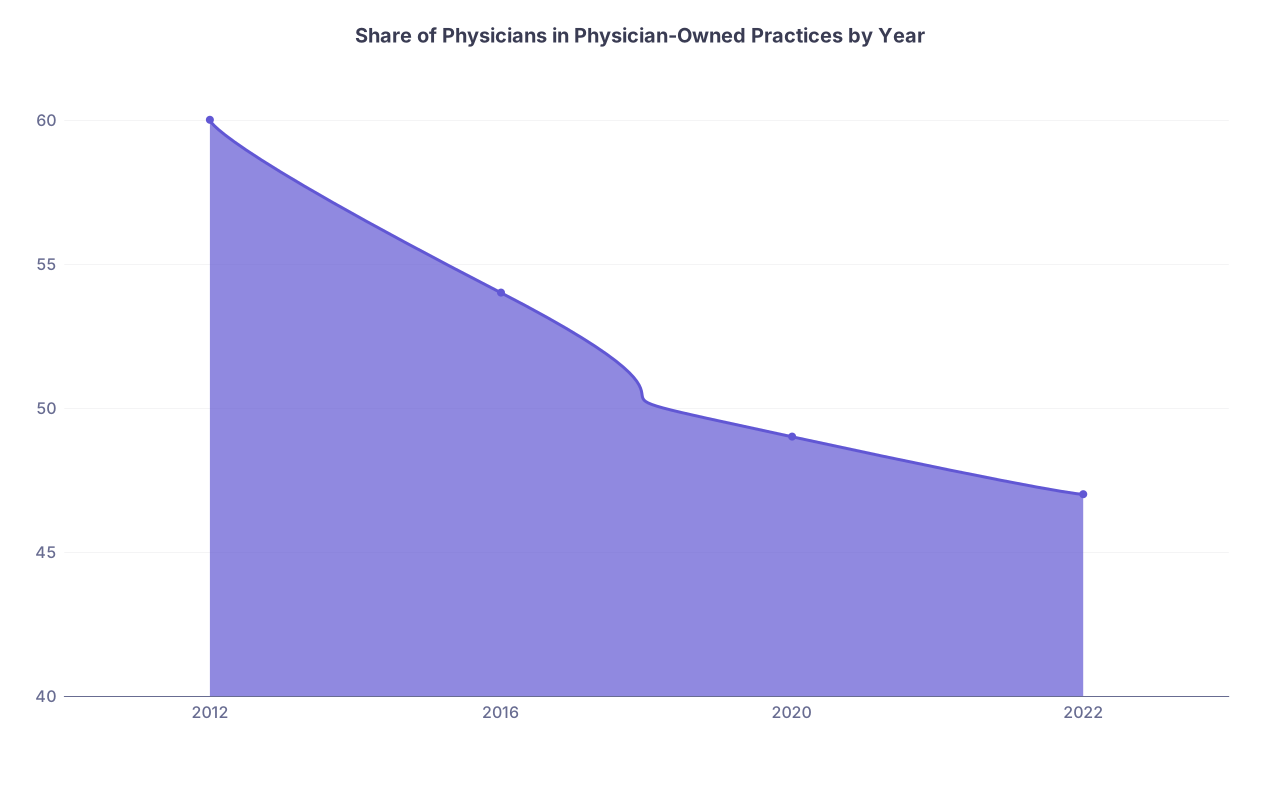
| Category | Value |
|---|---|
| 2012 | 60 |
| 2016 | 54 |
| 2020 | 49 |
| 2022 | 47 |
That chart looks like a death spiral if you only look at the slope. But flip it around: in 2022, almost half of physicians were still in physician-owned practices despite a decade of hyper-aggressive hospital and PE buying. That’s not terminal. That’s competitive.
The more accurate statement: the easy, default version of private practice is gone. The controlled, intentional version is still very viable—especially if you understand the business side and pick your market strategically.
Myth #2: “You’ll make less money in private practice than as an employed doc”
This one gets repeated with impressive confidence by people who have never seen a P&L.
Reality is messy:
- Some private practice jobs pay far more than hospital employment
- Some pay less
- A huge slice is roughly equivalent—but structured differently
Compensation depends on revenue minus overhead plus risk. Employed models hide that math under RVU formulas and “productivity tiers.” Private practice makes it explicit.
Here’s a simplified comparison I’ve seen play out in real offers for hospital-employed vs. private group outpatient jobs in the same region.
| Model | Base / Draw | Bonus Structure | Long-Term Upside |
|---|---|---|---|
| Hospital Employed IM | $260k | RVU bonus after high threshold | Minimal |
| Private IM Group (Partner track) | $230k draw | Profit share after overhead | High after buy-in |
| Hospital Employed Ortho | $550k | Small RVU bonus | Limited |
| Ortho Group Partner | $450k draw | 40–45% collections, ancillaries | Very high |
| EM Employed | $220/hr | None | None |
Are those exact numbers universal? Of course not. But the pattern is. Early on, employed comp can look higher because they guarantee you a salary while you ramp up. Over 3–5 years, as your panel or procedural volume grows, the ability to participate in profit and ancillaries (infusion, imaging, ASC, lab, cosmetics, optical, etc.) changes the math.
I’ve watched more than one new grad take a “safe” employed hospitalist or clinic job at $260k–$280k, only to hear 3–4 years later that one of their co-residents in a lean, well-run private group is taking home $350k–$450k for the same or fewer weekly hours, with schedule control and no service line director breathing down their neck about throughput.
The risk is real. You can absolutely join a dysfunctional practice and get burned. But the idea that private practice = permanently worse pay is just false.
Myth #3: “The admin and business work will crush you”
This myth starts with a tiny truth and blows it way out of proportion.
Yes, private practice demands more business thinking. But you are not personally doing payroll, negotiating every payer contract, and chasing every denial while you see 25 patients a day. If you are, the problem is not “private practice”—it’s that you joined a badly structured or under-resourced practice.
Modern private practices that survive do a few things right:
- They invest in a good administrator or practice manager
- They outsource billing to competent coders or build strong in-house revenue cycle
- They use an EHR that doesn’t fight them on every click (or at least they learn its quirks)
- They standardize workflows instead of letting every doc reinvent the wheel
The shock for many new grads is not that private practice has admin work.
It’s that every job has admin work.
You think you’ll escape bureaucracy by signing with Big Academic or MegaHealthSystem Inc.? They have entire departments whose full-time job is to invent new burdens for you: mandatory online modules, “quality” dashboards, EHR alerts, throughput metrics, satisfaction scores, documentation audits.
The difference is control.
In private practice, if your front-desk workflow is trash and no one answers the phones, you and your partners can change it. If your EHR template slows you down, you can fix it without presenting to a 14-person committee.
The work is not zero. But it’s not this mythical extra 20 hours a week on top of full-time clinical that residency attendings sometimes describe. The docs I know in well-run groups might spend:
- 1–3 hours a week on business-related email, quick decisions, staffing issues
- 2–4 hours a month in meetings that actually affect their income and clinic
That’s a manageable tax in exchange for control over your environment.
Myth #4: “You need an MBA to do private practice”
No. You need to learn basic numbers and not be naive. That’s different.
The myth that you need an MBA is partly self-defense from administrators who want to protect their mystique and partly from physicians who are afraid of spreadsheets and justify it as “I’m above the business side.”
You do not need:
- A second degree
- To become an expert in every arcane billing code
- To run the books yourself
You do need to understand:
- Fixed vs variable overhead
- How collections relate to RVUs and payer mix
- What a reasonable staffing ratio looks like
- How to read basic reports: P&L, aging AR, productivity metrics
This is weekend-course territory, not a 2-year degree.
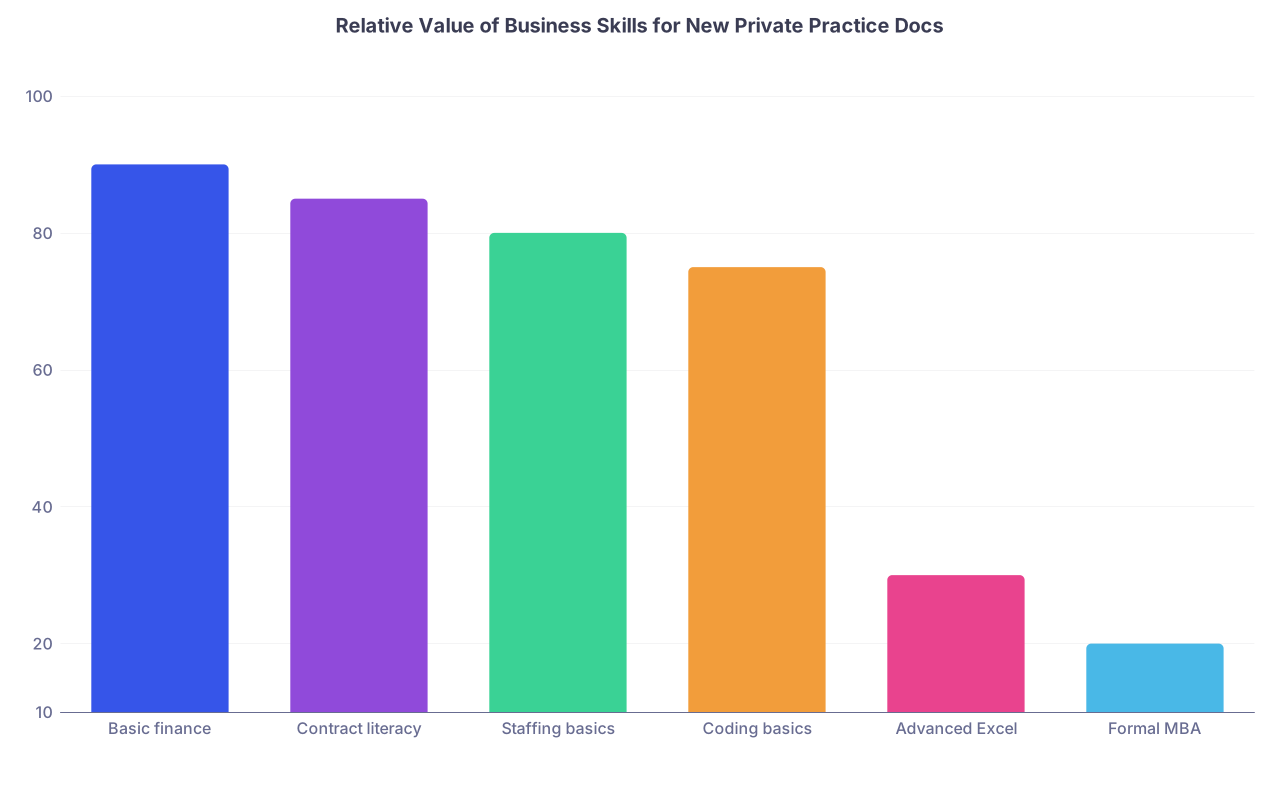
| Category | Value |
|---|---|
| Basic finance | 90 |
| Contract literacy | 85 |
| Staffing basics | 80 |
| Coding basics | 75 |
| Advanced Excel | 30 |
| Formal MBA | 20 |
I’ve seen partners with no formal business training run very successful practices because they were humble enough to:
- Hire competent billing and management help
- Ask questions until they understood their numbers
- Say “show me the data” when someone pitched a “new initiative”
Where new grads get burned is not lack of business credentials. It is walking into a group and signing whatever is placed in front of them because “it’s standard.”
Which brings us to the next myth.
Myth #5: “Partnership track is always a good deal if they offer it”
This one is dangerous because it sounds optimistic and pro-private-practice, but it’s just as wrong.
Partnership can be a fantastic deal. It can also be how senior docs offload risk and overhead onto you while keeping the real profits and control.
Key red flags I’ve seen in “partnership track” offers:
- No written criteria for partnership—just vague “fit” language
- Buy-in numbers that are totally disconnected from valuation
- Two-tier partnership structures where new partners have no vote and lower distributions
- Call, uncompensated admin, and worst payer mix all landing on the junior track
New grads routinely underestimate how much these details matter. If you are offering your labor to help build equity, you better know exactly what you’re building and what your share will be.
Conversely, some new grads automatically reject any buy-in on principle. Also a mistake. If the numbers work, paying into a building, ASC, or group equity can be one of the best long-term financial moves you make.
I’ve seen practices where partners who bought in for $60k–$100k within a few years were clearing an extra $150k–$300k per year compared to local employed peers, plus building real asset value. I’ve also seen groups where the “buy-in” was essentially paying for furniture that was already depreciated while the senior partners quietly owned the separate real estate LLC and siphoned rent.
Partnership is not automatically good or bad. It is math and governance. If they cannot clearly explain both, walk.
Myth #6: “You’ll have no work-life balance in private practice”
Residency warps your sense of what “busy” looks like. Fifteen 12-hour shifts in 16 days. 28-hour calls. Pre-rounding in the dark.
Then someone tells you, “If you do private practice, you’ll never be home.”
Some specialties are inherently brutal, regardless of practice setting. Trauma surgery is trauma surgery. But across common fields—IM, FM, EM, anesthesia, many surgical subspecialties—the idea that private practice uniquely destroys your life is wrong.
What actually happens:
- Early years in private practice can be front-loaded with building: panel growth, community outreach, some extra hours to stabilize systems.
- Once stable, many private practice docs have more control over their schedules than employed peers.
I’ve seen this shift:
- Employed IM clinic doc: 5 days/week, 22–24 patients/day, multiple “required” late meetings, hospital policies on vacation caps, 1:6 weekend call for an underpaid inpatient service.
- Private IM group: 4 days/week clinic by choice, 18–20 patients/day, 1–2 evenings a month of admin meetings that actually affect their income, call structured for fair comp or hospitalist coverage, real say in vacation schedules.

| Step | Description |
|---|---|
| Step 1 | Residency |
| Step 2 | Employed Job |
| Step 3 | Private Practice |
| Step 4 | Stable Salary |
| Step 5 | Limited Control |
| Step 6 | Early Build Up |
| Step 7 | Schedule Control |
| Step 8 | Higher Long Term Upside |
The trap is not “private practice.” The trap is saying yes to every patient, every add-on, every committee, every satellite clinic. You can burn yourself out in a hospital system much faster because the machine is bigger and less personal.
In private practice, if you and your partners decide you’re not doing 7 pm clinic anymore because everyone is miserable, you can stop. Income might dip a bit. Sanity might rise a lot. That’s an actual choice.
Myth #7: “The job market after residency is better if you avoid private practice”
Residency advisors often imply that going into private practice “locks you in” while academic or employed routes “keep doors open.” It sounds smart. It’s frequently backwards.
What hiring chairs and groups actually care about:
- Can you manage a panel or case load efficiently?
- Do you understand basic billing and documentation?
- Are you pleasant enough not to destroy a team?
- Do you bring any business, reputation, or niche skills with you?
Private practice experience often strengthens these points. You’ve had to understand productivity, manage time, maybe take on a bit of leadership. That plays well whether you later want to join a hospital-employed model, academic-lite hybrid, or another group.
And here’s the truth about “locked in”: contracts and non-competes exist in every setting. Hospital systems can chain you to a radius just as effectively as a private group. Some are worse.
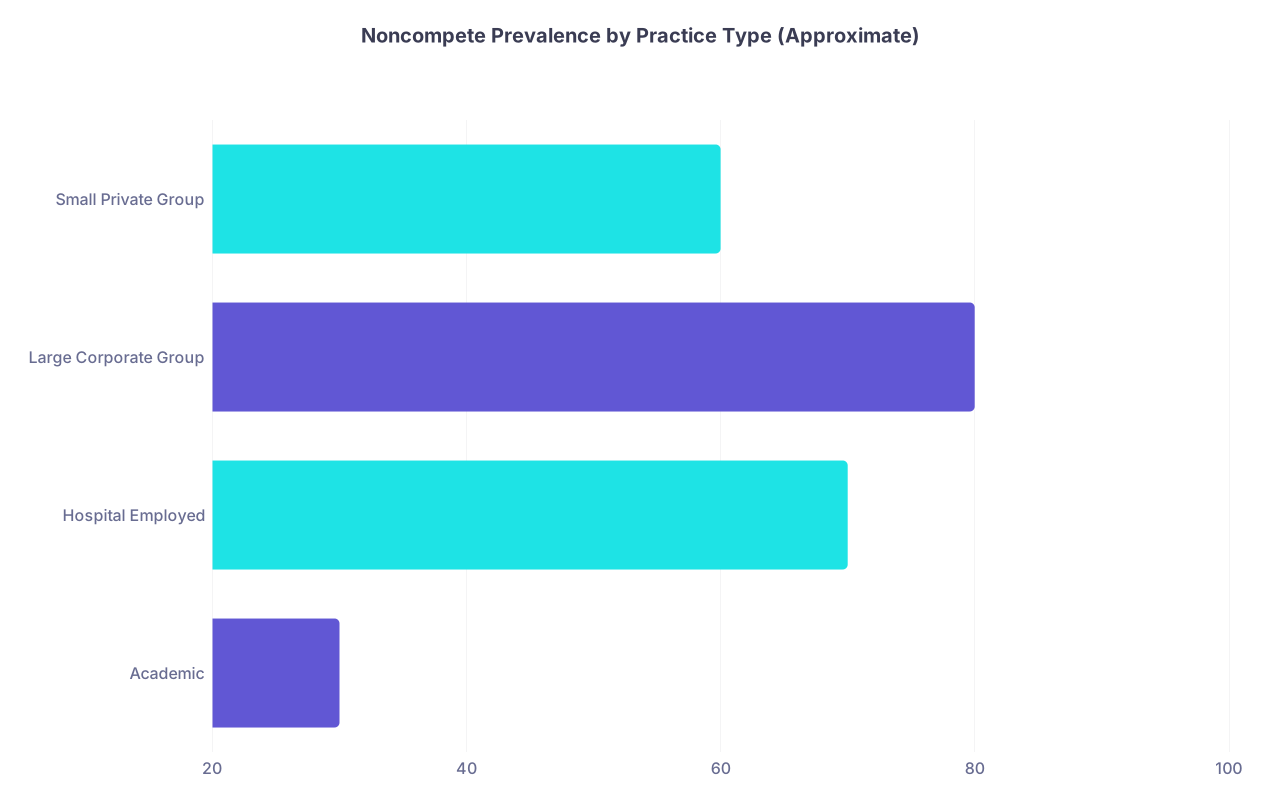
| Category | Value |
|---|---|
| Academic | 30 |
| Hospital Employed | 70 |
| Large Corporate Group | 80 |
| Small Private Group | 60 |
You’re not “safer” from legal handcuffs by avoiding private practice. You’re safer by actually reading your contract and pushing back before you sign.
Also, the notion that academic jobs are plentiful and stable long-term is increasingly fiction. Departments freeze hiring. RVU pressures creep up. Funding dries. Meanwhile, a lean private group with a solid referral base and rational overhead can often chug along through market cycles more predictably than a giant system discovering a “budget shortfall” and cutting staff.
Myth #8: “Private practice can’t compete with big systems long-term”
In some markets, yes—if there’s one 1,000-bed gorilla hospital buying every practice within 50 miles, your independent options shrink.
But in many places, independent and system-affiliated groups coexist precisely because private practice can move faster and focus tighter:
- They pick 1–2 service lines and become excellent at them.
- They obsess over front-desk efficiency and actual patient experience (because every bad review hurts).
- They build direct relationships with referring physicians and community orgs.
Big systems have scale. They also have bureaucracy. I’ve watched them spend 18 months deciding whether to adjust clinic templates by 5 minutes. A private group will test it next week and keep it if revenue holds.
Survival is not random. The groups that last usually:
- Understand their payer mix and margin by visit type
- Know their referral patterns cold
- Don’t over-leverage on fancy buildouts and equipment they can’t feed with volume
- Hire slowly and fire toxic people faster than hospital HR ever would
None of that is beyond you. It’s just not taught in residency.

So what should a resident actually do with all this?
If you want total predictability, yes, an employed job will often feel safer for the first 2–3 years. You sign a contract, show up, hit your RVUs, collect your W-2.
But if you’re even mildly interested in autonomy and upside, do not let the myths scare you out of private practice before you’ve done your homework.
Concrete steps, not fluff:
- During PGY2–3, ask to shadow a community doc who owns or partners in a practice. Listen to how they talk about overhead, staff, and scheduling.
- When you get offers, demand to see basic numbers: historical collections for the seat you’re filling, payer mix, average RVUs, overhead ratio.
- If someone waves away your questions with “don’t worry about that, the partners deal with it,” worry about that.
And stop taking financial advice from burned-out mid-career attendings who signed terrible contracts and haven’t looked at a balance sheet since med school.

| Step | Description |
|---|---|
| Step 1 | Job Offer |
| Step 2 | Review RVU and Noncompete |
| Step 3 | Review Numbers and Governance |
| Step 4 | Consider Strongly |
| Step 5 | Proceed With Caution |
| Step 6 | Employed or Private |
| Step 7 | Clear Path to Equity? |

The real bottom line
Strip away the myths and the story is simpler:
- Private practice is not dead; solo cowboy medicine mostly is. Group-based, data-aware private practice is very much alive and can be financially and personally rewarding.
- You do not need an MBA, but you do need to stop being afraid of basic business concepts and demand transparency before signing anything.
- The real differentiator is not practice type; it’s control. In private practice, you at least have a shot at shaping your hours, income structure, and work environment instead of being a cog in someone else’s machine.
Everything else is noise.