

The worst first attending job mistakes usually start with one thing: not understanding the difference between a W‑2 and a 1099 contract.
Let me be blunt. The clinical work might look identical. The paycheck amounts might even look similar. But the way you’re classified—employee (W‑2) vs independent contractor (1099)—changes your taxes, your risk, your benefits, your schedule, and how much mental energy you’ll burn outside of medicine.
If you’re just finishing residency or fellowship, you’re not picking a tax form. You’re picking a business model for your career.
Here’s how to think about it—practically, not theoretically.
Quick Definitions: What W‑2 and 1099 Actually Mean for You
Forget IRS jargon for a second. Here’s what each really means in your life:
W‑2 = You’re an employee.
- Taxes withheld automatically.
- Employer often provides benefits.
- You’re on payroll.
1099 = You’re a business.
- You get paid gross, no taxes withheld.
- You’re responsible for everything: taxes, retirement plans, benefits.
- You’ll probably need an accountant. And a spreadsheet. Or three.

Here’s a clean side‑by‑side so you can see the big picture:
| Aspect | W-2 Employee | 1099 Independent Contractor |
|---|---|---|
| Tax withholding | Done automatically | You pay quarterly estimates |
| Benefits | Often included (health, 401k) | You buy/build your own |
| Malpractice | Usually employer-paid | Often your responsibility |
| Control of schedule | Less control | More control (in theory) |
| Admin complexity | Low | High |
| Stability | Higher | Variable |
What Matters Most For Your First Job Out of Training
If you were 5 years out, already had an accountant, and understood S‑corps and solo‑401(k)s, I’d give you a different answer.
But you’re not there yet.
You’re transitioning from:
- Fixed PGY salary
- Built‑in benefits
- Automatic payroll and taxes
- Program telling you where to be and when
To:
- Real money
- Real risk
- Real choices that can haunt you for years
So the question isn’t “Which is better, W‑2 or 1099?”
The real question is: “Where do I not want to make my first batch of expensive mistakes?”
Here’s my position:
For most new attendings, a straightforward W‑2 job is the better first position.
Then, once you understand your baseline lifestyle and financial needs, you can layer in 1099 or transition later.
Let’s walk through why.
Money: Does 1099 Really Pay More?
You’ll hear this line a lot:
“1099 pays more because you don’t have all the overhead.”
Sometimes true. Often misleading.
The 1099 “more money” illusion
A group offers you:
- W‑2 hospitalist: $280k + benefits
- 1099 hospitalist: $330k, no benefits
On the surface, 1099 looks $50k better.
Except:
You have to cover your own benefits
- Health insurance
- Disability
- Life insurance
- Retirement plan match (that you’re now not getting)
- CME, licensing, DEA, tail coverage if needed
You’re paying both sides of payroll taxes
- As 1099, you pay the full ~15.3% self‑employment tax (Social Security + Medicare) on your net earnings up to certain caps.
- As W‑2, your employer pays roughly half.
You will absolutely need professional help
- A good CPA who understands physicians is not optional for 1099.
- More time on admin, less mental space for… everything else.
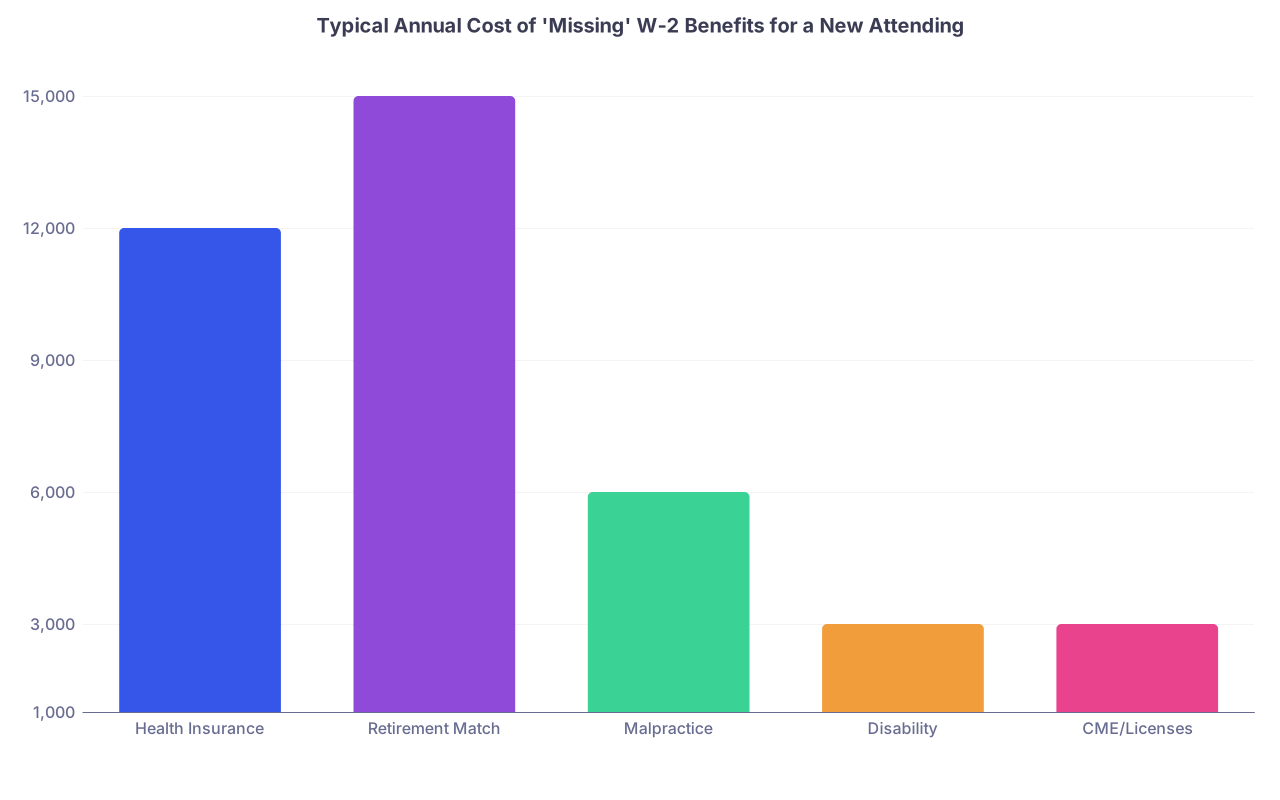
| Category | Value |
|---|---|
| Health Insurance | 12000 |
| Retirement Match | 15000 |
| Malpractice | 6000 |
| Disability | 3000 |
| CME/Licenses | 3000 |
In real life, that “extra” $50k from the 1099 offer can easily shrink to $5–15k once you:
- Replace benefits
- Pay extra payroll taxes
- Pay a CPA
- Buy appropriate insurance
Is $10k more worth the complexity and risk in your first attending year? For many people, no.
Taxes: What Actually Changes for You
Here’s the truth about 1099 “write‑offs”:
They’re not magical. They’re just business expenses.
How W‑2 feels
- You get a paycheck with taxes already taken out.
- You file your return once a year (maybe with a CPA, maybe with software).
- Very little to track. Not many deductions available.
How 1099 feels
- You get paid gross.
- You send tax money in quarterly.
- You must track:
- Income from each site
- Business expenses (CME, licensing, home office, cell phone portion, mileage, etc.)
- You’ll almost certainly form an LLC or S‑corp at some point.
Those YouTube videos promising you’ll “pay way less tax as 1099” leave something out: the work and risk.
Yes, you can often deduct more. But:
- Many residents simply don’t have the bandwidth in year one as an attending.
- If you screw up estimated payments, penalties are real.
- The IRS doesn’t care that you’re post‑call.
If you love the idea of running a small business and already read White Coat Investor and Physician on FIRE for fun? 1099 might be fine sooner.
If the thought of quarterly taxes makes you mildly nauseous? Stick with W‑2 to start.
Benefits & Protection: Where W‑2 Quietly Wins
Here’s where new attendings underestimate W‑2 jobs:
- Health insurance enrollment is automatic and subsidized.
- Disability coverage is usually set up for you (though sometimes you’ll want your own policy too).
- Malpractice is often fully covered, including tail in many employed settings.
- Retirement plan is ready-made: 401(k) or 403(b) with easy payroll deductions and often a match.
With 1099, you have to:
- Shop for health insurance (on or off exchange, possibly expensive and confusing)
- Pick and fund a retirement plan (SEP‑IRA, solo 401(k), etc.)
- Buy your own long‑term disability and life insurance
- Make sure you have malpractice and tail coverage if it’s a locums/contract job
That’s a lot of decisions in a year when you’re also:
- Moving
- Learning a new job
- Maybe starting a family
- Maybe paying off 6‑figure loans
That’s why I usually tell new grads:
Get your first attending legs under you with a W‑2 job. Then decide how much complexity you actually want.
Control & Lifestyle: Where 1099 Can Shine
Now, to be fair, there are real upsides to 1099—especially for flexibility.
1099 often makes sense when:
- You want maximum schedule control (locums, per‑diem, shift‑based work).
- You’re willing to travel for higher pay.
- You don’t care as much about a specific institution or title right away.
- You like the idea of mixing multiple gigs: e.g., part‑time telemedicine + locums + urgent care.
For example:
- An EM physician doing 100% locums across 3 states.
- A radiologist stacking teleradiology shifts at night from home.
- A hospitalist doing 7‑on/7‑off across multiple hospitals for higher pay.
For those people, 1099 can be fantastic. But notice something:
Most of them got there after a year or two in a more stable setting. Or they’re naturally wired as entrepreneurs.
Locums as a first job can work, but it’s not for everyone:
- You’ll be onboarding constantly.
- You won’t have a steady peer group.
- You’ll have to learn multiple EMRs, workflows, and cultures.
If your primary goals right out of training are:
- Solid mentorship
- Stable environment
- Time to learn how to be an attending
- Building a local reputation
W‑2 wins nine times out of ten.
The Real Trade‑Offs in Year One
Let’s strip this down to reality. Here’s what you’re really choosing between in your first job:
| Question | W-2 Tends To Be Better | 1099 Tends To Be Better |
|---|---|---|
| I want stability and predictability | ✔ | |
| I want max schedule flexibility | ✔ | |
| I hate dealing with paperwork | ✔ | |
| I want to maximize income right now | ✔ (if you manage it well) | |
| I want built-in mentorship | ✔ | |
| I enjoy business and autonomy | ✔ |

| Step | Description |
|---|---|
| Step 1 | New Attending |
| Step 2 | Start with W-2 |
| Step 3 | Consider 1099 or Locums |
| Step 4 | Top Priority |
| Step 5 | Comfort with Business Stuff |
If you’re on the fence, here’s a very simple rule of thumb:
- If you don’t understand how quarterly tax estimates, SEP‑IRAs/solo‑401(k)s, and malpractice tail coverage work, start W‑2.
- If you already understand those and they don’t scare you, 1099 is on the table.
A Smart Hybrid Strategy for New Attendings
You don’t actually have to marry one structure forever. You can date around.
One of the smartest early‑career setups I’ve seen:
Year 1–2:
- Core job: W‑2 employed position (hospital, large group, academic).
- Optional: A little 1099 moonlighting on top—one locums weekend a month, telemedicine, urgent care, etc.
Year 3+:
- Reassess:
- Do you like the stability and benefits?
→ Stay W‑2, maybe negotiate more flexibility. - Do you enjoy the autonomy and extra income from your 1099 side gig?
→ Consider moving to a mixed model or full 1099, with a good CPA and more deliberate planning.
- Do you like the stability and benefits?

| Category | W-2 Core Job | 1099 Side Gigs |
|---|---|---|
| Year 1 | 280000 | 20000 |
| Year 2 | 290000 | 40000 |
| Year 3 | 0 | 350000 |
This way:
- You learn the ropes of being an attending without drowning in admin.
- You get to “test drive” 1099 income and see how the taxes/complexity feel.
- You keep optionality.
When 1099 Does Make Sense as a First Job
There are scenarios where even for your first job, 1099 is reasonable or even ideal:
You’re in a high‑demand specialty with strong locums rates
EM, Radiology, Anesthesia, Hospitalist, some Surgical subspecialties.You absolutely need flexibility
- You’re caring for family in different locations.
- You want to stack time off in big chunks for travel.
- You don’t want to be locked into one hospital or system.
You already think like a business owner
- You’ve run a side business before.
- You’re already working with a CPA.
- You’re genuinely interested in squeezing every dollar of efficiency out of your work.
If that’s you, fine. Just don’t half‑commit. Treat it like what it is: you’re now a small professional corporation, not “just a doctor working some shifts.”
Concrete Steps You Should Take Before Deciding
Don’t just listen to recruiters. They’re paid to fill positions, not optimize your life.
Here’s what to do this week:
List your priorities for years 1–3 post‑residency
- Rank: stability, income, mentorship, flexibility, location, academic vs community, etc.
Ask each potential employer these specific questions For W‑2 offers:
- What exactly is included in benefits? (health, dental, vision, disability, life, retirement match, CME)
- Is malpractice occurrence or claims‑made? Who pays tail?
- How are bonuses structured and how realistic are they?
For 1099 offers:
- Do you provide malpractice and tail, or is that on me?
- Do you help with health benefits at all, or is it fully on my own?
- Can I talk to a current physician working under the same arrangement?
Run the numbers with someone objective
- Talk to a physician‑focused financial planner or CPA.
- Get after‑tax comparisons with realistic assumptions about benefits costs.
-
- W‑2 or 1099, doesn’t matter. Have a healthcare attorney or contract review service look at it.
- Non‑competes, call burden, RVU expectations, and termination clauses often matter more than the tax form.

Bottom Line: So Which Makes Sense for Your First Position?
My answer, after watching a lot of people stumble through this:
- If you want a stable launch into attending life, choose a solid W‑2 job for your first position.
- If you’re very comfortable with risk, admin, and business decisions—and you value flexibility above all—1099 can work, but go in eyes wide open.
You’re not signing up for a lifetime identity. You’re picking the training wheels for your financial and professional life as an attending.
Right now, open a blank page and write this at the top:
“Years 1–3 out of residency, my priorities are…”
Then list and rank them. Once you actually see those priorities written down, the W‑2 vs 1099 choice usually stops being confusing and starts being obvious.
FAQ: W‑2 vs 1099 Physician Jobs
1. Will I really make more money as a 1099 physician?
Possibly, but not always. Yes, 1099 rates are usually higher on paper. But you:
- Pay both sides of payroll taxes.
- Cover your own benefits (health insurance, retirement match, malpractice, disability).
- Pay for professional tax help.
Once you subtract all that, the “extra” might be much smaller than advertised. In some low‑benefit W‑2 jobs you might come out ahead as 1099. In generous employed positions, the W‑2 package can be financially equivalent or better.
2. Can I switch from W‑2 to 1099 (or vice versa) later?
Yes. You’re not locked in forever. Many doctors:
- Start W‑2 for a few years.
- Learn what they like and dislike.
- Then shift into locums or mixed 1099 work once they’re comfortable clinically and financially.
Just watch non‑compete clauses if you’re thinking about switching within the same geographic area.
3. If I take a 1099 job, do I need to start an LLC or S‑corp right away?
Not necessarily in month one. You can start as a sole proprietor (you just use your Social Security Number and track income/expenses). Once your income is stable and significant, a CPA can tell you if an LLC or S‑corp structure makes sense for tax and liability reasons. Don’t let “must set up an LLC immediately” be the thing that delays your decision, but also don’t wing it long‑term without advice.
4. Is it a bad sign if a group only offers 1099 and no W‑2 option?
Not automatically, but it’s a flag to investigate. Sometimes:
- It’s a locums model by design.
- It’s a staffing firm setup.
- Or it’s a way for the group/hospital to avoid providing benefits and protections.
You need to ask: Who pays for malpractice and tail? Is the rate truly high enough to justify no benefits? How stable is the work? Talk to current docs in that exact arrangement before you sign.
5. What kind of first‑job setup works best if I have heavy student loans?
Counterintuitively, often a stable W‑2 job. You want:
- Predictable income for repayment or PSLF.
- Benefits that keep your out‑of‑pocket costs controlled.
- Minimal administrative chaos so you can pick up extra shifts or side work deliberately if needed.
A chaotic 1099 setup with variable income and no benefits can make aggressive loan repayment harder, not easier, unless you’re very disciplined and organized.
6. What’s one red flag in any first‑job contract, regardless of W‑2 vs 1099?
Unclear expectations tied to pay. If your compensation depends on RVUs, productivity, or vague “bonuses” and nobody can show you what average attendings actually earn under that formula, be cautious. I’ve seen more disappointment and burnout from “mystery RVU contracts” than from almost anything else. Ask for concrete examples and current physician income data; if they dodge, that’s a problem.
Today’s action: pull up one real job posting you’re considering and write “W‑2” or “1099” at the top. Then, using what you just read, list out everything you would have to handle under that structure. If that list makes you tired just looking at it, you’ve got your answer.


