

The worst career mistakes for attendings usually happen in year two—not year one.
Year one, everyone gives you grace. You’re “new.” By year three, you’re “established” and harder to move. Year two is the window when you either fix a bad deal or quietly line up the exit ramp.
You’re in the danger zone right now.
This is the timeline for how to use year two as an attending to either renegotiate intelligently—or to quietly start re-searching the job market without blowing up your current gig.
Big Picture: The Year-Two Arc
Here’s the reality: most employers think of your “inertia curve” like this:
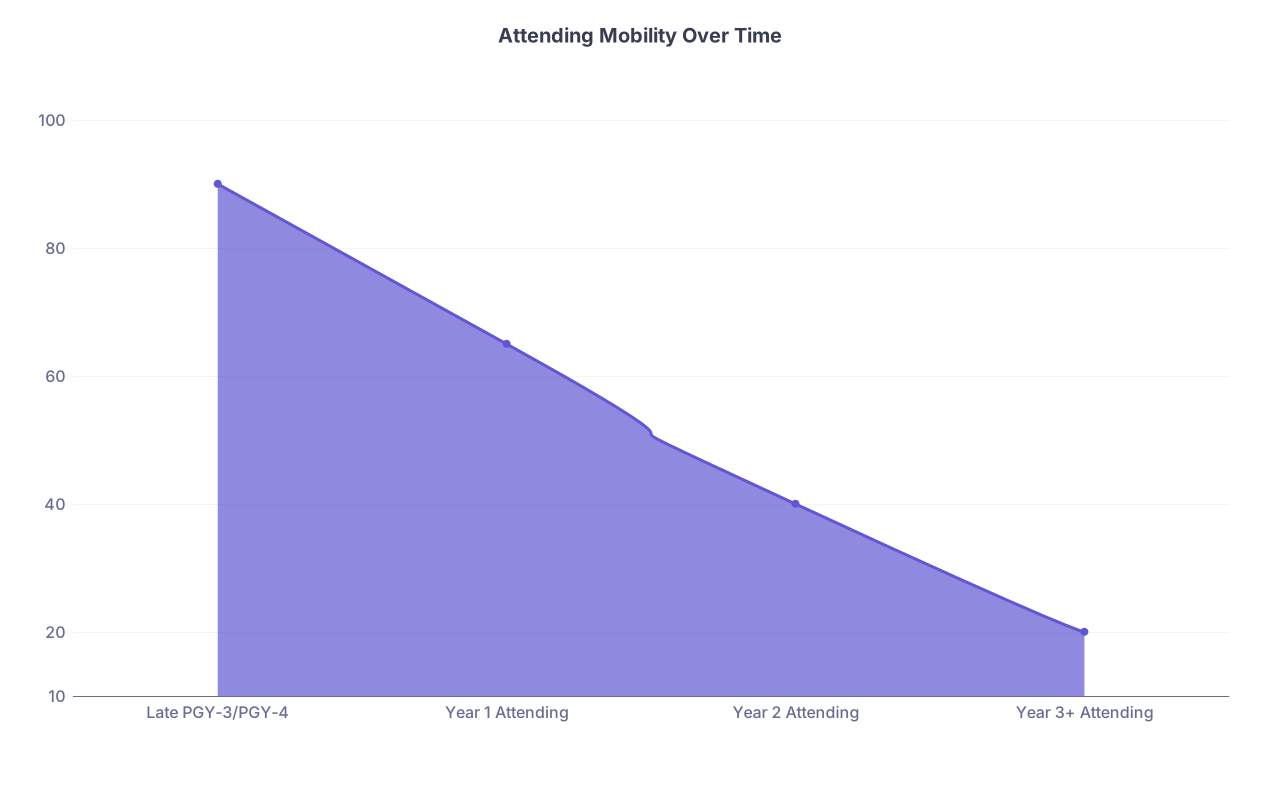
| Category | Value |
|---|---|
| Late PGY-3/PGY-4 | 90 |
| Year 1 Attending | 65 |
| Year 2 Attending | 40 |
| Year 3+ Attending | 20 |
- Late residency: 90% movable. No roots. Everyone knows you’re shopping.
- Year 1: 65% movable. You just landed, but leaving isn’t shocking.
- Year 2: 40% movable. Still feasible, but now you’ve got patients, maybe kids, a house.
- Year 3+: 20% movable. People assume you’re staying unless something is really wrong.
Year two is when your leverage shifts:
- You’ve produced data (RVUs, wRVUs, encounters, access metrics).
- You’ve proven (or disproven) your value.
- You’re no longer “too new” to renegotiate.
- You’re not yet “too rooted” to leave.
Use this year deliberately, month by month.
Months 0–3 of Year Two: Diagnostic Phase (Do Not Lead With Demands)
At this point you should collect data and define your problem. No ultimatums. No “I need more money” emails yet.
Step 1 (Month 13–14): Pull your numbers
You need objective ammo. By now you should be able to get:
- Annual RVUs or wRVUs
- Encounters/visits or cases per month
- Panel size (for primary care)
- Call burden (# nights/weekends)
- Clinic templates (slots per half day, new vs. return)
- No-show rates, cancellation policies
- Compensation details:
- Base
- Bonus structure and what you actually got
- Any productivity or quality incentives
If you do not know how to get this, you ask:
- “Who can pull my RVU and encounter reports for the last 12 months?”
- “Can I see the pay structure and thresholds tied to my contract language?”
Save these. Print, PDF, spreadsheet—whatever. Just not only in your Outlook inbox.
Step 2 (Month 14–15): Benchmark against the market
Now at this point you should compare your reality to external data.
Use:
- MGMA, AMGA (if you or a friend has access)
- Specialty society comp surveys
- Colleagues who’ve just signed elsewhere
- Recruiter emails you’ve ignored all year
Build a simple comparison:
| Item | Your Job | Market Median (Region) | Stretch Target |
|---|---|---|---|
| Base Salary | $240k | $270k | $300k |
| wRVUs/year | 7,500 | 6,500 | 7,000 |
| Call per month | 8 nights | 4–6 nights | 4 nights |
| Vacation weeks | 3 | 4 | 5 |
| CME + Stipend | 3 days / $2k | 5 days / $3k | 5 days / $4k |
You’re looking for patterns:
- Are you underpaid for your productivity?
- Are you overworked (call, clinic templates) compared with similar jobs?
- Are non-comp items (PTO, CME, admin time, support staff) way below average?
Step 3 (Month 15–16): Clarify your pain points
This is where people screw up. They go in with “I’m unhappy” instead of “Here are the three specific things that are misaligned.”
Write out:
- Top 3 non-negotiables that must improve if you stay.
- 2–3 “nice-to-have” items.
- Hard red lines (e.g., “I will not keep 1:3 home call with in-house rounds”).
Examples:
Non-negotiable:
- Compensation at least to regional median for my RVU level.
- Cap clinic at 22 patients/day or add NP/PA support.
- Reduce call from 1:3 to 1:4 or add call stipend.
Nice to have:
- Better schedule flexibility (one telehealth day/week).
- Increased CME days.
You need this clarity before you decide whether to renegotiate or quietly start re-searching.
Step 4 (End of Month 16): Decide your primary direction
At this point you should make your initial branch decision:
- Path A: Conditions are decent, leadership is reasonable → Renegotiate first.
- Path B: You’re significantly underpaid, culture is toxic, or leadership is rigid → Start quiet market re-search in parallel with a modest renegotiation attempt.
Use this quick gut-check:

| Step | Description |
|---|---|
| Step 1 | Review year one data |
| Step 2 | Plan focused renegotiation |
| Step 3 | Renegotiate but set deadline |
| Step 4 | Quiet job search + limited asks |
| Step 5 | More than 2 major misalignments? |
| Step 6 | Trust leadership to fix it? |
Months 4–6 of Year Two: Renegotiation Window
Hospitals and groups hate surprises. You want to time your conversation with budgeting cycles and your contract terms.
Step 5 (Month 16–18): Check contract timing and clauses
At this point you should read your contract again—with fresh eyes.
Find:
- Term length and auto-renew date
- Notice period for non-renewal (60–180 days is common)
- Noncompete radius and duration
- Any “review” or “productivity reconciliation” triggers
You want to know:
- When do you have to give notice if you plan to leave at the end of term?
- When is the natural time to revisit comp (annual review, RVU true-up, etc.)?
If your contract auto-renews in, say, month 24 with a 90-day notice period, your actual decision point is month 21. That means you renegotiate in months 17–20. Not month 23 when your hands are tied.
Step 6 (Month 17–19): Prepare your renegotiation packet
This is where you act like a grown attending, not a resident asking for schedule favors.
Build a 1–2 page packet:
Summary of your year-one contributions
- RVUs or encounters with comparison to departmental averages
- Access improvements (clinic wait times, added sessions)
- Quality metrics (readmission rates, satisfaction scores, throughput)
- Leadership/extra work (committees, protocol development, teaching)
Benchmark comparisons
- Short table (like above) comparing your comp to market midpoints
- Notes on call, PTO, CME, support
Specific, realistic asks
- Each item: what you want + brief rationale + options
- Prioritize 2–3 key items. Not 10.
Example framing:
- “Given my 7,500 wRVUs (dept avg 6,200) and MGMA 60th percentile comp benchmarks, I’d like to discuss adjusting my base to $280k with a productivity bonus above 7,000 wRVUs.”
- “To manage panel growth and reduce burnout risk, I’m requesting either: 1) an NP/PA 0.5 FTE dedicated to my panel, or 2) a cap at 22 patients/day.”
Step 7 (Month 18–20): Have the actual conversation
At this point you should schedule a formal meeting, not throw this into hallway chat.
- Meet with: section chief + admin/manager, or whoever controls money.
- Send your packet 24–48 hours before: “I’d love to review this in our meeting.”
In the room:
- Lead with appreciation and data.
- Be direct: “Here’s where I am, here’s what I’m asking for, here’s why.”
- Then shut up and let them talk.
What you’re listening for:
- Are they engaging seriously (numbers, options, timelines)?
- Or deflecting (“maybe next year,” “budget is tight,” vague promises)?
You do not need an immediate answer, but you do need:
- Clear next step.
- Who decides.
- A timeline for a concrete response (e.g., “By end of next month”).
Months 6–9 of Year Two: Evaluation & Parallel Quiet Search
Now the fork in the road.
At this point you should decide whether to:
- Double down and stay (if they respond reasonably), or
- Quietly start real market re-search even while they “consider” your ask.
Step 8 (Month 20–22): Grade their response
You’re not evaluating what they say; you’re evaluating what they do in 60–90 days.
Strong “stay” signals:
- Specific counter with numbers and dates.
- Concrete operational changes (adjusted templates, additional staff, lighter call).
- They put it in writing (contract amendment, updated comp plan).
Weak or “you should leave” signals:
- “We value you, but…” with no numbers.
- “Maybe next fiscal year” without an actual plan.
- Repeated delays, canceled follow-up meetings.
- “Everyone is underpaid right now; you’re no different.”
If you get mostly vague reassurance and no hard offers by 60–90 days after the ask, treat that as a no. Not “maybe later.” A no.
That’s when you quietly turn up the volume on re-search.
Step 9 (Month 20–24): Start (or intensify) the quiet job search
This is not emotional. This is risk management.
At this point you should:
Reply to 2–3 recruiter emails and ask for:
- Base + bonus structure
- Call schedule
- Noncompete terms
- Any partnership track details
Talk to a few trusted peers one or two years ahead of you:
- “Would you take your current job again?”
- “What do you wish you’d checked before signing?”
- “What were your red flags in hindsight?”
Use a simple comparison chart for 3–5 real options:
| Factor | Current Job | Option A | Option B |
|---|---|---|---|
| Base Salary | $240k | $290k | $275k |
| wRVU Target | 7,000 | 6,500 | 7,200 |
| Call Frequency | 1:3 | 1:5 | 1:4 |
| Noncompete | 20 mi / 2y | 10 mi / 1y | None |
| PTO Weeks | 3 | 4 | 5 |
| Culture (gut) | 4/10 | 8/10 | 7/10 |
Quiet means:
- No complaining at work.
- No threats.
- No forwarding job ads to your hospital email.
- Use personal email and phone. Always.
When Renegotiation Still Makes More Sense Than Leaving
You don’t want to job-hop every 18 months. Sometimes it’s smarter to fix your current situation, even if a new job dangles a slightly higher number.
Year two is prime for renegotiation if:
Your misalignment is mostly compensation, not culture.
If the people are good, leadership has your back, and the only real gap is pay or structure, lean hard into fixing that before you leave.Your RVUs are strong and documented.
If you can show you’re in the 60–75th percentile of productivity and 30–40th percentile of pay, you have real leverage.Noncompete is nasty and local roots matter.
If you’re locked into a tight radius and your kids/partner are anchored to the area, a local renegotiation may be less painful than uprooting.Leadership signals they actually want to invest in you.
You see them move money, adjust templates, add staff for others. That matters more than one recruiter promising “we take great care of our docs.”
In that situation, your play in year two is:
- Push for contract addendum with:
- Indexed base raise + clear RVU threshold.
- Call stipends or reduced call.
- Defined PTO and CME benchmarks.
- Revisit your role scope:
- Are you doing unpaid admin work that should come with protected time or stipend?
- Are you propping up a failing location without recognition?
You want real, structural changes, not soft “We appreciate you” emails.
When to Stop Renegotiating and Just Plan Your Exit
There are certain patterns I’ve seen again and again. If two or more are true by mid–year two, don’t waste cycles begging for scraps.
Walking signs you should prioritize re-search over renegotiation:
Chronic understaffing is treated as your personality problem.
You ask for MAs, nurses, or APP help. Response: “You just need to be more efficient.” Translation: We will burn you out until you leave.Your good performance only leads to more work, not better compensation.
Panels get dumped on you. Call gets heavier. “You’re so reliable” becomes “We know we can squeeze you.”Leadership turnover is constant.
New chief every 12–18 months. New “strategic direction” every three months. You’ll never get a stable deal.They weaponize guilt or “mission.”
“Think of the patients,” “We’re a family,” “You’re not a team player if you push on comp.” That’s code for: We don’t plan to pay you fairly.
If you check these boxes, year two should be:
- 30%: Doing your job well.
- 70%: Planning and securing your next, better job.
Not the other way around.
Months 9–12 of Year Two: Decision & Execution
The back half of year two is where you move from “thinking about it” to committing to a path.
Step 10 (Month 22–24): Make your call—stay with new terms, or set up departure
At this point you should have:
- A clear understanding of what your current job will actually offer (not just promises).
- At least 2–3 external offers or near-offers, so you know your market value.
Now you:
- Decide whether to stay.
- If staying, lock the changes in with documentation.
- If leaving, time your notice correctly with:
- Contract notice period.
- Signing date for new job.
- Noncompete impact.
If you’re staying:
- Get a written amendment with:
- New salary.
- Changed call expectations.
- Any changes in PTO/CME.
- Productivity or bonus formulas.
If they say “We don’t usually do amendments,” that’s a bad sign. Push. They can.
If you’re leaving:
- Do not overshare your plans.
- Give the contract-mandated notice, plus a bit of goodwill if you can stomach it.
- Stay professional. Medicine is a small town, specialty-wise.
A Quick Visual: Year-Two Action Timeline
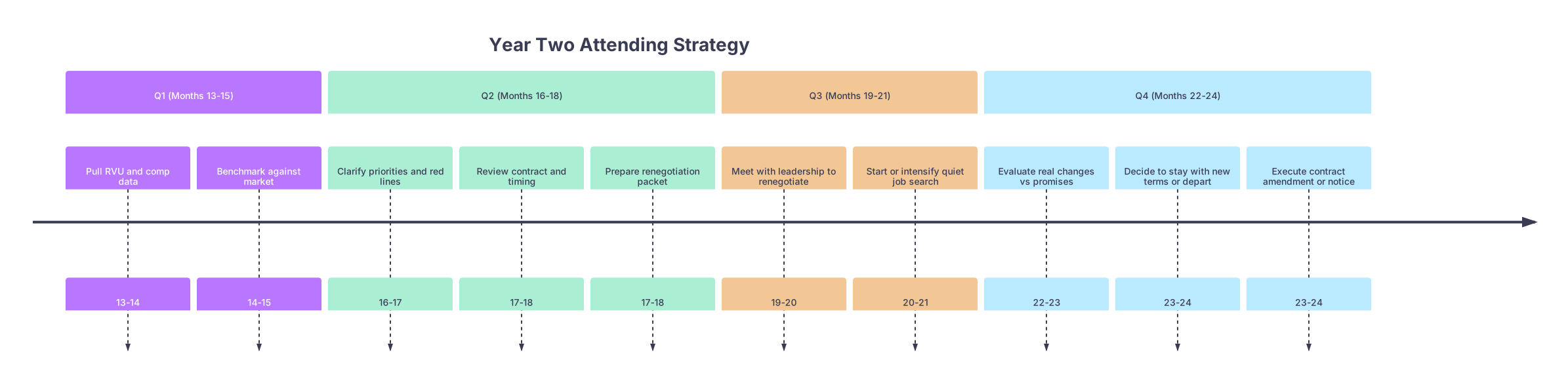
| Period | Event |
|---|---|
| Q1 (Months 13-15) - Pull RVU and comp data | 13-14 |
| Q1 (Months 13-15) - Benchmark against market | 14-15 |
| Q2 (Months 16-18) - Clarify priorities and red lines | 16-17 |
| Q2 (Months 16-18) - Review contract and timing | 17-18 |
| Q2 (Months 16-18) - Prepare renegotiation packet | 17-18 |
| Q3 (Months 19-21) - Meet with leadership to renegotiate | 19-20 |
| Q3 (Months 19-21) - Start or intensify quiet job search | 20-21 |
| Q4 (Months 22-24) - Evaluate real changes vs promises | 22-23 |
| Q4 (Months 22-24) - Decide to stay with new terms or depart | 23-24 |
| Q4 (Months 22-24) - Execute contract amendment or notice | 23-24 |
One More Layer: Emotional vs Strategic Timing
There’s usually a meltdown moment somewhere in year two:
- You get texts on your day off to “help cover.”
- Your bonus is a joke compared to what you produced.
- You watch a new hire get a better package than you.
Do not decide your future that week.
Instead:
- Log the event.
- Ask: “Is this an outlier or a pattern?”
- Feed it into your 12–24 month strategy, not a 12–24 hour reaction.
You’re not a resident anymore. No one else is managing your career arc. That’s you now.

How to Tell If You’re Late
Quick reality check. If you’re:
- Mid–year three and still in your “starter” job.
- Haven’t gotten a meaningful raise, template change, or call adjustment.
- Still telling yourself “I’ll see how it looks next year.”
You’re behind.
Not doomed. But behind. Your inertia is higher, your leverage lower, and your noncompete clock hasn’t even started yet if you haven’t left.
So if you’re in year two and you’re reading this? You’re right on time.

Key Takeaways
- Year two is your leverage window. You finally have data and credibility but aren’t yet so rooted that moving is impossible. Use it.
- Run a structured 12-month plan. First quarter: gather data and define your asks. Second: renegotiate. Third: evaluate outcomes and quietly test the market. Fourth: commit to staying with new terms—or leaving.
- Treat vague promises as “no.” If your group responds to clear, data-backed requests with delay and platitudes, don’t keep renegotiating. Start re-searching and plan your exit like a professional, not a burned-out resident.


