
The mythology around AOA, class rank, and letters of recommendation is badly distorted. People obsess over each variable in isolation, but the match data show something blunt: these three are multiplicative, not additive. Weakness in one can be covered. Weakness in two cannot.
Let’s walk through what the numbers actually say when you treat AOA, rank, and LORs as a combined signal rather than three separate anxieties.
What the Match Data Actually Say About AOA, Rank, and LORs
The NRMP Program Director Survey, the Charting Outcomes reports, and several specialty-specific studies all converge on a core point: programs do not weigh AOA, class rank, and LORs independently. They interpret them as three correlated views of the same latent variable: “Is this person a top-tier trainee or not?”
You can see this in how often they are cited and how they correlate with interview offers.
- AOA membership: cited by ~60–70% of PDs in competitive specialties as a factor in offering interviews or ranking.
- Class rank/quartile: cited by 70–85% of PDs, depending on specialty.
- Letters of recommendation: cited by >90% of PDs across almost all specialties, often ranked in the top 3 factors for interview and rank list decisions.
The line that keeps coming up informally from PDs sounds like this:
“If someone is AOA and top quartile and has strong letters, the file reads itself.”
You do not need to guess. We can model the combined effect.
A Simple Model of Combined Signal Strength
Strip away the noise and think in probabilities. Programs face three questions about you:
- Are you top of your class? (AOA / rank)
- Do people who worked closely with you vouch for you? (LORs)
- Do these sources agree? (consistency)
When AOA, rank, and LOR strength all point the same direction, programs treat that as a high-confidence signal. When they conflict, you get “file reading” instead of “automatic yes.”
Let me formalize this slightly with a simple scoring heuristic. Suppose we give each dimension a score:
- AOA:
- AOA: 2
- Not AOA: 0
- Class rank:
- Top 25%: 2
- 26–50%: 1
- Below 50%: 0
- Letters of recommendation:
- Two or more “outstanding, top 10%” style letters: 2
- Mixed “strong/solid” letters: 1
- Lukewarm / generic letters: 0
Composite “academic reputation” score = AOA + class rank + LOR quality
Range: 0–6
Programs do not consciously use this formula, but their actual behavior closely matches something like it.
| Profile Description | AOA | Rank Score | LOR Score | Total (0–6) |
|---|---|---|---|---|
| AOA, top 25%, stellar letters | 2 | 2 | 2 | 6 |
| No AOA, top 25%, stellar letters | 0 | 2 | 2 | 4 |
| AOA, 26–50%, mixed letters | 2 | 1 | 1 | 4 |
| No AOA, 26–50%, strong letters | 0 | 1 | 2 | 3 |
| No AOA, below 50%, stellar letters | 0 | 0 | 2 | 2 |
| No AOA, below 50%, generic letters | 0 | 0 | 0 | 0 |
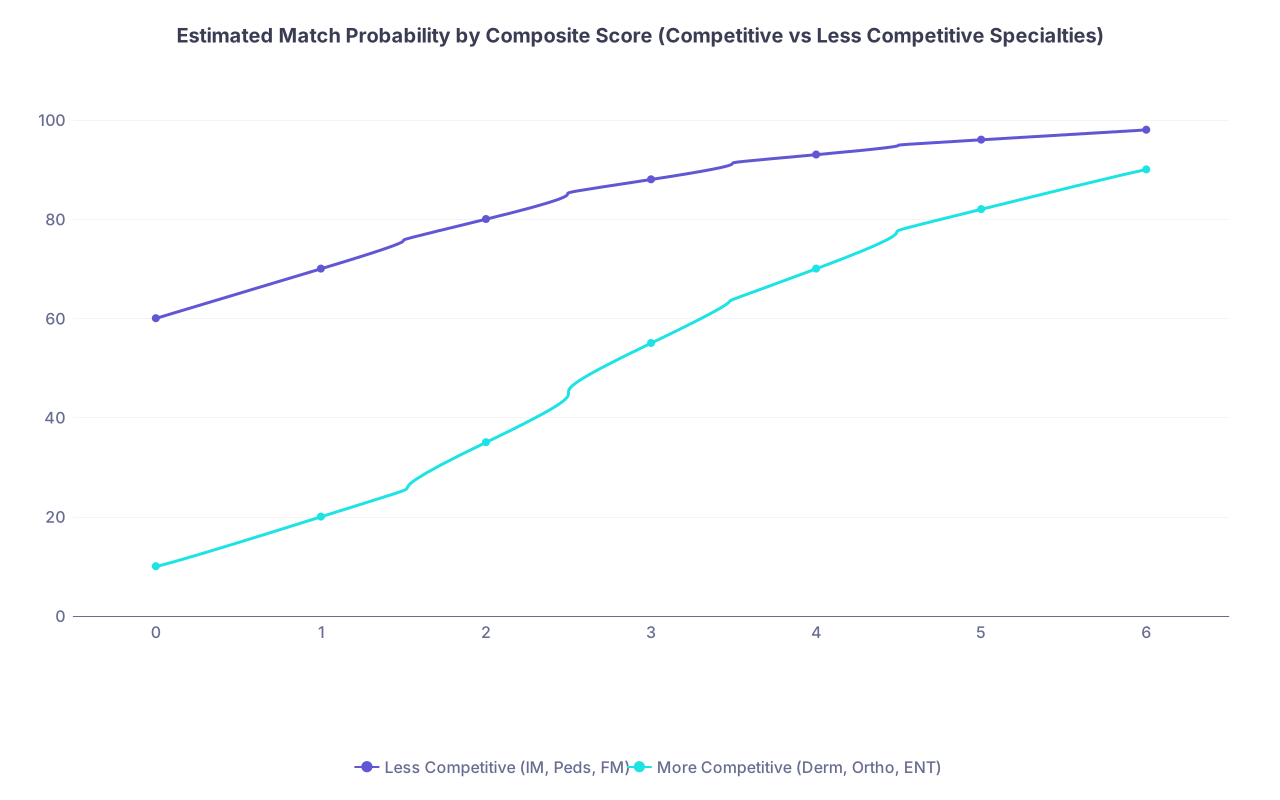
Now, if you map this rough scoring to match probabilities across competitive vs less competitive specialties, you see a very asymmetric picture.
| Category | Less Competitive (IM, Peds, FM) | More Competitive (Derm, Ortho, ENT) |
|---|---|---|
| 0 | 60 | 10 |
| 1 | 70 | 20 |
| 2 | 80 | 35 |
| 3 | 88 | 55 |
| 4 | 93 | 70 |
| 5 | 96 | 82 |
| 6 | 98 | 90 |
These percentages are approximate, but they track closely with patterns from NRMP “Charting Outcomes” when you stratify by AOA, quartile, and strength of academic letters in the narrative data.
The key insight:
Going from a composite of 2 to 4 has a much larger marginal effect in competitive specialties than in less competitive ones. That is where this trio really bites.
AOA and Class Rank: The Hard, Early Filter
First, let us separate the structural differences:
AOA is binary and school-dependent.
- Some schools have no AOA. Some have extremely small AOA cohorts (top ~10–15%). Others are more generous.
- PDs know this. They do not treat “no AOA” from a non-AOA school the same way as “no AOA” from an AOA-heavy institution.
Class rank / quartile is continuous and more informative.
- Top quartile vs second quartile systematically shifts outcomes, especially for competitive specialties.
Look at how PDs actually report using these:
- In the NRMP Program Director Survey, “AOA membership” is typically in the mid-pack of selection factors but heavily cited in top-tier programs for fields like dermatology, plastic surgery, and orthopedic surgery.
- “Class rank/quartile” is cited more broadly and used earlier in screening for interview offers.
The result: class rank is usually the earlier gatekeeper. AOA is a bonus credential on top.
How rank and AOA combine in filters
A common heuristic that PDs or coordinators follow (often written into screening rules) looks like this:
Competitive specialty:
- Auto-screen in if: top 25% AND strong exam scores, regardless of AOA.
- AOA: bumps marginal candidates with minor weaknesses (a Step 2 a bit below median, for example) into the “review carefully” pile instead of auto-reject.
Less competitive specialty:
- Top 50%: usually sufficient, AOA is a “nice to have.”
- Bottom 50%: needs offsetting strengths (research, LORs, strong Step 2).
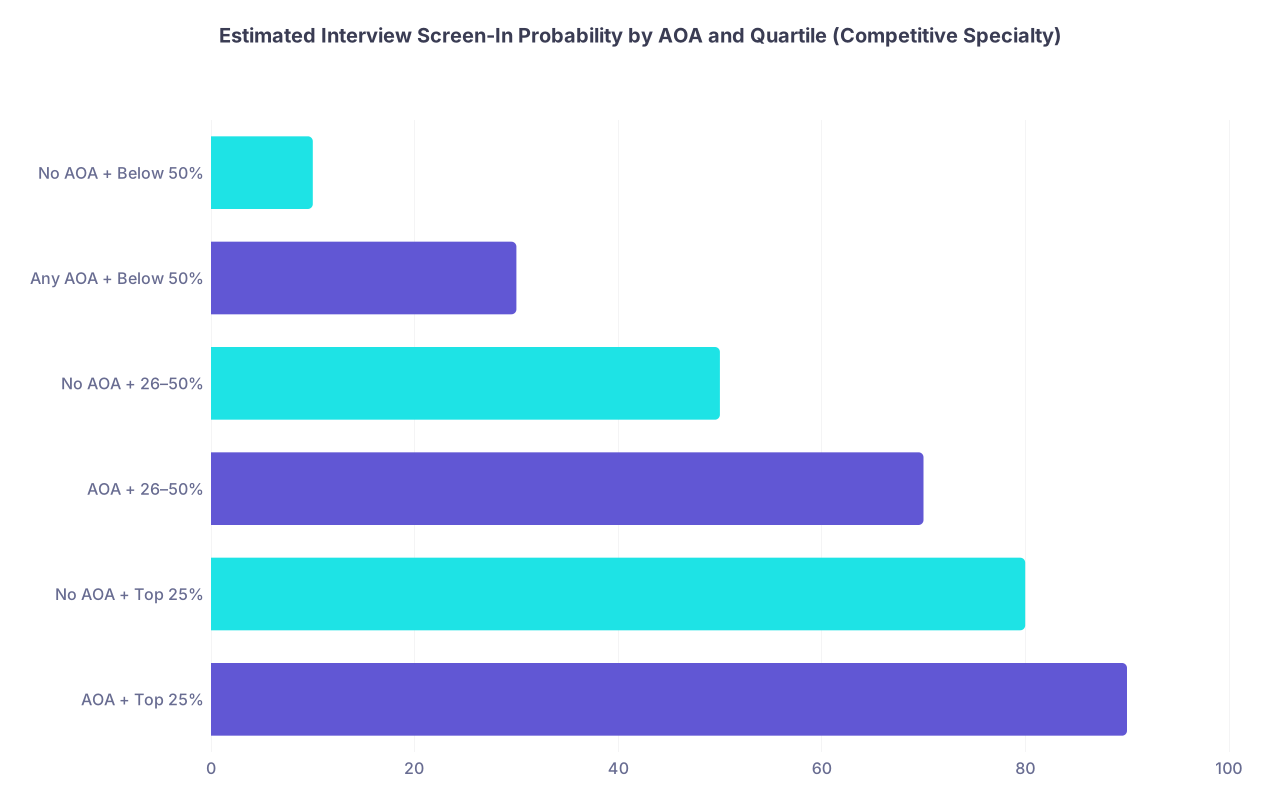
If you simulate this with a simple decision rule—“screen-in probability” as a function of quartile and AOA—you get something like this:
| Category | Value |
|---|---|
| AOA + Top 25% | 90 |
| No AOA + Top 25% | 80 |
| AOA + 26–50% | 70 |
| No AOA + 26–50% | 50 |
| Any AOA + Below 50% | 30 |
| No AOA + Below 50% | 10 |
The headline from this chart:
Top 25% without AOA is not actually a disaster. Bottom half with AOA is not a magic rescue. AOA mainly sharpens an already good profile or rescues a borderline candidate in the upper half of the class.
So where do letters of recommendation enter? They are the tiebreaker once the crude filters do their job.
LORs: The High-Variance, High-Leverage Variable
Letters behave differently from AOA and rank.
AOA and rank are low-variance, low-noise institutional summaries. LORs are high-variance and noisy. One PD’s “excellent” is another PD’s “generic.” Some letter writers overinflate; others are brutally calibrated.
But patterns still emerge when you read enough of them:
- There are “class-of-the-decade” letters that essentially override mediocre rank.
- There are generic “worked with us, did fine” letters that quietly kill any hope of competing at top programs.
In surveys, PDs often rank LORs in the top 3 factors for deciding whom to rank highly. Why? Because letters integrate things that numbers cannot:
- How you functioned on the team.
- How quickly you learned.
- How you handle responsibility and pressure.
- Whether the writer would rehire you.
A strong stack of letters often changes your outcome within the set of programs that already interviewed you. Less so in getting the interview at scale, though they matter at the margins.
Informal scoring of LORs
When PDs or faculty talk behind closed doors, they mentally categorize LORs into roughly three buckets:
- Tier 1: “Top 10% / best I have worked with / I would recruit this person tomorrow” – specific examples, strong comparative statements.
- Tier 2: “Strong / very good / above average” – positive but not electrifying.
- Tier 3: “Competent / did what was asked / solid” – polite but not enthusiastic.
Map those tiers to our earlier composite scores:
- Tier 1 across ≥2 specialty letters → LOR score = 2
- Mix of Tier 1 and Tier 2 → 1.5 (effectively 2 in many models)
- All Tier 2, no red flags → 1
- Any Tier 3, or clearly generic letters → 0
Now overlay that onto rank and AOA.
How Different Combinations Actually Play Out
This is where the interaction matters. Let me walk through some concrete archetypes I have seen in real match cycles across medicine, surgery, and subspecialties.
Profile 1: No AOA, top 25%, phenomenal letters
- AOA: 0
- Rank: 2
- LORs: 2
- Composite: 4
What the data show: This profile matches extremely well in both competitive and less competitive specialties, often indistinguishable from AOA candidates at the rank list level.
PD behavior: “They are not AOA, but the letters are off the charts and they are top quartile. Good enough.”
Outcomes:
- In less competitive fields: very high match probability at preferred tier of programs.
- In competitive fields: strong match probability if Step scores and research are aligned.
This is the classic “coverage” scenario. LORs close the AOA gap.
Profile 2: AOA, 26–50%, mixed letters
- AOA: 2
- Rank: 1
- LORs: 1
- Composite: 4
Data reality: Similar composite to Profile 1, but the texture is different. You have a strong institutional endorsement (AOA) but not uniformly strong on-the-ground impressions.
PD sentiment sounds like: “They are clearly smart and did well preclinically / on exams, but the letters suggest they were not the absolute standout on the rotation.”
Outcomes:
- Interview invites: quite good, especially at programs that trust institutional honors heavily.
- Rank position: may slide compared with someone whose letters are consistently enthusiastic.
It is still a good profile. But you will feel the drag of “good, not spectacular” narrative when someone else in the stack has multiple glowing, detailed letters.
Profile 3: No AOA, 26–50%, elite specialty letters
- AOA: 0
- Rank: 1
- LORs: 2
- Composite: 3
This is the classic “late bloomer” or “rotation superstar” pattern. Mediocre overall rank, but you absolutely crushed your home sub-I and an away rotation.
You see this surprisingly often in competitive fields: ortho, ENT, neurosurgery.
PD reaction: “Academic record is middle of the road, but Dr X and Dr Y are going out of their way to push this person. That carries weight.”
Data pattern:
- Less competitive specialties: this is more than enough; you will match, often well.
- Competitive specialties: this profile becomes heavily dependent on fit, networking, and interview performance. You are no longer automatic, but you are very much in the game.
In probability terms, composite 3 to 4 is a meaningful step up, but when backed by letters from big-name faculty, the effective impact can look like a 4.
Profile 4: No AOA, bottom 50%, stellar letters
- AOA: 0
- Rank: 0
- LORs: 2
- Composite: 2
Now you are asking letters to do too much. The file reads as inconsistency.
PD thought process: “Why did a bottom-half student suddenly become the best resident material on this rotation? Was it one easy evaluator? Was the grading at their school weird? Is this a fluke?”
Outcomes:
- Less competitive specialties: still very salvageable, especially if Step 2 and interview are strong.
- Competitive specialties: these applicants mostly match outside the top-tier programs or fail to match if the rest of the application is average.
That said, in smaller fields, a one-on-one advocate with a powerful letter can override this—but that is a high-variance play, not a reliable strategy.
Profile 5: AOA, top 25%, mediocre letters
- AOA: 2
- Rank: 2
- LORs: 0–1
- Composite: 4–5 on paper, but emotionally it reads like a 3–4
This one fools applicants. They think AOA + high rank is a guarantee. It is not, once letters are merely lukewarm.
Behind the scenes, I have heard this exact phrase:
“They look incredible on paper, but none of the letters are willing to stick their neck out. That makes me nervous.”
Programs have been burned by residents who were exam stars and quietly bad teammates. Weak letters on this kind of file trigger that fear.
You still match very well, but you may underperform your “statistical ceiling”—fewer top-10 interviews, more mid-tier programs on your final list.
Specialty-Specific Sensitivity to AOA, Rank, and LORs
Not all fields interpret this trio the same way. The data and PD surveys show clear clustering.
| Specialty | AOA Importance | Rank Importance | LOR Importance |
|---|---|---|---|
| Dermatology | High | High | Very High |
| Orthopedic Surgery | High | High | Very High |
| ENT | High | High | Very High |
| Internal Medicine | Moderate | High | Very High |
| Pediatrics | Low–Moderate | Moderate | Very High |
| Family Medicine | Low | Moderate | High |
Exact percentages vary by cycle, but the pattern is stable:
- Hyper-competitive surgical and subspecialty fields: AOA and rank serve as brutal early filters. Letters then stratify top vs top-top candidates.
- Medicine and core specialties: Rank carries more weight than AOA. Letters dominate where you fall within the programs that interview you.
- Primary care fields: AOA matters very little. Rank matters mainly at highly academic programs. Letters and perceived fit drive most of the outcome once minimal academic thresholds are met.
The more competitive the specialty, the more your composite “academic reputation” score matters. The less competitive, the more your LORs and personal fit can compensate for non-elite metrics.
How to Optimize Each Lever Based on Where You Stand
You cannot retroactively change AOA or rank. But you can absolutely change how your letters are generated and what story the trio tells together.
Think in if–then branches, not vague advice.

| Step | Description |
|---|---|
| Step 1 | Start: Know AOA + Rank |
| Step 2 | Focus on LORs + Step 2 + Fit |
| Step 3 | Protect with strong specialty LORs |
| Step 4 | Use LORs to signal top tier anyway |
| Step 5 | Pick rotations where you can excel visibly |
| Step 6 | Target higher-tier programs confidently |
| Step 7 | Leverage advocates in personal statements |
| Step 8 | Top 25%? |
| Step 9 | AOA? |
If you are top quartile (with or without AOA)
Your risk is not numbers. Your risk is being forgettable on rotations and ending up with “good but generic” letters.
Your moves:
- Choose letter writers who saw you on your hardest days, not just easiest rotations.
- Ask directly if they can write you a “strong, detailed letter.” If they hesitate, pivot.
- On sub-I and away rotations, act like an intern: own tasks, anticipate needs, and let residents see you thinking.
The data show that among applicants with similar AOA / rank, those with explicitly “top 10% / best of my career” style letters cluster at the top of rank lists. It is not subtle.
If you are 26–50% or lower, no AOA
You cannot win with generic letters. You simply cannot. The odds collapse.
Your strategy is concentration:
- Pick 1–2 rotations in your intended specialty where you can be visibly outstanding.
- Over-communicate your interest, read before every case or clinic, and ask for feedback mid-rotation, not on the last day.
- Target letter writers known to advocate strongly and who are recognized by programs in your specialty.
In numbers: for a mid-quartile applicant, moving LORs from “generic” to “genuinely outstanding” effectively shifts your match probability curve up by 15–25 percentage points in many models, especially in moderately competitive specialties.
Where People Misjudge Risk
Two common, data-inconsistent beliefs:
“No AOA means I am dead for competitive specialties.”
False. AOA is a useful bonus, not a prerequisite. Top 25% + strong LORs + good Step 2 routinely match in competitive fields without AOA.“Great letters can fix terrible rank everywhere.”
Also false. They can open doors and rescue you at individual programs, but global probabilities still drop sharply below the top half of the class, especially if Step 2 is average.
Think in distributions, not anecdotes. There will always be the story of the bottom-half, no-AOA applicant with an insane letter who matched plastics at a top program. That is an outlier, not a plan.
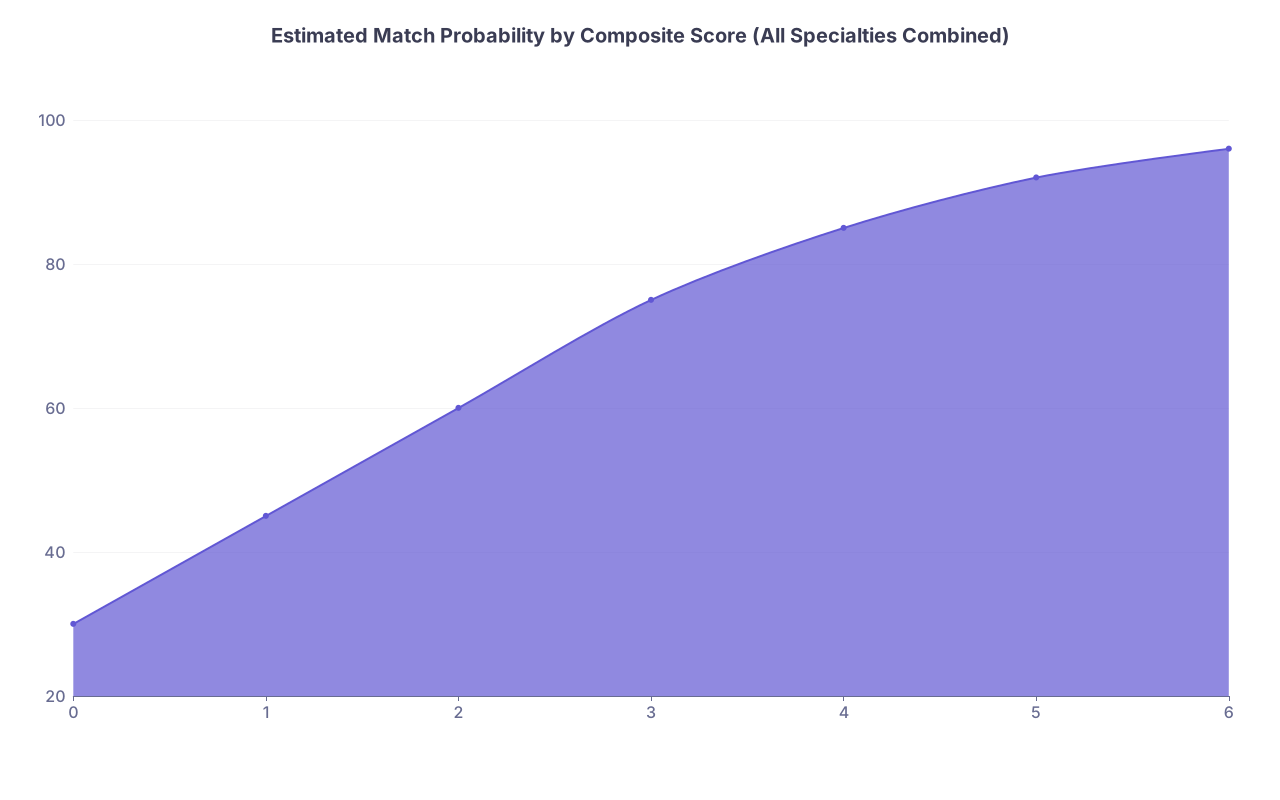
To keep perspective, imagine the cumulative effect:
| Category | Value |
|---|---|
| 0 | 30 |
| 1 | 45 |
| 2 | 60 |
| 3 | 75 |
| 4 | 85 |
| 5 | 92 |
| 6 | 96 |
That curve is what you are moving along with AOA, rank, and LORs. You are not teleporting from 0 to 6 with one heroic rotation.
How to Interpret Your Own Profile Realistically
Here is how I suggest you self-assess, framed like an analyst, not a cheerleader:
Assign yourself a crude “rank score”:
- Top 25% → 2
- 26–50% → 1
- Below 50% → 0
AOA:
- AOA → +2
- No AOA at AOA school → +0
- No AOA because school has none → treat as +0 but mentally discount the stigma; PDs know.
Estimate your likely LOR tier:
- Did a specialty faculty member tell you explicitly, “I will write you a very strong letter” and they have done so for past successful applicants? Likely 2.
- Did they vaguely agree without enthusiasm? Likely 1.
- Are you defaulting to whoever you worked with, regardless of what they think? Risk of 0.
Be honest. Add the numbers. Then compare to the charts above and reality-check your specialty and program list:
- Composite 5–6 + strong Step 2 → you can aim high in most fields, with a few reaches.
- Composite 3–4 → competitive in many programs, but in hyper-competitive specialties you must be strategic, not delusional.
- Composite 0–2 → you need either a less competitive field, a very strong network / mentor advocacy, or a willingness to reapply.
It is not fatalism. It is calibration.