
What do you do when your ERAS shows a 9‑month gap and you need attendings to explain it for you?
If you took extended leave in med school or during residency—health, family, remediation, personal crisis—you already know the fear: that dead space on your CV feels radioactive.
You can write a personal statement. You can prep talking points. But there’s one thing that carries more weight than anything you say about yourself:
A strong, specific letter of recommendation that directly and calmly explains the gap—without making you look unstable, unprofessional, or risky.
Let me walk you through exactly how to do that.
Step 1: Get brutally clear about your actual situation
You cannot ask for the right letter until you understand your own narrative in concrete terms. Not vibes. Facts.
You should be able to answer, in 1–2 sentences each:
What kind of leave did you take?
- Medical (physical or mental health)
- Family (caregiving, bereavement, childcare)
- Academic (remediation, repeating a year, Step failure)
- Personal (burnout, career doubt, religious mission, military, pregnancy)
How long was the gap?
- 3 months?
- 6–12 months?
- More than a year?
What’s the current status?
- Fully completed all requirements and cleared to graduate?
- On track to graduate after extended curriculum?
- Returned from leave and back in good standing?
What are program directors actually worried about with someone like you? Usually:
- Reliability: Will you show up? Finish residency?
- Stability: Is this problem ongoing?
- Performance: Did this leave mean you’re weaker clinically or academically?
- Professionalism: Was there misconduct?
Once you can name those fears, you know what your letters must quietly address.
Step 2: Decide which type of letter you actually need
Not every letter writer should talk about your gap. In fact, most shouldn’t.
You’re generally looking for:
- One letter that explicitly and professionally addresses the leave/gap.
- Two or three letters that simply make you look like a strong, reliable resident.
You’re trying to avoid an application where:
- Your personal statement references a “difficult year,”
- Your MSPE mentions “extended time,”
- And none of your letters say a word about it.
That silence is loud. Program directors read it as: “Something happened. No one wants to touch it.”
So you need to pick:
- Who is best positioned to comment on the leave?
- Who is best positioned to comment on your performance after the leave?

Who should address the gap?
Ideal choices (pick 1, maybe 2):
- Dean of students or academic affairs dean
- Clerkship or sub‑I director who supervised you after you returned
- Program director (if you’re already a resident applying to a different specialty or restarting)
- Long-term mentor who knew about the leave and your recovery/progress
Who should not be the primary “gap explainer” unless you have no choice:
- A random attending from a two-week elective who barely knows you
- Someone who only saw you before the gap and has no idea how you did after
- A letter writer who seems uncomfortable discussing the situation
You want the person who can say, in essence: “Yes, there was an issue. It was addressed. I’ve seen this person since. They’re stable, capable, and safe to train.”
Step 3: Shape your core message first (before talking to letter writers)
You need one consistent, boring, professional story that’s reflected in:
- Your personal statement (brief, high-level)
- Your ERAS entries (dates are honest)
- Your MSPE (which you might not control)
- One key LOR (which you can influence)
If you cannot summarize your situation in 3–4 sentences, you’re not ready to talk to letter writers.
Use something like this as your own internal script:
- “I took a 7‑month medical leave in my third year for a significant health issue. The condition is now well-managed, I’ve been cleared without restrictions, and I successfully completed my core and sub‑internship rotations afterwards. Since returning, I’ve had no further interruptions and have performed consistently at or above the level of my peers.”
or
- “I extended medical school by one year after failing Step 1 on my first attempt. I passed on my second attempt and completed additional structured study and clinical exposure. Over the next year, I honored most of my clerkships and performed strongly on shelf exams, demonstrating that the academic issue has been fully addressed.”
You don’t hand that paragraph to your letter writer word-for-word. But you use it to keep your messaging aligned.
Step 4: Choose which letter should carry the gap explanation
You do not want every letter obsessing over your leave. That makes your gap the main character of your application.
You want one “anchoring” letter that quietly stabilizes the story.
Usually best choices:
- If your leave was institutional (remediation, policy, extended curriculum):
- Dean’s letter or a letter from academic affairs / student affairs
- If your leave was health or family-related:
- A dean or a trusted senior faculty member who knows the context
- If you’re a resident reapplying:
- Current program director or associate PD who can speak to your current performance and clarify any gap
Then you stack that with:
- Purely performance-focused letters talking about:
- How you did on ICU sub‑I
- How you function on wards
- Your work ethic, reliability, growth
| Situation | Best Gap-Explainer LOR |
|---|---|
| Med school extended for health | Dean of students |
| Step/COMLEX failure + repeat year | Academic affairs / dean |
| Family caregiving leave | Dean or long-term mentor |
| Remediation of a clerkship | Clerkship director |
| Residency transfer after leave | Current program director |
Step 5: How to actually ask someone to address your leave
You need to be direct, not vague. Most students do this wrong—they hint at it and hope the writer will magically say the perfect thing.
They won’t.
Use a structure like this when you email or meet:
- Briefly name the situation.
- Be clear what you’re asking for.
- Provide context and reassurance.
- Offer concrete bullets they can use.
Example email framework:
Dr. Smith,
I’m applying to Internal Medicine this ERAS cycle and would be very grateful for a strong letter of recommendation from you.
As you know, I took a medical leave during my third year and returned to complete my core rotations and sub‑internships. Program directors will see the gap in my training timeline, and I think your perspective, as someone who’s seen my performance since returning, would be especially valuable.
Specifically, if you’re comfortable, it would help if your letter could:
- Briefly acknowledge that I took an approved leave and have since returned in good standing
- Comment on my reliability, professionalism, and clinical performance after my return
- Reassure programs that I’m able to meet the demands of residency
I’ve attached my CV, ERAS draft, and a short summary of my leave and how I’ve progressed since. If you don’t feel you can address this strongly, I completely understand and would still value your feedback.
That last sentence matters. If they can’t write a strong letter, you don’t want them writing at all.
Step 6: What a good gap‑explaining letter actually looks like
Let me show you the difference.
Weak, vague, anxiety‑provoking
“During medical school, John took some time away from training and later returned to complete his rotations. While I cannot comment on the details of this time, he has done reasonably well since coming back.”
Program directors read:
- Something bad happened.
- Writer is hedging.
- “Reasonably well” = not strong.
Strong, calm, reassuring
“During his third year, John took an approved medical leave from training. Since returning, he has completed his remaining core rotations and two sub‑internships in Internal Medicine without interruption. I have personally supervised him during this period and can state confidently that he is fully able to handle the demands of a busy residency.
On the wards, John is reliable, prepared, and engaged. He arrives early, stays late when needed, and follows through on patient care tasks without prompting. His performance is comparable to, and often exceeds, that of his peers who did not have an interruption in training.”
See the pattern?
- Acknowledge the leave. One sentence. No drama.
- Emphasize “approved,” “completed,” “without interruption.”
- Compare you favorably to peers.
- Explicitly say you can handle residency.
If your issue was academic, the letter should do this:
“Maria’s medical education was extended after she initially failed Step 1. She responded by working closely with our academic support team, modifying her study strategies, and ultimately passing on her next attempt. Since then, she has honored 4 of 6 core clerkships and scored at or above the national mean on the majority of her shelf exams. I view the prior failure as an isolated academic challenge that she has clearly overcome, not a reflection of her current or future potential.”
Again: past issue, specific response, concrete outcomes, clear conclusion.
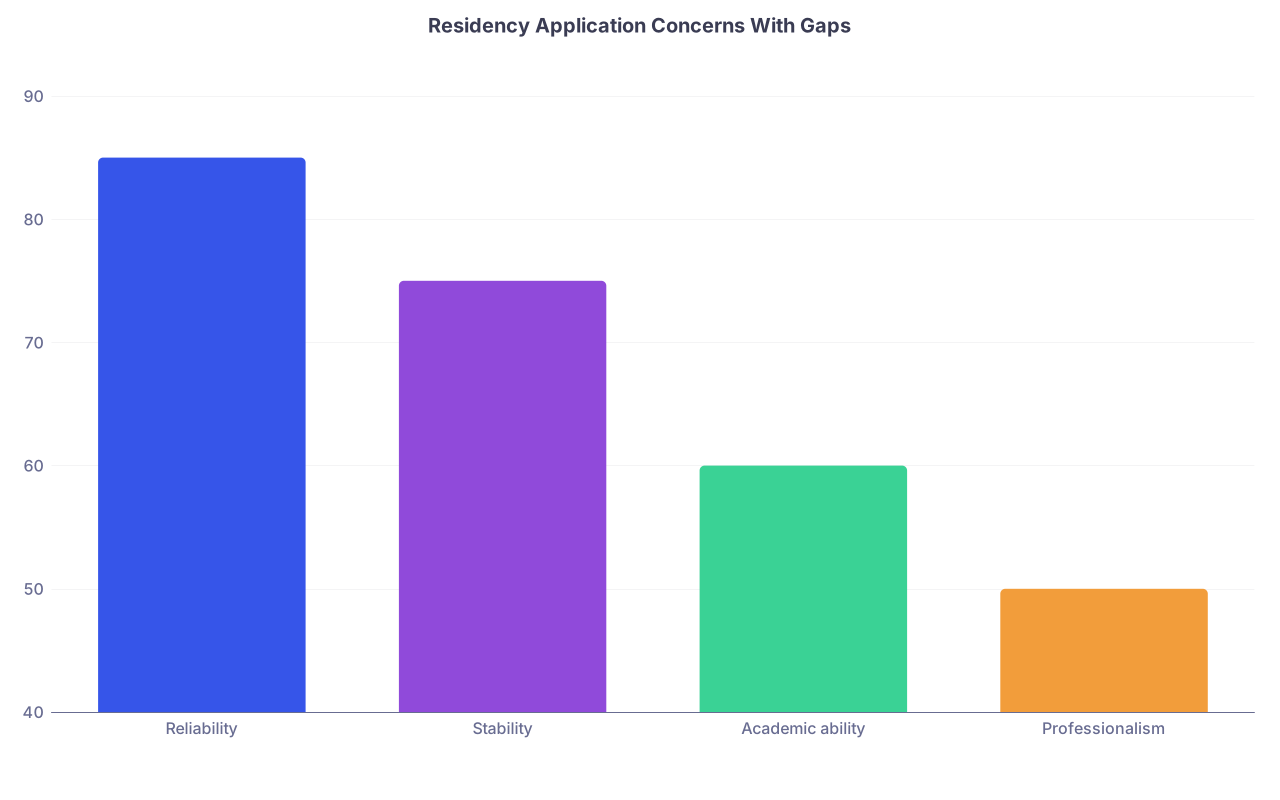
| Category | Value |
|---|---|
| Reliability | 85 |
| Stability | 75 |
| Academic ability | 60 |
| Professionalism | 50 |
(Those are roughly the weighted concerns you’re trying to neutralize.)
Step 7: What not to have in your letters about the gap
There are several ways your letters can accidentally hurt you:
- Oversharing personal medical details
- You do not want “treated for major depression with hospitalization” in a letter. Ever.
- Emotional overshoot:
- “Despite major personal struggles and emotional instability, she is trying very hard.”
- Backhanded reassurance:
- “I believe he will likely be able to complete residency if given sufficient support.”
- Vague mystery:
- “He faced some serious challenges that I’m not at liberty to discuss.”
- Overselling “resilience” while undercutting competence:
- “She’s very resilient, even though her performance can be inconsistent.”
Your job when you brief your letter writer is to steer them away from landmines like that.
You can literally say in a meeting:
- “I’m comfortable with you mentioning that I took an approved medical leave and that I’m now back in good standing. I’d rather not have specific medical details in the letter. It would be especially helpful if you could focus on how I’ve performed on rotations since returning and your view on my readiness for residency.”
Most attendings will be relieved you said it so clearly.
Step 8: Align your LOR with your personal statement and interviews
Letters don’t live in a vacuum. Committee members read them alongside:
- Your personal statement
- Your CV / timeline
- Your MSPE / transcript
- Your interview answers
So if your letter says:
“This was an isolated, resolved issue.”
You cannot go into interviews sounding:
- Uncertain if you can handle the workload
- Shaky about your readiness
- Emotional and unfocused when asked about it
You also cannot write a personal statement that romanticizes your crisis for drama while your letter keeps it clinical and resolved.
Keep it consistent:
- Personal statement: 2–4 sentences about the gap, framed around growth and insight, not trauma dumping.
- Letter: 2–4 sentences acknowledging the gap, then lots of detail about current competence.
- Interview: 20–40 seconds of clear explanation, then a pivot to: “Here’s how I’ve performed since, and here’s why I’m ready now.”

| Step | Description |
|---|---|
| Step 1 | Gap in Training Timeline |
| Step 2 | Personal Statement |
| Step 3 | LOR from Key Faculty |
| Step 4 | Interview Answer |
| Step 5 | Consistent Story |
Step 9: If your school is unhelpful or your dean refuses to be explicit
This happens more than people think. Some schools are lawsuit-phobic and will barely acknowledge anything.
If your dean says: “We don’t comment on individual leaves in letters,” then:
- Accept that you won’t get the ideal dean letter you wanted.
- Pivot to finding another senior faculty member who:
- Knows you
- Supervised you after your return
- Is willing to be more direct
You can still use the dean’s letter for the standard institutional overview and rely on:
- A clerkship director
- Sub‑I director
- Department vice chair
- Program director (if you’re a resident)
to be the “gap explainer.”
Programs care way more about how you actually show up on the wards now than about whether your dean is eloquent.
Step 10: Special situations and how to handle letters in each
1. Mental health leave
You don’t need the letter to say “depression,” “anxiety,” “bipolar,” etc.
Better language:
“He took an approved medical leave and has since returned fully able to meet the demands of clinical training, without restrictions.”
What matters most:
- No current performance issues
- No recent reliability problems
- Someone senior vouching that you’re stable and safe
2. Pregnancy / parental leave
Often this is the least problematic type of gap, but bias is real.
Your letter can simply say:
“She extended her training timeline by one year due to parental responsibilities and has since successfully completed all required rotations. Her performance on return has been excellent, and I have no concerns about her ability to meet the demands of residency.”
You don’t need a whole saga. They just need to know it’s not code for something worse.
3. Step failure + extended year
Here the letter absolutely has to hit academic performance after the failure.
You want:
- Shelf scores
- Clerkship grades
- Concrete study changes
- Evidence you don’t crumble under pressure anymore
Bad version:
“He struggled academically but has worked hard to improve.”
Good version:
“After initially failing Step 1, he passed on his second attempt and went on to honor Medicine, Surgery, and Pediatrics with shelf scores all above the national mean. This pattern reassures me that his initial failure does not reflect his current capability.”
4. Residency transfer or reapplication after leave
This is higher-stakes. Programs are scared of bringing in someone who might leave again.
You need your current PD or APD to say, clearly:
- You’re not being pushed out.
- You’re functioning well now.
- Whatever happened is resolved or well controlled.
For example:
“Dr. X took a 4‑month medical leave during his PGY‑1 year. Since returning, he has completed all scheduled rotations without incident and has functioned at or above the expected PGY‑1 level. His decision to apply to another specialty reflects a change in career goals rather than a concern about his performance or professionalism in our program.”
If your PD won’t say that, you have a different problem—and you may need a candid advisor to help you strategize.
Step 11: Timing and logistics you should not screw up
Ask early. 6–8 weeks before ERAS submission is reality.
Meet in person or via video if possible when it’s a sensitive situation. Email alone is weak.
Send:
- Updated CV
- Brief summary of your leave (1–2 paragraphs)
- Your personal statement draft
- Any specific points you’d appreciate them addressing
Follow up once at 2–3 weeks if they haven’t uploaded.
Then once more closer to deadline if needed.
Don’t assume they wrote what you hoped. They might not. But your prep increases the odds.

The bottom line: how strong LORs neutralize your gap
You’re not trying to erase your gap. You’re not going to “hide” it. That’s impossible and trying just makes you look shady.
You’re trying to do three things:
Name it once, calmly, in a controlled way.
One key letter that acknowledges the leave and states clearly that you’re now in good standing and functioning at an appropriate level.Overwhelm the file with current evidence of reliability and competence.
Other letters that don’t even mention the gap—they just show you as the kind of resident programs want: shows up, does the work, works well with the team.Keep your story boringly consistent everywhere.
Same basic explanation in your personal statement, LORs, and interview answers. No drama. No contradictions. No mystery.
If you do that, most program directors will do exactly what you need them to do: shrug at the gap, accept that life happened, and focus on the version of you who shows up on their wards in July.