
The worst-kept secret in residency applications is this: a professionalism issue does not end your career. Mishandling it does.
If you’ve had a professionalism concern in medical school—formal write-up, remediation, note in your MSPE, failed rotation due to behavior, “professionalism concern” box checked—you’re not dealing with a theoretical problem. You’re dealing with real humans deciding whether to put you in front of patients at 3 a.m. And those humans will read your letters of recommendation.
So the game is not: “How do I hide this?” The real game is: “How do I make sure my letters directly or indirectly counterbalance it and restore trust?”
Let’s walk through how to do that step by step.
Step 1: Get Very Clear on What’s Actually in Your Record
Before you think about letters, you need to know exactly what exists in writing about your professionalism issue. Vague anxiety helps nobody.
Do this in concrete terms:
Request/Review your MSPE (Dean’s Letter) draft as early as your school allows.
Do not just skim the “Summary” paragraph. Read the “Academic History,” “Professionalism,” and any “Adverse Action” sections word for word. This is what programs will see.Get copies (or at least exact wording) of:
- Any professionalism committee letters
- Remediation agreements
- Course/clerkship evaluations that mention behavior, deadlines, communication, or teamwork
Clarify with your dean:
- Is the issue labeled as “professionalism concern,” “adverse action,” “disciplinary action,” or something softer?
- Is it described as resolved/remediated?
- Are there multiple mentions or only one?
You need to know whether programs will see:
- A one-line note buried in the MSPE (“Required professionalism remediation in MS2 year; successfully completed with no further concerns”)
vs. - A full paragraph outlining a probational period and multiple incidents.
Those are completely different situations. Your LOR strategy changes based on which you’re in.
Step 2: Choose Your Letter Writers Like You’re Building a Legal Defense
You are not just collecting “strong letters.” You’re constructing a credibility case.
You want at least one letter that can, explicitly or implicitly, say:
“This person shows up, behaves professionally, works well with staff, is coachable, and I would trust them with my patients.”
Think in categories:
Anchor Letter (Trust & Professionalism) This is the person who can most credibly speak to your reliability, integrity, and growth. Often:
- A clerkship director you worked closely with
- A sub-I attending who’s seen you on call
- A faculty advisor who supervised your remediation or follow-up work
Clinical Performance Letter (Day-to-Day Resident Behavior) Someone who’s seen you in the trenches:
- “Shows up early”
- “Owns their patients”
- “Communicates clearly with nurses”
- “Accepts feedback without getting defensive”
Specialty-Specific Letter (Fit for the Field) For your chosen specialty (IM, EM, Psych, etc.). This letter proves you’re not just “rehabilitated,” you’re actually good at the job you’re applying for.
If possible, you want at least one of your letters to come from someone in a position of authority (clerkship director, program director, department chair). Titles matter when there’s a professionalism question.

Step 3: Decide Who Knows What (and Who Needs to Know It)
Here’s the mistake I’ve seen repeatedly: students hide the professionalism issue from letter writers, then are shocked when programs still worry. Of course they do. Your letters sound generic and disconnected from the red flag in your MSPE.
If a professionalism issue appears in your MSPE or transcript, at least one of your letter writers should be fully aware of it and able to comment—ideally someone who can speak to your behavior after the incident.
You have three levels of disclosure:
Full Transparency Letter Writer
- They know the incident
- They know the remediation
- They’ve seen you since then
- They can explicitly reference your growth (even briefly)
Context-Only Letter Writer
- You tell them: “There’s a professionalism concern mentioned in my MSPE”
- You summarize what programs will see, but you do not need to dump every detail
- They focus their letter more heavily on professionalism and reliability, without necessarily describing the incident
Standard Letter Writer
- They don’t need to know the details if:
- The issue is minor/old
- It’s barely mentioned in your MSPE
- You’ve already got strong “rehabilitation” letters lined up
- They don’t need to know the details if:
Rule of thumb:
If the professionalism note is more than a single vague line, you want at least one letter writer who can speak to it knowingly. Otherwise your application looks evasive.
Step 4: How to Actually Talk to a Potential Letter Writer About It
You’re not confessing a crime. You’re giving them the information they need to write a useful letter.
You do this in three moves: brief facts, remediation, and current performance.
Script it out before you walk in.
Example for an in-person ask (which is better if possible):
Open with the ask, not the problem.
“Dr. Lee, I’m applying to Internal Medicine this cycle and I was hoping you’d be willing to write a strong letter of recommendation based on my performance on the wards.”If they seem open, then give the context.
“There’s one piece I want to be straightforward about, because it may appear in my MSPE. During my third year, I had a professionalism concern documented related to [brief, factual in 1–2 sentences: e.g., a missed mandatory session and delayed communication about it]. I completed formal remediation, which included [X, Y]. Since then, I’ve [stayed in good standing / had no further issues].”Connect it to what they’ve seen.
“You’ve seen my work on the [service] rotation since then, and I’m hoping you’d be able to comment on how I function in the clinical environment now—reliability, teamwork, responsiveness to feedback—because programs will understandably pay attention to that.”
Then shut up.
You’re not trying to convince them it was nothing. You’re giving them a clean, honest frame and then letting them respond.
If they hesitate even a little—long pause, vague answer, “I can write you a letter but I’m not sure how strong it will be”—do not use them. That’s your sign.
Step 5: What You Want Your Strongest Letter to Actually Say
No, you don’t get to write it yourself. But you can influence the themes.
When you ask for the letter, you can say something like:
“Because there’s a professionalism note in my MSPE, it would be particularly helpful if, where appropriate, you could comment on my reliability, communication with staff, and professionalism in patient care.”
You’re not telling them what to write; you’re highlighting what matters.
The ideal letter for someone with a past professionalism issue includes elements like:
Concrete observations:
“He arrived early for pre-rounds consistently and was prepared with updated information on his patients.”Explicit reassurance:
“I had no concerns about her professionalism or reliability during the month she spent on our service.”Growth arc (if they know about the incident):
“I am aware that [Student] previously required professionalism remediation; the student I worked with this year was conscientious, mature, and proactive about communication. I would not hesitate to have them care for my own family.”Comparison to peers:
“In professionalism and teamwork, he was in the top third of our rotating students this year.”
Programs read between the lines. If they see:
- MSPE: “Professionalism concern – completed remediation.”
- LOR: “Shows up. Never had a problem. I’d gladly have them on my team.”
That combination is far more reassuring than a vaguely flowery letter that could’ve been written for anyone.
Step 6: How to Handle It If the Professionalism Issue Was With a Potential Letter Writer
This is the trickiest situation: the attending, clerkship director, or site director who was directly involved in your professionalism issue is also someone in your specialty.
Do you ask them for a letter?
You ask only if:
- The relationship has clearly normalized since then
- They’ve seen substantial, sustained improvement
- They’ve given you positive feedback afterward (not just “you passed”)
You do not ask if:
- They still feel like a source of tension
- They barely know you outside the incident
- Their final evaluation was tepid or heavily qualified
If you’re unsure, have a blunt conversation:
“Dr. Patel, we worked through a professionalism concern during my rotation last year, and I appreciate your feedback during that time. I’m applying to Pediatrics now. Do you feel you know my work well enough since then to write me a supportive letter, or would you suggest I ask someone else?”
You’re giving them an easy out. If they hesitate, let them off the hook.
Sometimes, your best move is to get a letter from someone else in the same department who supervised you later and can implicitly counter whatever concern the first person had.
Step 7: Coordinate With Your Dean’s Office—Do Not Freelance
If your school has a dean for student affairs or a dedicated advisor for residency applications, you need them in your corner. Especially if there’s a professionalism entry in your MSPE.
Here’s what you do:
- Schedule a dedicated meeting labeled explicitly: “Residency strategy with professionalism concern.”
- Bring:
- List of potential letter writers
- Exact wording of the professionalism note
- Any positive evaluations since the incident
Ask directly:
- “From a program director’s standpoint, what type of letter will matter most for me?”
- “Who at this institution would be the strongest person to write about my professionalism and growth?”
- “Do you think anyone needs to address it explicitly in a letter, or is emphasizing my current performance enough?”
Some schools will even coordinate messaging—making sure the MSPE, dean’s note, and key LORs are aligned in how they talk about your professionalism.
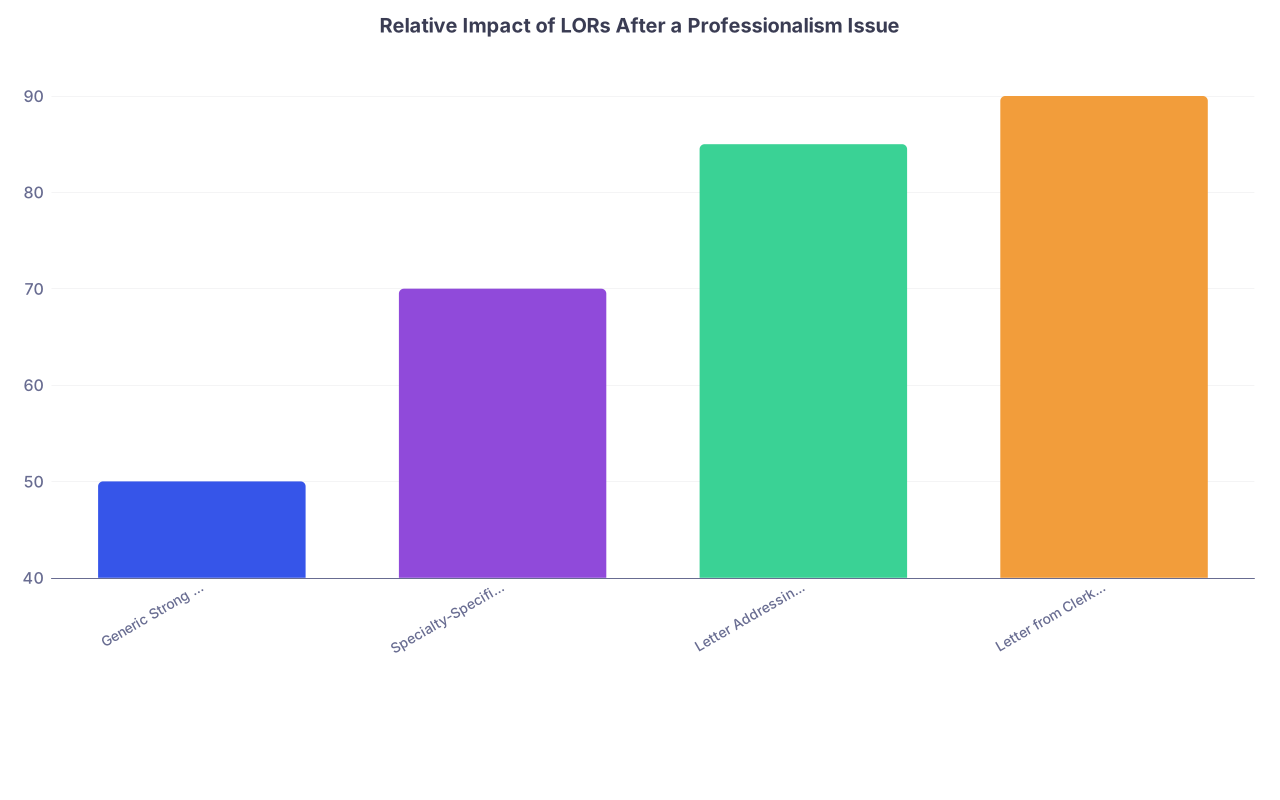
| Category | Value |
|---|---|
| Generic Strong LOR | 50 |
| Specialty-Specific LOR | 70 |
| Letter Addressing Professionalism | 85 |
| Letter from Clerkship Director | 90 |
Step 8: Don’t Over-Explain in Letters; Save Nuance for Your Personal Statement or Supplement
Letter writers are not there to relitigate your professionalism case. Overly detailed explanations in LORs can backfire and re-center the issue.
The right division of labor looks like this:
LORs
- Brief nod (if needed): “There was a prior professionalism concern that has been remediated.”
- Heavy emphasis on current behavior, reliability, teamwork, and trust.
- Clear reassurance: “I have no hesitation recommending this student for residency.”
Your Personal Statement or a separate supplemental essay (if a program offers one)
- Short, direct description of the mistake
- Clear ownership (no blaming)
- Concrete steps you took afterward
- How it changed your behavior going forward
Interview
- Consistent story with the above
- Calm, not defensive
- Ends focused on present professionalism, not past drama
Do not ask a letter writer to dump a full page defending the incident. That reads like damage control. You want them to sound like they’re describing a completely dependable resident, who happens to have a resolved issue in the record.
Step 9: Back Up Your Letters With Matching Behavior and Patterns
Programs look for patterns:
- Did problems continue after the remediation?
- Is there a mismatch between what the MSPE hints at and what letters say?
- Do the letters scream “generic” while the MSPE screams “concern”?
You help your letter writers and your application by:
- Making sure your post-incident rotations are solid, with no new professionalism flags.
- Showing up early, responding promptly to pages and emails, documenting clearly. Boring, but this is what “safe” looks like on paper.
- Asking for feedback during rotations: “Is there anything in my professionalism or communication I should be working on?” (Then fixing it immediately if they mention something.)
Your letters should feel like a natural extension of your recent track record, not a PR campaign pasted on top of a continuing mess.
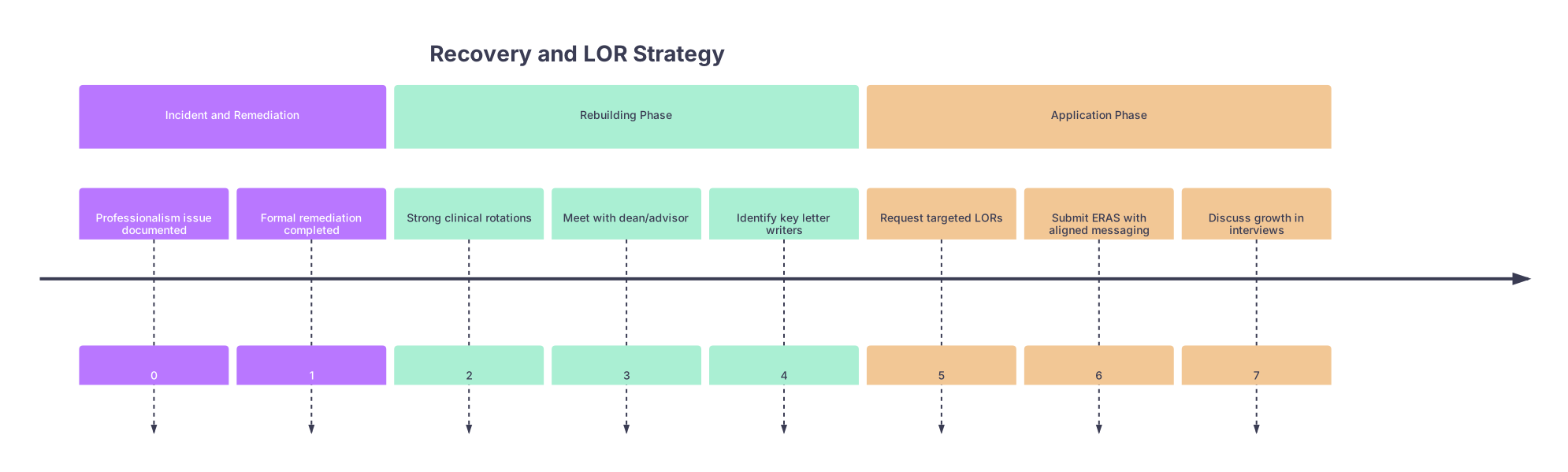
| Period | Event |
|---|---|
| Incident and Remediation - Professionalism issue documented | 0 |
| Incident and Remediation - Formal remediation completed | 1 |
| Rebuilding Phase - Strong clinical rotations | 2 |
| Rebuilding Phase - Meet with dean/advisor | 3 |
| Rebuilding Phase - Identify key letter writers | 4 |
| Application Phase - Request targeted LORs | 5 |
| Application Phase - Submit ERAS with aligned messaging | 6 |
| Application Phase - Discuss growth in interviews | 7 |
Step 10: Programs Read These Situations More Nuanced Than You Think
I’ve sat in rooms where program leadership discussed applicants with professionalism flags. The conversation is rarely: “They had a professionalism issue, reject.” It’s more like:
- “Was it a one-time lapse or a pattern?”
- “Was it something fixable (lateness, documentation, communication) or deeply concerning (dishonesty, harassment, boundary violations)?”
- “Do their letters support the idea that they’re safe and coachable now?”
- “Would I be comfortable handing them the pager?”
Your letters of recommendation are your best shot at transforming you from “risky file” to “recovering but now solid candidate.”
So if you’re in this situation right now, here’s the compressed action plan:
| Step | Action |
|---|---|
| 1 | Get exact wording of your professionalism entry in MSPE |
| 2 | Meet with dean/advisor to plan message and letter strategy |
| 3 | Identify at least one writer who can vouch for your professionalism post-incident |
| 4 | Be honest but concise with that writer about the issue and remediation |
| 5 | Ask all writers to emphasize reliability, teamwork, and communication where appropriate |
And no, you’re not the only one. Plenty of residents with past professionalism flags are now excellent attendings. The dividing line was not whether they were perfect in med school. It was whether they handled the fallout like adults, got real about what needed to change, and then made sure their letters told that story.
You’ve got one job now: build an application where your letters, your MSPE, and your interviews all say the same thing—
Yes, something happened.
No, it’s not ongoing.
Here’s the person I am now.
Once you’ve put that structure in place, the next step is learning how to answer professionalism questions in interviews without flinching or rambling. That’s the next stage in this process. And it’s where you’ll either confirm the trust you’ve started to rebuild—or blow it. But that’s a conversation for another day.