
The worst letters of recommendation after a failure are the ones that pretend nothing happened.
You failed a course or exam. That’s already in your file. The real move now isn’t to hide it; it’s to choose letter writers who can credibly argue why your failure is not the full story—and why you’re safe to train.
This is about damage control with precision, not wishful thinking.
Let’s walk through how to choose LOR writers wisely if you’ve got a fail (or more than one) on your record.
Step 1: Get Clear On What You’re Actually Up Against
Before you even think about letter writers, you need to be brutally honest about what’s on the table.
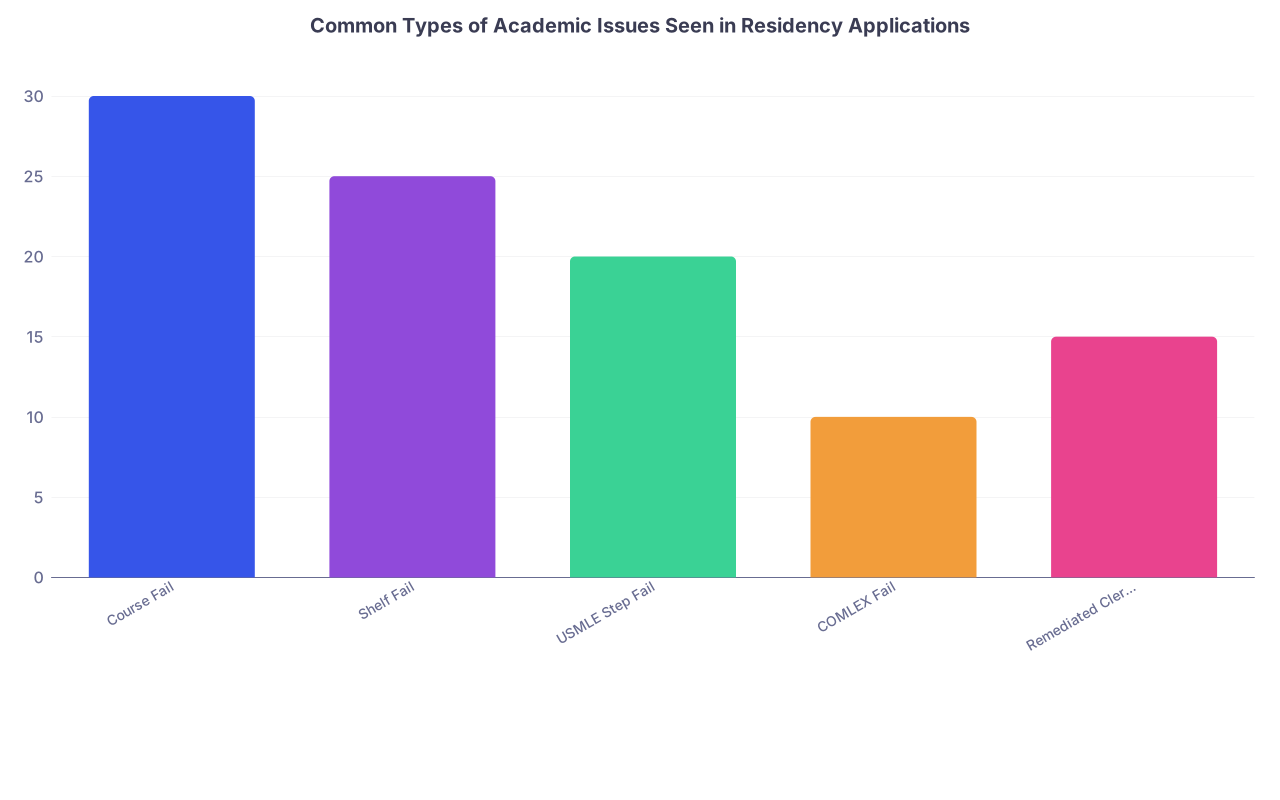
| Category | Value |
|---|---|
| Course Fail | 30 |
| Shelf Fail | 25 |
| USMLE Step Fail | 20 |
| COMLEX Fail | 10 |
| Remediated Clerkship | 15 |
Here’s how programs tend to mentally sort failures (even if they never say it out loud):
Single preclinical course fail, remediated
Translation: “Probably an adjustment issue. Show me upward trend and maturity.”Clinical course/clerkship fail
Translation: “Was this professionalism? Patient safety? Interpersonal? That worries me.”Shelf exam or block exam failure
Translation: “Maybe test-taking. Maybe study habits. Is there improvement?”USMLE/COMLEX Step fail (any of them)
Translation: “Risk. Will this person pass the next big exam and our boards requirement?”Multiple failures over time
Translation: “Pattern. Why? Have they actually changed?”
You cannot pick letter writers intelligently unless you know which of these buckets you’re in and how serious it looks from the program’s side.
If your failure is in the “risk to board pass rates or patient care” category (Step fail, clinical fail, repeated issues), you need your letters to do three things clearly:
- Acknowledge there was a concern
- Provide specific evidence of improvement or reliability
- Explicitly state confidence in your ability to handle residency
Vague “hardworking and compassionate” letters will not cut it for you. They hurt you more than they help.
Step 2: Decide Whether a Letter Should Address the Failure Directly
Not every letter needs to talk about your failure. But at least one should—if:
- The failure is significant (USMLE/COMLEX, core clerkship, professionalism concern), or
- It appears more than once
Here’s the rule I use when advising students:
If the failure is something PDs will raise their eyebrows at during the 30-second ERAS screen, you want at least one letter that anticipates that concern and answers it.
When a letter should address the failure
You want this if:
- You failed Step 1 or Step 2, but then improved by 20+ points on the retake
- You failed a clerkship early, then got Honors/High Pass in the same or similar clerkship later
- You struggled with preclinical coursework, then crushed clinical rotations or sub-I’s
In those situations, a strategic letter can turn a red flag into a “growth and resilience” story, if the writer actually saw the change.
When a letter should not dwell on your failure
If your fail was:
- One preclinical course from M1, remediated, and your record since then is clean
- A borderline shelf you retook with no other academic issues
- An early, one-off stumble with strong performance after
Then you let your personal statement or MSPE/Dean’s letter do the contextualizing, and you keep most of your specialty letters focused on: clinical performance, fit for the field, and current capability.
But here’s the nuance: you do not want multiple letters fixating on your failure. One well-placed, well-framed letter is enough. Any more and it starts looking like damage control rather than strength.
Step 3: Build a Prioritized List of Potential Letter Writers
You cannot just grab “whoever likes me.” That’s how you end up with three lukewarm “pleasant to work with” letters that say nothing about your actual problem.
You want to think in roles:
- Primary specialty advocates – people in the field you’re applying to
- Credible rehabilitation witnesses – people who saw you after the failure and can testify to growth
- Character references with long-term perspective – faculty or mentors who know your trajectory over time
| Type of Writer | Best Use Case |
|---|---|
| Specialty Attending | Core strength, fit for the field |
| Sub-I/Acting Intern Attending | Current readiness for residency |
| Course/Clerkship Director | Contextualizing a past failure |
| Research Mentor | Work ethic, long-term growth |
| Advisor/Dean's Office | Global narrative, professionalism |
If you have a failure, your strategy isn’t just “get 3–4 letters.” It’s “build a balanced set of voices that collectively say: ‘Yes, this person had a setback. And yes, they are now safe and worth the risk.’”
Step 4: Who You Should Definitely Ask (with a Failure on Record)
1. The “I Trust This Person with Patients” Attending
You need at least one letter that screams: clinical safety, reliability, and solid judgment—especially if your failure was clinical or Step-related.
Ideal candidates:
- An attending from an acting internship/sub-I in your chosen specialty
- A senior attending who actually let you manage patients, present plans, and saw you follow through
- Someone you worked with for at least 3–4 weeks, not two random days on consults
You want this person to be able to say things like:
“I would not hesitate to have [Name] care for my own family.”
“They handled increased responsibility like a junior resident.”
“Their clinical judgment improved significantly over the month and is now at or above the level of their peers.”
That kind of language directly counters the “is this person safe?” concern.
2. Someone Who Saw You After the Failure and Can Compare
This is critical and often missed.
If your big problem was a Step fail, I want someone who knew you when you were studying for the retake or saw you functioning clinically after that fail.
If you failed a clerkship, I want someone who:
- Saw you on a later rotation in a similar setting
- Can implicitly or explicitly say: “Whatever was going on before, that’s not what I saw.”
Perfect example:
You failed Internal Medicine early M3. Later you did a Sub-I in Internal Medicine, worked like a resident, and the attending loved you. That attending is gold. You want that letter.
3. A Letter That Can Safely Address Context (If Needed)
Sometimes the only person who can speak honestly about why you failed is:
- A course/clerkship director
- A Dean’s office faculty
- A longitudinal advisor who has known you for years
This is the letter that can say, in a controlled way:
- You had a major life event (illness, death in family, etc.) that overlapped with your failure
- You had documented learning or health issues that are now treated and stabilized
- There were structural issues (e.g., you were in the first cohort of a brand-new curriculum) plus your own responsibility and later improvement
You do not let this letter become an excuse fest. You want it to read like: “There were reasons. The student owned it. They changed. They improved.”
Step 5: Who You Should Avoid Asking (Even If They “Love You”)
This is where people sabotage themselves.
Do not ask:
- The attending who only knew you before your failure and never saw the rebound
- Someone who’s famously lukewarm with letters or writes the same bland paragraph for everyone
- A faculty member who barely remembers you but said “Sure, I’ll sign something if you draft it”
And be very cautious with:
- The person directly involved in your failed course/clerkship if you did not have a strong recovery with them later
- Anyone who seemed ambivalent about your performance (“You were fine” is not the energy you need)
You’re not just asking “who will say yes.” You’re asking “who can carry the story I need told.”
Step 6: How to Approach Potential Letter Writers When You’ve Failed
You cannot approach this like everything’s normal. You need to be deliberate and slightly vulnerable, without turning it into a confessional.
Here’s a script you can adapt when emailing a potential writer who knows about your failure or your struggles:
Dear Dr. [Name],
I’m applying to [specialty] this cycle and I was hoping to ask you for a strong letter of recommendation. I really valued working with you on [rotation/project] and felt you saw me at a time when I was working to improve after some earlier academic difficulties.
I did have a [brief description: Step 1 failure / failed [course] in MS2 / etc.], which has since been remediated. Since then, I’ve [briefly highlight improvement: passed Step 2 on first attempt, received Honors in X, etc.].
If you feel you can comment positively on my current readiness for residency and, if appropriate, on my growth since that setback, I’d be very grateful for your support. If you don’t feel you can do that, I completely understand and appreciate your honesty.
Thank you for considering this,
[Name]
That last line? Critical. You want someone to say no if they can’t write you a strong letter. A lukewarm letter is worse than no letter.
Step 7: Give Them the Right Ammo (Especially If They’ll Mention the Failure)
Do not just send your CV and hope for the best.
For you, specifically, with a failure in your record, your letter writer packet should include:
- Your CV
- Your personal statement draft (even if it’s not perfect yet)
- A short “context and growth” summary (1 page max) that includes:
- What happened (brief, factual)
- What you did about it (tutoring, therapy, time management, medication, study-skills changes)
- Evidence of improvement (scores, feedback, later evaluations)
- What you want programs to understand about you now
You can literally write something like:
“I’m not looking for the letter to dwell on this, but if you feel it’s appropriate to briefly mention the setback and my subsequent improvement, I’d appreciate that context being part of my story.”
You are guiding, not scripting. If you try to hand them a full draft that spins everything, good attendings will smell it and get irritated.
Step 8: Align Letters with the Narrative in Your Application
Your letters can’t be telling a completely different story from your personal statement and MSPE.
If your personal statement says:
“I struggled with Step 1 due to poor study strategy, sought help, and improved significantly on Step 2.”
Then you do not want a Dean’s letter or LOR hinting heavily at “personal issues” or “medical problems” that you never mentioned. That discrepancy freaks programs out.
The story across documents should feel like:
- MSPE: Factual description of the failure and remediation
- Personal statement: Your internal story—what you learned, how you changed
- At least one LOR: External validation—someone else saying, “Yes, I saw the growth and here’s what it looks like in real life.”
To make this coherent, some people need to explicitly talk with the Dean’s office or advisor-type letter writer:
Ask them:
- “How are you planning to address my failed course / exam in your letter?”
- “I’m framing it this way in my personal statement: [briefly explain]. Does that align with how you see it?”
You’re not trying to control them; you’re trying to make sure you’re not telling two different stories.
Step 9: If You Have Multiple Failures, Tighten the Strategy
One failure is a stumble. Multiple failures are a pattern. Programs know the difference.
If you have more than one major academic problem (e.g., two course fails, or a Step fail plus a failed clerkship), you need:
- At least one letter strongly validating your current clinical performance
- One letter that explicitly addresses the pattern and why it’s no longer ongoing
- No letter that is totally generic—you can’t afford fluff
This is where a Course Director or Dean can be strategic:
They can say something like:
“Early in medical school, [Name] had significant academic difficulties, including [very brief mention]. Over the past two years, they’ve consistently demonstrated improved performance, as reflected in [Honors on X rotations / solid Step 2 score / strong clinical evaluations]. I have seen their work ethic and insight into their learning needs change substantially, and I believe they are now well-prepared for residency.”
That’s the kind of framing that makes a PD think, “Okay, they’re not hiding this. And there’s a clear before-and-after.”
Step 10: Timing and Logistics (Don’t Shoot Yourself in the Foot)
Logistics can quietly wreck you if you’re not careful.
Aim to:
- Ask your key writers early (at least 6–8 weeks before you need letters uploaded)
- Prioritize the ones who can speak to your recovery or current performance—those letters carry more weight in your situation
- Gently remind them 2–3 weeks before the deadline with a brief, respectful email
For you, I’d rather you have:
- Three very strong, coherent letters submitted on time
- Than four letters where one is weak or generic
If your school requires certain types of letters (e.g., a Department Chair letter), and that person doesn’t know you, make sure you’ve met with them, given them context, and maybe worked with them clinically or on a brief project if possible. The less they know you, the more your packet and story matter.
A Quick Example: How This Looks in Real Life
Let me sketch a composite scenario I’ve seen versions of:
- You failed Internal Medicine M3 due to a combination of poor time management and one bad eval from a particularly harsh attending.
- You remediated and passed.
- You then did an Internal Medicine Sub-I where you essentially functioned as an intern, got glowing feedback.
- You also failed Step 1, then passed Step 1 on second attempt and scored solidly on Step 2.
How do you pick letters?
You probably go with:
- Sub-I attending in Internal Medicine (core clinical strength, current ability).
- Another IM attending or subspecialty attending (e.g., Cardiology) where you did well and showed reliability.
- IM Clerkship Director or Dean’s letter writer who can briefly contextualize the fail + Step issues and affirm your growth and current readiness.
You do not chase a letter from the original failing attending. You don’t need that story resurrected by someone who doesn’t believe in you.
Final Tight Takeaways
- Do not pretend the failure never happened; pick at least one writer who can credibly show how you recovered and why it is no longer the headline.
- Prioritize attendings who saw you after your failure and can vouch for your current clinical competence and reliability.
- Coordinate your letters, personal statement, and MSPE so they tell one coherent story: setback, insight, action, and documented improvement that makes you safe to train.