
The way most unmatched applicants handle letters of recommendation is lazy and unsafe.
They tweak their personal statement, apply to more programs, maybe add one token new LOR. Then they’re shocked when they get the same result. If that was your last cycle, you’re not alone—but you cannot repeat that strategy.
You’re reapplying after going unmatched. Your LORs now have to do two jobs:
- Prove you’re a strong resident for this specialty.
- Quietly reassure programs you’re not a risky re-applicant.
Here’s how you rebuild that from the ground up.
Step 1: Diagnose What Went Wrong With Your Last LORs
Do not start by asking for new letters. Start by doing an autopsy on the old ones.
Get your old letters if you can
If your school or dean’s office will let you review old LORs confidentially (some do, some do not), do it. Sit in that office and actually read them. Take notes. I’ve seen people discover:
- “Solid student, hardworking” with zero detail
- “Pleasure to work with” but no residency-level endorsement
- Generic rotation descriptions copy‑pasted from evaluations
- Backhanded comments: “Will do well with close supervision,” “Improved during rotation,” “Quiet at times around patients”
If you cannot see the letters, then:
- Look at who wrote them. Were they actually influential in your target specialty, or just whoever was available?
- Ask a trusted faculty mentor or PD (if you have one willing to be blunt): “I used Dr. X, Y, Z last year—would you consider those strong letters?” Let them react.
Here’s a simple grid you can sketch on paper and fill from memory:
| Letter Writer | Specialty | Knew Me Well? (Y/N) | I Did Strong Work With Them? (Y/N) | Likely Strong/Generic/Weak |
|---|---|---|---|---|
| Dr. A | Target | N | ? | Generic |
| Dr. B | Target | Y | Y | Strong |
| Dr. C | Other | Y | Y | Generic |
| Dept Chair | Target | N | N | Weak/Boilerplate |
If more than one letter falls into “Generic” or “Weak/Boilerplate,” that’s a serious problem—and a fixable one.
Common LOR problems in unmatched applicants
I see the same patterns over and over:
- All letters from non‑target specialties
- Chair letter that’s 100% template, 0% personal
- Letters focused on being “nice,” “pleasant,” “team player” with no clinical teeth
- Red-flag coded language: “with support,” “within their limitations,” “not yet ready for independent responsibility”
If any of that smells familiar, rebuilding your LOR strategy is not optional. It’s mandatory.
Step 2: Decide Your Exact LOR Mix This Time
You need a clear target structure before you start chasing writers. Not “as many as possible.” Strategic.
For most reapplicants, this is the sweet spot (adjust for specialty rules):
- 3–4 total letters actually uploaded to ERAS
- 2–3 letters from your reapplying specialty
- 1 letter from another field or a general “clinical excellence” letter (IM, medicine sub‑I, transitional year, etc.)
If you’re changing specialties (for example, unmatched in Gen Surg, now applying IM), your entire LOR set must reflect the new direction—otherwise programs smell indecision and risk.
Here’s how different scenarios should look:
| Situation | Target LOR Set (3–4 letters) |
|---|---|
| Same specialty, no gap year job | 2 new letters in specialty, 1 strong prior, 1 IM |
| Same specialty, in prelim/TY | 2 from current program, 1 specialty, 1 old best |
| Switching specialties | 3 in new specialty/IM, 1 flexible |
| Big academic gap, in research | 2 clinical, 1 research, 1 flexible |
Notice the pattern: clinical letters beat everything. Research letters help, but they cannot carry an application by themselves unless you’re going for a research‑heavy field and already have strong clinical support.
Step 3: Identify Who Should Not Write Your New Letters
This is where people make the same mistakes twice.
You should NOT get a letter from:
- Someone who supervised you briefly and barely remembers you
- A “big name” who didn’t directly oversee your work
- A resident or fellow writing “on behalf of” an attending without real oversight
- An attending who previously wrote you a lukewarm letter
- A mentor who will write about your backstory but not your performance
If you were a so‑so student on a rotation or clashed with the attending, do not go back to them just because they’re famous. A slightly famous generic letter is worse than a strong, detailed letter from a mid‑level but engaged faculty member.
Step 4: Design the Next 6–12 Months Around Strong Letters
If you’re reapplying, your calendar now serves one purpose: create situations where attendings can see your work long enough, and closely enough, to write very strong, specific LORs.
Build real clinical contact
If you’re not currently in a clinical role, you need to fix that fast.
Options that actually move the needle:
- Prelim or transitional year position (if you matched there but not into advanced)
- Structured clinical fellowship year at your med school or teaching hospital
- Full‑time clinical research with built‑in patient contact and team involvement
- A well-run observership/externship with clear evaluation and letter potential
And no, two-week shadowing blocks stacked together are not equal to a solid, supervised month-long rotation.
Here’s the mental rule: you want at least 4–6 weeks of regular, substantial interaction with any potential letter writer.
Step 5: Prep Before You Ask – You Need a Story, Not Just a CV
Your ask is not “Can you write me a letter?”
Your ask is: “Can you advocate for me as a strong candidate for X specialty this coming cycle?”
Before you send a single email, assemble a tight packet for each potential letter writer:
- Updated CV
- Draft personal statement (or at least a one‑page “story” document)
- Brief bullet list (not an essay) of:
- What you did with them specifically
- One or two clinical cases where you shined
- Any teaching, leadership, QI, or research connected to their service
And you need one paragraph that directly addresses your reapplicant status. Something like:
“Last year I applied in Internal Medicine and unfortunately did not match. I’ve spent the past year working as a medicine prelim at X Hospital, focusing on improving my clinical efficiency, documentation, and independent management. I’m reapplying this cycle with stronger clinical evaluations and more targeted letters.”
Do not hide that you went unmatched. Programs know. Faculty know. Your job is to show growth, not pretend it did not happen.
Step 6: How to Actually Ask for a Strong LOR (Without Sounding Needy)
Email is fine. In‑person plus email is better. The script needs to be direct.
Here’s a version that works:
Subject: Request for Strong Letter of Recommendation for [Specialty] Residency
Dear Dr. [Name],
I’m applying (reapplying) to [specialty] this coming ERAS cycle and wanted to ask if you’d feel comfortable writing a strong letter of recommendation on my behalf.
Working with you on [rotation/unit/service] between [dates] was a major part of my decision to continue pursuing [specialty]. I learned a great deal from [specific example or aspect of your style/teaching].
I’ve attached my updated CV and a short overview of my work during the year since graduation, including my unmatched cycle last year and how I’ve tried to grow from that experience. I’m very open to feedback if you’d like to discuss whether you feel you can advocate for me strongly.
Thank you for considering this,
[Your Name]
AAMC ID: [ID]
The key phrase: “strong letter of recommendation.” It gives them an out. If they hesitate, that’s your answer—they’re not your writer.
Step 7: Reusing Old Letters vs. Demanding New Ones
This is tricky, and people screw it up constantly.
When you SHOULD reuse an old letter
You can reuse an old LOR if all of the following are true:
- The letter was clearly strong (based on feedback or direct review)
- The writer is well‑regarded in the specialty
- It doesn’t reference a specific application year
- You pair it with newer letters that update your story
If the letter starts “I write on behalf of Ms. X, who is applying in the 2024 Match…”—you either ask them to update, or you retire that letter.
When you MUST get a fresh letter
You need a brand-new letter if:
- You’re in a new clinical role (prelim/TY, fellowship, new hospital)
- You changed specialties
- Your performance has materially changed (for better or worse)
- Last cycle’s outcome was significantly below your target (no interviews, or only low-tier interviews)
Do not cling to mediocre letters out of nostalgia. Programs do not care that Dr. Famous wrote you something three years ago if it’s vague and outdated.
Step 8: What Programs Are Actually Looking for in Reapplicant LORs
This is the part most people never get told explicitly.
For a reapplicant, programs reading your LORs are scanning for:
Evidence of clinical growth.
Phrases like “noticeable improvement,” “has significantly advanced in efficiency and clinical judgment,” “functions at or beyond expected PGY‑1 level.”No red flags about professionalism.
They want reassurance: reliable, on-time, accountable, integrates feedback, no drama.Clear specialty commitment.
Actual language: “I strongly support Dr. X’s application to residency in [specialty] and would be happy to have them in our program,” not “they are exploring several options.”Comparative statements.
“Among the top 10% of students I’ve worked with in the last five years.”
“Comparable to our current categorical residents.”
If your current or most recent attendings can’t say things at that level, you have bigger issues than your LORs. You may need another year of focused clinical improvement before reapplying.
Step 9: Plan Your Timeline Backwards From ERAS
Do not ask for letters in September. That’s for people who are not serious.
You’re a reapplicant. You run on an earlier clock.
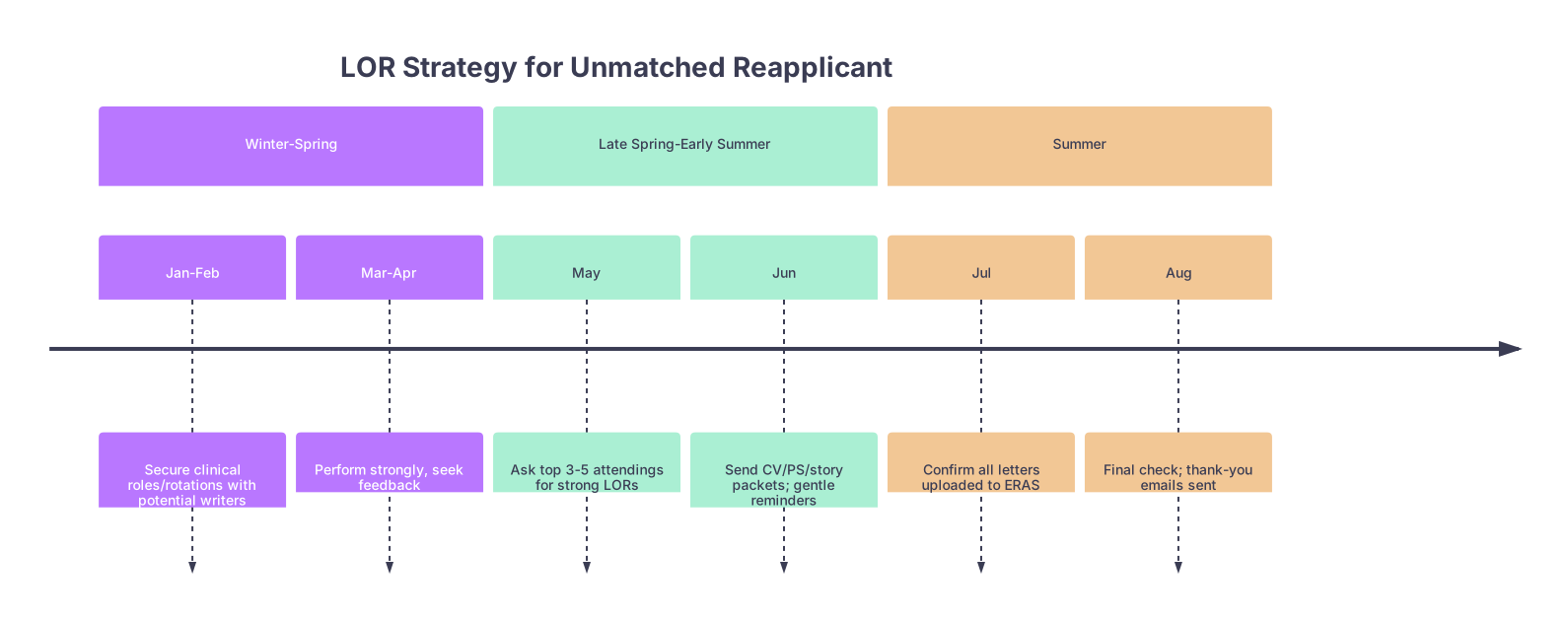
| Period | Event |
|---|---|
| Winter-Spring - Jan-Feb | Secure clinical roles/rotations with potential writers |
| Winter-Spring - Mar-Apr | Perform strongly, seek feedback |
| Late Spring-Early Summer - May | Ask top 3-5 attendings for strong LORs |
| Late Spring-Early Summer - Jun | Send CV/PS/story packets; gentle reminders |
| Summer - Jul | Confirm all letters uploaded to ERAS |
| Summer - Aug | Final check; thank-you emails sent |
Aim to have all requested by May–early June and submitted by July. That gives you buffer for slow writers and for redirecting if someone ghosts you.
Step 10: Special Situations and How to Handle Them
If you matched a prelim or TY but not advanced
You’re in a better spot than you probably feel.
Your most valuable letters will now be:
- Program director of your prelim/TY
- One or two attendings who’ve seen you handle floor/ICU/night responsibilities
- One legacy letter from prior specialty (if still relevant)
Be honest with your PD:
“I didn’t match last year in [specialty]. I’m reapplying this year and I want to make sure my LORs reflect how I’ve grown here. What would I need to show over the next few months for you to feel comfortable writing me a strong letter?”
Then actually go do those things. PDs remember that kind of conversation.
If you’ve been out of clinical work for a year or more
This is rough, but not impossible.
Your top priorities:
- Get back into structured clinical exposure where you are evaluated
- Do not lead with research letters; lead with whatever clinical supervision you can get
- If you have only one solid clinical writer, still get them, but you must aggressively pursue new, current clinical impressions
If the gap was for visa issues, family, illness, etc., you’ll need that context in your personal statement—but your letters should focus on present performance, not excuses.
If your school closed or you’re an older IMG
Then your recent clinical experiences matter more than whatever happened years ago. You probably need:
- 2–3 U.S. (or target country) clinical letters
- At least one from a setting similar to residency workload (inpatient, call, EM, etc.)
- Clear statements that you function at or above a PGY‑1 level
This population gets hurt badly by generic “observership” letters that just describe watching rounds. Avoid those like the plague.
Step 11: Use Data To See When Your LOR Strategy Is Working
You won’t get LOR feedback directly, but you can see the effect.
Track three numbers across cycles:
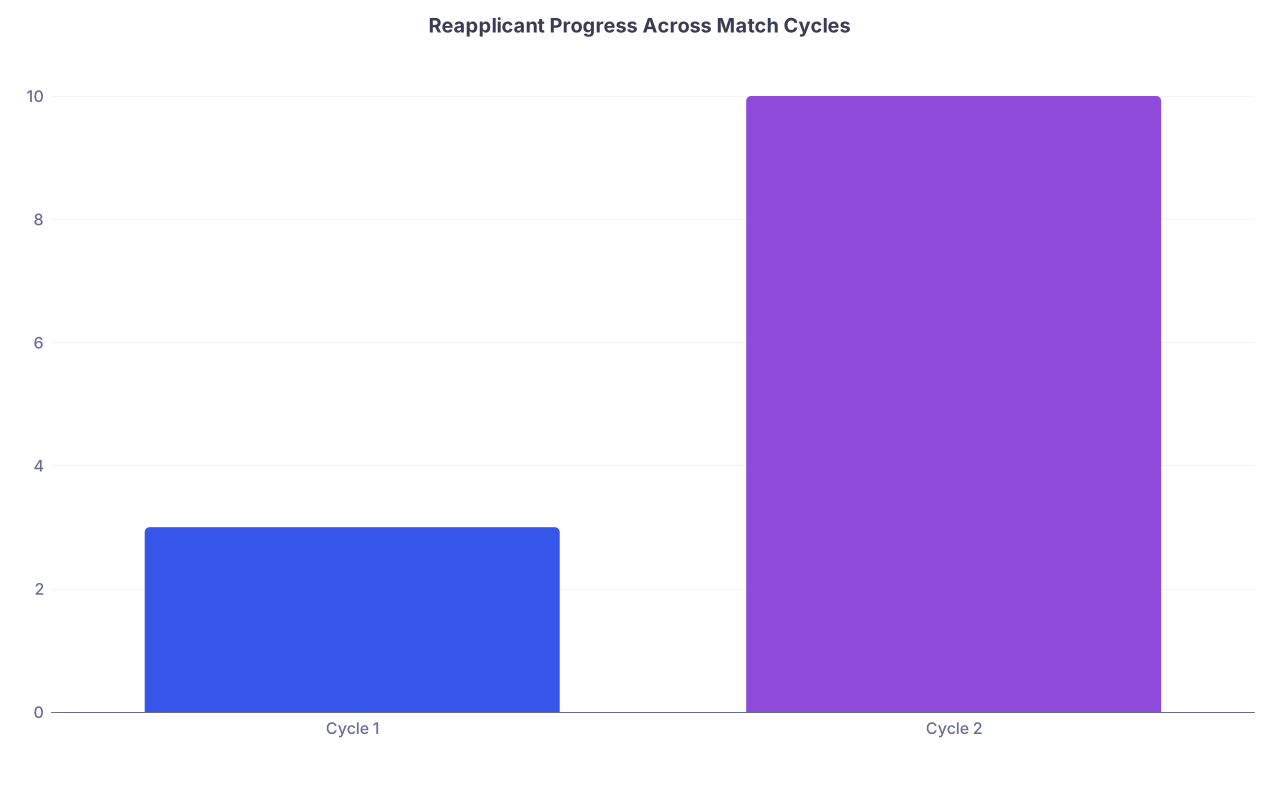
| Category | Value |
|---|---|
| Cycle 1 | 3 |
| Cycle 2 | 10 |
Where those numbers might be:
- Number of interview invites
- Proportion of invites from mid‑ to upper‑tier programs
- Number of interviewers who explicitly mention your letters (“Dr. X wrote great things about you”)
If nothing improves—same or fewer invites, same level of programs—you didn’t fix the signal: your LORs, your clinical story, or both are still weak.
Step 12: How to Brief Your Letter Writers Without Being Annoying
You’ve asked, they’ve said yes. Now don’t disappear—and don’t harass them either.
Solid middle path:
- Send the packet (CV, PS, short “growth since last cycle” summary, any specific points you hope they’ll emphasize).
- One short reminder 2–3 weeks before your ideal deadline:
“Just checking in to see if you need anything else from me for the letter. ERAS opens to programs on [date], so having it in by [earlier date] would help a lot.”
- Immediate thank-you once ERAS shows the letter is uploaded.
- A follow-up at end of cycle with outcome, no matter what. People remember that.
Step 13: What to Do If You Suspect a Bad Letter Tanked You
This is sensitive, but I’ve seen it.
Clues that one letter might have been an anchor:
- You had solid stats and clinical record but almost no interviews
- A faculty member quietly warns you: “I’m not sure Dr. X is the best person to advocate for you”
- You requested four letters but used only three; the one excluded might have been weak
If you strongly suspect a bad letter:
- Do not reuse it. At all.
- Tell a trusted mentor: “I think one of my letters last year might have hurt me. Can we build a plan that doesn’t rely on that writer and includes explicit growth from my recent work?”
- Overcompensate with clearly strong letters from this new cycle. The best antidote to one old bad impression is fresh, high‑credibility praise.
Step 14: Reality Check – LORs Can’t Fix Everything, But They Can Kill Anything
Let me be blunt. If your Step scores are far below cutoffs, or you failed multiple exams, or you have professionalism issues on record, letters alone won’t magically solve that.
But.
A weak or toxic letter can absolutely sink an otherwise decent application, especially for a reapplicant. Programs are triaging risk. Reapplicants already trigger a quiet “why?” in everyone’s head. Your LORs are either your best evidence that you’ve answered that question—or proof that you have not.
So you treat them like critical lab values, not optional extras.
Final Takeaways
- Stop recycling. Your unmatched cycle probably included generic or weak letters; this time, you need fresh, specific, clinically grounded advocacy from people who actually know your current work.
- Build your year around letters. Choose rotations, jobs, and supervisors with one question in mind: “Can this person eventually say I perform at or above a PGY‑1 level in this specialty?”
- Be direct and strategic. Ask for “strong” letters, give writers a clear story of your growth since going unmatched, and drop anyone who hesitates—your reapplication cannot afford a single lukewarm voice.