
It’s late December. You’ve done a bunch of interviews in one specialty, your ERAS is locked in with that narrative, and your letters of recommendation are all lined up for it. Then it hits you—on a rotation, in a random call night conversation, or after one brutally honest attendings’ talk—you picked the wrong field.
Now you’re seriously thinking about switching specialties. Not in theory. Right now. With this application cycle already moving. And your LORs? All tailored to the specialty you’re trying to leave.
Here’s how you deal with that. What’s salvageable, what’s not, and exactly what to do next depending on where you are in the cycle and how big your switch is.
Step 1: Be Brutally Clear on What’s Actually Changing
Before you touch your letters, get specific: what type of switch are you making?

There are three main scenarios:
Minor pivot within a related area
- Example: Categorical Internal Medicine → Preliminary Medicine to reapply later
- Example: Diagnostic Radiology → Interventional Radiology (or vice versa)
- Example: Child Neurology → Adult Neurology
Adjacent but different field
- Example: General Surgery → Anesthesiology
- Example: Internal Medicine → Neurology
- Example: Pediatrics → Family Medicine
Complete 180
- Example: Dermatology → Psychiatry
- Example: Orthopedic Surgery → Pathology
- Example: Emergency Medicine → Ophthalmology
Why this matters: letters that are “fine” for a minor pivot look bizarre for a complete 180. You do not want a letter passionately describing your surgical talent while you’re applying to psychiatry. That reads like you got dumped and just grabbed whatever was lying around.
So first: write down (yes, actually write) your:
- Original specialty
- New specialty
- Whether you still plan to apply to both this cycle (some people do)
- When Match Day is relative to right now (are you pre-rank list, post-Match, or thinking about SOAP?)
Once you know what kind of move you’re making, you can decide how aggressively to rework your LOR set.
Step 2: Understand What PDs Actually Care About in LORs
Program directors are not reading your letters looking for “I love cardiology” vs “I love psych.” They care about:
- Work ethic and reliability
- How you function clinically: thinking, follow-through, ownership
- Communication and team skills
- How you handle stress and feedback
- Any red flags
They also care about specialty fit—but that comes second to “Is this person going to be a problem?”
So there are two questions you should ask about every existing letter:
- Does this letter clearly show that I’m safe, competent, and hardworking?
- Does this letter actively misalign me with the new specialty? (Not just “less ideal,” but misaligned.)
The first kind you can often keep. The second kind you either fix or drop.
Step 3: Sort Your Existing Letters into Three Piles
You probably have 3–5 letters right now. Do this triage on each:
Pile A: Safely Reusable Letters
These letters:
- Focus heavily on your clinical performance and professionalism
- Mention your original specialty only briefly or generically
- Highlight traits valued in almost any field
Example:
“Jane was an outstanding student on our inpatient medicine service. She consistently took ownership of her patients, communicated clearly, and demonstrated maturity beyond her level of training. She is well-prepared for any residency program.”
This can go almost anywhere. If the final line says “She will make an excellent internist,” it’s not ideal for psych, but it’s not fatal. That’s what PDs expect if you applied as IM originally.
You keep these.
Pile B: Potentially Salvageable with an Update
These letters:
- Are strong but very specialty-heavy
- Say things like “will be an outstanding surgeon” fifteen times
- Anchor your entire identity to that field
These might be fixable if:
- You have a good relationship with the letter writer
- They genuinely like you
- You’re willing to have an awkward but necessary conversation
Hold these for now. We’ll come back to what conversation to have.
Pile C: Dead on Arrival for the New Specialty
These letters:
- Are laser-focused on your commitment to a field you’re leaving
- Explicitly mention things that clash with your new choice
- “He is not interested in chronic disease management” while you’re applying to primary care
- “She thrives in high-acuity, procedure-heavy environments and dislikes outpatient continuity work” when you’re applying to psych
- Have content you know will feel wrong to the new specialty
You don’t use these. They’re done.
Step 4: Decide Strategy Based on Where You Are in the Cycle
Different timing, different moves.

| Step | Description |
|---|---|
| Step 1 | Thinking of Switching |
| Step 2 | Rebuild LOR Set Fully |
| Step 3 | Targeted LOR Adjustments |
| Step 4 | Fresh LORs for Next Cycle |
| Step 5 | When? |
Scenario 1: You Haven’t Submitted ERAS Yet
You’re in the best possible version of a bad situation.
Your priorities:
Lock in at least one letter from the new specialty.
Yes, even late. Ask for a quick-turnaround letter from:- A faculty on your current rotation in the new field
- An away rotation you just did
- A clerkship director who can speak to your fit
Reframe your best general letters.
Use strong IM/Peds/whatever letters that are not hyper-specialty-specific as backbone letters.Carefully choose which specialty-specific letter to keep (if any).
Example: surgery letter emphasizing your work ethic and resilience with only a closing line like “will be an excellent surgeon” is still usable for EM, anesthesia, or even IM if the rest is excellent.
If you’re switching into a notoriously competitive field (derm, ortho, ENT) late in the game with zero in-specialty letters, be realistic: you’re likely setting up for a strategic “toe in the water” year and a real run next cycle. You can still apply, but don’t lie to yourself about probabilities.
Scenario 2: You Already Submitted ERAS but Before Rank Lists
This is where most people panic.
You’ve:
- Sent apps in Specialty A
- Interviewed at some programs
- Now want to apply to Specialty B, either this year or next
You have two paths:
Path A: Dual-Apply This Season (Risky, Sometimes Smart)
Common combos:
- IM + Neurology
- EM + Anesthesia
- Peds + Family
- TY/Prelim + Future Competitive Field
You can:
- Keep using your original letters for Specialty A programs (do not change anything mid-cycle unless specifically allowed/requested).
- Add new letters targeted to Specialty B for programs you’re just now applying to.
ERAS lets you assign different letters to different programs. Use that. For new programs in Specialty B:
- Assign:
- 1–2 general “strong student/strong intern” letters
- 1 letter from the new specialty if humanly possible
- Avoid the most specialty-specific old letters unless the writer can update.
Path B: Finish This Cycle, Switch Later
You ride out this Match, rank programs honestly, and if you match, decide later whether to complete the residency or reapply.
For this year’s LORs: do nothing. You’re not switching this application; you’re mentally reconsidering your future.
Your LOR work shifts to: what do you need during intern year to open doors for a specialty switch?
- Make a list of intern rotations that overlap with your potential future field.
- Plan to crush those and ask early for letters with language like:
- “Would strongly support this resident in any internal medicine or subspecialty program”
- “Excellent candidate for further training in [new specialty]”
We’ll hit post-Match strategy later.
Scenario 3: You Went Unmatched / SOAP and Are Reapplying
Different pain, different rules.
You’re not just changing specialties; you’ve now got an unmatched label. Your letters have to do three jobs:
- Prove you’re competent and safe.
- Explain that not matching was more fit/timing than you being a disaster.
- Show fit for the new specialty.
In this case:
- Retire any letter that ties you too tightly to the old specialty unless it’s from a big-name person clearly vouching for your general quality.
- Prioritize fresh letters from:
- A gap year job (prelim/TY spot, research, chief year, hospitalist scribe with real responsibilities)
- Rotations in the new specialty
- Program leadership at your current institution
Ask those letter writers explicitly to:
- Acknowledge your prior application path only if necessary.
- Emphasize how your performance since then shows growth and confirms your fit for the new field.
Step 5: How to Ask for an Updated or Reframed Letter
This is the part everyone dreads. But I’ve seen it done cleanly when students do not overexplain or get melodramatic.
Here’s a template that works with minor editing:
Dear Dr. Smith,
I hope you are doing well. I’m writing with an update and a request. After more clinical experience this year, I’ve decided to pursue [new specialty] rather than [prior specialty]. My time on your [rotation/service] was a big part of clarifying the type of physician I want to be—particularly [specific thing they saw in you that overlaps both fields: communication, complex decision-making, longitudinal care, procedures, etc.].
You previously wrote a letter of recommendation for my [prior specialty] application. If you feel comfortable, I would be extremely grateful if you could update or reframe that letter to support my application to [new specialty], with an emphasis on my clinical performance, work ethic, and any qualities you feel are relevant across fields.
I’m happy to provide an updated CV and a short paragraph about my reasons for this change if that would be helpful.
Thank you again for your support and for everything I learned on your service.
Best,
[Your Name]
Key moves here:
- You don’t apologize excessively.
- You don’t insult the old specialty.
- You frame it as a more refined understanding of fit.
- You give them an out (“if you feel comfortable”).
Some will say no. That’s fine. Use their original letter when it still helps, and build new ones from people who actually buy your pivot.
Step 6: Matching Your LOR Mix to Your New Specialty
Let’s talk proportions. PDs expect certain patterns.
| New Specialty | Ideal Letters | Acceptable Mix if Switching |
|---|---|---|
| Internal Medicine | 2 IM + 1 Dept/Chair | 1 IM + 2 strong general medicine |
| General Surgery | 2 Surgery + 1 Other | 1 Surgery + 2 strong procedural/ICU |
| Psychiatry | 1-2 Psych + 1 Med/Peds | 1 Psych + 2 strong general clinical |
| Emergency Med | 2 EM SLOEs + 1 Other | 1 EM SLOE + 2 strong acute care |
| Anesthesiology | 1 Anes + 2 Med/Surg | 0 Anes + 3 strong OR/ICU/Med (risky but possible) |
If you’re switching late, you may not hit the “ideal” column. Your job is to get as close as possible and make sure the narrative of your letters lines up with “this person will function well in our environment.”
Examples:
- Surgery → Anesthesia: You can absolutely use a surgery letter praising your OR focus, attention to detail, and calm under pressure. That actually helps.
- IM → Psych: Use a strong inpatient IM letter that talks about your communication with difficult patients, patience with complex social dynamics, and interest in behavior/affect.
But if the letter is like: “He dislikes longitudinal relationships and is most excited about acute resuscitation,” that’s good for EM, not for psych. That goes in the trash for the psych application.
Step 7: What to Do If You Have Zero Letters in the New Specialty
This is common when the epiphany hits in December–January.
You have three realistic plays:
Hustle for a late elective
- Ask your school for a last-minute elective in the new specialty.
- Tell the clerkship director up front you’re considering a switch and will likely need a letter.
- Show up like your career depends on it. Because this time, it does.
Use adjacent rotations strategically
- For EM: ICU, trauma surgery, hospitalist night float.
- For psych: IM wards with lots of medically-ill psych patients, consult-liaison experiences, continuity clinics with complex social cases.
- For anesthesia: OR-heavy surgery rotations, ICU.
Plan ahead for next cycle
If it’s already too late to get a real in-specialty letter this cycle (e.g., you’re trying to pivot into ophtho in January with no ophtho exposure), stop pretending this is a full switch now.- Apply to a solid backup this year (TY/prelim, your original field, or a less competitive but acceptable field).
- Spend the next 6–12 months deliberately building 2–3 killer in-specialty letters for the reapplication.
Not every pivot can be fully fixed this year. You’re not failing if you treat this as a two-year strategy.
Step 8: If You’re a Current Resident Switching Specialties
Now you’re in the “I started Residency A, want to move to Residency B” situation.
Your letter needs shift:
You MUST have:
- A strong letter from your current PD or APD (or an explanation if you do not—PDs will assume the worst).
- At least one faculty letter from your current residency service showing you’re a good resident.
- At least one letter from the new specialty, ideally from an elective or moonlighting-like exposure.
When you ask your current PD for a letter, you’re not asking them to endorse your new field. You’re asking them to vouch for your professionalism and performance:
“Dr. X has performed very well during intern year in our program. They are timely, reliable, and provide safe, thoughtful patient care. While they have decided that their long-term interests align more closely with [new specialty], I believe they will be an asset to any program.”
That’s what you want. Not drama. Not psychoanalysis of your career decisions.
Step 9: Don’t Ignore the Red Flag Question
Program directors will ask: “Why the switch?” Your letters need to be aligned enough that your answer makes sense.
Your LOR set should quietly support a story along these lines:
- You genuinely engaged in your original field.
- Over time, you realized your strengths and long-term interests are better matched to [new specialty].
- The skills people have always praised you for are actually core to this new field.
That’s where letters help. You want them to consistently echo some themes:
- Communication
- Teamwork
- Handling complex/challenging patients
- Owning tasks
- Curiosity about [X aspect] that fits both fields
If your letters paint you as an OR junkie who only cares about procedures and hates clinic, and now you’re saying you want outpatient psych because you love talking with patients for an hour—PDs will notice the mismatch.
So when you ask for updates or new letters, steer your writers subtly:
“I’m especially hoping the letter could comment on my communication with patients and the team, and my ability to manage complex, longitudinal issues—that’s a big part of what draws me to psychiatry.”
You’re not scripting them. You’re reminding them what to emphasize.
Step 10: Quick Checklists for Common Switch Scenarios
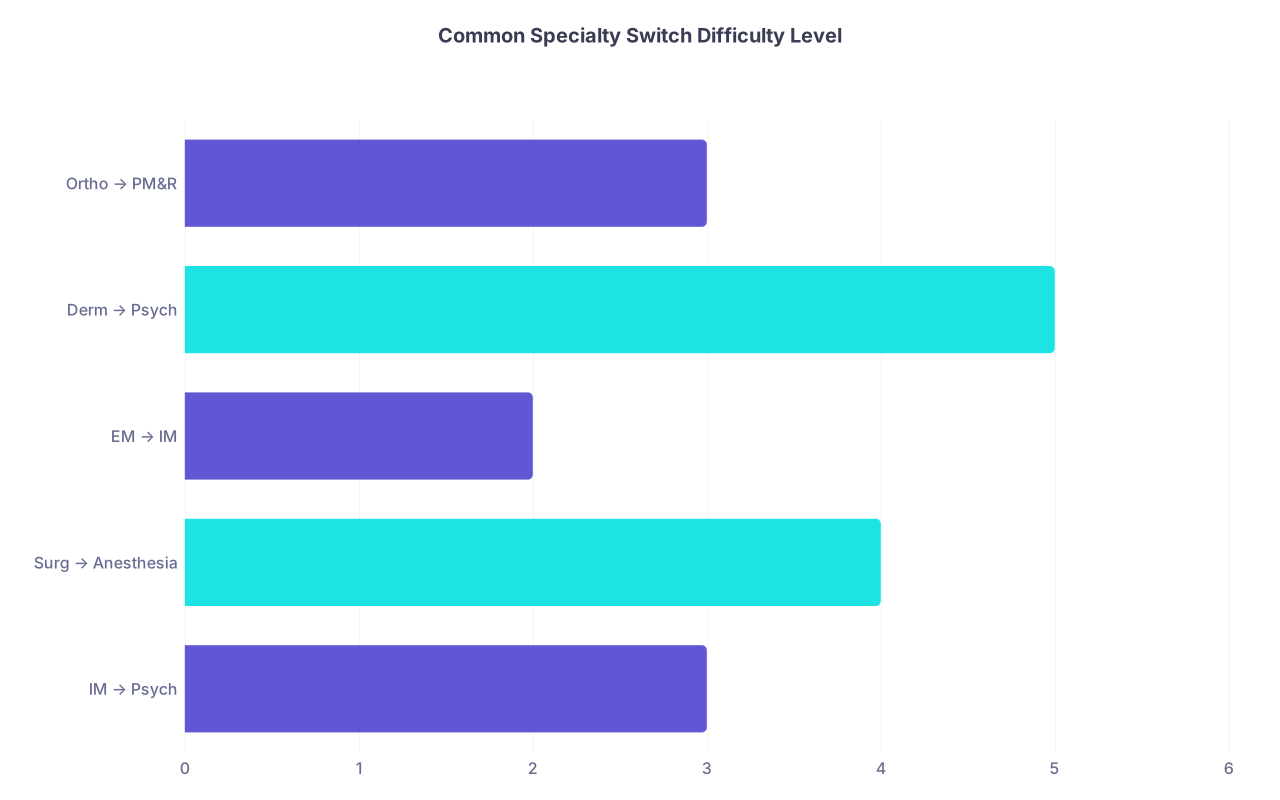
| Category | Value |
|---|---|
| IM → Psych | 3 |
| Surg → Anesthesia | 4 |
| EM → IM | 2 |
| Derm → Psych | 5 |
| Ortho → PM&R | 3 |
(Scale 1 = easiest LOR adaptation, 5 = hardest.)
Surgery → Anesthesia
- Keep:
- Letters highlighting OR performance, calm in crises, attention to detail, teamwork with anesthesia/OR staff.
- Update if possible:
- Ask surgery letter writers to mention your interest in physiology, perioperative medicine, or working closely with anesthesia.
- Add:
- At least one anesthesiology letter as soon as you can arrange the rotation.
IM → Psych
- Keep:
- Wards letters focusing on communication, working with complex psychosocial situations, adherence issues, motivational interviewing.
- Kill:
- Any letter saying you dislike the “talking” part of medicine.
- Add:
- A psych letter from consult-liaison, inpatient psych, or an outpatient clinic where they’ve seen you manage mood/psychosis/anxiety cases.
EM → IM (often after EM market concerns)
- Keep:
- EM letters emphasizing handoffs, careful workups, multidisciplinary coordination, follow-up planning.
- Update:
- Ask if EM attendings can comment on your interest in longitudinal care or complex medical decision-making beyond disposition.
- Add:
- A solid IM wards letter, preferably from a PD or clerkship director.
High-Competition Field → Less Competitive Field (e.g., Derm → Psych)
- Be careful: your letters probably scream “derm or bust.”
- Keep only general ones that highlight you as a good doctor and human, not a niche subspecialist.
- New specialty letters must make it obvious this isn’t a backup panic move but a considered choice. That’s mostly about how they talk about your actual behavior and interest on service.
Step 11: Don’t Let LOR Perfection Delay Necessary Action
One last point: a suboptimal but honest LOR set, aligned with your new direction, is better than a perfect set for a specialty you no longer want.
You can:
- Apply with some imperfect-but-acceptable letters.
- Explain your story clearly in your personal statement and interviews.
- Use your next year (prelim, TY, research, gap) to assemble the stronger, fully aligned LOR set if you need to reapply.
What you cannot fix later is never applying at all because you were waiting for the perfect letter mix that was never going to materialize.
Key Takeaways
- Do a hard triage of your existing letters: keep general performance letters, update or drop hyper-specialty ones that clash with your new field.
- Secure at least one letter from the new specialty as soon as possible, then backfill with strong general clinical letters that support your pivot story.
- When asking for updates or new letters, be direct, honest, and specific about what qualities to highlight so your LOR set quietly matches the specialty switch you’re making.