
The riskiest move for a research-heavy applicant is treating non-clinical letters like a consolation prize.
If your CV screams “bench, grants, and PubMed” but your rotations list is thin, you cannot afford generic, lukewarm non-clinical LORs. They will either save your application or quietly confirm every doubt a PD already has about you.
Let’s walk through what to do if this is you:
- You have strong research.
- You have fewer core or away rotations than your peers.
- You need to use non-clinical or research letters to fill gaps.
I’m going to assume you care about actually matching, not just “getting letters in.”
Step 1: Be Brutally Honest About Your Situation
You cannot fix what you refuse to name.
You’re in one (or a mix) of these buckets:
| Profile | Key Features |
|---|---|
| Pure Research Heavy | Multiple years of research, several pubs, but average clinical evals and few rotations |
| Late Specialty Switcher | Switched to a competitive specialty late, few specialty rotations, strong research in that field |
| Extended Research Time | Took 1–3 research years, clinical letters are older, non-clinical mentors know you best |
| International / Non-Traditional | Limited US rotations, most close relationships are with research or academic supervisors |
For each, ask yourself three direct questions:
- Who knows my work ethic best?
- Who has seen me handle pressure, deadlines, or complex tasks?
- Who can compare me to other residents/trainees they’ve worked with?
If most of those answers are research PIs, lab directors, MPH supervisors, or QI leads—good. That means your non-clinical letters can be a strength. But only if they read like “this person will be a good resident,” not “this person is a good grad student.”
Your problem is not “I have to use non-clinical letters.” Your problem is “I have to make non-clinical letters sound residency-relevant.”
That is absolutely solvable.
Step 2: Understand What Program Directors Actually Want From Any LOR
A common mistake: you think PDs want “clinical” letters. They don’t. They want evidence.
They read your LORs with a few questions in mind:
- Will this person be safe with patients?
- Will this person show up, do the work, and not melt down at 2 a.m.?
- Can I trust them with incomplete information and time pressure?
- Are they teachable? Or are they a pain?
Whether that evidence comes from an ICU attending or a research PI doesn’t matter as much as people think—if the letter translates your behaviors into residency language.
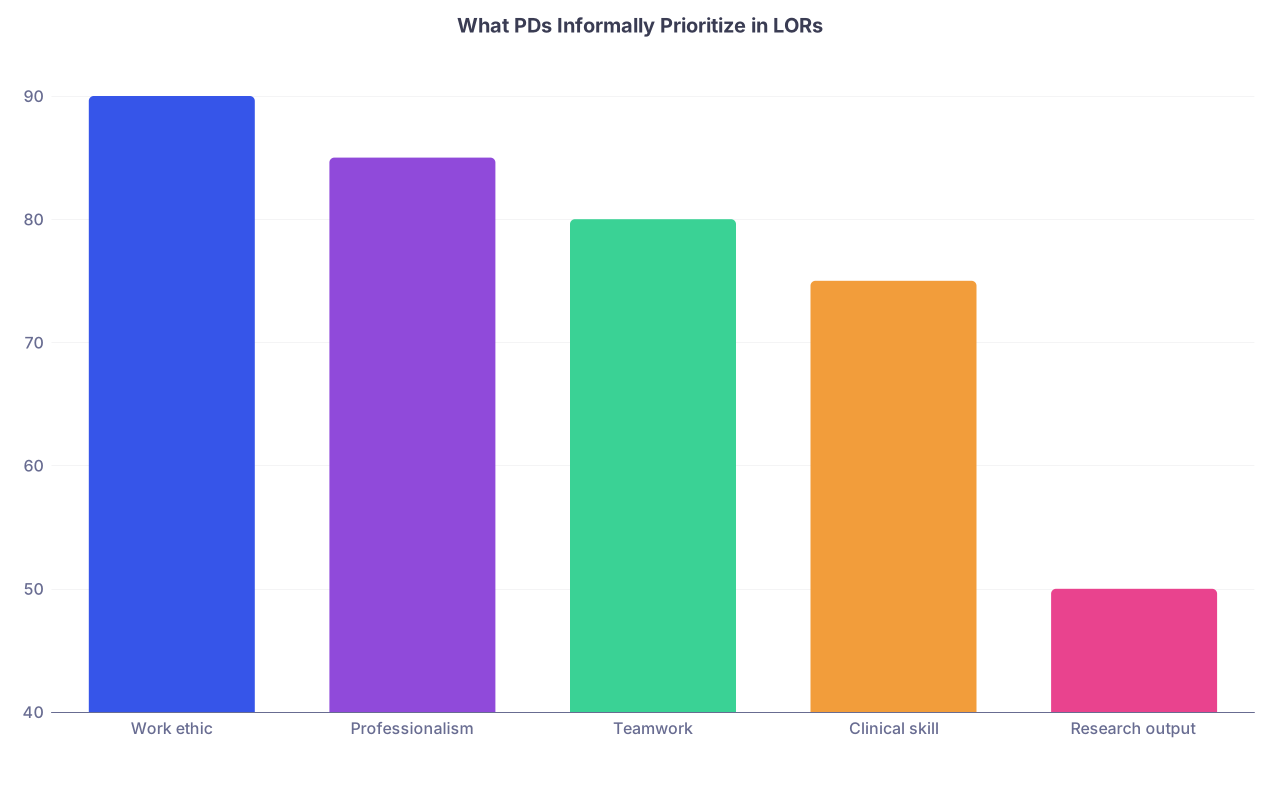
| Category | Value |
|---|---|
| Work ethic | 90 |
| Professionalism | 85 |
| Teamwork | 80 |
| Clinical skill | 75 |
| Research output | 50 |
Research mentors can absolutely comment on:
- Work ethic over long periods, not just 4-week blocks
- Intellectual ability to handle complexity
- Response to feedback and failure
- Professionalism, reliability, initiative
- Communication skills with teams / collaborators
What they usually lack is direct observation of:
- Running a list
- Presenting on rounds
- Independent patient care
So your job is to:
- Make sure they don’t pretend to know what they don’t.
- Make them very specific about what they do know.
- Help them connect the dots to residency-relevant traits.
Step 3: Pick the Right Non-Clinical Letter Writers (Not Just the Fanciest Names)
Name-dropping a world-famous PI who barely remembers you is a rookie mistake. PDs can smell a ghost-written, three-paragraph, “I support their application” letter from a mile away.
You want:
- Someone who knows you well.
- Over a long enough period (6+ months ideally).
- In situations where you had responsibility, not just shadowing.
If you have to choose, here’s how I’d rank them in your scenario:
| Rank | Writer Type |
|---|---|
| 1 | Research PI who supervised you closely (day-to-day or weekly) |
| 2 | Co-PI or senior fellow who directly oversaw your work and reports to a PI |
| 3 | QI/clinical research lead who saw you interact with clinical teams |
| 4 | MPH / graduate thesis advisor with strong, detailed perspective |
| 5 | Course director or longitudinal mentor with long-term contact |
Examples of good candidates:
- The PI who watched you grind a retrospective study from IRB to publication and saw how you handled data disasters, coauthor drama, and deadlines.
- The QI mentor who watched you manage an EMR-based project with nurses, IT, and residents, and saw how you handled pushback.
- The research year director who saw you manage multiple projects, juniors, and presentations.
Examples of bad candidates:
- The department chair who met you three times and mostly knows your name from the author list.
- The lab head who didn’t directly supervise you and will forward you to their admin to “draft something.”
- The online course instructor who only saw test scores.
Choose substance over title. Every time.
Step 4: Prime Your Non-Clinical Writers to Talk Like Residency Evaluators
Do not just send a CV and ERAS ID and hope for the best. That’s how you end up with “He was a pleasure to work with” and three paragraphs of generic fluff.
You need to give them:
- A one-page “LOR packet” that orients them to residency.
- Concrete reminders of things they saw you do.
- Language that translates research behaviors into residency traits.
Your packet can be simple:
- Updated CV
- Personal statement (or at least your specialty choice and narrative)
- A short “reminder memo” (1 page max) with:
- Your work with them
- 3–5 key traits you hope they can speak to
- 2–3 specific stories or projects
Example memo structure:
- Opening: “I’m applying in Internal Medicine this cycle. You’ve seen me most closely during my 2 years in your lab, and I’d be grateful if you could comment on my work ethic, independence, and ability to work on teams.”
- Bullet reminders:
- “Led the data cleaning and analysis on the ARDS outcomes project with X patients; fixed the dataset after the data merge error the night before the deadline.”
- “Trained two new students and organized weekly sub-team check-ins.”
- “Handled revisions for the JAMA submission, including responding to Reviewer 2’s statistical concerns under a tight deadline.”
Do not script their letter. That’s gross and obvious. But you can absolutely say:
“I know most of my strongest experiences with you were research-based, not clinical. PDs have told me they like to hear how applicants handle workload, pressure, and feedback. If you’re comfortable, comments on those areas would help programs understand how I’ll function as a resident.”
You’re giving them a translation key.
Step 5: Turn Research Stories Into Residency-Relevant Evidence
If your mentor is a normal overworked physician-scientist, they will not sit down and philosophize about how your R code meltdown at 11:45 p.m. translates into night float performance.
You need to make that leap for them—then let them phrase it.
Here are residency-relevant traits you want to highlight, and how they might emerge in non-clinical contexts:

Reliability and ownership
Research: Showing up consistently, meeting deadlines, fixing errors without drama.
Clinical translation: This person isn’t going to disappear or leave work unfinished at sign-out.Problem-solving under uncertainty
Research: Dealing with incomplete data, failed experiments, reviewer critiques.
Clinical translation: This person can handle incomplete information on call and still move forward safely.Communication and teamwork
Research: Coordinating multi-site projects, managing co-authors, explaining complex stats.
Clinical translation: This person can talk to nurses, consultants, and families clearly.Response to feedback
Research: Rewriting drafts, learning new methods when told their first approach was wrong.
Clinical translation: This person doesn’t crumble or get defensive with attending feedback.Longitudinal grit
Research: Staying engaged on a project for 1–3 years with delayed rewards.
Clinical translation: This person doesn’t burn out mentally after 2 tough months.
Give your writers concrete memory hooks:
“Do you remember when we had to redo the entire analysis 48 hours before the abstract deadline because of the coding error? That’s one of the moments that really shaped how I handle pressure and last-minute changes. Feel free to mention it if you think it fits.”
They’ve probably forgotten half those details. You haven’t. Use that.
Step 6: Balance Clinical and Non-Clinical Letters Without Looking Lopsided
You still need clinical voices. Programs want at least one letter from someone who’s seen you with patients in something resembling real time.
If you have limited rotations, structure your LOR mix like this (for a typical 3–4 letter upload plan):
- 1–2 clinical letters from core or specialty rotations
- 1–2 research/non-clinical letters that are truly strong and detailed
For competitive fields (derm, rad onc, ortho, ENT, etc.), usually:
- At least one letter from someone in that specialty
- One strong research letter if your application leans that way
- One more general IM/medicine or surgery letter if possible
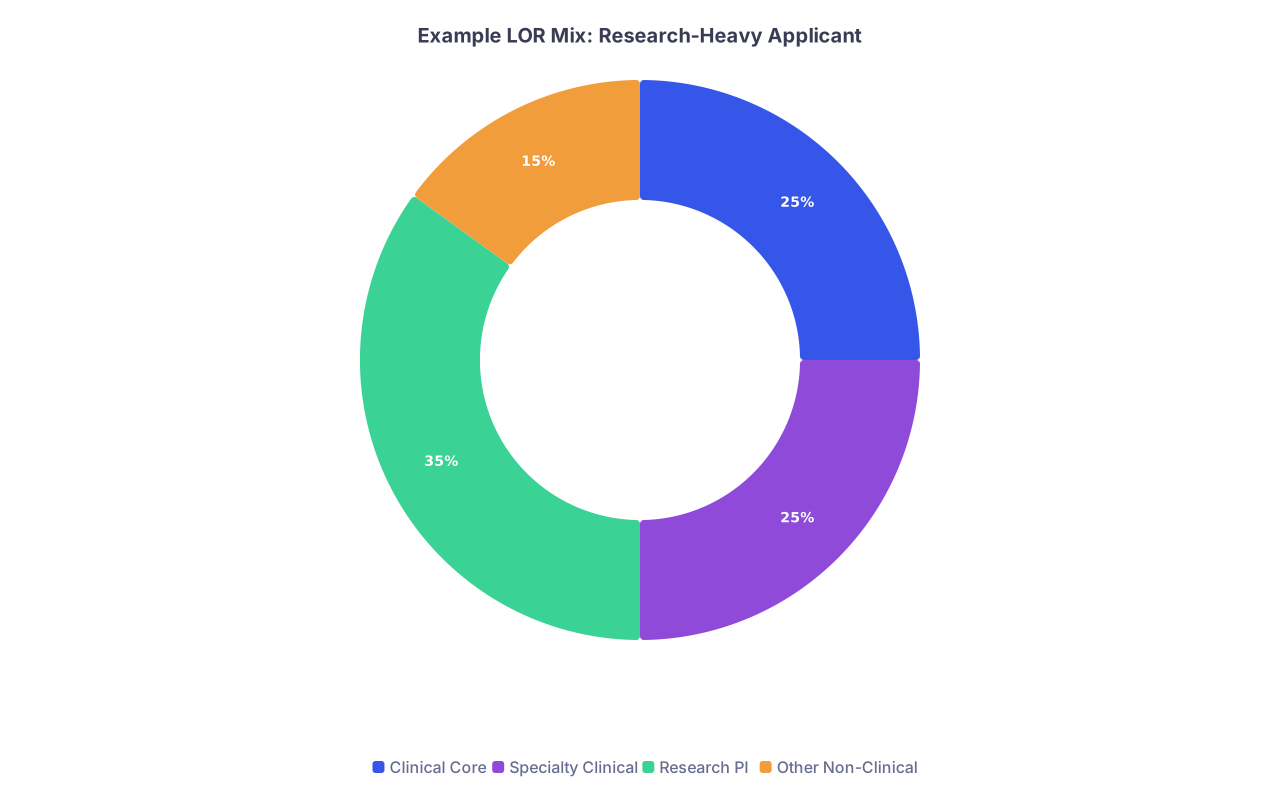
| Category | Value |
|---|---|
| Clinical Core | 25 |
| Specialty Clinical | 25 |
| Research PI | 35 |
| Other Non-Clinical | 15 |
If your clinical letters are weak or ancient (e.g., 2+ years old because of research time), do two things:
- Explain the timeline clearly in your personal statement or experiences.
- Let your research letter explicitly address your trajectory and current readiness.
For example, your PI can say:
“Although most of my work with [Name] has been in the research setting during their dedicated research years, I am aware through discussion with their clinical mentors that they have maintained and refreshed their clinical skills, and I have every confidence in their readiness to return full-time to patient care.”
It’s not perfect. But it’s better than silence.
Step 7: Pre-empt Program Concerns Inside the Non-Clinical Letter
Programs will worry about three things with you:
- Are you too “research-y” to tolerate actual clinical grind?
- Are your clinical skills rusty or underdeveloped?
- Are you using research as a shield for weaker clinical performance?
A strong non-clinical LOR can directly defuse this.
How? By saying the quiet part out loud, but in your favor.
Examples your PI could incorporate (if true):
- “Despite intensive involvement in research, [Name] repeatedly sought out opportunities to maintain clinical exposure, including X, Y, Z.”
- “Even in research meetings, [Name] consistently grounded discussions in clinical relevance and patient impact, reflecting clear clinical thinking.”
- “I have supervised multiple residents and fellows who went on to highly competitive programs; in terms of maturity, reliability, and capacity for hard work, [Name] is already functioning at the level of a strong intern.”
They are basically saying: This is not a lab rat. This is a future resident who happens to be excellent at research.
Step 8: Timing and Logistics – Do Not Lose Strong Letters to Sloppiness
I’ve watched good applicants sabotage themselves with chaos:
- Asking late
- Not waiving their right to view
- Not following up gently
- Letting rushed letters go out 24 hours before deadlines
Do this instead:
Ask 2–3 months before ERAS opens, earlier if possible.
In the ask (email or in-person), be direct:
- “Would you feel comfortable writing me a strong letter for [specialty] residency?”
If they hesitate or downgrade the word “strong,” move them into backup category.
- “Would you feel comfortable writing me a strong letter for [specialty] residency?”
Waive your right to view in ERAS. If you don’t, PDs will assume the letter is filtered.
Set an internal deadline 2–3 weeks earlier than the real one. Follow up once at 2 weeks out, once at 1 week out.
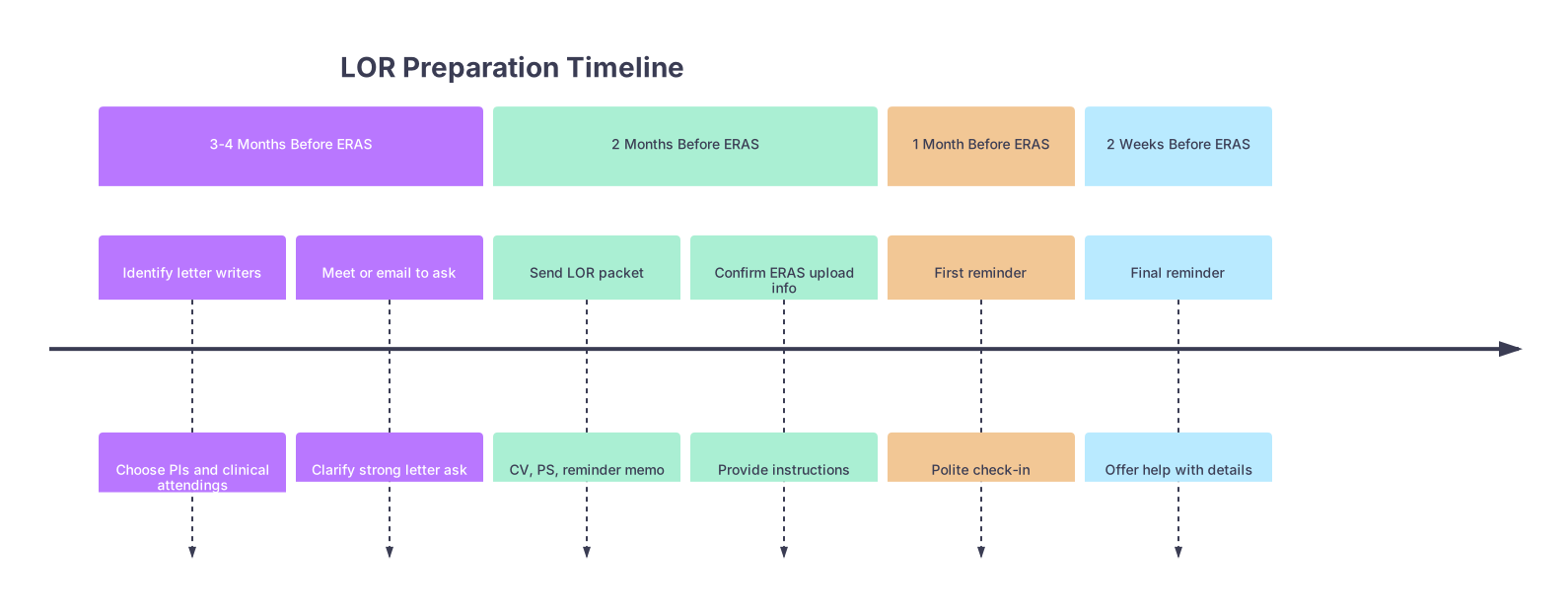
| Period | Event |
|---|---|
| 3-4 Months Before ERAS - Identify letter writers | Choose PIs and clinical attendings |
| 3-4 Months Before ERAS - Meet or email to ask | Clarify strong letter ask |
| 2 Months Before ERAS - Send LOR packet | CV, PS, reminder memo |
| 2 Months Before ERAS - Confirm ERAS upload info | Provide instructions |
| 1 Month Before ERAS - First reminder | Polite check-in |
| 2 Weeks Before ERAS - Final reminder | Offer help with details |
If a big-name person is dragging their feet and a mid-level but enthusiastic mentor already uploaded, lean toward the strong, on-time letter. PDs don’t care about names as much as med students think. They care about specifics.
Step 9: Align Your Whole Application With the Story Your Non-Clinical Letters Tell
Your non-clinical letters should not feel like they’re from a different person than your personal statement and experiences.
If your PI’s letter paints you as a relentless, detail-obsessed, take-ownership person—and your ERAS descriptions read like vague “participated in data collection” fluff—you’ve created dissonance.
Tighten the whole story:
In your personal statement, explicitly connect your research strengths to residency:
- “Running a 2-year outcomes study taught me how to manage long-term responsibility and stay organized through months of uncertainty—exactly the mindset I want to bring to residency.”
In your experiences section, write about behaviors, not just titles:
- “Led weekly research huddles with 4 team members, assigned tasks, tracked deadlines, and prepared updates for PI meetings.”
In interviews, echo the traits your non-clinical letters highlight:
- If they called you “unflappable under pressure,” you better have a story ready that shows exactly that.
You want PDs reading your file thinking, “Yeah, this all lines up.”
Step 10: Situations Where Non-Clinical Letters Should Not Carry the Weight
I’ll be blunt: non-clinical letters cannot fix certain things alone.
- Major professionalism issues in clinical settings
- Consistently poor clinical evals
- Failing to get even one solid letter from someone who has seen you with patients
If that’s your reality, your priority is not “optimize my non-clinical letters.” It’s:
- Get a strong, recent sub-I or acting internship
- Over-communicate with that attending about needing a robust LOR
- Possibly adjust your specialty expectations to something more realistic this cycle
Non-clinical letters can amplify your strengths and soften concerns. They cannot hide fatal weaknesses forever.
If You’re Reading This Late in the Game
Let’s say you’re 3–4 weeks from submission, minimal prep done, and feeling behind. Here’s the “do this tonight” list:
- Identify your top 2 non-clinical writers who know you best.
- Draft a one-page reminder memo for each with specific shared stories.
- Email them a clear, respectful ask referencing your specialty and traits you hope they can address.
- Clean up your ERAS experiences so they match what you hope they’ll say.
- Plan one follow-up message date and set reminders. Don’t spam them; be professional.
You cannot rewrite your CV in a month. You can absolutely upgrade the quality and relevance of your non-clinical letters.
The Bottom Line
Three things you should walk away with:
- Non-clinical LORs are not “second-tier” if they are specific, honest, and clearly tied to residency-relevant behaviors.
- The best letters come from people who truly know you, not the biggest name on your publications page.
- Your job is to help your non-clinical writers translate your research or academic life into evidence that you’ll be a reliable, teachable, hard-working resident—not just a good scientist.