
The residency world does not care why you did fewer rotations. It cares whether someone credible can vouch for you.
If illness limited your clinical rotations, your job now is not to apologize endlessly. Your job is to manufacture credible, specific, defendable evidence that you are safe, competent, and ready — even if you only had a short time to prove it.
This is fixable. But only if you stop waiting for “perfect” rotations and start deliberately building LOR opportunities out of what you do have.
Step 1: Be brutally clear about your starting point
Before you chase letters, you need to know exactly how bad (or not) your situation is. Be honest with yourself.
Ask yourself:
- How many core rotations did you complete with full participation (not half-remote, not on leave in the middle)?
- How many US clinical months do you have (if you’re an IMG/DO applying to certain specialties)?
- Do you already have any LORs? From whom? How strong are they really?
Make a quick inventory.
| Item | Typical Applicant | You (Fill In) |
|---|---|---|
| Total clinical months | 10–12 | |
| Specialty-specific months | 2–3 | |
| US clinical months (if IMG) | 3–4 | |
| Total LORs available | 3–4 | |
| Strong specialty LORs | 1–2 |
If you were out for illness, your situation might look like:
- 4–6 months of real clinical time instead of 10–12
- 0–1 specialty rotations in your chosen field
- 1–2 generic letters from early core clerkships and that’s it
That’s not fatal. It just means you cannot do what everyone else does. You need to be strategic and a bit aggressive about creating letter opportunities out of every clinical minute you have left.
Step 2: Own the illness gap — but do not let it define you
Programs are not allergic to illness. They are allergic to risk and mystery. A vague “limited rotations” with no context looks worse than a clear, contained story.
You need three aligned stories:
- What happened (in brief, in your MSPE/Dean’s letter and, if needed, personal statement)
- What you can safely do now (in attending LORs)
- How you’ve performed since coming back (also in attending LORs and transcript)
Your letters should indirectly answer four unspoken questions that PDs always have about anyone with gaps or limited rotations:
- Are you clinically safe?
- Are you reliable (attendance, follow-through, no disappearing)?
- Are you physically/mentally able to handle residency demands now?
- Is this illness over or at least well-managed?
The letter writer does not need your diagnosis. They need evidence: you showed up, you worked hard, you handled call, you did not fall apart with stress, and your performance improved over the block.
You can help them write that kind of letter by telling them directly:
“I had to take time away from clinicals last year for a medical issue that’s now resolved and cleared by my school. Since returning, I’ve been focused on demonstrating consistent reliability and clinical readiness. If you’ve observed anything specific that shows that improvement, it would be extremely helpful to have that in the letter.”
No drama. No overshare. Just facts and a request.
Step 3: Design rotations to maximize letter potential
If you have limited rotations left before you apply, you cannot afford passive, unstructured experiences. Every future clinical month should be chosen and run like a letter-generation project.
Pick rotations with high LOR yield
You want:
- One or two months directly in your chosen specialty (IM, FM, psych, surgery, etc.)
- At least one month where one attending sees you closely for multiple weeks
- Environments where students are actually known to get letters (ask the class above you, not the website)
Do not waste your few remaining months on:
- Rotations where you mostly shadow with minimal documentation or presentations
- “Service-only” nightmares where attendings barely know your name
- Pure research blocks unless you know the PI writes real, detailed LORs and you’re willing to show up in person
If you’re an IMG or DO, this is even more important. US rotations with hands-on roles (sub-I, acting intern, or audition electives) carry much more LOR value than vague “observerships.”
Step 4: Act like someone who needs a letter from day 1
Here’s where most students with time gaps screw up. They think, “Let me just survive this rotation, then I’ll think about letters.”
You do not have that luxury. You’re behind on clinical time; you cannot coast for the first two weeks.
From day 1 on any rotation that might yield an LOR:
- Introduce yourself to your main attending and state your intention (briefly, like an adult):
- “I had to miss some clinical time earlier in med school due to a health issue that’s now resolved. Because of that, I’m very focused on getting strong clinical feedback and, if possible, a letter from this rotation. I’d really appreciate any guidance on how I can best contribute to the team.”
- Ask for expectations in concrete terms:
- “What does a top-tier student look like to you on this service?”
- “If I want to be working at an intern level by the end of the month, what should I be doing day-to-day?”
Then match their expectations and make it visible:
- Own a small list of patients and know them cold
- Write thoughtful notes that actually help the team
- Present clearly and concisely, not reading the chart at them
- Volunteer for the unglamorous but useful stuff — discharge summaries, calling families, tracking follow-ups
You’re not trying to be perfect. You’re trying to give your attending evidence and stories they can put in a letter.
Step 5: Ask for the right kind of LOR, at the right time
Timing and phrasing matter. If you’ve had limited clinical time, you may feel awkward asking. Do it anyway.
When to ask
Ask after they’ve seen you in a range of situations but before the rotation ends and they forget you. For a 4-week block, that’s usually:
- Late week 3
- Early week 4
Do not wait until three months later by email. The letter will be vague at best.
How to ask
Ask in person if at all possible. Something like:
“Dr. Smith, I wanted to ask if you’d feel comfortable writing a strong letter of recommendation for my internal medicine residency applications. I’ve really appreciated your feedback this month and I know my situation is a bit atypical with fewer rotations due to past illness, so your perspective on my current readiness would mean a lot.”
That word — strong — is intentional. If they hesitate, you have your answer. You need people who can go to bat for you, not “meh, they showed up.”
If they say yes, immediately follow with:
“Thank you. I’ll send you my CV, personal statement draft, and a short summary of the cases and responsibilities I’ve had on this service, to make things easier. Is there anything else you’d like me to include?”
Then actually do it the same day.
Step 6: Give your letter writers ammunition
Do not just email, “Here’s my CV, thanks.” That’s how you get bland, forgettable letters.
You’re the one who was out sick. You’re the one with fewer data points. You have to help them connect the dots.
Send them a short, structured package:
- CV
- Personal statement draft (even if not final)
- One-page “LOR support doc” with:
- A 2–3 sentence reminder of your illness gap and recovery, phrased professionally
- Bullet points of what you actually did with them (numbers help: “followed 5–8 inpatients daily, wrote X notes/week, managed X admissions/discharges”)
- Specific moments that show growth or reliability:
- “You gave me feedback on my presentations in week 1; I worked on structuring them by problem, and by week 3 you mentioned the improvement on rounds.”
- “On call on 7/12, I stayed late to complete all pending notes and follow up on labs for two unstable patients.”
You’re not writing the letter for them. You’re jogging their memory so they can write a genuine, specific letter that doesn’t sound like 500 others.
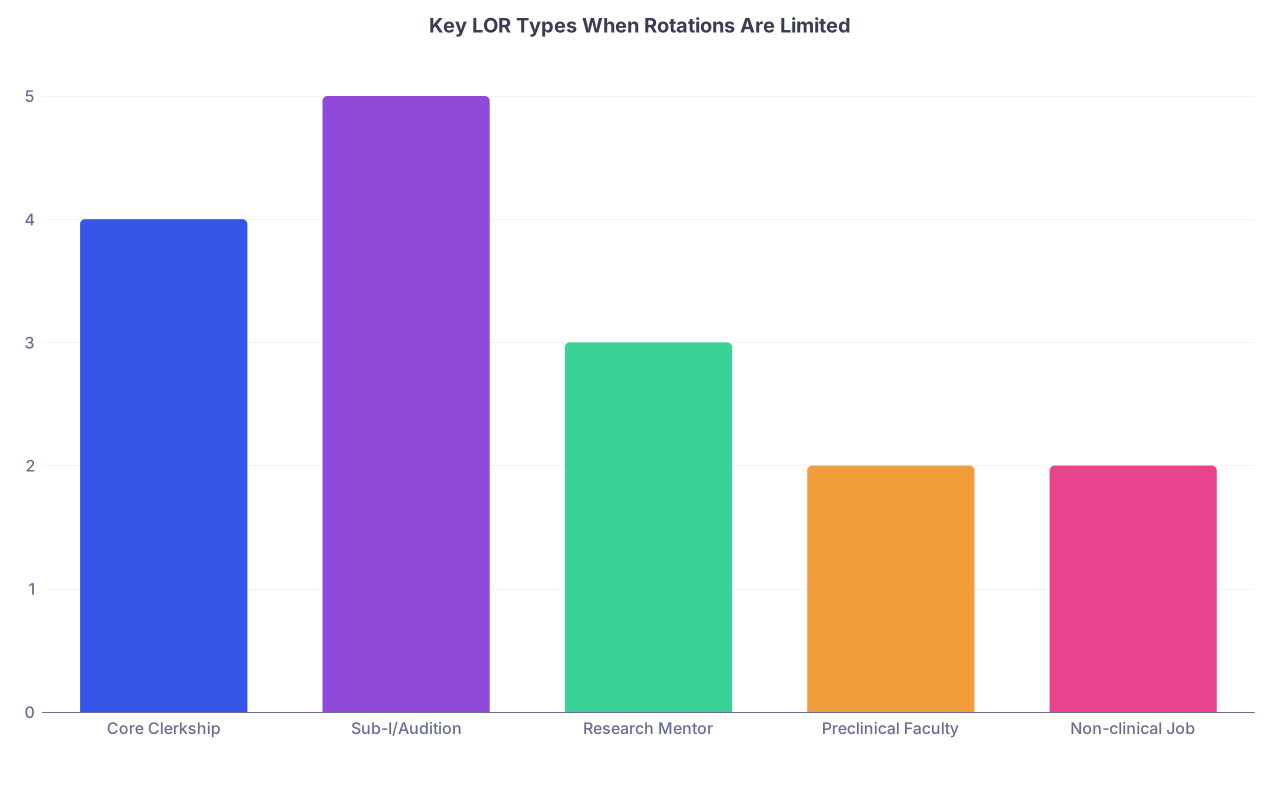
| Category | Value |
|---|---|
| Core Clerkship | 4 |
| Sub-I/Audition | 5 |
| Research Mentor | 3 |
| Preclinical Faculty | 2 |
| Non-clinical Job | 2 |
Quick translation of that chart:
- Sub-I/audition letters are gold
- Strong core clerkship letters are close behind
- Research mentor letters help, especially if they know your work ethic
- Preclinical faculty and non-clinical jobs are backup letters only — fine as letter #3 or #4, not as your main clinical voice
Step 7: Use research, QI, and “side doors” to create credible advocates
If you lost months of clinical time, you probably did not magically gain more clinical spots. So you need to create parallel opportunities for strong letters.
These are your best “side door” options:
1. Research (especially clinical)
If you can get onto a project where you:
- Attend weekly lab or team meetings
- Present your work
- Help with data collection, chart review, or manuscript writing
…then a PI can comment on your work ethic, reliability, and intellectual ability.
Not as good as “I saw them on nights cross-covering six patients,” but still legitimate. Especially if the PI is:
- Well-known in the field
- At a program where you’re applying
- Willing to talk honestly about your situation
Make it clear when you start:
“I’m also hoping this work can help support my residency application, since I had to cut some clinical time short due to illness. I’m very committed to being consistently present and reliable on this project.”
Then actually be the person who answers emails, meets deadlines, and takes annoying tasks off their plate. That’s how you earn a real letter.
2. QI or administrative projects tied to patient care
Hospital QI projects, committee work, or patient safety initiatives can generate strong advocacy letters. The people who run these can say:
- You show up
- You understand systems
- You care about improving care, not just checking boxes
Again: only useful if they know you well and can talk specifics.
3. Longitudinal experiences
Did you have a longitudinal clinic (e.g., a continuity clinic over a year) before you got sick? Circle back to that preceptor. Even if you only saw them one half-day a week, over time that adds up to a strong, personal impression.
Step 8: Address the illness head-on in one place — not in every letter
Do not use your letters to tell your illness story in detail. That’s not their job. Their job is to say, “I see this person now, and they are ready.”
Where do you explain the gap?
- MSPE/Dean’s letter: usually a short, factual explanation
- Personal statement or ERAS “experiences” section: one short, controlled paragraph
- Maybe one LOR from someone who knew you before and after the illness, if they can credibly speak to your growth
You can suggest language to your writer like:
“If you feel it’s appropriate, you’re welcome to mention that I had a period of medical leave earlier in training, but that since returning I’ve been consistently present and functioning at the expected level.”
Do not push them to disclose details. Most PDs do not want them.

| Step | Description |
|---|---|
| Step 1 | Limited Rotations Due to Illness |
| Step 2 | Clarify Clinical Months Left |
| Step 3 | Choose High-Yield Rotations |
| Step 4 | State Goals to Attendings Early |
| Step 5 | Perform at High, Visible Level |
| Step 6 | Ask for Strong LOR in Week 3-4 |
| Step 7 | Add Research/QI/Longitudinal Work |
| Step 8 | Secure Supplemental LORs |
| Step 9 | Package LORs + Gap Explanation |
| Step 10 | Submit Application with Context |
Step 9: Strategically assemble your LOR set
Most programs want 3 letters; some will accept 4. With limited rotations and an illness gap, here’s a realistic and strong structure:
Letter 1 – Core clinical / sub-I in your specialty
The most important one. Ideally from an attending who supervised you for most of the block and can talk about your clinical reasoning, notes, and interpersonal skills.Letter 2 – Another clinical letter (any specialty, but recent)
Internal medicine, family med, surgery, psych — whatever. The key is recency and clear statement that you’re functioning at the level of a ready-for-residency intern.Letter 3 – Research/QI/longitudinal mentor
Should talk about reliability, work ethic, and follow-through over time.Optional Letter 4 – Preclinical or other faculty who knows you well
Only if they truly know you. Not a random anatomy professor from MS1 who remembers nothing.
If you genuinely have only one or two clinical letters, that’s not ideal, but you’re not dead. Then you lean hard on:
- Honest, concise explanation of the illness timing
- Strong narrative of recovery and recent performance
- Additional mentors who can vouch for you as a serious, reliable adult
Step 10: Be ready to talk about this in interviews
If you get interviews, programs are already partially comfortable with your situation. Your job in person is to match your letters.
You should be able to say, calmly, in about 30–45 seconds:
- What happened — in general terms
- What you did during that time (treatment, recovery, any productive work if applicable)
- How you returned and what you’ve done clinically since
For example:
“During my third year I had to take several months of medical leave for a health issue that required treatment. I’m fully cleared now and have been back in full-time clinical rotations for the past X months. Since returning, I’ve completed internal medicine, [your specialty] and an acting internship, and my attendings have been very encouraging about my readiness for residency. I’ve also been more deliberate about time management and asking for feedback early, which has helped me grow faster.”
Then stop talking. Let your letters back you up.
Final check: What to do if you’re still early in this process
If you’re reading this and you still have 4–8 months before applications:
- Front-load high-yield rotations: sub-I in your specialty, IM/FM, anything that gives you daily attending contact
- Tell your school you need rotations where attendings write letters — be explicit
- Start at least one research or QI project now, so by ERAS time you’ve had 6+ months with that mentor
- Keep an informal “brag sheet” of cases, feedback, and responsibilities to give to future letter writers
If you’re reading this a month before ERAS opens:
- Immediately email past attendings who saw you at your best and ask if they can write a strong letter
- Give them a clear, concise explanation and supporting docs right away
- Use any ongoing research/QI mentors as backup letter-writers
- Tighten your illness explanation to one paragraph and make sure your letters focus on the “after,” not the “during”
Key takeaways
- Your illness and limited rotations are a context, not your identity; programs care most about what you can do now, and your letters must prove that.
- Every remaining rotation and project must be run like a letter-generating operation: clear expectations, visible performance, specific stories.
- A slightly unconventional but coherent LOR set — 1–2 strong recent clinical letters plus 1–2 deep-relationship mentor letters — beats a pile of generic, lukewarm notes from people who barely know you.