
The most wasted asset in international clerkships is the overseas letter of recommendation.
Not the experience. Not the learning. The letter. Most applicants treat it like bonus glitter on ERAS. Programs treat it like… background noise.
If you are spending money, time, and energy to go abroad, that is a bad deal. Let’s fix it.
This is about one thing: if you do international electives or clerkships, how do you turn those foreign letters into something that actually helps you in the US residency match, instead of sitting in your “Supplements” folder, politely ignored?
I’m going to assume you’re either:
- An IMG planning/doing an away rotation in the US after international stuff, or
- A US student going abroad and wondering if any of this will matter on ERAS.
Either way, you want those overseas LORs to actually move the needle.
1. Understand the Harsh Reality First
You cannot game this if you don’t understand what you’re up against.
Most US program directors rank letters like this (whether they admit it or not):
| LOR Type | Typical Impact Level |
|---|---|
| US academic faculty in your specialty | Very High |
| US faculty who supervised you clinically | High |
| US program director/department chair | Very High |
| US private physician in your specialty | Moderate |
| Non-US (international) physician, same specialty | Low–Moderate |
| Non-US (international) physician, other specialty | Low |
Now pair that with time and money:
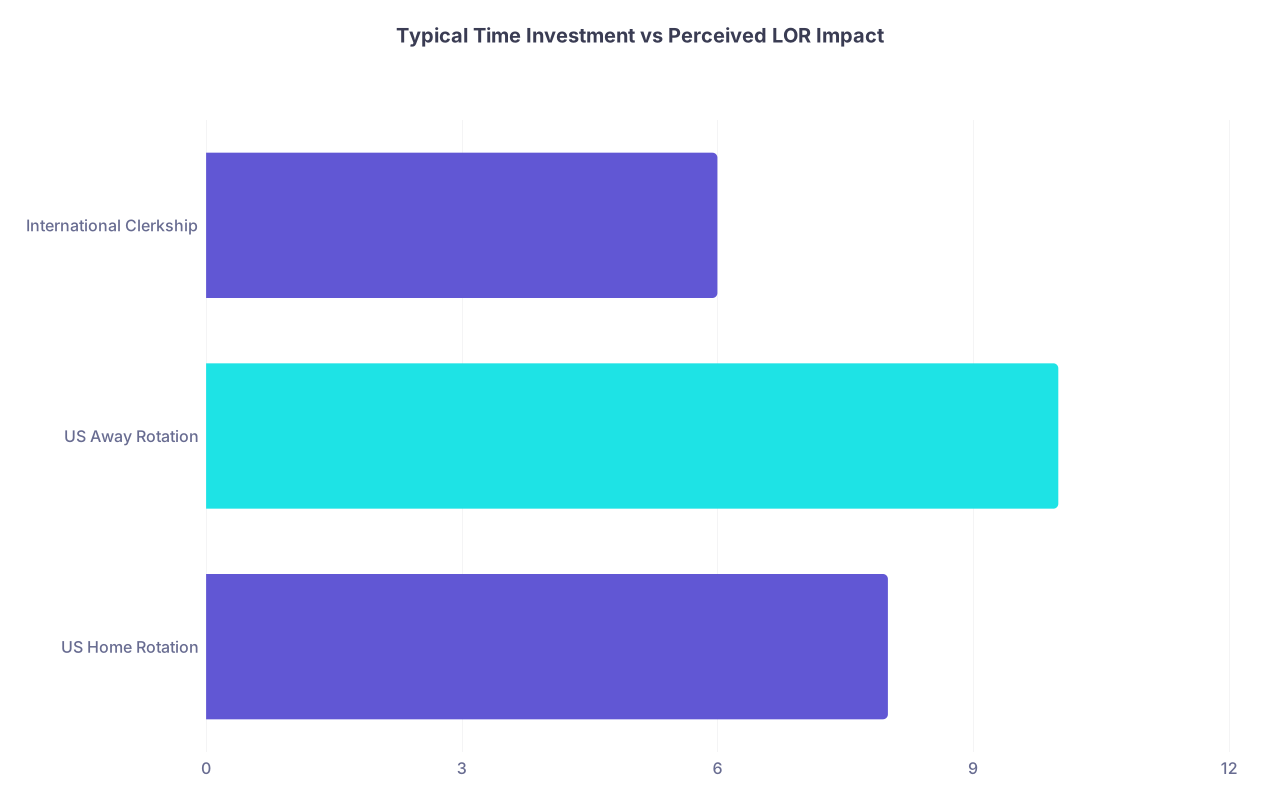
| Category | Value |
|---|---|
| US Home Rotation | 8 |
| US Away Rotation | 10 |
| International Clerkship | 6 |
(8–10 = high perceived LOR impact; 6 = usually lower impact per week of effort.)
Three blunt truths:
- A mediocre US letter > a glowing generic overseas letter.
- Academic titles matter. A foreign department chair in your specialty still beats a random consultant.
- Specificity beats geography. A detailed, behavior-based overseas LOR can outrun a vague US letter.
So your mission isn’t “get an overseas LOR.” It’s:
Make your overseas LOR read like a serious, credible, data-rich document that a US PD can quickly trust.
2. Decide If You Should Even Ask for an Overseas LOR
Some of you should not bother. That’s the part nobody says out loud.
Ask yourself:
- Did I work closely with this physician for at least 2–4 weeks?
- Did they see me:
- Present cases?
- Write notes/order plans (within their system)?
- Interact with patients and team?
- Show up consistently and on time?
- Do I have at least one US-based letter in my specialty already or coming soon?
If the answer is:
- No US letters yet, but this overseas physician really saw me work hard and clinically → Yes, get it.
- I have 3 strong US specialty letters lined up → You can skip a weak overseas one; or use it only as supplemental.
- They barely know my name, and I mostly shadowed → Do not ask. You’ll get a useless paragraph of fluff.
Quick litmus test: if you cannot imagine this person remembering three specific things you did, they are not your letter writer.
3. Engineer the Letter While You’re Still There
You don’t “request a letter” at the end. You build toward it from day one.
Step 1: Frame your goals early
Within the first 2–3 days, say something like:
“Dr. Ahmed, I’m applying for internal medicine residency in the United States. Letters of recommendation are very important there. I’d really like you to evaluate me on my clinical work while I’m here, so I’d like to get as involved as possible — presenting patients, forming plans, writing notes if allowed. Is that alright with you?”
This does three things:
- Signals ambition and seriousness
- Gives them a reason to pay attention
- Opens the door later for a LOR that doesn’t feel like a surprise
Step 2: Behave like someone worth writing about
You know this, but international settings add extra layers. PDs worry about:
- Communication in English
- Interpersonal skills in a different culture
- Adaptability to a foreign system
- Work ethic despite travel and jet lag
So you need to engineer moments they can write about.
Concretely:
- Volunteer to present first. Especially new admissions.
- Ask to do mini-presentations (5 minutes) on a case-related topic.
- Handle small independent tasks reliably: following labs, checking imaging, talking to families with permission.
- Show up early, leave late the first week. Then sustain steady reliability.
You are not trying to impress everyone. You are trying to give one person enough concrete material to say, “I saw this student do X, Y, Z consistently.”
Step 3: Clarify they’re evaluating you for US standards
Middle of the rotation, have a check-in:
“Dr. Singh, since I’m hoping to apply for a US residency, would you be comfortable giving me feedback specifically on things US programs care about — clinical reasoning, reliability, communication with staff and patients?”
This nudges them to start sorting your behavior into US-relevant buckets, not just “nice foreign student, pleasant.”
4. How to Ask for the Letter (and Get a Useful One)
Timing: last 3–5 days of the rotation.
Do it in person if at all possible.
The actual ask
“Dr. Oliveira, I’ve really appreciated working with you these past four weeks and I’ve learned a lot from your approach to complex patients. I’m applying for [specialty] residency in the US this coming cycle. Would you feel comfortable writing a strong letter of recommendation that comments on my clinical abilities and work ethic?”
Key word: strong. This gives them a polite opt-out if they’re lukewarm.
If they hesitate or say something vague like “I can write a letter” with no enthusiasm, you thank them and quietly do not use it as a core letter. Maybe keep it as supplemental.
Give them a US-focused LOR packet
Most international attendings have no clue what a US residency LOR needs to look like. Hand them a simple, focused packet or email:
Include:
- One-page CV (bullet style, nothing fancy).
- Your ERAS personal statement draft or a 1-paragraph career summary.
- A one-page “US Letter Guidance” document — keep it lean.
Do not send them a 12-page instruction manual. They will not read it.
That guidance page should include:
- Who you are applying to (specialty + PGY1/advanced info if relevant)
- Who will read the letter (program directors; many not familiar with your system)
- The most helpful things they can comment on:
- Clinical reasoning and decision-making
- Reliability and work habits
- Communication skills in English
- Teamwork and professionalism
- Specific stories/examples from your time there
You can even give them bullet prompts like:
- “Describe a case where the student took initiative or showed strong reasoning.”
- “Comment on how the student compares with other students you have worked with.”
Most attendings actually appreciate this. They are busy and not fluent in the US game.
5. Make the Letter Legible and Credible to US Readers
There are two failure points for overseas letters:
- The writer’s English is weak, or too formal/opaque.
- The writer’s role, setting, and grading standards are unclear.
You can’t rewrite the letter. But you can:
A. Prep the writer’s header and signature
Gently suggest the following structure (show them a sample):
- Full name, degrees (e.g., MD, FRCP, PhD)
- Official title: Consultant Neurologist, Associate Professor of Internal Medicine
- Institution name (in English)
- City, Country
- Department chair or residency-type role if applicable
- Email and phone with country code
The goal: a US PD can glance and instantly understand, “Senior medicine faculty at a major teaching hospital in X country.”
B. Clarify context and grading scale
Ask them to include 1–2 sentences explaining:
- What your role was (visiting final-year student, elective student, extern, etc.)
- How long they supervised you (e.g., 4 weeks full-time)
- How you compare to local or international students they’ve had
- Any objective thing: “top 10% of students I’ve worked with in the last 5 years”
They won’t always do this. But if even one of those appears, it rescues the letter from the “generic overseas praise” bucket.
C. Keep it in English
Seems obvious, but I’ve seen people try to upload letters in Spanish, French, Arabic, etc., “with translation attached.”
Don’t do this unless literally unavoidable.
If they’re not comfortable drafting in English, you can:
- Offer: “If it’s easier, you can write it in your language and I can have an official translator prepare an English version — but most US programs prefer letters written originally in English. Even simple English is perfectly fine as long as it’s clear and honest.”
What you cannot do is write your own letter and have them sign. That’s still unethical, even if everyone else in your class does it.
6. How to Use Overseas Letters Strategically in ERAS
Overseas letters are not all-or-nothing. You decide where and how they appear.
Know your letter slots
Most programs allow up to 3–4 letters. You control which letters each program sees.
Basic priority rule:
- US LORs in your specialty
- US LORs in related or strong internal medicine/family med/surgery (for prelims, etc.)
- Overseas LOR in your specialty
- Other overseas letters
So if you’ve got:
- 2 strong US internal medicine letters
- 1 solid overseas internal medicine letter
- 1 generic home-country letter in another field
You probably send:
- 3 letters to most categorical IM programs: 2 US + 1 overseas specialty
- Maybe 4 letters only if the 4th adds something genuinely new (e.g., research mentor).
Where overseas letters actually help
They pull real weight in a few situations:
- You’re an IMG with limited USCE, and this is one of the only detailed clinical evaluations you have.
- The overseas writer is a major name in your field with international publications.
- The letter highlights something that’s otherwise invisible: language skills, ability to adapt to a very different healthcare system, handling high patient volume, etc.
They can also be useful for:
- Community programs that regularly take IMGs from certain regions and know those hospitals.
- Programs with global health tracks who like applicants with real overseas experience.
Where to be careful
Overloading programs with letters is dumb. I’ve seen applicants attach 4–5 letters to every program when 2–3 were actually strong.
If a program says, “We review up to 3 letters,” don’t send 5. They will either ignore extras or skim everything.
Better: choose the 3 strongest and keep the rest as backup or for other program types.
7. Make That Overseas Experience Work Beyond the Letter
The LOR is only one way that clerkship shows up in your application.
You can (and should) use the experience in:
- Your personal statement
- Your ERAS experiences section
- Interview answers
Because here’s the thing: a PD may glance at your overseas letter for 10 seconds. But they might talk to you for 5 minutes about that rotation if it sounds interesting.
So align your story:
- The letter says: you adapted quickly in a resource-limited hospital in Nairobi and took initiative managing complex HIV/TB co-infections.
- Your personal statement mentions: that rotation changed how you think about continuity of care and follow-up.
- In an interview, when asked “Tell me about a challenging patient,” you draw on a story from there.
Now the overseas letter isn’t just a floating PDF. It anchors a whole narrative about you being adaptable, committed, and effective in tough environments.
8. Common Mistakes that Make Overseas LORs Useless
I’ve watched people burn months of travel and tuition for letters that might as well not exist. Avoid these:
Shadow-only rotations. If you can’t touch the chart, can’t present, can’t be assigned specific tasks, stop expecting a strong LOR. Treat it as observership, not a letter source.
No early expectations. Asking for a letter from someone who never knew you were aiming for US residency is like asking for a reference from your Uber driver.
Lack of structure in the request. “Can you write a letter for residency?” with no info → generic garbage.
Using low-impact authors. Sometimes the friendly junior attending is not the best writer. A slightly more distant but senior consultant who saw you work is usually better.
Stacking overseas letters. Three foreign letters and zero US letters for a competitive specialty? That’s not strategy; that’s self-sabotage.
Ignoring content. If you get a copy (some systems allow you to see it), and it’s clearly weak, you don’t have to upload it. You are not obligated to use every letter you collect.
9. Special Scenarios and How to Handle Them
Scenario A: You did several overseas electives, one was great, one was mediocre
Use only the great one. PDs don’t award points for quantity. One specific, detailed LOR in good English from a respected physician beats three generic “excellent student” letters.
Scenario B: The attending wants you to draft the letter
Common in some countries. Ethically tricky.
What you can do:
Offer instead to send bullet points of what you did and strengths you hope they might comment on.
Example:
- Worked on the inpatient cardiology service for 4 weeks
- Presented 1–2 new patients per day on rounds
- Took the lead in managing discharge planning and follow-up
- Interested in internal medicine residency with focus on cardiology
If they absolutely insist that you draft the full letter, you have two choices: push back (“I’d really prefer it in your own words”) or accept the risk. I strongly recommend you avoid ghostwriting; it’s a line you don’t want to cross.
Scenario C: You don’t have any US letters at all
Then the overseas letter becomes more important, but you need to be realistic.
Programs will still prefer applicants with US clinical letters. So:
- Maximize the overseas LOR quality with all the steps above.
- Be explicit in your application about why you don’t have USCE (visa, finances, timing, etc.) and what you did instead.
- Target programs known to be more IMG-friendly and less rigid about USCE.
10. A Simple Overseas LOR Strategy Template
If you want a plug-and-play roadmap, here:

| Step | Description |
|---|---|
| Step 1 | Start Clerkship Abroad |
| Step 2 | Day 1-3: Tell attending about US residency goal |
| Step 3 | Week 1-2: Be visible & take responsibility |
| Step 4 | Mid-rotation: Ask for targeted feedback |
| Step 5 | Final week: Ask for strong LOR in person |
| Step 6 | Provide CV + US LOR guidance sheet |
| Step 7 | Upload selectively in ERAS based on program type |
Overlay that with your actual calendar and you’re already ahead of 90% of people who treat overseas letters as an afterthought.
11. How to Know If Your Overseas LOR Is “Good Enough”
You often won’t see it. But if you do, or if you can get the gist, check for these elements:
, Comment on Communication, Explicit Recommendation](https://cdn.residencyadvisor.com/images/articles_svg/chart-key-elements-of-a-high-value-overseas-lor-7383.svg "Key Elements of a High-Value Overseas LOR")
| Category | Value |
|---|---|
| Clear Role & Duration | 9 |
| Specific Clinical Examples | 10 |
| [Comparison to Peers](https://residencyadvisor.com/resources/lor-residency/how-pds-read-between-the-lines-of-polite-but-weak-lors) | 8 |
| Comment on Communication | 7 |
| Explicit Recommendation | 9 |
You’re aiming for:
- Clear description of your role and length of contact
- At least one concrete example of you taking initiative or reasoning through a case
- Some comparison (“above average,” “among the best students this year,” etc.)
- Direct mention of your English and communication
- Explicit statement like “I strongly recommend [Name] for a residency position in internal medicine in the US.”
If you have 3+ of those, use the letter. If not, it’s probably filler.
12. The Bottom Line
International clerkships are not cheap. Or easy. Or simple to schedule into already crowded medical training.
If the only thing you walk away with is a few nice photos and a line on your CV, you underused it.
Your overseas LOR will never fully replace a strong US faculty letter. But it can absolutely:
- Reinforce a story about your adaptability and grit
- Provide a clinical evaluation from a different system that makes you more interesting
- Serve as one of your core clinical letters if US options are limited
The key is intentionality.
Don’t just hope a good letter appears in your inbox after you fly home. Design it from day one: who you work with, how you show up, how you ask, and how you deploy that letter in ERAS.
Today’s action: open a document and draft your one-page LOR guidance sheet for overseas attendings — include your specialty goal, what US programs care about, and 5–7 prompts they can use. Have it ready before you step on the plane.