The residency game is not built for students at tiny schools with five faculty and a borrowed conference room. But you can still win it.
If you’re at a small program, community-based school, new school, or a campus where the “department” is basically one overworked clinician and a fax machine, your letters of recommendation can feel like a rigged part of the application. Same two attendings write every letter. No big‑name chair. No one’s on a national committee. You’re thinking: “Are programs just going to toss my app into the polite rejection pile?”
Here’s the truth: weak letters hurt you. But “few options” is not the same as “weak.” Your job is to turn a small pool into a sharp, strategic set of letters that actually help you match.
Let’s walk through exactly how to do that in your situation.
Step 1: Get Real About What Programs Actually Care About
Before you panic about your school’s size, understand what letters are doing for you.
Programs use LORs to answer three questions:
- Can you function safely as an intern?
- Are you reliable and not a headache to work with?
- Do people who know this specialty think you’ll succeed in it?
They’re not scanning for brand names first. They’re scanning for:
- Specific behaviors: “She personally called families daily,” “He stayed late to follow up labs.”
- Clear comparisons: “Top 10% of students I’ve supervised in the last 10 years.”
- Specialty fit: “Shows real aptitude for EM’s pace and uncertainty,” “Thinks like an internist.”
If you’re at a small school, you probably can’t get the PD of Famous University Hospital to write for you. Fine. But you can make sure every letter you do get screams: “This person will be a low‑maintenance, high‑value intern.”
For context, here’s how programs typically weigh letters:
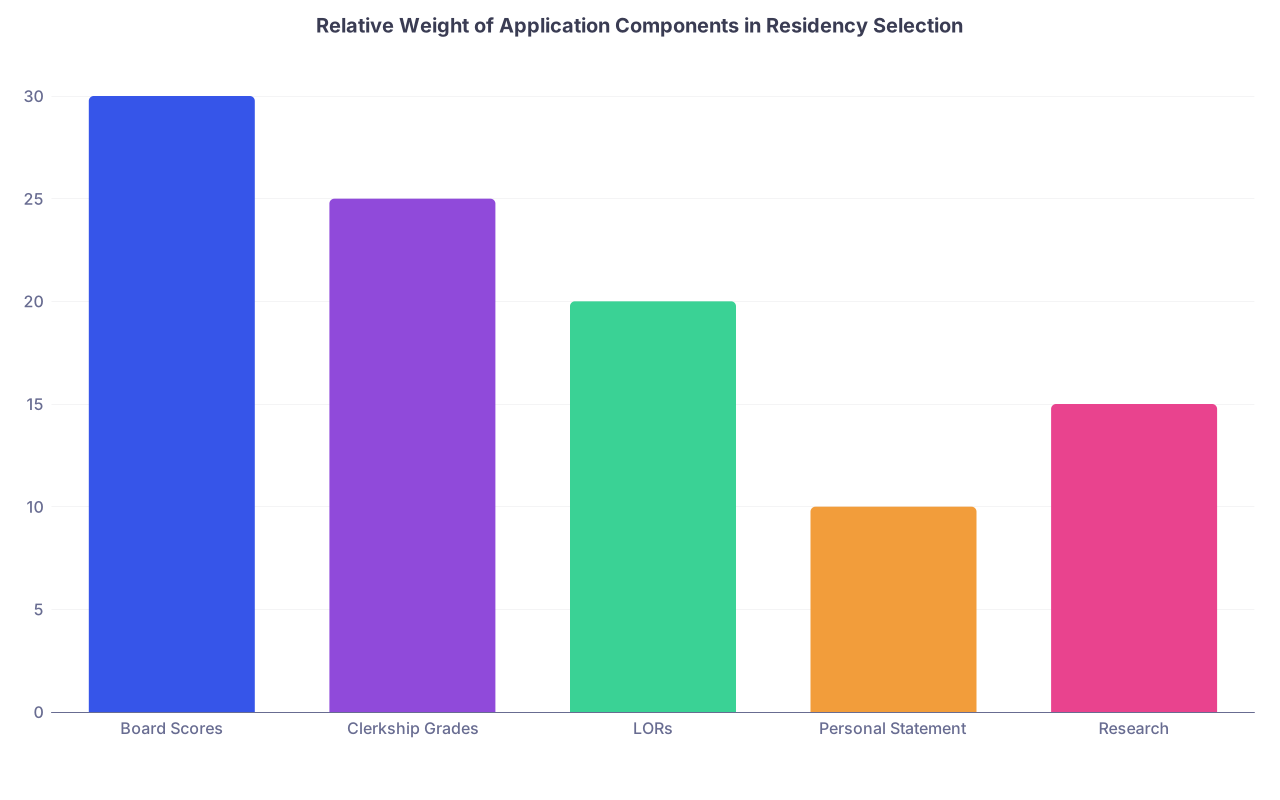
| Category | Value |
|---|---|
| Board Scores | 30 |
| Clerkship Grades | 25 |
| LORs | 20 |
| Personal Statement | 10 |
| Research | 15 |
Letters are not everything. But they’re plenty important. And they’re especially critical when you don’t have a famous institution doing half the selling for you.
Step 2: Map Your Actual Letter Options (Not the Imaginary Ones)
Most students in your position start from “I only have two people.” Usually wrong. You have more potential options than you think, but you need to map them.
Pull up a blank page and list every attending or senior person who:
- Has directly supervised you clinically
- Has seen you repeatedly (clinic, inpatient, continuity, electives)
- Has seen you teach, lead, or run something
Then categorize them:
| Category | Examples |
|---|---|
| Core specialty faculty | IM, FM, EM, Surg in your field |
| Non-core clinical | Other specialties, sub-specialty |
| Research/academic | PI, QI mentor, project lead |
| Leadership/other | Course director, dean, coach |
| Away rotation faculty | Visiting program attendings |
Now ask three questions about each:
- Who has seen me at my best?
- Who actually likes me (you know this from tone, not guessing)?
- Who has time and a track record of writing real letters, not one‑liners?
When options are thin, you prioritize “knows me well” over “famous name.” A glowing, concrete letter from Dr. Nobody in Community Hospital weighs more than a generic “Pleasure to work with” letter from Dr. National Chair who barely remembers your name.
Step 3: Play By Specialty Rules Without Letting Them Box You In
Each specialty has its own unspoken rules about letters. You need to respect those rules, then use every bit of flexibility they allow you.
Here’s the rough landscape:
| Specialty | Ideal Mix (3–4 letters) |
|---|---|
| Internal Med | 2 IM clinical + 1 any clinical/research |
| FM / Peds | 2 core (FM/Peds) + 1 other clinical |
| Gen Surg | 2–3 surgery + 1 other |
| EM | 1–2 SLOEs (EM) + 1 other |
| Psych / Neuro | 1–2 specialty + 1–2 core med/other |
If you’re coming from a small place with:
- Only one surgeon
- No EM rotation on site
- One overextended core IM faculty
…then your strategy is not “pretend you can meet big academic center norms.” It’s:
- Hit the minimum true specialty exposure letters you can reasonably get.
- Make everything else strong and personal, even if it’s from “off‑specialty” attendings.
- Use your personal statement and MSPE (if you can influence it) to contextualize your school’s size and limitations in a clean, factual way.
Programs are not stupid. They know some schools are small, community‑based, or new. As long as your letters explain who you are clearly, they’ll understand why you do not have three subspecialists writing about your brilliance in a department that does not exist.
Step 4: Manufacture Depth When You Only Have One or Two Faculty
The worst position: you’ve got, say, one core IM attending who likes you and a PD who barely knows you, plus some randoms.
You cannot conjure new faculty out of thin air, but you can deepen the relationships you already have—before you ask for letters.
Here’s what that looks like in real life:
- You did your medicine clerkship with Dr. Shah at the community hospital. She liked you, you got an Honors.
- Instead of disappearing after the rotation, you:
- Email: thank her, share what you learned, ask if you can come to her clinic half a day a month.
- Show up. Consistently. Be useful, not clingy.
- Ask questions that show you’re thinking like an intern: “How would you present this patient to a consultant?” not “What’s on the test?”
- Volunteer for one concrete, finite task: help build a patient handout, update a clinic protocol, prepare a short talk for the team.
After 3–4 months of this, Dr. Shah does not just remember you. She has stories. Real ones:
“Between March and July, she repeatedly returned to my clinic on her own time. She independently followed up several complex patients and identified a medication error that prevented harm.”
That’s a program director’s catnip.
You can do a version of this with:
- A single surgeon → scrub with them whenever possible, follow up their patients, ask to attend M&M or clinic.
- A single pediatrician → volunteer for their resident teaching activities, help with a QI project.
- The only psychiatrist → join their research, help with teaching sessions, ask if you can help with a case discussion series.
Point is: depth beats breadth. If you can’t diversify who writes for you, max out how much they truly know you.
Step 5: Use Away Rotations as Strategic LOR Engines (Not Just “Exposure”)
If your home base is tiny, away rotations aren’t optional “nice experiences.” They’re how you plug into the letter‑writing ecosystem.
You want at least one away rotation that gives you:
- Direct, consistent contact with an attending or PD
- A formal system for letters (especially EM with SLOEs)
- Enough time (4 weeks) for them to see you under pressure
Plan them backward from application season:
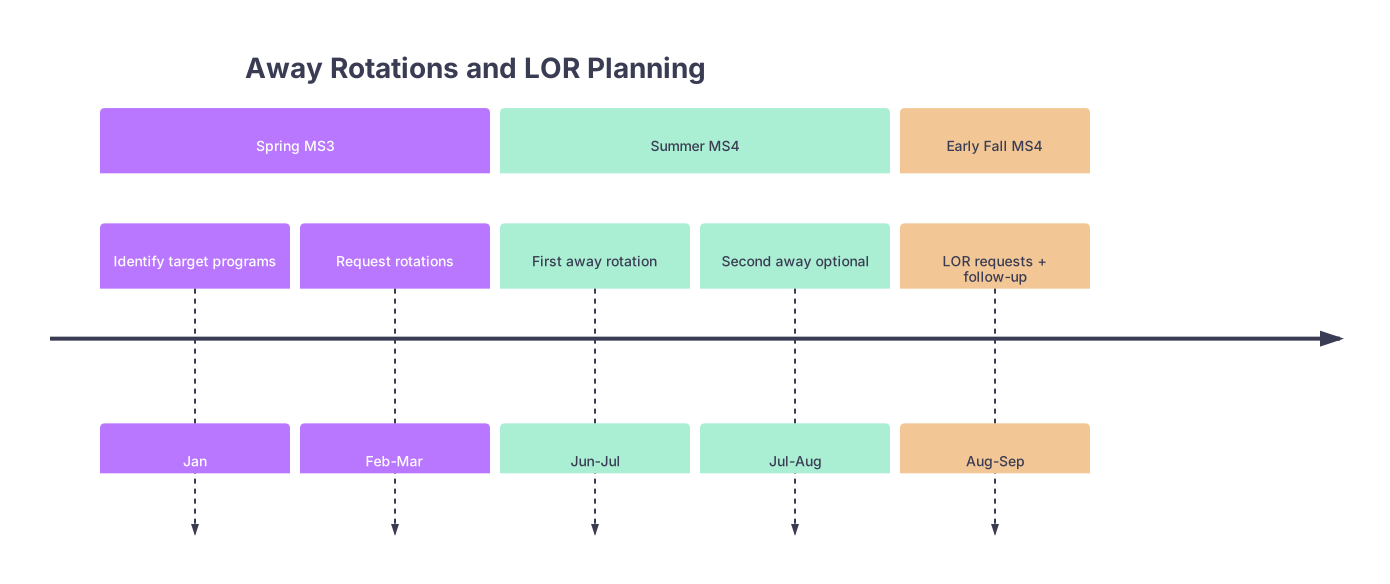
| Period | Event |
|---|---|
| Spring MS3 - Identify target programs | Jan |
| Spring MS3 - Request rotations | Feb-Mar |
| Summer MS4 - First away rotation | Jun-Jul |
| Summer MS4 - Second away optional | Jul-Aug |
| Early Fall MS4 - LOR requests + follow-up | Aug-Sep |
You’re not going on aways to “explore cities.” You’re going to:
- Work like an intern
- Signal your interest in that specialty and style of program
- Earn at least one letter that makes you look like you can hang at a busier place
If you can only afford one away (money, time, family), pick a place that:
- Represents the kind of program you actually want (don’t go to super‑academic if you want community, unless you’re very intentional about it).
- Has a history of taking students from non‑fancy schools.
- Is known for writing solid, detailed LORs or SLOEs.
You do not need the “top 10 name.” You need “a place that will write the truth about how hard you worked for four straight weeks.”
Step 6: When One Person Is Writing for Half Your Class
This is common in small schools: Everyone applying to IM has a letter from Dr. Lee. Programs see ten ERAS files from your school, all with the same name.
That’s not ideal—but it’s manageable if you handle it correctly.
You need to:
- Make sure your letter from that person is clearly not the same cookie‑cutter paragraph.
- Counterbalance it with at least one letter from someone else who knows you on a different dimension (leadership, research, longitudinal clinic, away rotation).
- Give that “main letter writer” enough ammo so they can differentiate you.
That “ammo” is not a 6‑page CV dump. It’s:
- A tailored one‑pager with:
- 3–5 specific patients or cases where you think you stood out.
- 3 bullet points on how you handle feedback, reliability, and teamwork.
- A short paragraph on why you’re going into this specialty.
- A copy of your personal statement draft (doesn’t have to be perfect).
- Your CV, but with the key 3–5 things highlighted.
Then, when you ask, you don’t say: “Can you write a letter?” You say:
“I know you write for a lot of our students. I’m hoping you can comment particularly on [my work on X rotation / my reliability / how I interacted with the team]. I’ve attached a one‑pager to make that easier.”
That shows you understand their reality and are trying to make their job easier, not harder. People respond well to that.
Step 7: Handling Non‑Traditional or “Odd” Letter Writers
In small schools, you see some funky letters:
- The community preceptor who’s an NP/PA, not an MD/DO.
- The PhD researcher who barely sets foot in the hospital.
- The dean of student affairs who knows you mainly from disciplinary committee work (hopefully not as the subject).
Some of these can help you; some can hurt you.
Here’s the blunt hierarchy when options are thin:
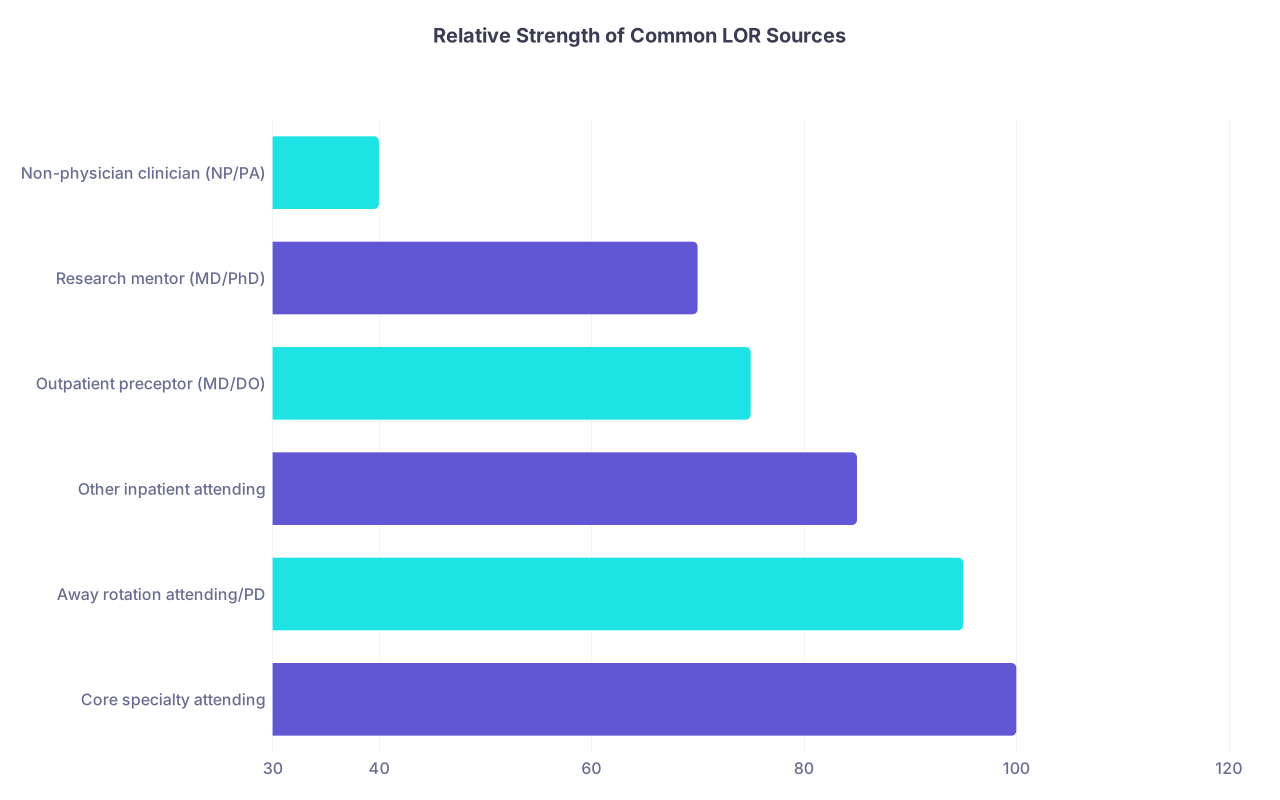
| Category | Value |
|---|---|
| Core specialty attending | 100 |
| Away rotation attending/PD | 95 |
| Other inpatient attending | 85 |
| Outpatient preceptor (MD/DO) | 75 |
| Research mentor (MD/PhD) | 70 |
| Non-physician clinician (NP/PA) | 40 |
Use non‑traditional letters like this:
- NP/PA letter: Avoid as one of your “main” ERAS letters unless the person has a big role in the program and knows you extremely well. You can still ask them for a private reference if a program calls.
- PhD / research letter: Great as your 3rd or 4th letter, especially in IM, neuro, psych, or competitive specialties. Only if they can speak to your work ethic, reliability, and some clinical relevance.
- Dean / administrator: Often too generic. If they truly know you well and can speak to your professionalism or overcoming hardship, then maybe. But don’t waste a slot on a generic “good student” page.
When you only have 3 letter slots, you protect them like ICU beds. Core clinical performance comes first.
Step 8: How to Ask for a Strong Letter (When You Feel You Have No Leverage)
You’re worried: “If I push too hard, I’ll annoy the only attending I’ve got.” That fear keeps people from asking the right way.
Here’s a direct script that works, even in small, relationship‑heavy environments:
In person (best) or via email:
“Dr. Martinez, I’m applying to internal medicine this cycle and I really valued working with you on the wards. I was wondering if you’d feel comfortable writing me a strong letter of recommendation that comments on my clinical performance and readiness for residency?”
And wait. Do not fill the silence.
You’re listening for the hesitation. If they say:
- “Of course, I’d be happy to,” in a normal tone → green light.
- “Well, I can write you a letter…” in a slow, reluctant voice → that’s a soft no. You need to consider other options.
Your situation is already constrained. The one thing you absolutely cannot afford is a lukewarm letter. A so‑so letter from the only big name at your site can be worse than a glowing one from a less impressive title.
If they agree, you follow up the same day with:
- Thank you
- Your CV
- Personal statement draft
- A bullet list of 3–5 patients or situations where you think you performed well
- A soft deadline: “ERAS opens on X date; it would help me a lot to have the letter in by Y if possible.”
Small programs run on relationships. You’re not being demanding. You’re being organized.
Step 9: If You’re Late to the Game (Already MS4, Application Season Looming)
You’re reading this in July or August of MS4 and realizing: “I should’ve started all this six months ago.”
Too late to be perfect. Not too late to improve.
Here’s your crash plan:
- Identify the 2–3 people most likely to write now.
- Immediately go see them in person on a clinic day or send a clear, concise email.
- For the next few weeks, make yourself visible: show up early, offer to help, be sharp on your current rotations.
- Ask for letters as soon as you’ve had at least 2 solid weeks of contact (if they’re new).
- For anyone from earlier in MS3, jog their memory hard with specific reminders of cases and feedback they gave you.
You also do one more thing: you own the small‑school reality in your story.
You don’t whine in your personal statement. You simply say something like:
“Attending physicians at my community‑based school know us well because we work with a small faculty closely for repeated rotations. Dr. X supervised me on [rotations], observed my growth from [concrete example] to [concrete example], and encouraged me to pursue [specialty].”
You’re flipping the script: small school = more direct supervision, more responsibility, more meaningful relationships.
Step 10: Know When to Explain and When to Shut Up
There are exactly two places you can contextualize thin LOR options without sounding defensive:
- Your personal statement (1–2 clean sentences, max).
- Your interview answers, if asked.
Example for your personal statement:
“My medical school is a small, community‑based program with a limited number of faculty in [specialty]. This meant working closely with the same attending physicians over multiple rotations, who provided consistent feedback and mentorship. Their letters reflect this longitudinal perspective.”
Notice what that does:
- States fact: small, limited faculty.
- Flips it: longitudinal mentorship, consistent feedback.
- No apology. No “despite this” drama.
In interviews, if someone asks about letters or your school’s size, you keep the tone straightforward:
“We’re small, yes. The upside has been that my attendings really know me. Dr. Y has seen me on [rotations] and [clinic], and I think that comes across in her letter.”
And then you stop talking. Do not oversell or sound insecure. You’re explaining the setting, not begging for mercy.
Your Next Concrete Step (Do This Today)
Open a blank document and:
- List every potential letter writer you’ve had meaningful contact with.
- Label each: core specialty / other clinical / research / admin.
- Star the 3–4 people most likely to write strong, specific letters for you.
- For your top 1–2, write a short one‑pager: 3–5 specific cases/situations where you think you shined, plus a draft paragraph on why you’re choosing your specialty.
Then, within 48 hours, schedule or send one ask to your #1 choice using the exact “strong letter” wording above.
Do not wait for the perfect plan. Letters are built on relationships and time, and you’re at a small place. The earlier you start moving, the bigger you’ll look on paper.