
How many reminder emails can you send your attending about that residency letter before you start hurting your relationship… or your application?
Let me answer the core question first.
Yes, it is absolutely okay to remind your letter writer multiple times. In fact, if you do not, there’s a good chance some letters will never get written. The key is timing, tone, and having a clear system so you’re not guessing every week.
Here’s the framework I recommend and have seen work for hundreds of applicants.
The Short Answer: What’s “Normal” for Reminders?
If you’re asking “How often is too often?” use this as your default schedule:
- Ask for the letter: 6–8 weeks before you need it
- Add ERAS / system request: Same day or within a few days
- First reminder: 2 weeks after the initial request
- Second reminder: 2 weeks later
- Third reminder: 1 week before your real deadline
- Emergency nudge (if needed): 48–72 hours before deadline
So yes, 3–4 total reminders is normal and not annoying if they’re polite, concise, and spaced out.
The wrong move is silence for a month and then a panicked “I need it in 24 hours!!” email.
Before You Even Start: Ask Early, Ask Clearly
Most “I feel bad sending another reminder” problems start way earlier—when people ask without a clear timeline or plan.
When you ask for a residency LOR, do three things:
Give a real deadline
Do not say “whenever you get a chance.” That translates to “when I have a free weekend,” which for many attendings = never.Say something like:
“ERAS opens for programs on September 25. To be safe, I’m aiming to have all letters in by September 15. Would that timeline work for you?”
Provide materials upfront
Attach:- CV
- Personal statement draft (even version 1 is better than nothing)
- ERAS letter ID / instructions
- Bullet list of 3–5 things you worked on with them
Confirm the plan in writing
If you ask in person, follow up with an email that documents:- The fact that they agreed
- The deadline
- How they’ll submit (ERAS, portal, etc.)
This makes later reminders feel natural: you’re just following up on a plan you both agreed to.
Ideal Reminder Timeline (With Exact Wording)
Here’s a simple schedule for ERAS residency letters. Adjust dates to your situation.
Baseline timing
Assume:
- Target date for programs to see complete app: Sept 25
- Your personal “safe” letter deadline: Sept 15
Work backward:
- Ask for LOR: Late July / early August
- System request (ERAS): Same week
- 1st reminder: Mid-August
- 2nd reminder: Late August
- 3rd reminder: Sept 8–10
- Emergency nudge: Sept 13–14 (only if still not in)
Now let’s make it concrete.
First reminder (about 2 weeks after initial ask)
Subject: Residency letter of recommendation – brief follow-up
Dear Dr. Smith,
I hope your week is going well. I just wanted to briefly follow up regarding the residency letter of recommendation you kindly agreed to write for me for Internal Medicine.
I’ve sent the ERAS letter request through the system. My goal is to have all letters submitted by September 15 so everything is ready when programs start reviewing applications.
Please let me know if you need any additional information from me (CV, personal statement, or a bullet list of cases we worked on together). I really appreciate your support.
Best regards,
[Your Name]
This is normal. No one reasonable is offended by this.
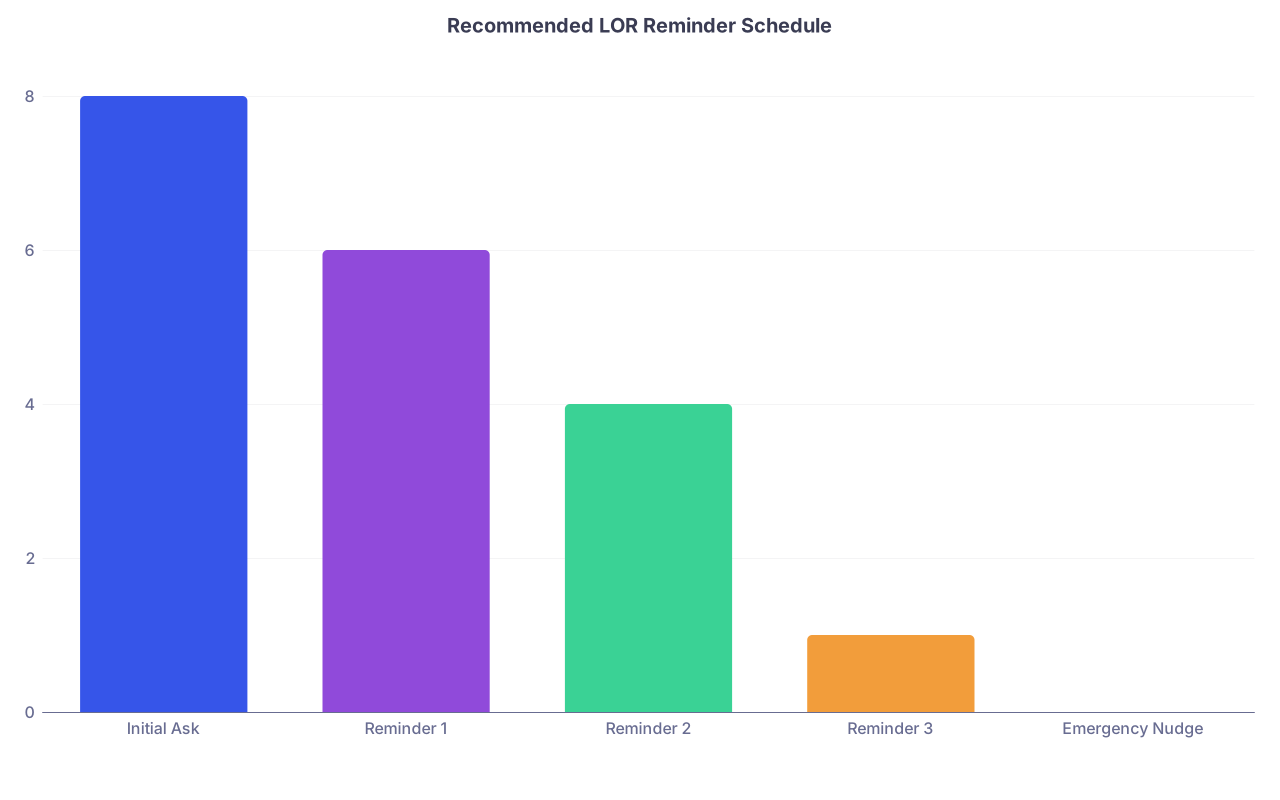
| Category | Value |
|---|---|
| Initial Ask | 8 |
| Reminder 1 | 6 |
| Reminder 2 | 4 |
| Reminder 3 | 1 |
| Emergency Nudge | 0 |
Second reminder (about 2 weeks later)
Subject: Residency LOR – coming up on Sept 15 target
Dear Dr. Smith,
I wanted to send a quick reminder about the residency letter of recommendation for my Internal Medicine applications. My target date for having all letters in is September 15, which is about two weeks away.
I know your schedule is very busy, and I truly appreciate you taking the time to support my application. If it would be helpful, I can resend my CV and personal statement or a short summary of our work together.
Thank you again,
[Your Name]
Still polite. Still fine.
Third reminder (about 1 week before your deadline)
This one can be a bit more direct.
Subject: Final reminder – residency LOR (Sept 15)
Dear Dr. Smith,
I wanted to send a final reminder about the residency letter of recommendation for my application. My goal is to have all materials submitted by September 15, which is now about a week away.
I’m very grateful that you agreed to write this letter. If your schedule has changed and it will be difficult to complete it by then, please let me know so I can adjust my plans.
Thank you again for your support,
[Your Name]
Notice the key line: you give them an out. That’s respectful and also practical—if they cannot do it, you need to know in time to pivot.
Emergency nudge (48–72 hours before)
Use only if:
- This letter is critical (e.g., your only specialty-specific letter), and
- They have previously been responsive / supportive of you
Subject: Time-sensitive – residency LOR
Dear Dr. Smith,
I apologize for the repeated messages. Since ERAS applications are about to be reviewed, I wanted to check one last time on the status of my letter of recommendation.
If you’re no longer able to complete it, I completely understand and would appreciate you letting me know so I can make alternate arrangements.
Thank you again for your time and support,
[Your Name]
If there’s still silence after this, you need a backup plan. Which brings us to…
How to Tell If You’re Crossing the Line
You’re not being annoying if:
- You spaced reminders by at least 7–14 days
- You clearly stated the timeline when you first asked
- Your tone is respectful and concise
- They’ve previously said “Yes, I’ll do it” and haven’t told you otherwise
You might be crossing the line if:
- You email more than once a week without any new information
- You’re sending messages like “Just checking in again!” every few days
- You’re texting them late at night or on weekends for something non-urgent
- You never gave a real deadline and now you’re trying to compress everything into 2–3 days
Most attendings are disorganized, not malicious. They forget. They mean well. They’re juggling patient care, notes, meetings, families, their own stuff. Well-timed reminders are actually helpful to them.
What If They Never Respond or Still Don’t Submit?
This happens more than anyone likes to admit.
Here’s the triage:
Check status in ERAS (or your portal)
Make sure the issue isn’t on your side: wrong email, wrong letter slot, etc.Add a different writer in parallel
If you’re 1–2 weeks from your real deadline and still no letter, start activating Plan B:- Another attending from the same rotation
- A subspecialist you worked with closely
- A research mentor in the same field
Loop in an intermediary if appropriate
Sometimes a polite nudge from:- Your clerkship director
- Program coordinator
- Chief resident
can make a difference. But use this carefully; don’t escalate after a single missed email.
Be willing to let that writer go
If they can’t answer three reminders and a clear “are you still able to write this?” message, they’re not a safe person for something this time-sensitive. Cut your losses and reallocate your energy to people who actually show up for you.

| Step | Description |
|---|---|
| Step 1 | Ask Attending for LOR |
| Step 2 | Send ERAS Request |
| Step 3 | Reminder 1 |
| Step 4 | Wait |
| Step 5 | Reminder 2 in 2 Weeks |
| Step 6 | Reminder 3 + Ask if Still Able |
| Step 7 | Activate Backup Writer |
| Step 8 | Monitor Until Submitted |
| Step 9 | 2 Weeks Passed? |
| Step 10 | Response? |
| Step 11 | 1 Week to Deadline? |
| Step 12 | Still No Response? |
How Many Letters Are “Safe” to Be Waiting On?
You don’t want to be in a position where your whole application depends on one chronically late person.
For residency, most people need 3–4 letters. I’d structure it like this:
- 1–2 “early and reliable” writers (people who historically turn things in on time)
- 1 or 2 “wild cards” (very strong letters but may be slower or less responsive)
And you stagger your anxiety. Don’t have all 4 letters coming from notorious procrastinators.
| Letter Type | Recommended Number | Risk Level |
|---|---|---|
| Core specialty faculty | 2 | Medium |
| Subspecialty faculty | 1 | Low/Med |
| Research mentor | 1 | Variable |
How to Make Reminding Less Awkward
If you always feel like you’re begging, fix your system. A few simple moves help:
Use a tracking sheet
Google Sheet, Notion, whatever. Include:- Writer
- Date asked
- Date ERAS request sent
- Reminders sent (dates)
- Status: Agreed / Submitted / No response
Then you’re not “feeling” your way through reminders; you’re following a plan.
Standardize your templates
Write 2–3 email templates (initial ask, reminder, final reminder). Customize quick details, but don’t reinvent the wheel every time. Cuts down on emotional friction.Anchor everything to dates you’ve already discussed
“As we discussed, I’m hoping to have all letters in by Sept 15…” sounds like teamwork. Because it is.Match the medium to the relationship
- Senior research mentor? Email.
- Attending you worked with daily who texts residents regularly? A short, respectful text or in-person reminder may be fine, with a follow-up email.
Rule: anything related to applications should exist in email at least once for clarity and documentation.
How Often Is Too Often? Quick Scenarios
Let me be blunt on a few common edge cases.
Scenario 1: They said “Yes” two months ago, you’ve sent 3 reminders, and it’s now 3 days before your deadline.
- Do you send another reminder? Yes, and immediately activate a backup writer. Don’t wait.
Scenario 2: They never responded to your initial ask, and you’ve followed up once 2 weeks later.
- Do you keep pushing? One more follow-up is reasonable. If still nothing, move on.
Scenario 3: They verbally agreed, but you never sent a follow-up email with a date, and it’s now “late.”
- You still send a reminder. You just own the lack of clarity:
“I realize I did not give you a specific deadline previously…”
Scenario 4: You already have 4 solid letters and your “famous name” writer is ghosting you.
- Stop burning energy. Submit with the strong letters you have. A big name that never appears in your file is useless.

Key Principles To Remember
If you remember nothing else, remember this:
- Multiple reminders are normal
- Spacing and clarity make them professional, not pushy
- Written timelines upfront give you permission to follow up
- A non-responsive writer is a liability, not a prize to chase forever
- Your job is to advocate for your application, not protect someone else’s poor time management
Programs will not know or care how many times you had to remind someone. They only see whether the letter showed up.

FAQ: Reminding LOR Writers for Residency
1. Is it rude to remind an attending more than once about my letter?
No. Two or three reminders, spaced about 1–2 weeks apart, is standard and reasonable. What’s rude is expecting someone to remember a one-time hallway conversation from six weeks ago with no follow-up. As long as you’re polite, concise, and refer back to the timeline you both agreed on, you’re fine.
2. Can I text my letter writer to remind them?
Sometimes, but text should rarely be your primary method. Use text only if:
- You already have an established texting relationship
- They’ve texted you first in the past about work-related things
- You pair it with a follow-up email for the actual details
Example text:
“Hi Dr. Lee, this is [Your Name]. I just sent a brief email about my residency LOR with the final deadline. Wanted to flag it for you since I know your inbox is busy. Thanks again for your support.”
3. What if my letter is late but ERAS still lets me submit?
Programs start screening applications very early. A missing letter when they first open your file is a disadvantage. Will a late letter kill your chances? Not automatically. But relying on “it can come later” is weak strategy. Push to have all core letters in before programs seriously start reviewing—typically within the first 1–2 weeks after opening.
4. Should I tell my letter writer which programs I’m applying to?
You don’t need to list every single program. But you should tell them:
- Your specialty (obvious, but people skip this)
- The level/type of programs (academic vs community mix)
- Any specific focus (physician-scientist, primary care–focused, etc.)
It helps them tailor the letter. Example:
“I’m applying to a mix of academic internal medicine programs with strong clinician-educator pathways, such as [Program A], [Program B], and [Program C].”
5. What’s one thing I can do right now to make reminders less stressful?
Make a simple tracking table and set calendar reminders. List each writer, when you asked, your target letter date, and your planned reminder dates. Then you’re not sending “whenever I panic” emails; you’re calmly following a schedule. That alone removes half the anxiety around “Am I being annoying?”
Open your calendar or task manager right now and plug in three reminder dates for each of your letter writers—2 weeks after the ask, 4 weeks after, and 1 week before your deadline. Give yourself a script, give them clear dates, and stop guessing.