The biggest mistake students with prior grad coursework make is assuming it automatically “replaces” a post-bacc. It does not.
If you’re trying to figure out whether a formal or informal post-bacc still makes sense when you’ve already got a master’s, MPH, MS, or other graduate work behind you, you’re in a very specific—and very fixable—situation. Let’s walk through it like an advisor who has actually sat with people in this exact mess.
Step 1: Accept the Harsh Truth About How Med Schools View Your Grad Work
Medical schools do not care about titles. They care about numbers and context.
Harsh but true breakdown:
- Your undergraduate GPA is the primary academic metric.
- Your BCPM (biology, chemistry, physics, math) undergraduate GPA is heavily scrutinized.
- Graduate coursework, even a 4.0, is supporting evidence, not a reset button.
Here’s what I’ve seen over and over:
- Student with a 2.9 undergrad, 3.8 SMP (MS in Medical Sciences) → gets attention at many MD and DO schools.
- Student with a 2.7 undergrad in English, 4.0 MPH with mostly policy/research → still screened out at multiple MD programs because undergrad and science GPAs are weak or thin.
- Student with a 3.1 undergrad, then random graduate certificate with one or two C’s in statistics → in worse shape than before because now there’s more mediocre academic data.
So you can’t ask: “I already did a grad degree, do I still need a post-bacc?”
You have to ask: “Given my current undergrad and science record, what would an admissions committee see… and does a targeted post-bacc fix the obvious problems?”
Most of the time, the answer is yes, you still need additional undergrad-level coursework. The graduate degree just changes which kind of post-bacc makes sense.
Step 2: Diagnose Your Exact Situation (Pick the Closest One)
Forget generalities. Find yourself here.
Now, zoom into your specifics.
Situation A: You Have a Strong Undergrad GPA but Weak or Scattered Science
Example: 3.6 overall in psychology, but only took:
- Intro Bio I (B)
- One stats course
- Maybe a random chem
Your grad work: MPH, MEd, MA, MS in something not heavy on the med-school type sciences.
Here’s your problem: you’re “smart enough” on paper, but you’re not academically proven in the hardcore sciences.
In this case, a post-bacc still makes a lot of sense—specifically a career-changer style post-bacc to build:
- Full prereqs: Gen chem, orgo, physics, full bio, biochem
- A real BCPM GPA for committees to evaluate
You do NOT rely on your grad GPA here. It’s nice, but it doesn’t cover:
- Rigorous organic chemistry under time pressure
- Multi-semester lab sequences
- A sustained science course load while juggling life
You need undergrad-level sciences on a transcript. Post-bacc is where you get that.
Situation B: You Have All the Prereqs, but They’re Old or Ugly
Example: 3.0 undergrad with:
- Gen chem: C+ / B-
- Orgo: C / C
- Physics: B- / C+
- Bio: B / C+
Then you did an MS in something non-medical or mixed (e.g., biomedical engineering, public health, data science). Maybe you got a 3.5–4.0. Still, your undergrad BCPM is flat.
Here’s the hard truth: med schools will look at those old C/C+ prereqs and wonder if you can handle med school pace.
A post-bacc can still absolutely make sense, but you need to be smart:
You’re not a “career-changer.” You’re in record-enhancer territory.
Post-bacc goals here:
- Show recent (last 2–3 years) A-/A work in upper-level sciences.
- Either:
- Repeat true disaster courses (C- or below), or
- Add new, hard, relevant sciences (biochem, physiology, cell bio, genetics).
Your grad courses help, especially if they were advanced bio/biostatistics, but you still want undergrad-level science improvement for AMCAS and AACOMAS GPA calculations. You’re trying to move your science GPA trend line from “meh” to “clearly improved.”
Situation C: You Have a Science/Med-Adjacent Graduate Degree with Good Grades
Example:
- MS in Physiology, 3.7 GPA
- MS in Biomedical Sciences, 3.8 GPA
- MS in Medical Science (SMP-style), 3.6 GPA
Undergrad:
- 3.1–3.3 overall, 3.0–3.2 BCPM
You’re in that annoying gray zone. You already did what a lot of people would use a formal post-bacc for.
Do you still need one? Sometimes yes, sometimes no. Here’s the breakdown:
You probably do NOT need another formal post-bacc if:
- You have clear upward trend: last 45–60 credits (undergrad + grad) mostly A-/A
- Your graduate program was clearly rigorous and science-heavy
- Your MCAT (or practice MCATs) are competitive (510+ MD, 503+ DO as rough ballparks, depending on your target schools)
You MIGHT still benefit from targeted undergrad post-bacc coursework if:
- Your undergrad BCPM is under about 3.2 and you’re aiming MD
- Your graduate program is not widely known or respected as “rigorous” to adcoms
- Your grad transcript has several B- or worse in key science courses
In those cases, 12–20 credits of A-level upper-level undergrad science can help anchor the narrative: “I used to struggle; now I have the academic maturity and skills to excel.” You don’t need a full new program. You need a sharply chosen set of classes.
Situation D: You Have Graduate Work That Makes Things Worse
This is the one people hate acknowledging.
Example:
- Undergrad: 2.9 overall, 2.7 BCPM
- Grad certificate or master’s: 3.0 with some B/C grades in graduate-level sciences or stats
Now you don’t just have one weak academic story; you have two.
Is a post-bacc still worth doing? Often yes—but not casually. You’ve got to treat it like your last serious chance to show a complete academic turnaround.
This is where a structured, high-accountability post-bacc or SMP might make sense:
- Small classes
- Mandatory advising
- Sometimes linkage or interviews contingent on performance
If you go this route and you do not absolutely crush it (3.7+), you’re probably out of MD contention and maybe even DO. So do not start this lightly.
Step 3: Decide Between Formal vs. DIY Post-Bacc When You Already Have Grad Credits
You’ve got grad loans. You’re not excited about more tuition. Understandable.
But there’s a difference between formal post-baccs and DIY/informal:
- Formal: Cohort, advising, committee letter, linkage options, set curriculum.
- DIY: You enroll as non-degree or second bachelor’s, pick classes yourself, no dedicated “program” label.
When a Formal Post-Bacc Still Makes Sense Despite Prior Grad Work
It’s still a good move if:
- Your undergrad BCPM is below ~3.3 and you need a strong, structured academic reinvention.
- You want:
- Committee letter
- Advising with med-school-savvy staff
- Possible linkage agreements
- Your transcript looks chaotic (multiple institutions, withdrawals, inconsistent semesters) and you need a clean, recent block of A-level sciences in one place.
Think of programs like:
- Temple ACMS
- UC Berkeley Extension Post-Bacc (with advising)
- Goucher/Bryn Mawr/Columbia (for true career changers)
- Local university structured post-baccs attached to premed advising offices
If you’re in Situation B or D from above, this is often smarter than piecemeal DIY.
When DIY / Informal Post-Bacc is Enough (or Better)
DIY usually makes sense if:
- You already have:
- Decent undergrad GPA (3.3+)
- Good graduate science performance
- You only need:
- Missing prereqs (e.g., physics + orgo)
- A handful (12–18 credits) of upper-level biology to update your record
You can do this at:
- Your local state university
- A nearby reputable private university
- Sometimes a strong community college (ideally paired with some 4-year work)
Just do not be sloppy:
- Don’t scatter 1–2 classes per year over 5 years.
- Don’t hop across three schools.
- Don’t mix rigorous upper-level work with no-effort filler.
Aim for 2–3 courses per semester, all science, all A’s. Show you can handle a med-school-like load at a high level while managing adult life.
Step 4: Understand How Your Grad and Post-Bacc Work Will Actually Be Read
Picture an admissions committee member scanning your file. They’re looking for:
- Overall academic trajectory
- Ability to handle science intensity
- Evidence of growth and maturity
This is the silent mental checklist:
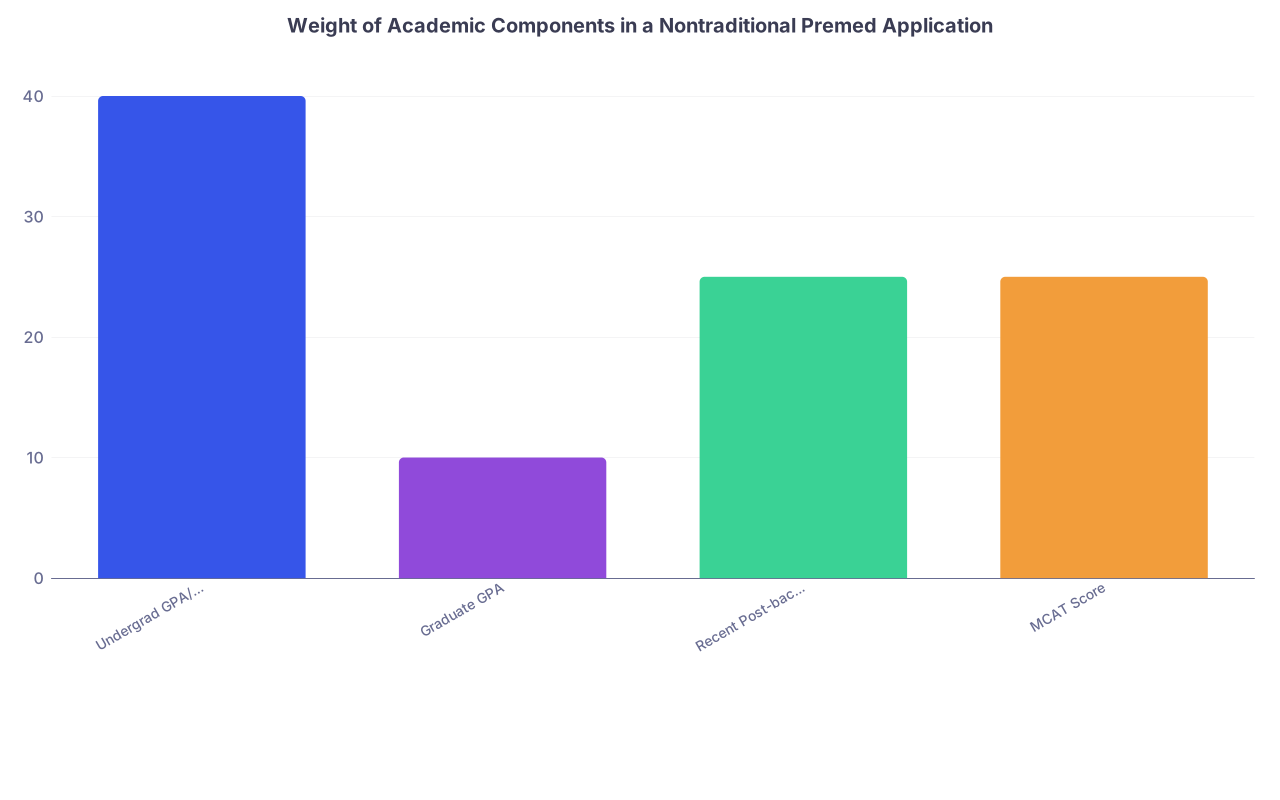
| Category | Value |
|---|---|
| Undergrad GPA/BCPM | 40 |
| Graduate GPA | 10 |
| Recent Post-bacc/SMP | 25 |
| MCAT Score | 25 |
Rough reality (numbers approximate, but the priority order is right):
- Undergrad GPA/BCPM: still the anchor
- Recent post-bacc/SMP: can partially override undergrad trends
- Graduate GPA: context, especially if science-heavy and rigorous
- MCAT: proof of current cognitive horsepower and content mastery
Post-bacc still matters—even with a grad degree—because it hits two critical questions head-on:
- Can this person currently handle heavy science coursework with A-level mastery?
- Did they learn how to be a different kind of student than they were at 19?
Grad work sometimes answers that. Post-bacc work answers it more cleanly because of how GPA is calculated and compared across applicants.
Step 5: Concrete Scenarios & What I’d Actually Tell You to Do
Let’s make this brutally specific.
Scenario 1: BA in Sociology (3.5), MPH (3.8), Only Took Bio 1 + Stats
You:
- Want MD or DO.
- Are 28, working full-time.
Do you need a post-bacc? Yes, 100%.
What to do:
- Enroll in a career-changer style post-bacc or DIY with:
- Gen Chem I & II
- Orgo I & II
- Physics I & II
- Full bio sequence
- Biochem
- Take 2–3 sciences/term, no grades below A-.
- Use your MPH to show you understand healthcare, but let the post-bacc do the heavy lifting on science credibility.
Scenario 2: BS in Biology (3.0 overall, 2.8 BCPM), MS in Biomedical Science (3.6)
You:
- Have all prereqs, but undergrad is weak.
- Did very solidly in your MS.
Post-bacc? Maybe, but not always.
If your MS program is known to adcoms and your MCAT is strong (515+), I’d tell you:
- Skip a big post-bacc.
- Maybe take 2–3 targeted undergrad upper-level bios at a local university and crush them.
- Focus energy on MCAT and building a tight school list (more DO, mid-tier MD, plus regionals where you have ties).
If your MS is obscure or your MCAT is average:
- Do 12–16 credits of upper-level undergrad science and nail a 3.8–4.0.
- Apply MD and DO. Use your personal statement and secondaries to explicitly describe your upward trend.
Scenario 3: BA in English (2.9), MA in Education (3.9), Planning to Apply in 2 Years
You:
- Have almost no science.
- Have a ton of life experience, possibly teaching.
Here, the MA doesn’t change your need for serious, structured science rebuilding. You’re not a light DIY candidate.
What I’d tell you:
- Strongly consider a formal career-changer post-bacc with advising and linkage if financially possible.
- Otherwise, DIY at a reputable 4-year with:
- Full prereq sequence
- 1–3 upper-level bios
- You need 40–50 credits of A/A- science to make MD plausible. DO is more forgiving, but the academic bar is still real.
Your grad work helps your narrative. It does not move the GPA math.
Step 6: When a Post-Bacc Actually Doesn’t Make Sense Despite Prior Grad Work
There are some cases where adding more coursework is just spinning your wheels.
You probably do NOT need or benefit from a post-bacc if:
- Undergrad GPA: 3.6+
- BCPM GPA: 3.4+
- You’ve completed all core prereqs with mostly A-/A and nothing worse than a B-
- Your grad degree is solid but not critical to your narrative
- Your MCAT is (or should be, based on practice) in a competitive range
In that case, more classes are just delaying your application and draining your bank account. You’d be better off:
- Taking 1–2 targeted courses only if you truly need content refresh for MCAT
- Focusing on:
- MCAT
- Clinical exposure
- Shadowing
- Service and leadership
- Strong letters
I’ve seen people in this exact bucket waste 1–2 years doing extra classes they absolutely did not need, just because they felt “behind” compared to gunners. Don’t do that to yourself.
Step 7: How to Explain Multiple Degrees + Post-Bacc in Your Application
If you do end up with undergrad + grad + post-bacc on your transcript, you’ll need to tie it together so it doesn’t look like endless wandering.
Your narrative should:
- Own the early weaknesses directly.
- Show specific changes in habits, mindset, and circumstances.
- Highlight the last 2–3 years as the “real you.”
Example framing:
- “During my early undergraduate years, I treated school as something to get through, not something to master. My grades reflect that. In my graduate program, I began to approach learning with structure and discipline, but I knew medical school demanded more. Over the past two years, I’ve taken a rigorous science courseload—12–15 credits per term while working part-time—and earned A’s in courses like biochemistry, physiology, and cell biology. That trajectory reflects the student I am now and the one I’ll be in medical school.”
If your grad work is very relevant, connect it:
- “My MS in Physiology gave me an early window into the intensity of medical training. I completed graduate-level physiology and pharmacology with A grades, and I chose to add targeted undergraduate upper-level courses afterward to demonstrate consistent excellence across course levels.”
You’re not apologizing for your past. You’re showing evolution.
FAQ (Exactly 3 Questions)
1. If I already have a 4.0 in my master’s program, will a mediocre post-bacc hurt me?
Yes. It absolutely can. Once you choose to do additional undergrad-level science after your graduate degree, adcoms will look closely at it. If you follow a strong grad performance with B’s and C’s in post-bacc work, the message is: under strong, structured conditions you can perform, but with more independence or competing responsibilities you struggle. If you cannot commit to A-/A level performance in a post-bacc, it may be safer to lean on your graduate work plus a strong MCAT and skip extra undergrad courses.
2. How many credits of post-bacc do I need if I already did a science-heavy grad degree?
If your grad work is in a rigorous biomedical field and your undergrad GPA is borderline but not disastrous, 12–18 credits of recent, upper-level undergrad science with mostly A’s is often enough to demonstrate a solid upward trend. You do not need another 40-credit overhaul unless your undergrad BCPM is very low (<3.0) or your graduate record is mixed. The key is density and recency: 2–3 hard sciences per term, all done in the last 2–3 years.
3. Does it matter if my post-bacc classes are at a community college if I already have a graduate degree?
It still matters, but context softens it. One or two community college classes to complete missing prereqs can be fine, especially for DO and some MD schools, if the rest of your record (undergrad upper-level, grad work) shows success at a 4-year institution. However, if you’re trying to repair a weak academic record, relying mostly on community college science after college and grad school can look like you avoided rigor. In that case, prioritize a 4-year university for most of your post-bacc work and, if you use a community college, keep it limited and defensible (schedule constraints, cost, proximity).
Key points:
- Your prior graduate coursework does not erase weak or thin undergrad science—it just changes what kind of post-bacc makes sense.
- Formal post-baccs are for structure, linkage, and major academic repair; DIY is for targeted, efficient strengthening.
- If you commit to a post-bacc after grad school, you must crush it. Those grades become the final word on your academic readiness.