Most post-bacc students ruin the first six weeks and spend the last six in panic. You are not going to do that.
You have one year. No summers, no do-overs, no “I’ll fix it next cycle.” A one‑year post‑bacc is a sprint with MCAT, grades, letters, and clinical experience all fighting for space in the same calendar.
I will walk you week by week through that year. At each point: what to focus on, what can wait, and what you must not drop. Treat this like your operating manual.
Big-Picture Structure Of Your One-Year Post-Bacc
Before we zoom into weeks, you need the skeleton.
- Months 1–2: Orientation, foundations, build systems, start light clinical work
- Months 3–4: Midterm season + early MCAT content review
- Months 5–6: Final exams (Year 1 courses), MCAT ramp-up, letters positioning
- Months 7–8: Summer term or dedicated MCAT + clinical hours jump
- Months 9–10: Heavy coursework + MCAT (if late) + application prep
- Months 11–12: Final exams, last grades, letters finalized, application polishing
You are juggling:
- Core sciences (probably Gen Chem, Bio, Physics, maybe Orgo)
- MCAT timing (spring vs late summer)
- Shadowing and clinical exposure
- Volunteering (longitudinal looks better than random bursts)
- Letters of recommendation and committee letter
- Application assets (personal statement, activities, school list)
Now we slice it week by week.
Months 1–2: Orientation to Competent Grind
Week 0–1: Orientation + System Setup
At this point you should:
Lock down logistics:
- Confirm course schedule, add/drop deadlines, exam dates
- Identify tutoring center hours, office hours for each course
- Figure out transportation, parking, or commuting time
Build your academic infrastructure:
- Choose one calendar and stick to it (Google Calendar works)
- Enter:
- All exam dates
- Quiz/lab deadlines
- Known MCAT target date (even if tentative)
- Set weekly recurring blocks:
- 2–3 hour blocks per science course, 2–3 times per week
- One block for admin / email / logistics
Clinical + volunteering baseline:
- Secure low-friction clinical exposure:
- Hospital volunteer, scribe job, MA role, hospice, free clinic
- Realistic target for now: 3–4 hours/week, no more. The trap is starting at 10+ and failing coursework.
- Secure low-friction clinical exposure:
MCAT decision:
- If you need to apply the summer after this year:
- Spring MCAT → Content review begins gently around Month 3–4
- Late summer MCAT → More flexibility, but do not drift
- If you need to apply the summer after this year:
Your only real goal this week: walk into Week 2 with a functioning schedule, not vibes.
Week 2–3: Establish Study Routines
At this point you should:
Lock in how you study, not just when.
- For each course, define:
- Primary resources (textbook, slides, question bank)
- Weekly routine:
- Pre‑lecture skim (10–15 min)
- Active note‑taking or annotation in lecture
- Same‑day consolidation (30–45 min)
- Practice problems within 48 hours
- For each course, define:
Start meeting professors:
- Go to office hours in Week 2. Even if you “don’t have questions.”
- Script is simple:
- “I’m a post‑bacc premed; I will be applying in [year]. I want to make sure I’m learning this at a high level. Any advice on how to approach your course?”
- You are not asking for a letter. You are starting a relationship that might turn into one.
Track everything:
- Set up a simple tracker (spreadsheet or notebook):
- Columns: Course, Date, Hours studied, Type (reading, problems), Score (quiz/exam)
- This is where you will see early if you are slipping.
- Set up a simple tracker (spreadsheet or notebook):
Ignore MCAT for now, unless your exam date is within 7–8 months. Foundation first.
Week 4–5: First Exams + Reality Check
At this point you should:
Hit your first assessments hard.
- First exams matter because they define your curve position.
- The week of your first exam:
- All extra shifts? Cut them.
- Social commitments? Minimal.
After the exam returns:
- Do a post‑mortem within 48 hours:
- Where did you lose points? Content vs. carelessness vs. time?
- Was your practice similar to test style?
- What would you change this week?
- Do a post‑mortem within 48 hours:
Adjust clinical and volunteering:
- If you scored below B+ on any major exam:
- Reduce non‑academic hours immediately.
- I have seen too many students cling to 8–10 clinical hours and tank Organic Chemistry.
- A steady 3–5 hours/week clinical + 2–3 hours/week service is fine now.
- If you scored below B+ on any major exam:
MCAT remains background planning. Grades are the current main metric.
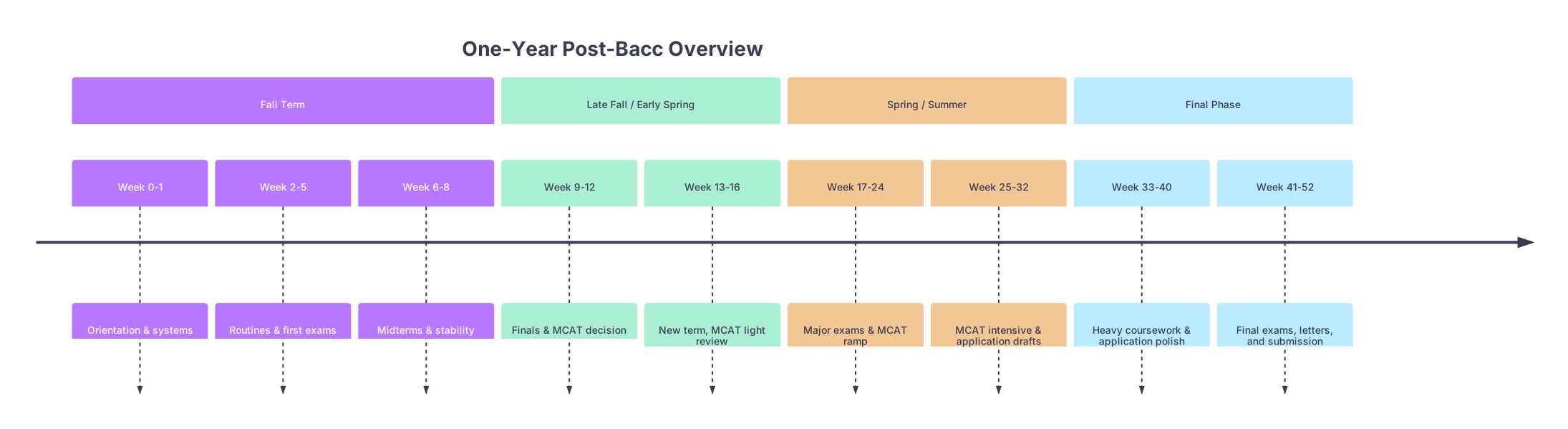
| Period | Event |
|---|---|
| Fall Term - Week 0-1 | Orientation & systems |
| Fall Term - Week 2-5 | Routines & first exams |
| Fall Term - Week 6-8 | Midterms & stability |
| Late Fall / Early Spring - Week 9-12 | Finals & MCAT decision |
| Late Fall / Early Spring - Week 13-16 | New term, MCAT light review |
| Spring / Summer - Week 17-24 | Major exams & MCAT ramp |
| Spring / Summer - Week 25-32 | MCAT intensive & application drafts |
| Final Phase - Week 33-40 | Heavy coursework & application polish |
| Final Phase - Week 41-52 | Final exams, letters, and submission |
Months 3–4: Midterms, Stability, and MCAT Entry
Week 6–7: Midterm Season 1
At this point you should:
Run a weekly exam prep loop:
- 7–10 days before each exam:
- Switch from passive reading to 70–80% practice problems
- One full “mock exam” session in exam conditions if possible
- 2–3 days before:
- Hit high‑yield summary (equations, mechanisms, pathways)
- Teach material out loud to yourself or a classmate
- 7–10 days before each exam:
MCAT soft start (if testing in ~6–8 months):
- Very light entry:
- 2–3 hours/week of content review only
- No full‑length practice yet
- Focus:
- Identify weak content overlap with current courses
- Get used to CARS style (maybe 3–4 passages/week)
- Very light entry:
Re‑evaluate non‑academic commitments:
- Ask yourself: If courses suddenly got 20% harder, could I maintain this schedule?
- If no, trim now. Not when you are drowning.
Week 8–9: Consolidation + Relationship Building
At this point you should:
Stabilize your GPA trajectory:
- You should know roughly where you stand:
- If you are below 3.5 in the program so far:
- Double down on office hours
- Consider a tutor (early, not when you are failing)
- If you are at 3.7+:
- Maintain, do not coast
- If you are below 3.5 in the program so far:
- You should know roughly where you stand:
Start positioning for letters:
- Identify 2–3 potential letter writers:
- Lecture professor who knows your name and work
- Lab instructor / PI if you are doing research
- Concrete actions:
- Ask at least one professor for feedback on how you could improve in their course or prep for med school level expectations
- Participate in class more; ask one real question per week
- Identify 2–3 potential letter writers:
MCAT planning locked:
- By now, you must decide:
- Spring MCAT (soon after spring term)
- Late Summer MCAT (after year ends)
- Put the exact test date and registration deadline into your calendar.
- By now, you must decide:
This is where drifting kills people. “I’ll see how the semester goes” is how you end up with no MCAT slot and rushed applications.
Months 5–6: Finals + MCAT Ramp-Up
Week 10–12: First-Term Finals
At this point you should:
Treat finals like a performance block:
- 2–3 weeks out:
- Build a written finals plan by course:
- Topics to review
- Practice sets to complete
- Office hours to attend
- Schedule review blocks by day (yes, literally write: Mon 2–4 pm: Orgo mechanisms)
- Build a written finals plan by course:
- 2–3 weeks out:
Clinical and volunteer hours temporary pullback:
- Drop to minimum sustainable commitment (often ~2–3 hours/week) just during finals window.
- Communicate clearly with supervisors; they usually understand.
MCAT: still light, but consistent:
- If Spring MCAT:
- Start 1 short practice section/week (CARS or science)
- If Summer MCAT:
- Continue 2–3 hours/week content review, no heavy lift yet
- If Spring MCAT:
End of this term sets the tone of your new academic record. Protect it.
Week 13–16: New Term + Structured MCAT Start
At this point you should:
Start new courses ruthlessly clean:
- Day 1–7:
- Collect all syllabi and exam dates
- Add all grading components to your tracking sheet
- Week 1:
- Go to office hours for each science course and repeat the intro: you are a post‑bacc, this year matters, you want to do well.
- Day 1–7:
MCAT moves from “light” to “structured”:
- If Spring MCAT (3–4 months away):
- 6–8 hours/week:
- 3–4 hours content
- 3–4 hours passage‑based practice
- 6–8 hours/week:
- If Summer MCAT (5–7 months away):
- 4–6 hours/week:
- Mostly content with a steady trickle of passages
- 4–6 hours/week:
- If Spring MCAT (3–4 months away):
Weekly priorities now look like:
- 25–35 hours coursework study
- 4–6 hours MCAT
- 3–5 hours clinical / volunteering
If those numbers are not realistic with work/family, something has to give. The thing that gives is not grades.
Months 7–8: Peak Studying and MCAT Heavy Phase
Week 17–20: Midterm Season 2 + MCAT Practice
At this point you should:
Integrate MCAT with coursework:
- Align MCAT content with what you are learning:
- Taking Physics? Do MCAT physics passages that week.
- In Orgo II? Hit MCAT orgo passages aligned with reactions you just learned.
- Align MCAT content with what you are learning:
Begin full-length MCAT practice (for Spring testers):
- About 8–10 weeks before test:
- 1 full-length (FL) every 1–2 weeks
- Detailed review over 1–2 days:
- Why each wrong answer was wrong
- Why each right one was right
- Content gaps to plug that week
- About 8–10 weeks before test:
Letters of recommendation:
- By now you should:
- Have at least 1 professor who can speak to your work
- Be preparing a brief “letter packet”:
- CV
- Short summary of your goals
- Draft personal statement (even rough)
- By now you should:
You are not asking for letters yet if they have only seen you one term. But you are getting ready.
Week 21–24: Finals Again + MCAT Peak (Spring Testers)
At this point you should:
If taking Spring MCAT (test in ~4–6 weeks):
- Weekly:
- 1 FL per week
- 2 days of review per FL
- Remaining MCAT hours: targeted drills
- Coursework:
- Maintain B+/A range; do not fall off a cliff
- Use your MCAT studying to reinforce course content whenever possible
- Weekly:
If Summer MCAT:
- Increase to 8–10 hours/week:
- 1 FL every 2–3 weeks
- Continued content review
- You still must finish the term strong—summer MCAT will not fix a bad GPA trend.
- Increase to 8–10 hours/week:
Clinical / volunteering:
- Again, trim during finals windows. Short‑term GPA spikes matter more than your volunteer supervisor’s idea of an ideal schedule.
This phase feels brutal. You are tired and the year is only halfway. That is normal. What is not normal is letting structure fall apart.
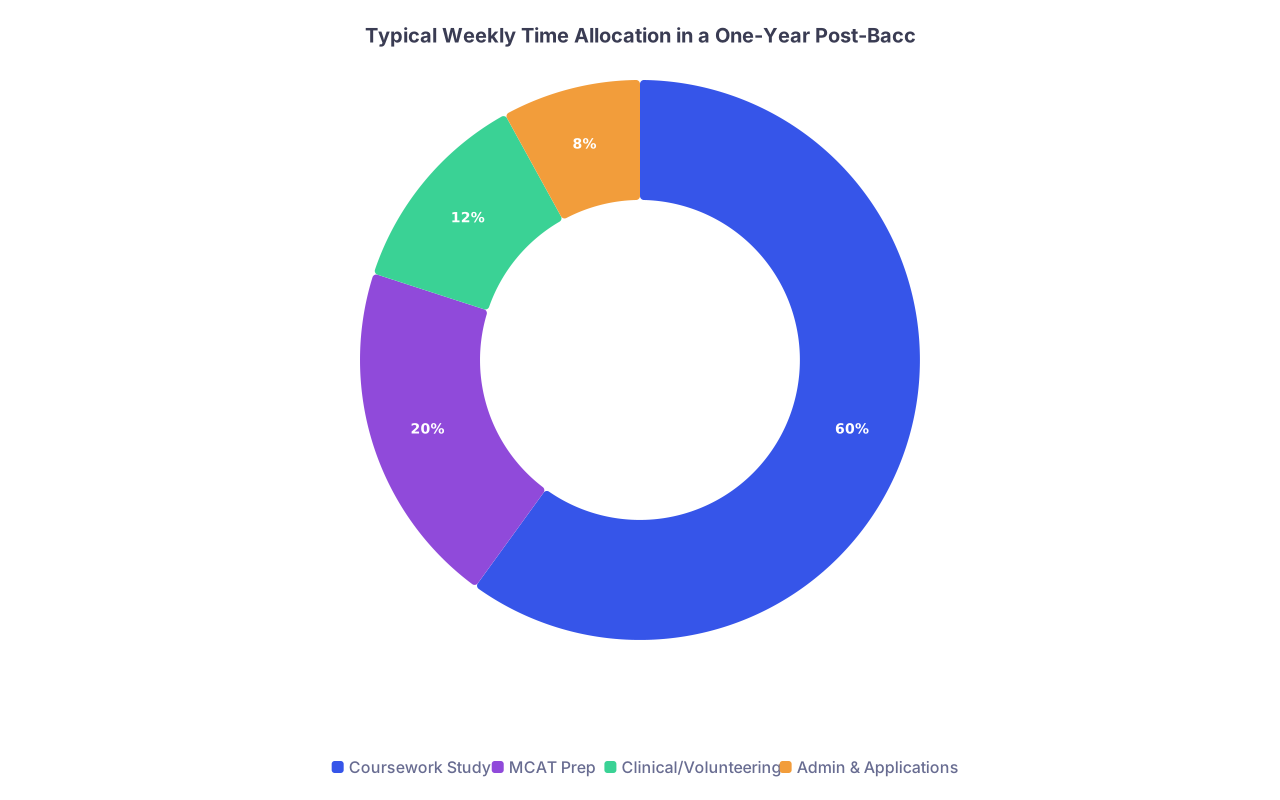
| Category | Value |
|---|---|
| Coursework Study | 60 |
| MCAT Prep | 20 |
| Clinical/Volunteering | 12 |
| Admin & Applications | 8 |
Months 9–10: Application Build and Final Coursework Push
Week 25–28: Application Materials Begin
At this point you should:
Start writing, badly, on purpose:
- Draft:
- Personal statement (two versions if needed)
- Activities list bullets
- These do not need to be pretty. They need to exist.
- Draft:
Committee letter / pre‑health office:
- If your program has a committee letter:
- Confirm deadlines
- Complete required meetings / forms early
- Miss this and you are scrambling alone for letters.
- If your program has a committee letter:
MCAT (Summer testers):
- Now at 10–15 hours/week:
- 1 FL per week or every 10 days
- Heavy review
- If FL scores are still 10+ points from target with 6 weeks left, you either:
- Commit to a brutal but structured final push, or
- Move test and push application a cycle (harsh, but sometimes correct)
- Now at 10–15 hours/week:
Week 29–32: Pre‑Application Crunch
At this point you should:
Polish application components:
- Personal statement:
- 2–3 rounds of revision
- One reader who knows you
- One reader who does not (to see if it actually makes sense)
- Activities:
- 2–3 substantial clinical entries
- 1–2 community service entries
- A clear, non‑inflated description of roles and impact
- Personal statement:
Letters of recommendation:
- Now you ask.
- For each letter writer:
- Request in person or via a respectful email
- Provide:
- CV
- Draft PS
- Unofficial transcript
- Bullet points of things you did in their course/lab
- Give a deadline 2–3 weeks before you actually need it.
Grades:
- You are in the last real chance to shift GPA trend.
- Any C at this stage is very hard to explain. B’s are survivable, A’s are gold.
If you are not applying this coming cycle, you still follow this timeline, but with less application stress and more room to perfect MCAT and GPA.
Months 11–12: Final Exams, Final Evidence, Final Impression
Week 33–40: Final Term and Submission Window
At this point you should:
Lock down your best academic narrative:
- You want:
- Upward or solid high performance trend across the year
- No sudden collapse in the last term
- You want:
Application submission (if this is your cycle):
- Aim to submit primary applications on opening month, not months later.
- Pre‑loading:
- School list reasonably balanced (state schools, mid‑tiers, a few reaches)
- All transcripts requested early
- MCAT score either in hand or test date clearly planned
Ongoing commitments:
- Keep clinical/volunteering steady and visible:
- Adcoms like to see continuity
- Do not quit everything the moment you submit
- Keep clinical/volunteering steady and visible:
If you are finishing the program but applying next year, this is where you secure final letters and keep experiences going, not where you coast.
Week 41–52: Final Exams and Aftermath
At this point you should:
Crush final finals.
Sounds obvious. But people mentally move on once applications are “in progress.” Big mistake.- Last 4–6 weeks:
- Full exam preparation schedules
- Final office hours pushes
- Ask professors for feedback and, where appropriate, explicit permission to use them as letter writers going forward.
- Last 4–6 weeks:
Compile your post‑bacc portfolio:
- Final transcript with GPA
- List of courses with brief notes (e.g., “Biochem – post‑bacc, A, heavy problem‑based exams”)
- Updated CV with:
- Research
- Clinical hours (approximate totals)
- Volunteering
- Leadership or teaching roles
Post‑program months:
- If you are still waiting to test MCAT:
- Treat MCAT as your job for 6–8 weeks
- If you already tested:
- Keep 3–5 hours/week clinical / volunteering active
- Prepare for interviews: practice basic questions, know your story cold
- If you are still waiting to test MCAT:
You are now someone with a defined academic redemption or enhancement year. The story you tell in applications must match the data you just created.
FAQ (Exactly 3 Questions)
1. How many hours per week should I realistically work during a one‑year post‑bacc?
If you can avoid working, do it. If you must work, 15 hours/week or less is the upper limit I recommend for most students in a rigorous one‑year program. Above that, I have seen grades slip, especially with Orgo + Physics combinations. Your priority order is: GPA > MCAT > clinical/volunteering > income. That may sound harsh, but medical education is already expensive; stretching the program by an extra year is usually more costly than cutting some work hours now.
2. Is it better to delay the MCAT until after my post‑bacc finishes?
If your undergraduate science base is weak or old, yes, often it is better. Testing 2–3 months after the post‑bacc ends lets you leverage fresh content while freeing bandwidth from coursework. The trade‑off is application timing. If delaying MCAT pushes your application a full cycle later but gives you a much stronger score and more mature experiences, that is usually a smart decision, not a failure. A rushed 502 is far worse than a deliberate 513 a year later.
3. What if I mess up one course during the year? Is the whole post‑bacc “ruined”?
One B– or even a C in an otherwise strong post‑bacc is not fatal, especially if the trend is upward and the rest of the year is solid A/A– work. The problem is patterns, not single data points. If something goes wrong:
- Do a post‑mortem within a week.
- Adjust your schedule and commitments immediately.
- Use the next exams and courses to show you learned from it.
In your application, you can briefly explain a discrete issue (illness, overload, adjustment) and then point to a clear recovery. That recovery is often what convinces committees you are ready.
Key points:
- Treat each 4–6 week block of your post‑bacc as a separate “mission” with specific academic, MCAT, and clinical priorities.
- When conflict hits, protect GPA first, then MCAT, then everything else. That ordering is not negotiable.
- Relationships with professors and consistent, modest clinical/volunteer work built over the entire year beat frantic last‑minute padding every time.