The fastest way to destroy a linkage opportunity is to ignore the calendar.
Most postbac students obsess over MCAT scores and GPA, then miss the actual gatekeeper: dates. Linkage contracts are unforgiving. MCAT windows, course sequencing, grade release dates, committee letters—if you do not line them up, the program will quietly move on without you.
I am going to walk you through how to synchronize everything—MCAT, coursework, and linkage deadlines—on a month‑by‑month and week‑by‑week timeline, so you are not the person emailing, “Is there any flexibility with the deadline?” (There usually is not.)
(See also: Month-by-Month Timeline: From Post-Bacc Enrollment to AMCAS Submission for a detailed guide.)
0–3 Months Before Your Postbac Starts: Foundation and Backwards Planning
At this point you should be planning backwards from the specific linkage you want, not vaguely “keeping options open.”
Step 1: Map the Linkage Requirements and Hard Deadlines
Pick 1–2 realistic linkage targets (not 6). For each medical school linkage, write down—in writing, not in your head:
- Required courses (and whether they must be completed or just in progress)
- Minimum GPA cutoffs (overall, science, and sometimes postbac‑only)
- MCAT requirement:
- Minimum score
- Latest acceptable test date
- Whether scores must be back before you apply or just before interview
- Application deadlines:
- Linkage application open date (often Dec–Feb)
- Internal postbac deadline (often earlier than the med school’s)
- Med school’s AMCAS or secondary deadline for linkage candidates
- Letter/committee deadlines:
- When your committee letter needs to be complete
- Minimum number of faculty letters and from which courses
- Other timing rules:
- Required number of postbac terms completed before applying
- Whether you must apply while still enrolled or after completion
If you do not have this, you are guessing. Guessing is how you miss a January 15 MCAT deadline by two weeks.
Step 2: Build a Simple Year‑View Calendar
Now you work backwards. Put on a 12‑month calendar:
- Start and end dates for each postbac term (Fall, Spring, Summer)
- Final exam weeks
- Grade posting dates (registrar calendars are public)
- MCAT test dates you are actually willing to sit for
- Linkage application deadlines
- Committee letter deadlines, if your program has them
At this point you should be able to say one clear sentence:
“I am targeting the [X School] linkage, which requires my MCAT by [date] and completion of [these courses] by [term].”
If you cannot finish that sentence, you are not ready to commit to a linkage.
Months 1–3 of Your Postbac: Laying Academic Groundwork (and Not Rushing MCAT)
This is usually Fall term for most programs, but the structure is the same no matter when you start.
Month 1: Orientation to Reality
At this point you should:
- Confirm exact policies with:
- Your postbac advisor
- The linkage liaison (if your program has one)
- Ask very specific timing questions:
- “Does X linkage require grades in hand for orgo II, or is in‑progress acceptable?”
- “What is the latest MCAT date that has worked for previous students?”
- “When does the committee letter process open and close?”
Lock these answers into your calendar. Not in an email folder you never open again.
Side task: Book a rough MCAT window, not a specific test date. For example:
- “Between June 15 and July 15”
- Or “Between January 15 and February 15”
You are not scheduling the MCAT yet. You are blocking time where it must likely fall to satisfy the linkage.
Month 2: Test the Load Before You Stack MCAT On Top
You need to know whether you can survive 12–16 credits of hard science before you add MCAT prep. Many students get this exactly backwards.
During Month 2:
- Track weekly hours:
- Class + lab
- Study per course
- Commute or work hours
- Write down how many truly free hours you have:
- Not “I could maybe,” but: “I have 8–10 consistent hours/week I could use for MCAT prep.”
If that number is under 8, you are not doing serious MCAT prep during this term. You can do light foundation review, but not a full push.
Month 3: Decide MCAT Season, Not Exact Date
Now that you know your academic reality, choose:
- Will your MCAT be:
- During the Summer after your first year of postbac?
- During the Spring of your second term?
- During a glide year?
Overlay this with linkage constraints. For example:
- If a linkage wants MCAT scores by February 1:
- You must take MCAT no later than early January
- Which means heavy prep in Fall term
- Which means you need real proof that you can handle that load
At this point you should know whether your linkage goal forces a “too early” MCAT. If it does, you either:
- Change the target linkage, or
- Abandon linkage and apply regular cycle after a better‑timed MCAT.
Months 4–9: The Core Year – Exact Synchronization of MCAT, Courses, and Deadlines
This is where people blow it. The calendar gets crowded: second term of orgo/physics, possible biochem, MCAT prep, committee letters, and linkage applications all collide.
Let us build a prototype year. Assume:
- Fall: Start postbac
- Spring: Second term of core sciences
- Summer: MCAT
- Fall: Linkage application
- Next Fall: Matriculate to med school via linkage
You can adjust months relative to your own start date.
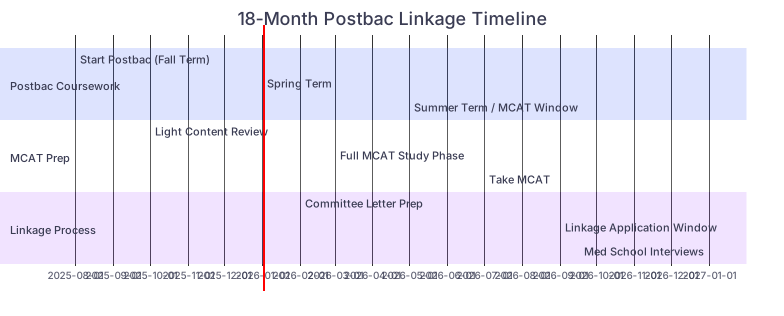
| Task | Details |
|---|---|
| Postbac Coursework: Start Postbac (Fall Term) | a1, 2025-08, 4m |
| Postbac Coursework: Spring Term | a2, 2026-01, 4m |
| Postbac Coursework: Summer Term / MCAT Window | a3, 2026-05, 3m |
| MCAT Prep: Light Content Review | b1, 2025-10, 3m |
| MCAT Prep: Full MCAT Study Phase | b2, 2026-03, 4m |
| MCAT Prep: Take MCAT | b3, 2026-07, 1m |
| Linkage Process: Committee Letter Prep | c1, 2026-02, 3m |
| Linkage Process: Linkage Application Window | c2, 2026-09, 3m |
| Linkage Process: Med School Interviews | c3, 2027-01, 3m |
Months 4–6: Second Term Courses + Light MCAT Alignment
At this point you should:
Lock the actual MCAT date.
You have your season; now you choose the test.Check:
- MCAT date
- Score release date (AAMC posts them)
- Linkage MCAT deadline
Your MCAT score release must fall at least 2–4 weeks before:
- The linkage’s stated MCAT deadline, and
- Any internal “committee review” date that depends on the score
Start targeted, not frantic, MCAT work.
Example Spring pattern:- 5–7 hours/week:
- 2–3 hours: content review aligned with your courses
- 2–3 hours: practice passages
- 1 hour: CARS
- 5–7 hours/week:
You are not doing full‑lengths yet if your test is 4–6 months out and you are drowning in orgo.
- Begin committee letter logistics.
At this point you should:
- Identify 2–3 faculty who might write strong letters.
- Attend office hours. Be visible.
- Know when your postbac opens its committee letter file and what they require:
- Autobiographical sketch
- CV
- Forms
- Deadlines
Write those dates on the same calendar as your MCAT.
Months 7–9: Full MCAT Phase + Finishing Key Courses
This is typically Summer after your first postbac year. MCAT is now the main event, but it must be aligned with:
- Course completion requirements for linkage
- When grades will post
At this point you should:
- Run a full 10–12 week MCAT plan counting backwards from test day.
Example if your test date is July 15:
Week −12 to −9 (late April–mid May):
- 10–15 hours/week
- Finish major content review
- Start 1–2 passages/day in each section
Week −8 to −4 (mid May–mid June):
- 15–20 hours/week
- Full‑length every 1–2 weeks
- Aggressive review of weak areas
Week −3 to 0 (late June–mid July):
- 3–4 full‑lengths
- Taper volume 3–5 days before test
- Check that required courses are done before the linkage application.
Common pitfall: A linkage requires:
- 2 semesters of orgo with lab
- 2 semesters of physics with lab
- 1 semester of bio
And you decide to take physics II in the Fall after your intended linkage application. That might disqualify you.
You must confirm with your advisor:
- Which courses must be fully completed before applying
- Which can be in progress
- Whether Summer grades will be in the system before the linkage file review
If your physics II grade posts August 20 and the linkage committee meets August 10, you are technically not complete—even if the med school itself would accept the course later.
The “Fast Linkage” Scenario: MCAT During Coursework
Some linkages push you towards an even more aggressive plan: MCAT during the Spring term of your first year so you can apply that Fall and matriculate straight through. That usually looks like:
- Fall: Start postbac
- Spring: MCAT + full load of sciences
- Summer: Finish any missing prereqs
- Fall: Linkage application
Here is how it tends to fail:
- January: You schedule a late March MCAT “just to get it done”
- February: Orgo II midterm crushes you; MCAT practice tests stall
- March: You postpone the MCAT to June.
- June score release: Too late for that year’s linkage.
If you are going to attempt this track, your planning must be ruthless:
At this point (3–4 months before the MCAT) you should:
- Have baseline MCAT scores already in reasonable range.
- If your diagnostic is 490–497 and you want 515+ in 12 weeks while taking orgo and physics, you are dreaming, not planning.
- You should already be within ~8–10 points of your target before the heavy sprint.
- Trim your nonessential commitments.
This is one of the rare times I will say it bluntly: you cannot maintain a 25‑hour/week job, 14 credits of science, and serious MCAT prep and expect top‑tier outcomes. Something gives. Usually the linkage.
- Coordinate course choices deliberately.
If MCAT is in March:
- Avoid starting heavy new content (e.g., biochem) that month if possible.
- Front‑load assignments and lab reports.
- Consider lighter electives or fewer credits that term if your program allows.
Application Year: Aligning MCAT Results, Course Completion, and Linkage Files
Fast forward. You have taken the MCAT. Scores are back. You have another term or two of coursework ahead and a ticking linkage timeline.
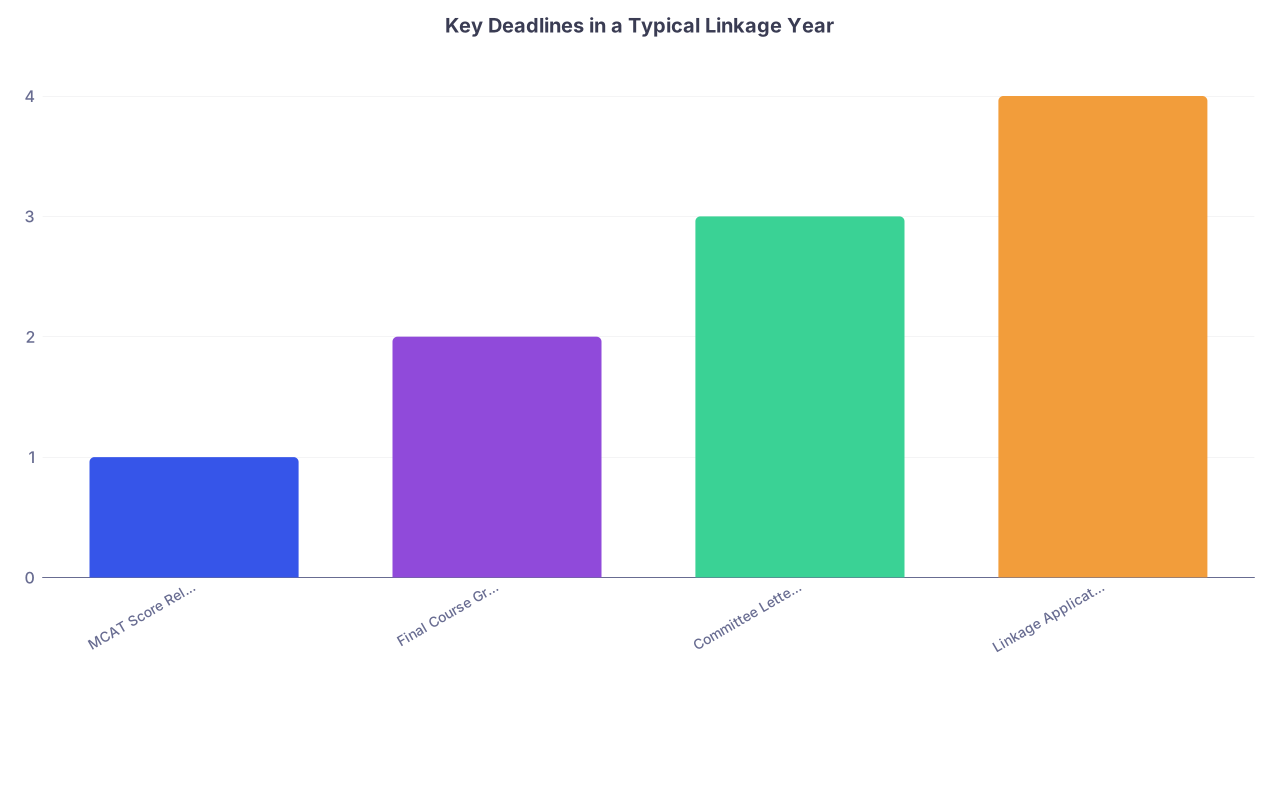
| Category | Value |
|---|---|
| MCAT Score Release | 1 |
| Final Course Grades Posted | 2 |
| Committee Letter Complete | 3 |
| Linkage Application Deadline | 4 |
Legend: later numbers = later in the calendar year. You want this order: MCAT (1) → Grades (2) → Committee letter (3) → Linkage deadline (4). If your real life does not follow that order, something is off.
Month 10–12: Right After MCAT Scores Post
At this point you should:
- Decide, with real data, whether linkage is still on the table.
Ask:
- Does your MCAT meet or exceed the posted minimum by at least 2–3 points?
- Is your postbac and science GPA comfortably above the floor?
- Are the remaining courses straightforward and on track for A/A−?
If you are scraping the minimums, linkage is technically possible but strategically questionable. Many students in that band do better applying in the regular cycle with a full year of grades behind them.
- Finalize coursework needed before the linkage application.
You should know:
- Exactly which courses you must complete before the committee reviews your file.
- When those grades will be visible to:
- Your postbac committee
- The medical school
Match those dates against the posted committee letter deadline. If they do not line up, ask whether late grades can be added as an update. Some programs can, some cannot.
- Complete all committee letter tasks early.
Do not wait until the week before the deadline. A realistic internal timeline:
- 4–5 months before linkage application opens:
- Draft personal statement and CV
- Request individual letters from faculty
- 3 months before application opens:
- Submit committee packet materials
- 1–2 months before:
- Confirm all letters have arrived
- Fix any missing documents
Final 3–6 Months Before Linkage Submission: Week‑by‑Week Precision
This is where details kill people. Wrong transcript timing. Late letters. Syllabi or course descriptions missing. You are close; do not get sloppy.
3 Months Before Linkage Deadline
At this point you should:
Have:
- MCAT score in hand
- All but 1–2 remaining science courses completed
- No active academic issues (no incompletes, no pending grade disputes)
Do:
- Meet with your advisor with a printed calendar:
- Show MCAT date and score
- List completed courses and current term
- Point to the linkage deadline
- Ask explicitly: “Is there any timing issue you see that would disqualify me procedurally, even if my stats are fine?”
- Meet with your advisor with a printed calendar:
Start:
- Drafting linkage‑specific essays and brief answers
- Clarifying why this school and why linkage now, not later
2 Months Before Deadline
At this point you should:
Confirm:
- Committee letter completion date
- All individual letters submitted
- Final official transcripts requested for all institutions
Double‑check:
- Your MCAT scores have released to AMCAS and are visible
- Any required shadowing or clinical hours are documented and date‑stamped
Tighten:
- Personal statement (adapted to the school’s mission)
- Activity descriptions (focused, not bloated)
Do not be the person discovering that their community college transcript never arrived the day before the deadline.
1 Month Before Deadline
At this point you should:
- Have a nearly complete linkage application:
- Essays drafted and edited
- Activities entered
- Schools listed (if via AMCAS)
- Confirm with your postbac:
- Exactly when they will transmit your committee letter
- Whether they batch send on certain dates
If your program only sends letters every other Friday and your deadline is a Monday, you must plan for the prior Friday.
2 Weeks Before Deadline
At this point you should:
Submit the application unless explicitly told to wait. Many systems:
- Timestamp the submission date
- Allow letters and transcripts to arrive slightly later
Re‑verify:
- All coursework appears correctly on your application
- MCAT score is linked
- Your contact info is correct (yes, people screw this up)
You want 1–2 weeks of slack for any last‑minute disasters. A missing letter. A registrar delay. A typo in your AMCAS ID.
Day‑By‑Day in the Final Week
This is overkill for some, but for linkage it is smart.
7 days out:
- Re‑read every major field in your application for accuracy.
- Confirm with recommenders that their letters are submitted (or submitted to the committee).
5 days out:
- Check your application portal:
- Are all transcripts marked “received”?
- Is the committee letter marked as “planned” or “received”?
3 days out:
- Send a brief, professional email to your advisor or linkage coordinator:
- Confirm they see your application as ready or know when remaining pieces will arrive.
1 day out:
- Submit if you somehow have not already.
- Take screenshots of submission confirmation pages.
Deadline day:
- Do nothing new. The work should already be done.
- If you discover a true emergency (lost transcript, wrong test date entered), contact the appropriate office immediately—ideally by phone plus email.
Two Non‑Negotiable Points
- Work backwards from the latest acceptable MCAT date and the last required course completion, not from your ideal fantasy schedule. Reality beats intention every single time.
- Synchronizing linkage, MCAT, and coursework is not about being heroic. It is about being boringly early: early MCAT window, early letter requests, early committee materials, and zero last‑minute surprises.