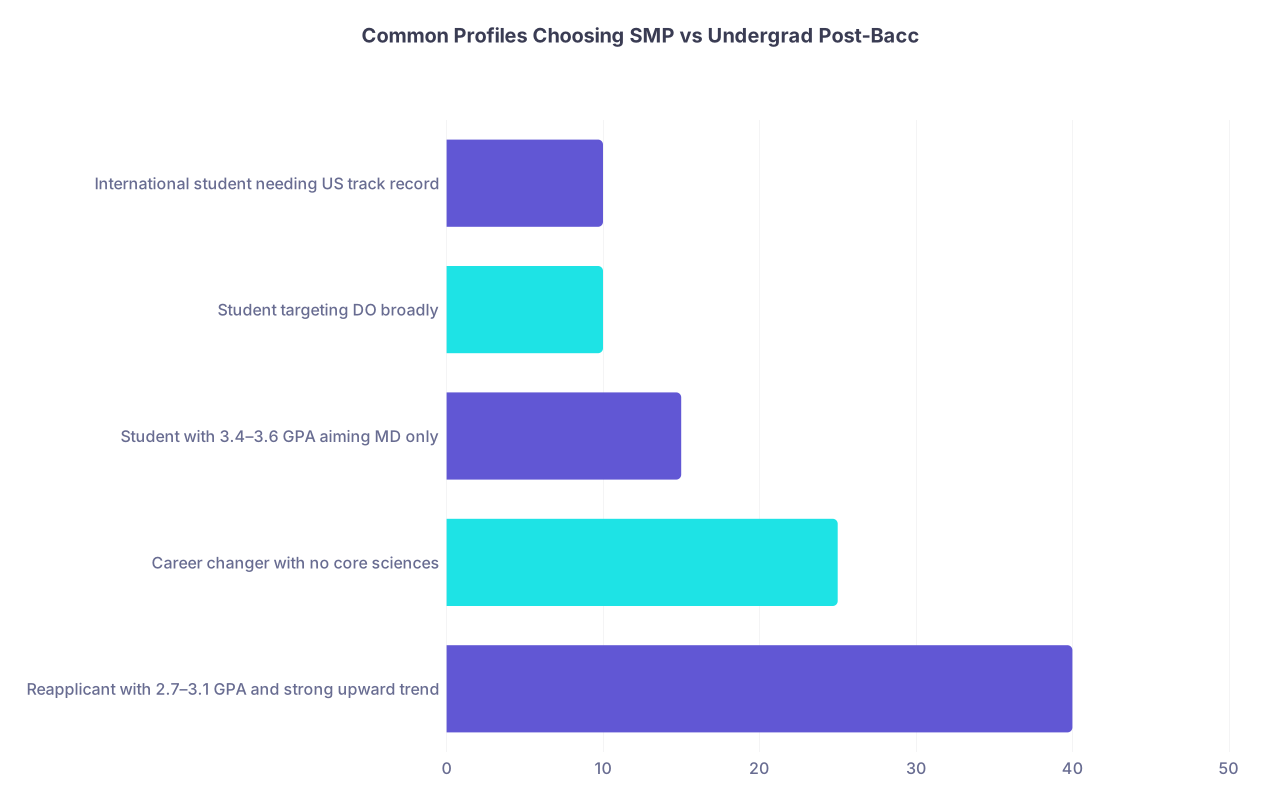
| Category | Value |
|---|---|
| Reapplicant with 2.7–3.1 GPA and strong upward trend | 40 |
| Career changer with no core sciences | 25 |
| Student with 3.4–3.6 GPA aiming MD only | 15 |
| Student targeting DO broadly | 10 |
| International student needing US track record | 10 |
SMP vs Undergraduate-Level Post-Bacc: When Each Fits Your Profile
It is March. You got your last “we regret to inform you” email two weeks ago, and it still stings. Your AMCAS portal is closed out. Your premed advisor has said some version of “you might consider a post-bacc” but could not give you anything more concrete than a brochure rack.
You keep seeing two phrases everywhere: “Special Master’s Program (SMP)” and “Undergraduate-Level Post-Bacc.” Everyone speaks about them like they are interchangeable upgrades to your application.
They are not. Picking the wrong one for your profile can waste a year, five figures of tuition, and still leave you uncompetitive.
Let me break this down specifically.
1. First principle: What problem are you actually trying to solve?
(See also: Post-Bacc Linkage Policies for more details.)
Before program names, forget the marketing jargon. You have to answer one question brutally honestly:
What is the primary problem in your file?
Usually it is one of these:
- You lack the prerequisite sciences (career changer).
- You have them, but your GPA is weak (academic enhancer).
- You have a “borderline” GPA and need to show readiness for a heavier load.
- You actually have solid stats but need structured glide year / linkage / narrative.
SMPs and undergrad-level post-baccs are not two flavors of the same fix. They are different tools:
- SMP = “I need to prove I can survive medical school–level work. Now.”
- Undergrad post-bacc = “I need to rebuild or build my undergraduate science record. Carefully.”
If you already know which of those sentences sounds like you, you are 70% of the way there.
2. What an SMP actually is (and what it is not)
A proper Special Master’s Program in this space has three defining features:
- Graduate-level degree (usually MS in Medical Sciences / Physiology / Biomedical Sciences).
- Curriculum that either:
- Shares courses with M1 students, or
- Mirrors M1 content in intensity and exam style.
- Embedded in or tightly linked to a medical school.
When people say “true SMP,” they usually mean programs like:
- Georgetown SMP
- Cincinnati MS in Physiology SMP
- Boston University MAMS
- Tulane ACP / ACMS
- EVMS Medical Master’s
- Loyola MAMS
- Temple ACMS
There are countless “Master’s in Biomedical Science” programs that are really just generic graduate science degrees with no real track record with med schools. Same tuition, far less impact.
Key SMP realities, stripped of brochure fluff:
- They are high-risk, high-reward.
- A strong performance (3.6+ in a rigorous SMP, especially in shared med school courses) can partially “override” a weak undergrad GPA in adcom minds.
- A mediocre performance (3.0–3.3) in an SMP will often hurt more than help because you have now demonstrated difficulty at med-school adjacent rigor.
SMPs are a bet. You are telling admissions: “Ignore my 2.9 from sophomore year; this 3.7 in M1 physiology is who I am now.”
That bet is only smart if you are very confident you can deliver.
3. What an undergraduate-level post-bacc is (the real version)
Now the other tool: undergraduate-level post-bacc.
Two big flavors:
Career-changer post-bacc
You basically have no core premed sciences. Maybe you were a History major who took one random CHEM 101 years ago. A proper career-changer post-bacc gives you:- Gen Chem I & II
- Organic Chem I & II
- Physics I & II
- Bio I & II
- Often Biochemistry
- Sometimes statistics / psychology / sociology
These are taken for undergraduate credit, graded normally, and appear as additional undergrad coursework (and count in your AMCAS/AACOMAS GPA calculations).
Academic-enhancer post-bacc
You already completed the basics, but your GPA is an anchor. Think cumulative 2.6–3.2 with mediocre science work. An enhancer post-bacc lets you:- Retake C/D grades in key pre-reqs (especially useful for DO schools).
- Add upper-level undergrad sciences (physiology, immunology, micro, neuro, etc.).
- Show a sustained upward trend.
Undergrad post-baccs are about rebuilding the foundation; SMPs are about stress-testing the system at near-med-school level.
4. How med schools actually read these paths
You have to think like an adcom committee, not a desperate applicant.
The GPA problem: arithmetic vs signal
Undergrad-level coursework (post-bacc or not) does two things:
- It changes your GPA numerically because AMCAS and AACOMAS recompute everything.
- It sends a “trajectory” signal—what direction you are moving.
Graduate coursework (SMP) usually:
- Does not change your undergraduate GPA.
- Appears in a separate graduate GPA column.
So if your cumulative undergrad GPA is 2.7 and you do an SMP and get a 3.8, your file will still show:
- uGPA: 2.7
- sGPA: 2.6 (or similar)
- Graduate GPA: 3.8
Some MD schools will say explicitly: “We are impressed by a strong SMP, but we still have a hard screen at 3.0 undergraduate.” They might not phrase it that brutally on their website, but in committee that is exactly what happens.
DO schools, in contrast, often weigh recent trend and SMP more flexibly, especially if you retake undergrad courses and show a sharp upward trend.
So rule of thumb:
- If you are below ~3.0 cumulative undergrad GPA, relying solely on SMP is dangerous, especially for MD. You usually must do some undergraduate repair first.
- If you are ≥3.1–3.2 with a clear upward trend in late undergrad/post-bacc, an SMP can be the “capstone” that convinces skeptical MD schools.
5. Profiles where an SMP fits (and where it is a terrible idea)
Let me draw this the way I do with students in advising sessions.
Profile A: The low-GPA reapplicant with upward trend
- Original undergrad: 2.6 cumulative, 2.4 science. Disaster.
- Did a 2-year academic-enhancer post-bacc: 3.7 with tough upper-level sciences.
- Combined AMCAS GPAs now: 3.05 cumulative, 3.0 science.
- MCAT: 513.
This person is right on the line. For MD, many schools will still hesitate because numeric cutoffs. For DO, already competitive.
Where an SMP fits:
A strong SMP (3.6–3.8) at a reputable program can push MD adcoms to say, “Ok, yes, the early GPA is ugly, but for the last 3–4 years and at graduate level this applicant is solid.”
Where an SMP is a terrible idea:
If this person is burned out, has poor study habits, or barely managed that post-bacc by grinding 80 hrs/week, then signing up for a med-school level year could backfire badly. A 3.2 SMP in this context screams “ceiling reached.”
Profile B: The mid-3’s candidate trying to go from “OK” to “MD-competitive”
- Undergrad: 3.45 cumulative, 3.4 science.
- Last 60 credits: 3.6.
- MCAT: 509.
This is not a catastrophe. This student may not need an SMP at all. Many MD schools interview this profile, especially with strong experiences and a smarter school list.
When would SMP make sense?
- If they are fixated on higher-tier MD programs where the median GPA is 3.75+, then a strong SMP might help but will not magically turn them into a top-20 candidate.
- More realistically, I recommend: targeted upper-level undergrad courses or a lightweight academic-enhancer post-bacc + MCAT improvement to 514+. Cheaper, less risk.
SMP here is often overkill. I have seen students in this bracket chase an SMP because “everyone online says it is the way” and then realize they did not need it.
Profile C: The strong MCAT / weak GPA mismatch
- Undergrad: 2.9 cumulative, 2.8 science.
- MCAT: 518.
Committees see this and think: “Clearly bright, but something is off about discipline or long-term work.” A good SMP performance here can absolutely rehabilitate their narrative.
But again: if that 2.9 reflects ongoing issues — ADHD unmanaged, chronic instability, poor time management — those will get exposed in the SMP and potentially sink the application further.
So: SMP fits when you have:
- Demonstrated recent upward trend already, even in limited credits.
- Corrected underlying problems (health, life chaos, study skills).
- Bandwidth (money, time, mental health) to handle an M1-style year.
6. Profiles where undergrad post-bacc is the right first move
Now the other side. Where an undergraduate-level post-bacc is clearly the correct starting point.
Profile D: True career changer
- BA in English, 3.5 GPA, no sciences beyond maybe one “rocks for jocks” class.
- Zero premed prerequisites.
This person should not go anywhere near an SMP. They first need the classical premed core. A structured, formal career-changer post-bacc (Bryn Mawr, Goucher, Scripps, Columbia, etc.) or a carefully crafted DIY at a local university is appropriate.
For them, an SMP—if ever—is something you think about later, and usually you never need it if you perform well and score decently on the MCAT.
Profile E: The low-2s / mid-2s GPA
- Undergrad: 2.4 cumulative, 2.2 science, no clear upward trend.
- Three W’s junior year, a few F’s turned to D’s.
I am blunt with this group: SMP is off the table initially. You do not jump from flunking Bio II to taking classes alongside M1s in neurophysiology.
You have to rebuild:
- Go back for 30–60 credits of undergraduate sciences.
- Fix F/D grades where possible (especially useful for DO grade replacement trends, even though formal grade replacement is gone).
- Aim for at least 3.5+ in this fresh work.
Only after that, with your cumulative creeping into the high 2’s / low 3’s and a proven new trajectory, do you even consider SMP as a second-stage strategy (if you are still MD-focused).
Profile F: The “just below competitive” student with limited funds
- 3.3 GPA, 3.3 science, no catastrophic semesters, MCAT 507.
- Decent but not spectacular experiences.
- Finances are tight. Taking on 50–70k for an SMP is a major risk.
Here, an SMP is usually a poor risk-return trade. I lean strongly toward:
- 1–2 years of undergrad-level post-bacc:
- 24–36 credits of upper-level sciences (cell bio, immuno, micro, physiology, biochem).
- Aim for 3.7+ in this slate.
- MCAT retake with disciplined prep (target 511+).
- Apply broadly MD + DO.
This is cheaper, lower risk, and often enough to cross the threshold for many schools.
7. MD vs DO: How your target changes the recommendation
This part gets glossed over constantly.
If you are MD-or-bust (especially U.S. MD)
You have less room for mediocrity in any post-bacc or SMP.
MD committees care about:
- Numeric uGPA cutoffs. Many screen out <3.0, some <3.2.
- Strength of institution and rigor of program. A 4.0 at a random local MS program is not the same as a 3.7 in Georgetown’s SMP.
- Coherence of trajectory. They want an explanatory arc: early struggle → defined correction → sustained high-level performance.
For MD-or-bust candidates with serious GPA damage:
- Stage 1: Academic-enhancer undergrad post-bacc to get cumulative up into realistic range and prove sustained improvement.
- Stage 2: If still needed, a high-quality SMP with known outcomes and advising.
Skipping Stage 1 when your undergrad record is truly weak is what sinks many SMP hopefuls.
If you are happy with DO
DO schools, in practice, tend to:
- Place more weight on recent academic performance and less strict hard-screening by old cGPA.
- Be more receptive to significant grade trends and course retakes.
- Value SMPs, but do not require them for applicants with strong undergrad post-bacc work.
For many DO-focused candidates:
- A solid undergrad post-bacc (3.5–3.8 in 30–40 new credits) plus MCAT 505–510 is often enough.
- An SMP is “nice if you really need one more push” but rarely mandatory.
If you are sitting at 2.8 with 3.8 in 40 post-bacc credits and 506 MCAT, you already have realistic DO options without gambling on an SMP.
8. Risk, cost, and mental bandwidth: the uncomfortable math
People underestimate how brutal SMPs are.
You are often taking:
- 18+ credits of dense material.
- Block exams resembling NBME style.
- Sometimes literally sitting in med school lecture with M1s who already fought their way through the gauntlet.
Meanwhile, you still need MCAT prep or a retake, clinical hours, and your life.
Undergraduate post-baccs, even rigorous ones, are generally more forgiving. You can:
- Control your course load more granularly (9–12 credits at a time).
- Spread work over more than one year.
- Recover from a bad semester without it being a blaring neon sign on a separate graduate transcript.
Financially:
- SMP: Think 30–70k tuition + living + opportunity cost for 1 year.
- Undergrad post-bacc: Highly variable, but DIY at a state school can be dramatically cheaper; even formal programs are often less expensive than brand-name SMPs.
If you are already carrying undergraduate debt and have family / work obligations, an SMP can be financially and mentally dangerous. I have watched smart people crack under the combination of academic pressure plus latent burnout.
If your bandwidth is limited, do not chase the “sexy” SMP label. Solid, slow, boring undergrad-level repair often wins.
9. Decision grid: When each path fits your profile
Let me give you a rough mental checklist.
You are better suited for an UNDERGRAD-LEVEL POST-BACC if:
- You do not have the core premed sciences (career changer).
- Your cumulative GPA is <3.0 and you have no substantial upward trend.
- You have multiple F/D grades that you can improve with retakes or new coursework.
- You have constraints that make a med-school-style constant grind risky.
- Your primary target is DO, and you are okay playing the long game.
You are better suited for an SMP if:
- You have already done significant undergrad-level repair with a strong upward trend.
- Your cumulative is around 3.0–3.3 with the last 30–60 credits at ~3.6+.
- You are targeting MD programs and need a dramatic, clear demonstration of med-school readiness.
- You have addressed prior performance issues and can handle a high-intensity year.
- You choose a program with:
- Documented med school acceptance stats.
- Real linkages / interview guarantees contingent on performance.
- Substantial overlap with M1 courses.
And here is the part most people miss: sometimes the right answer is “neither, yet.”
If your life is unstable, you are burned out, or you have not fixed the root causes of your initial academic collapse, adding another degree program is just changing scenery, not trajectory.

| Step | Description |
|---|---|
| Step 1 | Weak Undergrad Record |
| Step 2 | Career-Changer Undergrad Post-Bacc |
| Step 3 | Academic-Enhancer Undergrad Post-Bacc |
| Step 4 | Enhanced Post-Bacc + MCAT → Apply |
| Step 5 | SMP at Reputable Med-School-Linked Program |
| Step 6 | Strong SMP Performance + MCAT → Apply |
| Step 7 | Have core sciences? |
| Step 8 | uGPA ≥ 3.0 and recent upward trend? |
| Step 9 | Target MD or DO? |
10. How to vet specific programs (because they are not created equal)
Do not trust marketing brochures. Ever.
For SMPs, you want to ask:
- What percentage of students in the last 3–5 years were accepted to MD or DO within 2 years of completion?
- How many SMP students matriculate into THIS institution’s MD/DO class each year?
- Which courses are shared with M1s, and what percentage of the SMP cohort passes them on the first attempt?
- Are there guaranteed interview or conditional acceptance agreements based on performance thresholds (e.g., 3.7 GPA + MCAT ≥ 510)?
- What is the attrition rate?
If a program cannot or will not give specific numbers, that is a red flag.
For undergrad post-baccs:
- Are you formally categorized as a post-bacc / non-degree student, or are you just registering ad hoc?
- Do they provide pre-health advising and committee letters?
- What is the class registration priority? (Many DIY post-bacc students get blocked from needed courses.)
- Do they have historical med school acceptance data for their post-bacc cohort?
Sometimes a cheaper DIY solution at a local state university, with good planning, beats an expensive “formal” post-bacc that offers little beyond the label.
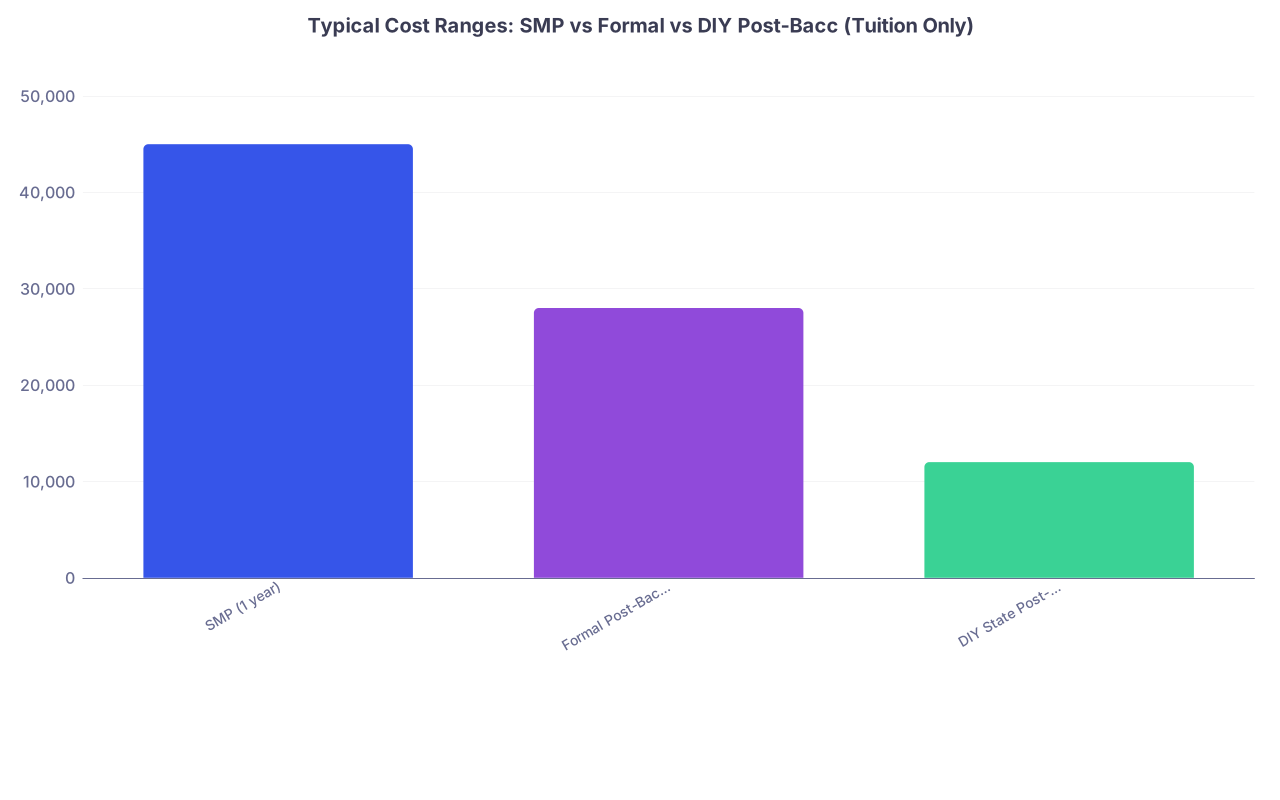
| Category | Value |
|---|---|
| SMP (1 year) | 45000 |
| Formal Post-Bacc (1 year) | 28000 |
| DIY State Post-Bacc (1 year) | 12000 |
11. Putting it together: three worked scenarios
To make this concrete, let me walk through three specific cases.
Case 1: 2.7 GPA, 505 MCAT, strong upward trend late
- Early undergrad: catastrophic, multiple C/D/Fs.
- Last 40 credits: 3.8 with harder sciences.
Right move:
- Do 20–30 more undergrad credits, focused on upper-level bio/chem, seeking to push cum GPA to ~3.0.
- Retake MCAT with focused prep, aiming 510+.
- Apply DO broadly. Consider SMP only if:
- After that, cum is ~3.1–3.2.
- You are still fixated on MD and ready for a true M1-level gauntlet.
SMP directly from 2.7 with no sustained repair is too risky.
Case 2: 3.3 GPA, 513 MCAT, strong ECs
- No major disaster semesters.
- Upward trend from 3.1 to 3.6 over last 2 years.
Right move:
- Do not reflexively jump into an SMP. First, craft a smart school list with a mix of mid-tier MD and DO.
- You might add 1 year of part-time upper-level undergrad sciences if you want to tighten your academic story, but this profile often matches without extra degrees.
- SMP here is optional at best, and often unnecessary.
Case 3: 3.0 GPA (after some post-bacc), 520 MCAT, non-trad engineer
- Original undergrad engineering with 2.8.
- Recent 30 credits post-bacc at 3.8.
- Very high MCAT.
Right move:
- This is a classic MD+SMP consideration. You already did some undergrad repair and showed aptitude.
- A strong SMP at a school you would be happy attending could tip many MD schools in your favor and give you an inside lane to that institution.
- But you can also apply directly with a compelling narrative: “I was an immature undergrad in a hard major, then grew up and crushed my last 2 years and MCAT.”
If you do an SMP, you must be prepared to excel; a 3.2 grad GPA here would undercut the 520.
FAQ (exactly 6 questions)
1. Is an SMP always viewed as “better” than an undergrad post-bacc?
No. Committees do not award style points for “graduate” on the transcript. They care about fit and trajectory. If your undergrad record is so weak that your cumulative GPA stays in the 2’s, a strong SMP does not magically erase that. For many profiles, undergrad-level repair is far more valuable than jumping into an SMP too early.
2. If I do an SMP, do I still need to improve my undergraduate GPA first?
If your cumulative undergrad GPA is below about 3.0, yes, in most cases you should. Many MD schools have hard screens around 3.0. If your uGPA never crosses that, the SMP only helps at schools that look deeply beyond the initial filter. DO schools are more flexible, but even there, showing undergrad-level improvement before grad work strengthens your story.
3. Can a strong SMP overcome a low MCAT score?
Not really. An SMP can convince adcoms you can handle content volume and exam style, but the MCAT is still a standardized, comparable metric. A 3.8 SMP with a 498 MCAT will not impress anyone. If you are going the SMP route, you should treat MCAT preparation as non-negotiable. Strong SMP + competitive MCAT is the combination that moves the needle.
4. Do DO schools value SMPs as much as MD schools do?
They recognize and respect strong SMP performance, especially from rigorous, med-linked programs. But DO schools tend to care more about recent undergrad performance and the overall upward trend. For many DO applicants, a well-done undergrad post-bacc plus a solid MCAT is sufficient; an SMP becomes optional rather than essential.
5. Should I choose an SMP at a lower-ranked med school or a generic MS at a highly ranked university without a med school linkage?
If your primary goal is medical school admission, you almost always choose the SMP that is directly tied to a medical school and shares courses / guarantees interviews, even if the institution is not top-ranked overall. A generic MS in biology at a fancy university without clear med school outcomes is usually a poor investment relative to a proven SMP with clear placement data.
6. What if I start an SMP and do poorly—am I finished for medicine?
You are not automatically finished, but you will have a much harder path. A weak SMP performance, especially after prior undergrad struggles, tells adcoms there may be a real ceiling to your academic performance at med-school level. Some DO programs may still consider you if you show improvement elsewhere and have strong non-academic strengths, but the margin for error shrinks dramatically. This is why I push students to be absolutely sure they are ready—academically and personally—before committing to an SMP.
Two key points to leave with:
- SMP vs undergrad post-bacc is not about prestige; it is about matching the tool to the specific damage in your record and your realistic goals (MD vs DO).
- The most successful applicants treat this as a staged repair process, not a one-shot miracle degree. Fix the foundation first, then consider higher-risk, higher-yield moves only when your trajectory actually supports them.