
The pre‑match offer that ignores your partner’s Match is not a blessing. It is a test.
You’re in a relationship, your partner already matched in another city, and now you’ve got a pre‑match offer in a place that doesn’t line up. Everyone around you is saying, “Wow, congrats!” and all you can think is: “So… do I blow up my relationship or my career plans?”
Let me walk you through how to handle this like an adult, not like a panicked MS4 clicking “accept” at 1 a.m.
Step 1: Get Brutally Clear on Your Actual Situation
Do not start with feelings. Start with facts.
You should be able to answer all of this in writing:
- Where is your partner matched?
- What PGY level and length is their program?
- What exactly is your offer?
Spell it out. Literally write:
Partner:
- Specialty:
- City:
- Program length:
- Start: July [year]
You:
- Specialty you’re applying in:
- Cities on your list:
- Current offer: Pre‑match / contract / pressure to commit by [date]
Then, define what kind of geographic conflict you actually have. There are really three flavors:
| Scenario Type | Distance Range | Typical Commute Reality |
|---|---|---|
| Same Metro | 0–40 miles | Daily commute possible |
| Regional Split | 40–200 miles | Weekend commute, long drives |
| True Distance | 200+ miles / flight | See each other monthly |
Your thinking changes a lot between “she’s in Brooklyn, I’m in Manhattan” and “she’s in Seattle, I’m in Dallas.”
Now add the part no one likes to say out loud: how stable your relationship actually is. On a scale from “we’ve been married 3 years” to “we started dating on surgery rotation six months ago,” your decision calculus is different. Pretending it is not will just make you miserable later.
Step 2: Understand the Pre‑Match Pressure Game
Programs offering pre‑match often do one of these:
- Give you a short fuse deadline (“We’d like your answer in 48–72 hours.”)
- Subtly guilt you (“We really need to know if you’re committed to us.”)
- Suggest scarcity (“If you don’t sign, we’ll give it to someone else.”)
None of that means the offer is bad. It just means they’re protecting their interests. You need to protect yours.
Here’s what you clarify before you even think about accepting:
- Is this a binding contract that removes you from the Match if you sign?
- If it’s outside the NRMP Match system, what’s the penalty for backing out?
- When is the exact deadline to respond?
- Is there any flexibility on that deadline?
You’re not just “so excited and grateful.” You are a professional evaluating an employment contract that affects your partner, your finances, and your mental health for the next 3–7 years.
Step 3: Run the Two Parallel Tracks – Career and Relationship
You don’t choose “career or relationship” in one big dramatic gesture. You run two tracks side by side and see what survives.
Track A: Career Reality
Ask yourself:
- If I were single, would this offer still be attractive?
- How does this program stack up to my target programs for:
- Training quality
- Fellowship prospects (if relevant)
- Lifestyle / call schedule
- Reputation enough to transfer later if needed
Be honest: some pre‑match offers are clearly better than anything else you’re likely to get. Others are mid-tier at best, but arrive early and loud.
If you’re borderline competitive in your specialty (weak Step scores, limited letters, applied late), a guaranteed spot is not trivial. You don’t just throw that away casually for an imagined perfect couples match that may or may not materialize.
Track B: Relationship Reality
Now the part you’ll want to skip but cannot: real talk with your partner.
You’re not just chatting. You are negotiating a multi‑year, high‑stress, long‑distance or same‑city plan. So have a structured conversation. Not in the car, not over text. Block actual time.
Lay out:
- The offer
- What it means geographically
- Best‑case and worst‑case relationship scenarios
And ask:
- Are we willing to be long distance for residency? If yes, for how long?
- Are we both open to one of us trying to transfer later to get closer?
- Does either of us have non‑negotiables about location (kids, family caregiving, immigration, etc.)?
This is where people say things they’ve never said before:
- “I can’t do long distance again.”
- “Honestly, if we’re in different cities, I’m worried we won’t last.”
- “I’ll resent you if you say no to a great offer just for me.”
You need those sentences out in the open now, not in October of PGY‑1.
Step 4: Map the Concrete Options on the Table
At this point, you should be able to boil it down to 3–5 realistic pathways. Something like:
- Accept pre‑match, do long distance
- Accept pre‑match, plan on one of you transferring later
- Decline pre‑match, stay in Match, aim for same city as partner
- Try to negotiate with pre‑match program about geography/flexibility
- Delay decision briefly while you talk to more programs (if possible)
Now evaluate them like an attending would—high level, focused on outcomes, not vibes.
Option 1: Accept and Do Long Distance
Realistic if:
- Distance is drivable or short flight
- You both have a track record of surviving heavy schedules without falling apart
- Neither of you is expecting to have kids very soon, or you’re okay doing that long distance (hard mode, but people do it)
What people underestimate: logistics. You will have:
- Golden weekends that don’t line up
- Chiefs who won’t swap your calls just because your partner is in another city
- Holidays spent on FaceTime eating microwaved leftovers in a call room
You plan for that upfront:
- Identify likely visit patterns (every 2–4 weeks? longer?)
- Budget for travel (you’re not magically affording 2–3 flights a month on a PGY‑1 salary)
- Decide how you’ll handle major life events (weddings, funerals, family emergencies)
Option 2: Accept and Plan on Transferring
This is the fantasy many people cling to: “I’ll just transfer later and we’ll fix it.”
Transfers do happen. I’ve seen residents move programs to join partners, move closer to family, or transition specialties. But it’s not automatic.
Transferring is more plausible when:
- You’re in a large specialty with many programs (IM, peds, FM, psych)
- Your evaluations are strong and you’re not barely hanging on
- The target city has multiple programs and you’d be okay with any of them
You need to ask the pre‑match program direct questions before signing:
- “Historically, have residents successfully transferred out to other programs?”
- “How supportive are you of residents seeking transfers for family reasons?”
- “Would you consider helping facilitate a joint opportunity if a position opens closer to my partner?”
If the PD sounds offended or dismissive that you’re even asking, log that. You’re about to commit several years of your life to someone who can’t tolerate you mentioning your partner? Not great.
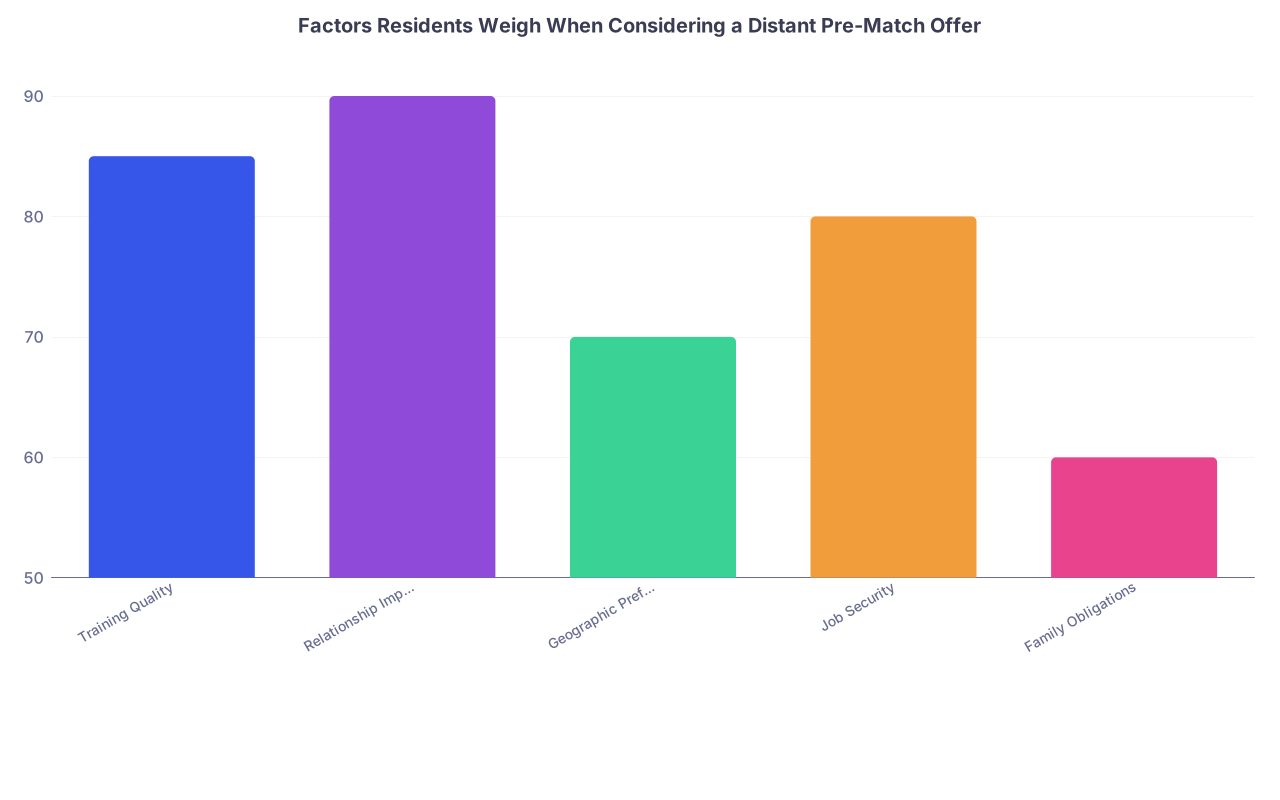
| Category | Value |
|---|---|
| Training Quality | 85 |
| Relationship Impact | 90 |
| Geographic Preference | 70 |
| Job Security | 80 |
| Family Obligations | 60 |
Option 3: Decline and Bet on the Regular Match
This is the high‑risk, potentially high‑reward move.
You do this if:
- You have a decently strong application in a not‑insane specialty
- You’ve applied broadly, especially to programs near your partner
- Staying geographically close is a top priority for both of you
But do not lie to yourself. If you’re a marginal applicant, small school, weak scores, no home program, and you toss a guaranteed offer hoping for the dream couple situation—this can backfire brutally.
If you’re considering this, I’d strongly suggest:
- Talking honestly with at least one advisor who isn’t afraid to hurt your feelings
- Looking at last year’s match data for your specialty and your school
- Asking: “If I end up unmatched, will I still think declining this offer was worth it?”
Step 5: Use Time Strategically Without Burning Bridges
Programs expect some hesitation. They don’t expect radio silence or emotional monologues.
Here’s how you buy time and keep your options open without looking flaky.
Script for Asking for More Time
Try something like:
“Thank you very much for the offer. I’m very interested in your program and honored by the opportunity. My partner has already matched in [City], and I want to think carefully about the logistics before I commit. Would it be possible to have until [specific date, 3–7 days out] to give you a firm answer?”
Direct. Professional. No begging.
If they say no and give you a hard 24–48 hour deadline, you’ve learned something about their flexibility culture. That doesn’t mean you run away, but you note it.
While You’re Using That Time
You’re not just spinning in anxiety. You are:
- Calling / emailing 1–3 trusted faculty mentors with the exact facts (“Partner matched X, I have pre‑match Y, here are my stats”)
- Reaching out discreetly to residents who trained long distance or transferred—ask how it really played out
- Running your own scenario math: where do you live, how often do you see each other, what does year 1, 2, 3 look like?
And if there’s any chance of getting closer to your partner through other programs, you use this time to:
- Contact programs in your partner’s city or nearby with a concise update:
- Brief re‑expression of interest
- Any new achievements
- Clear mention: “My partner has already matched at [Program/City], and I’m very interested in training in the same region if possible.”
You’re not begging them to rescue your relationship. You’re giving them a reason to pull your file out of the pile and actually read it.
Step 6: Communicate Smartly with Programs About Your Partner
This part is delicate. Mishandled, you sound unserious. Done right, you sound like a thoughtful adult with a life.
Here’s when and how to mention your already‑matched partner:
- In emails to programs in the same city/region as your partner
- During interviews, if geography/family comes up naturally
- When responding to a pre‑match and explaining why you need time
Sample language:
“My partner matched in [Specialty] at [Institution] in [City], so I’m particularly motivated to train in the same region if possible. That said, I’m committed to finding the best training environment and would be excited to contribute to your program.”
Note the order:
- You mention your partner as a factor
- You do not frame yourself as a hostage to geography
- You emphasize training first, relationship second (even if in your heart it’s the other way around)
For the pre‑match program in a different city, if they explicitly ask about your hesitation:
“I want to be transparent that my partner is already matched in [City]. I’m very interested in your program, but I need to think carefully about whether we can realistically manage the distance for the length of training. I don’t want to accept a spot I’m not fully prepared to commit to.”
This is the adult way to handle it. PDs can smell half‑hearted acceptance a mile away. Some would rather you say no than say yes and spend PGY‑1 emailing other programs looking to transfer.

| Step | Description |
|---|---|
| Step 1 | Receive Pre-match Offer |
| Step 2 | Clarify Offer Details |
| Step 3 | Decide Based on Usual Factors |
| Step 4 | Talk with Partner |
| Step 5 | Assess App Strength |
| Step 6 | Leaning to Accept for Security |
| Step 7 | Consider Decline and Match Near Partner |
| Step 8 | Consider Accept and Long Distance |
| Step 9 | Ask for Brief Extension |
| Step 10 | Get Mentor Input |
| Step 11 | Final Decision |
| Step 12 | Partner Matched Far Away |
| Step 13 | Geography Priority High |
Step 7: Make the Decision Like You’ll Have to Explain It to Your Future Self
At some point, you stop gathering input and you choose. Here’s the lens I want you to use:
Imagine you’re PGY‑3, exhausted post‑call, sitting in the call room. You’re explaining your decision to your co‑resident. What do you want that story to sound like?
You want something like:
- “I had a guaranteed spot 1,500 miles away from my partner. My application was shaky, and I didn’t want to risk going unmatched. We decided together to suck up the distance, and we built a plan for visits and eventual transfer. It’s been hard, but I don’t regret having stable training.”
or
- “I turned down a solid pre‑match because my partner was already locked into a program here and being in the same city mattered more to us than program name. I knew I might end up at a less famous program, but the trade‑off made sense for our life.”
What you’re trying to avoid is:
- “I panicked and said yes in 24 hours without really talking it through. Now we’re both resentful and stuck.”
If you can explain your decision in one coherent paragraph without hand‑waving, you’ve probably done it right—even if the outcome isn’t perfect.
And yes, there is risk either way. You’re not going to eliminate that. You’re choosing which version of risk you’re more willing to own:
- Risk of going unmatched or matching far away but together in the system
- Risk of being locked into a far‑from‑partner program for years
Pick your risk consciously, not by default.
Step 8: Once You Decide, Stop Re-Deciding Every Week
The worst thing you can do to yourself is make the decision… and then re‑litigate it in your head every time you have a bad day.
If you accept the pre‑match:
- Close the door on Match fantasies. Withdraw from the Match if required. Stop stalking every program’s social media praying for a last‑minute couples miracle.
- Shift fully into: “How do I make this work logistically and emotionally with my partner?”
- Talk specifics: moving dates, visit schedules, financial planning, communication routines.
If you decline and stay in the Match:
- Accept the anxiety that comes with that. It’s part of what you signed up for.
- Go all‑in on strengthening your application and networking in your partner’s region.
- Do not torture yourself with, “What if I never match?” every night. If you end up SOAPing or taking an extra year, you’ll deal with that as a separate problem when it actually arrives.
Residency is hard enough without dragging ghosts of abandoned options behind you.
Final Reality Check
Let me cut through what everyone else will wrap in soft language.
- A pre‑match offer in another city when your partner is already matched is not purely good or purely bad. It’s leverage, and sometimes a trap. Treat it with respect.
- Long‑distance residency can work, but it is not romantic. It is logistics, money, and two exhausted people trying not to drift apart.
- There is no “correct” decision that guarantees you both perfect careers and a perfectly preserved relationship. You’re choosing which sacrifice you’re willing to live with.
If you walk away with anything, make it this: decide with your eyes open, in partnership with the person you claim to care about, and in a way that your future self can explain without cringing.