
The worst pre-match decision you’ll make is pretending it’s only about “fit” and ignoring the politics.
If your home program pre-matches you, you’re not just choosing where to train. You’re choosing sides. You’re signaling loyalty. And every program director who sees your name later will be reading between the lines.
Let me walk you through what’s actually going on and what to do, step by step, depending on your goals.
1. Understand What a Home Pre-Match Really Means
Before you react emotionally—flattered, pressured, or both—get clear on the mechanics.
In most specialties and regions using the NRMP, classic “binding pre-matches” are rare or banned. But versions of pre-match offers still happen:
- Informal: “If you rank us highly, we’ll rank you to match.”
- Strong signal: “We want you. You’re safe here.”
- Semi-formal: “If you commit to us, we’ll stop recruiting hard for your spot.”
At your home program, this is amplified. You’re not just an applicant. You’re:
- The student they already know
- The person their residents precepted and maybe went to bat for
- The person their chair might be calling about
So their “pre-match” isn’t just: “We like you.” It’s: “We’re investing reputation and political capital in you. Are you with us or not?”
Here’s the subtext you need to hear, even if nobody says it:
- They’re trying to lock in known quantity over unknown risk.
- They’re worried other programs will like you too.
- They want to control the outcome early.
That doesn’t make them villains. It makes them strategic. You should be strategic too.
2. First 48 Hours: How to Respond Without Burning Bridges
You got the call / email / “come talk to my office.” Here’s what to do in the first two days.
Step 1: Buy time, politely and clearly
Never commit on the spot. You say something like:
- “I’m really honored you feel strongly about me. This means a lot. I want to think carefully about my options and talk with my family/mentors. Can I get back to you by [specific date]?”
Give a concrete timeline (3–7 days is reasonable) so you don’t seem evasive.
What not to do:
- Do not gush and imply commitment if you’re not sure. Word spreads.
- Do not go vague with “we’ll see how the season goes.” That sounds unserious.
Step 2: Clarify what kind of “offer” this is
You need specifics. Very calmly, very professionally:
- “I want to be sure I understand. Are you asking for a formal commitment not to rank other programs above you, or is this more a statement that I’m ranked highly and very likely to match here if I rank you highly?”
You’re listening for:
- Binding vs non-binding
- Expectations about your behavior (interviews, ranking, signaling)
- Whether they expect you to cancel other interviews
If they dance around it, that’s a red flag. Good programs can be straightforward without violating NRMP rules.
Step 3: Talk to two sets of people
Not one. Two.
Internal mentors at your home institution
- A trusted faculty member who knows your file
- A chief resident or senior resident you trust
External perspective
- A mentor at another institution (research PI, away rotation contact, or advisor)
- Or at least someone not beholden to your home department politics
Internal mentors understand the local stakes. External mentors are more honest about your competitiveness on the open market.
Give them the exact words used in the offer. Don’t summarize loosely. Language matters a lot here.
3. Diagnose Your Situation: How Competitive Are You Really?
Your entire decision strategy hangs on one thing: your true market value as an applicant.
Here’s a rough breakdown of how I’d think about it:
| Profile Type | Market Position | Pre-Match Offer Weight |
|---|---|---|
| Strong National | Top 10–20% applicants | Optional, leverage |
| Solid Regional | Middle of the pack | Serious safety anchor |
| Borderline/At-Risk | Below avg or red flags | Gold, possibly take it |
| Non-traditional/Gap | Variable | Depends on context |
Now, how do you estimate your category?
- Step scores / COMLEX (even with Step 1 P/F, Step 2 still matters)
- Class rank / AOA / Gold Humanism
- Quality of rotations and letters (“top 5% resident” vs “pleasant to work with”)
- Specialty competitiveness (Derm vs FM are not the same universe)
- Your interviews so far: Many invites? None yet?
If three separate honest people—who are willing to tell you “you’re not that special”—say you’re a strong candidate nationally, you have more room to be choosy.
If the feedback is more like, “You’re solid, but the market is tight this year,” that pre-match becomes much more valuable.
4. Politics and Loyalty: What’s Actually at Stake
People pretend this is pure merit. It isn’t. There’s relationship and reputation currency involved.
How your home program sees it
From their side, if they pre-match you (or strongly signal they want you), they are:
- Telling faculty, “We’re keeping our own.”
- Potentially turning down other strong applicants assuming you’re theirs.
- Investing emotional energy—attendings and residents may already be picturing you in the call pool.
If you say no, they’ll feel it. Not always rationally, but they will.
Worst-case political outcomes if you decline:
- Cooler relationships with certain attendings in the future (for fellowships, letters).
- Less enthusiasm for your success stories being shared or supported.
- Subtle but real sense of “they weren’t loyal.”
That doesn’t mean you must say yes.
But do not kid yourself: declining has relational costs. You can manage them. You cannot erase them.
How outside programs read your choice
Program directors know home programs pre-match or heavily woo their own students. If you:
Turn down your home program and match somewhere strong:
- Outside PDs read it as “this person is ambitious and mobile.” Often fine.
Turn down your home program and then don’t match well or at all:
- It can look like overreaching or poor judgment—especially in small specialties.
You’re threading a needle between loyalty, ambition, and realism.
5. Strategy Based on Your Scenario
Let’s walk through actual situations you might be in.
Scenario A: You secretly want to stay. You’re just scared to commit.
Home program is solid. You like the residents. You’re overthinking whether you “should go away.”
In this case:
- Confirm details: Is your spot guaranteed if you rank them #1?
- Ask about anything that matters to you: fellowships, research, schedule, mentorship.
- If it all checks out, it’s reasonable—and often wise—to accept in principle.
How you communicate:
- “I’m honored. I’ve thought about it, and I’d be very happy to train here. I plan to rank you first.”
You can still quietly attend a few dream interviews if they’re already scheduled, but do not tell other programs you’re undecided if you’re really not.
Scenario B: You absolutely do not want to stay long-term
You want a different city, different patient population, or your home program has legitimate issues (toxic culture, poor board pass rates, bad reputation).
Here you need to be honest with yourself:
- Would you truly rather scramble/SOAP or go to a much weaker program somewhere else than stay home?
If yes, then:
- Be respectful but clear that you’re exploring other options.
- Do not promise to rank them #1.
- Maintain professionalism and show appreciation.
Example language:
- “I really appreciate how supportive everyone has been. I’m exploring a range of programs and locations for personal reasons as well as professional. I’m not comfortable making a definitive commitment yet, but I’m very grateful for your support and interest.”
They will understand what that means. They may not like it. That’s the tradeoff.
Scenario C: You’re borderline for the specialty or worried about matching
This is where people blow up their careers by chasing fantasy.
Signals you might be borderline:
- Below-average Step 2 / COMLEX
- Failed / remediated courses or leaves of absence
- Very limited interview invitations, late in the season
- Applying in a hyper-competitive specialty with a “just okay” application
If your home program is offering you a heavily implied safe harbor, that may be your best and only realistic safety.
In this situation, I lean strongly toward:
- Take the pre-match sentiment seriously.
- Strongly consider committing—especially in places like neurosurgery, ortho, derm, plastics, ENT, urology, etc.
You can still attend a few dream interviews. But passing on a near-guaranteed home spot with a borderline application is how people end up unmatched, then reapplying in a weaker specialty a year later.
Scenario D: You’re competitive and aiming higher-tier than your home program
Classic tension. You’re maybe at a solid community or mid-tier academic program, but you’re competitive for bigger-name places.
Here’s the play:
- Do not reflexively accept or reflexively reject.
- Map out your realistic target and safety range.
Something like this:
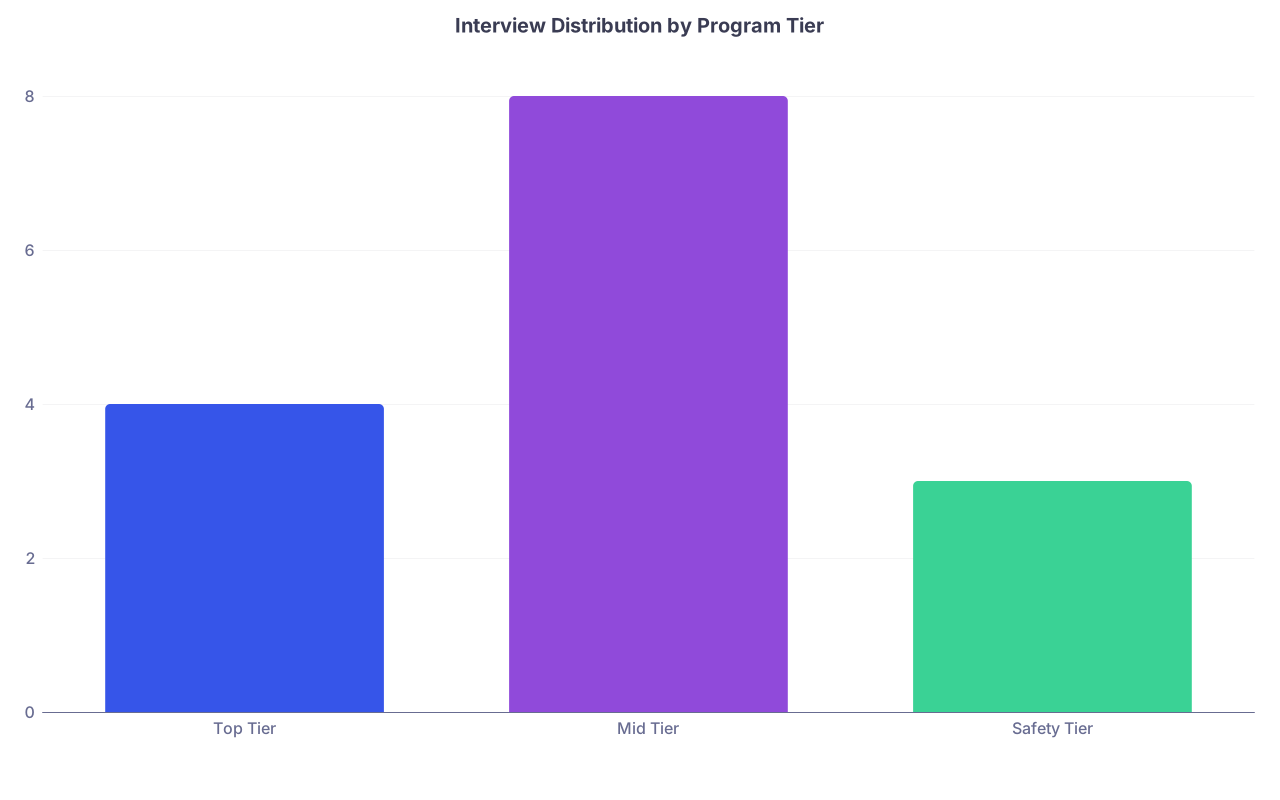
| Category | Value |
|---|---|
| Top Tier | 4 |
| Mid Tier | 8 |
| Safety Tier | 3 |
If you already have multiple interviews at programs equal or stronger than your home, you can safely keep your options open. You might say:
- “I’m very honored. I’m excited about the possibility of training here. I am also exploring some programs that align with my specific fellowship/research interests. I don’t feel comfortable making an exclusive commitment, but I want you to know you’re very high on my list.”
Translation: I respect you, but I’m shopping.
If you end up not matching at the dream places but match at another strong program, your home department may be slightly annoyed but they’ll usually get over it.
6. How to Communicate Without Violating Match Rules or Ethics
You have to walk a fine line between honesty, self-interest, and NRMP rules.
A few ground rules:
- You can tell a program they are your top choice.
- You cannot make or request binding commitments outside the Match.
- Don’t lie. This field is small. People talk.
Three common communication templates:
You’re 100% sure they’re #1
- “I want to be transparent: this program is my first choice, and I will be ranking you number one.”
They’re in your top tier, but you’re not sure about #1
- “You’re one of my top choices, and I’d be very happy to train here. I’m still in the process of finalizing my rank list.”
You appreciate the interest but don’t want to mislead
- “I’m very grateful for your support and the strong signal of interest. I’m still considering several programs and don’t want to overstate my level of commitment to any single one right now.”
If a program director pushes for more (“So are we #1 or not?”), do not cave into lying. You can say:
- “I really value honesty in this process. I’m not ready to state a definitive #1 yet, but I want you to know I hold this program in very high regard.”
They may be annoyed. Better annoyed than catching you later in a lie.
7. Tactical Moves: Scheduling, Interviews, and Backups
This is the part people screw up because they either panic or get arrogant.
Don’t cancel all your interviews just because of one pre-match
Unless:
- It’s a truly binding offer and you’re thrilled with it
- Or your risk tolerance is basically zero
Even then, I’d still keep a couple of interviews at equivalent or slightly higher-tier places just in case something changes.
Be strategic about which interviews you do attend
Use a simple mental grid:
- Programs clearly weaker than your home: Only attend if you’re truly scared about matching.
- Comparable programs: Worth going if you’re not sure you want to stay.
- Stronger programs: Definitely attend if you’re at all open to leaving.
Watch your fatigue and attitude
Once people feel “safe,” they sometimes:
- Show up sloppy to other interviews
- Talk too casually about having a home backup
- Seem checked out
Word about that attitude gets around too. Act like every interview could still change your life (because it might).
8. If You Decide to Accept the Home Pre-Match in Spirit
Let’s say after all the analysis, you decide: “Yes, I want to stay.”
Here’s how to do it cleanly and smartly.
Tell the program director clearly and early
- “After thinking about it carefully, I’d be very happy to train here. I plan to rank [Program] first.”
Ask if they want you to cancel other interviews
- Some will say no, some will say they’d appreciate it.
If you keep a few interviews: keep them discreet
- Do not brag to residents or faculty elsewhere that you’re “already safe at home.” It sounds arrogant and wastes everyone’s time.
Maintain performance at your home institution
- You’re not “in the club” yet. A disastrous late rotation or professionalism issue can still sink you.
9. Long-Term View: How This Plays Out Over Your Career
People obsess over this pre-match moment like it’s the only plot twist in their career. It’s not.
What actually affects your long-term trajectory:
- How hard you work and how teachable you are in residency
- The quality of mentorship and exposure you get
- Your reputation as a resident others want on their team
- Your ability to leverage your program (home or away) for the next step: fellowship, job, etc.
Yes, saying no to your home program can sting people. I’ve seen former students come back for fellowship and still get warmth. I’ve also seen people who stayed home and were miserable because they were afraid to leave.
You’re not choosing approval. You’re choosing a training environment, a city, a lifestyle for years.
Make the decision with a clear head, not out of guilt.

| Step | Description |
|---|---|
| Step 1 | Home pre-match offer |
| Step 2 | Keep options open |
| Step 3 | Consider committing, keep few top interviews |
| Step 4 | Strongly consider locking in home |
| Step 5 | Home becomes critical safety |
| Step 6 | Prioritize other interviews |
| Step 7 | Want to stay here? |
| Step 8 | Application strong? |
| Step 9 | Risk of not matching? |
FAQ (Exactly 5 Questions)
1. Can my home program punish me if I don’t rank them first after a pre-match offer?
They cannot legally or formally punish you in the Match process itself. But relationally? Yes, there can be fallout. Some attendings may be less enthusiastic about writing future letters or supporting your fellowship applications. That said, most departments get over it if you match into a strong program elsewhere and handle your communication respectfully.
2. Should I tell other programs that my home institution pre-matched or strongly signaled me?
Usually no. It doesn’t help you and can come off as posturing. Programs care if you’re genuinely interested in them, not whether you’re “in demand” elsewhere. The only mild exception: in a 1:1 with a PD who directly asks about your situation, you can briefly and neutrally mention you have strong support at home but are very interested in their specific strengths.
3. Is it unethical to say a program is my “top choice” if I’m not 100% sure?
Yes. If you tell multiple programs they are your “number one,” you’re lying. The Match system assumes good-faith communication. You can say “one of my top choices” if that’s true, but reserve “I will rank you first” for when you mean it.
4. What if I accept in spirit, then change my mind later and rank another program first?
You can—the Match doesn’t enforce verbal promises. But it’s a reputational hit. Your home PD will likely find out, and that can leave a lasting bad taste. If you think you might change your mind, do not give a firm “you are my #1” statement. Keep your language honest but non-binding.
5. How long can I reasonably wait before giving my home program an answer?
Usually 3–7 days is acceptable after a clear pre-match type conversation. Longer than that, and you risk irritating them or looking indecisive. If you truly need more time (waiting for key interviews), update them: “I’m still very grateful and seriously considering staying. I’m waiting on a few critical interviews over the next two weeks. Can we touch base again on [date]?” That keeps communication open without ghosting.
Key points to keep in your head:
- A home pre-match is not just a compliment; it’s a political and strategic move. Treat it as such.
- Your real competitiveness and risk tolerance should drive your decision—not guilt or ego.
- Say what’s true, protect your future relationships, and choose the program where you can actually become the doctor you want to be.