
The pre‑match offer is not a prize. It is a lever. When a family illness hits during interview season, that lever can save your sanity—or trap you in the wrong program.
You’re not dealing with a theoretical career move anymore. You’re juggling flight alerts, ICU visiting hours, and PD emails while trying to remember which program had the good teaching versus the malignant call schedule. I’ve watched residents blow up their future because they panicked when a pre‑match offer came in during a crisis. I’ve also watched others use that same offer to stabilize their life and still end up exactly where they needed to be.
This is about how you handle that moment.
Step 1: Get Clear On Your Actual Situation (Not The Drama Version)
Slow down for thirty minutes. You need facts, not vibes.
Ask yourself three blunt questions:
- How sick is your family member, realistically?
- What does that mean for where you need to be geographically?
- How much bandwidth do you truly have left for more interviews?
Let’s translate that into something concrete.
- If your parent just got a new cancer diagnosis but is outpatient, functioning, and has support from others, that’s very different from: intubated in the ICU with no one else around.
- If you’re the only adult child within 1,000 miles and your mom’s new stroke means someone has to coordinate everything from rehab to bills—that’s a serious, time‑intensive role.
- If you’re already exhausted, missing flights, crying between interviews, and forgetting basic questions—you’re not “fine, just stressed.” You’re showing up as a worse version of yourself.
Now look at your current interview map versus the illness:
- Is there a clear regional cluster you now need to prioritize (e.g., within 2 hours’ drive of home)?
- Are there programs you were only mildly interested in that are now logistically impossible or irresponsible?
This is the foundation. Before thinking “pre‑match,” you need: where do I need to be, what can I realistically do, and what’s non‑negotiable for your family role.
Step 2: Understand Pre-Match Power When Life Just Changed
Pre‑match offers can do three things for you in this situation:
- Lock you into a stable plan close to home.
- Give you leverage with other nearby programs.
- Free up time and mental space by letting you cancel low‑yield interviews.
But they can also screw you if you treat them like a life raft instead of what they are: a binding professional contract.
Here’s the blunt reality of a true pre‑match offer:
- It’s binding. Once you sign, you’re done. No match. No ranking. No “I changed my mind.”
- Programs assume you take it seriously. Reneging is viewed as unprofessional and can follow you.
- Your panic level does not change the ethics. “My dad got sicker” tugs heartstrings, but it doesn’t reset the rules.
So you use pre‑match carefully, not impulsively.
You should be asking:
- Does this program’s location actually fit your new family reality?
- Is this program somewhere you could tolerate three to seven years if the family situation stabilizes or worsens?
- Does saying “yes” today give you more control—or just numb the anxiety for 24 hours?
If the only honest answer is “it just makes me feel less panicked,” you probably need to slow down, not sign.
Step 3: Re‑Sort Your Programs Around the Crisis
You can’t keep working off the rank list you mentally built before the illness. That list assumed normal life. Your life is not normal right now.
You need a temporary “crisis‑adjusted” ranking just for pre‑match decision making.
Make three short columns on a page:
- Column A: Programs within your new “safe radius” of family (define that: 30 minutes, 2 hours, same state—be explicit).
- Column B: Programs outside that radius that you still deeply want (dream programs).
- Column C: Everyone else. The “nice to have but not crucial” and the “probably no anyway.”
Now sort:
- Any pre‑match offer from Column C? That’s a huge red flag. You’re about to lock yourself into something you already half‑dismissed—just because you’re scared. Bad move.
- Offers from Column B? That’s tougher. Amazing program, far from family, during a crisis. Might still be right, but you must be brutally honest about whether your guilt/regret later will eat you alive.
- Offers from Column A? These are the ones that deserve real, careful consideration as potentially the smartest move in this situation.
This is where pre‑match can actually help you: if you get a solid offer inside your new geographic and emotional constraints, you might trade some “prestige” for actual life stability. That is not weakness. That’s adulthood.
Step 4: Use Time Delays Intelligently (Without Burning Bridges)
A lot of applicants treat pre‑match like a bomb: “I have to decide RIGHT NOW.” That’s rarely true.
You’re allowed to ask for time—professionally.
When a program emails or calls with a pre‑match offer, your script looks like this:
“Thank you so much for this offer. I’m very interested in your program. I’m also currently managing an unexpected serious family illness that has changed some of my considerations. Would it be possible to have until [specific date, usually 48–72 hours] to give you a thoughtful answer? I want to be sure that, if I commit, I can honor that commitment fully.”
That sentence does three things:
- Signals genuine interest.
- Gives a legitimate reason without oversharing.
- Shows you care about professionalism and honoring contracts.
Many PDs will say yes. Some will say “we need to know by tomorrow” or “we can’t hold it.” Good to know. That tells you something about their flexibility culture.
Use that 48–72 hours strategically:
- Call family. “If I’m at X program, I’ll be [distance] away. Here’s what that looks like for you and me.”
- Re‑check your map. Are there other nearby programs you haven’t interviewed with yet? Can you bump them, ask for earlier dates, or at least show strong interest?
- Sleep, once. Don’t decide this level of commitment at 1 a.m. after a cross‑country flight and 3 hours of broken rest.
Step 5: Communicate With Other Programs Without Sounding Desperate
If you have a decent pre‑match offer near home, you can and should use that politely with other local programs you’d prefer.
The email you send to a higher‑choice nearby program might look like this:
“Dear Dr. [PD Last Name],
Thank you again for the opportunity to interview with [Program Name] on [date]. I remain very interested in your program, especially given your strong [specific aspect: ICU training, underserved focus, research opportunities].
I wanted to let you know that I’ve recently received a pre‑match offer from another program in [city/region]. However, due to an unexpected serious family illness, staying in this area has become especially important to me.
Your program is a top choice within this region. If there is any consideration for a pre‑match offer or if you anticipate ranking me competitively, that information would be extremely helpful as I make this difficult decision.
Thank you for your time and consideration.
Best regards, [Your Name] AAMC ID: [ID]”
You’re not demanding anything. You’re not threatening. You’re giving them information and a chance to respond.
Three likely outcomes:
- They say nothing specific. Translation: don’t count on a pre‑match here.
- They say some vague “we think highly of you.” Useless for pre‑match decisions.
- They say, “We’re not doing pre‑match, but we plan to rank you highly.” That means: if you forgo the current safe offer, you’re gambling on the match.
- They hint at or offer a pre‑match. Then you compare both honestly.
If you’re in a specialty that barely does pre‑match or not in Texas or another specific system where pre‑match is a formal thing, adapt the logic: you’re still weighing an early contract‑like offer (pre‑match, outside match, SOAP‑avoiding offers) against unknown future options.
Step 6: Decide When to Take the Safe Pre‑Match
Here’s where people get stuck: “What if something better comes?” That’s fear of missing out dressed up as strategy.
You accept a pre‑match (in this situation) when:
- It’s within your new geographic/family constraints.
- The program is at least solid: people seemed decent, residents didn’t look wrecked, training is respectable.
- The thought of spending the next 3–7 years there feels “good enough,” not “I’ll be miserable.”
- The stability actually takes weight off you and your family, not just numbs your anxiety for 24 hours.
You do not accept a pre‑match when:
- You’re using it as an emotional anesthetic because the family situation feels out of control.
- It’s last‑minute at a program you found sketchy, malignant, or disorganized.
- It’s geographically wrong for your new responsibilities.
- You’re hiding from the effort of finishing a few remaining high‑value interviews that still align with your crisis‑adjusted priorities.
One helpful exercise: imagine your family member stabilizes or recovers in six months. Would you be angry at past‑you for locking into this program? If yes, don’t sign.
Another: imagine things get worse and you need to be even more involved than expected. Does this program’s schedule and culture give you any flexibility—or do the residents already look punished for having needs?
Step 7: Protect Your Interview Season If You Don’t Take It
Sometimes the right move is to say no to a pre‑match and keep going. That’s fine. But then stop pretending you’re in a normal interview season. You’re not.
If you decline a pre‑match during a family illness, you now need structure:
- Cap your interview number. If you originally planned 15–18, maybe your new cap is 10–12, focused in your chosen region.
- Ruthlessly cancel low‑priority interviews in places you realistically won’t rank high, even if they’re “good name” programs.
- Cluster travel where possible so you aren’t ping‑ponging coast to coast while fielding ICU updates between flights.
Be honest with yourself: your performance tanks when your personal life is on fire. Fewer, better‑chosen interviews where you’re actually present beats 20 interviews where you’re mentally at a hospital bedside the whole day.
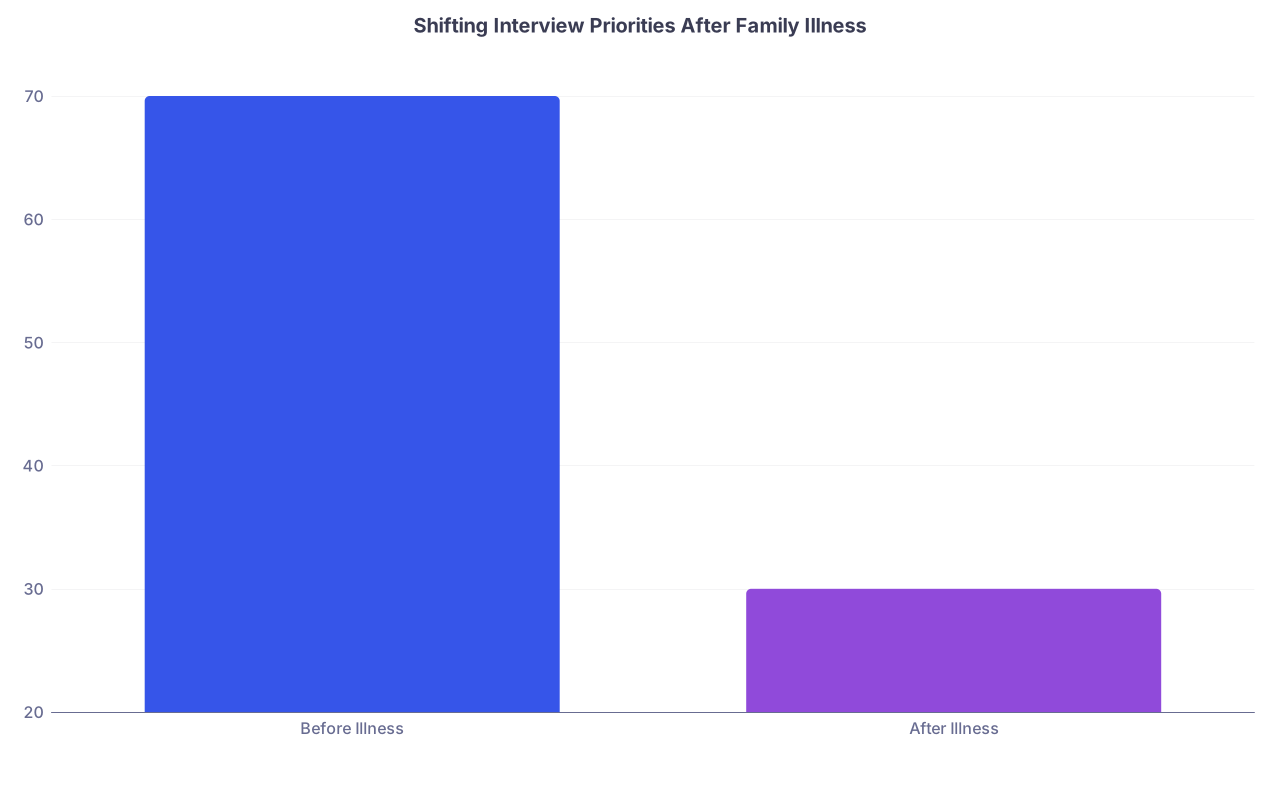
| Category | Value |
|---|---|
| Before Illness | 70 |
| After Illness | 30 |
(Think of that as 70% “chase the best‑name programs” vs 30% “stay near family” before. After the illness, those numbers should flip.)
Step 8: How To Talk About The Illness Without Oversharing or Weaponizing It
Programs are made of humans. Some are decent. Some are not. Don’t assume everyone is your therapist.
You can mention the family illness when:
- Explaining travel changes, cancellations, or rescheduling.
- Asking for a decision extension on a pre‑match.
- Answering “what geographic areas are important to you?” or “how do you handle stress?” if it naturally fits.
You don’t need full details. Your line can be:
“I’ve recently had a serious family illness come up, so being within driving distance of [city/region] is newly important to me.”
Or:
“I’ve had to manage a serious family illness during this season, which has forced me to prioritize and set clear boundaries with my time.”
Don’t crypledge. Don’t present it as a bargaining chip. Just be straightforward, calm, and matter‑of‑fact. PDs remember the applicants who handled hard things like adults.
If a PD presses for uncomfortable medical details about your family member, you’re allowed to hold the line:
“It’s been a tough situation, but I’d prefer not to go into medical specifics. The key impact for me is needing to be within [distance] of [location] to be involved in their care.”
That’s enough.
Step 9: Worst‑Case Moves To Avoid (I’ve Seen All Of These)
Let me be blunt about a few things that will blow up on you:
Accepting a pre‑match, then trying to back out if another offer appears.
Programs talk. This follows you. It’s unprofessional and can sink you entirely in some specialties.Ignoring your family responsibilities to “maximize your options.”
You’re still going to be this person in July. If you burn every bridge at home now, you’ll be the intern trying to swap shifts every week for last‑minute flights back. That wears thin fast.Pretending the illness doesn’t change anything.
It does. Even if you decide to prioritize your career and go far away, that’s still a choice made with eyes open, not “oh well, nothing I could do.”Letting guilt choose for you.
Some of you will feel obligated to lock into the nearest mediocre program because you feel guilty. Others will feel guilty turning down the far‑away elite program. Guilt is a terrible planner. Use facts and values, not just emotion.Going silent on programs.
If you need to cancel or reschedule because of a hospitalization or critical event, send a clear, professional note. Radio silence comes across as disrespect, even if your reason was legitimate.
Step 10: A Simple Decision Framework When an Offer Hits Mid‑Crisis
When the email or call comes in, run it through this quick filter:
- Does this location work with my likely role in my family member’s care?
- Is this program at least “solid” in training, safety, and culture?
- If all match outcomes vanished and this was my only path to residency, would I feel okay, not devastated?
- Am I saying yes from clarity or from panic?
If you get 1–3 as yes and 4 as “clarity,” you can seriously consider accepting.
If 1 or 2 are no, that’s almost always a pass, even in crisis.

| Step | Description |
|---|---|
| Step 1 | Pre match offer received |
| Step 2 | Do not accept |
| Step 3 | Ask for 48-72 hours, reassess |
| Step 4 | Strong candidate to accept |
| Step 5 | Location works for family? |
| Step 6 | Program solid and safe? |
| Step 7 | Would you feel okay if it is your only option? |
| Step 8 | Decision from clarity or panic? |
Print that in your head and run the decision through it. Quickly, but not impulsively.
In a chaotic interview season shaken by an unexpected family illness, you do not need perfection. You need a workable life and a good-enough training environment.
Three things to keep in focus:
- Use pre‑match as a tool, not a sedative. Take it only if it aligns with your new geographic and family reality and you can live with it long‑term.
- Be transparent but professional with programs—ask for brief extensions, communicate constraints, and don’t overshare or weaponize the illness.
- Rebuild your priorities around the crisis and protect your bandwidth: fewer, targeted interviews and deliberate choices beat scattered, panic‑driven scrambling.
You can come out of this with a residency you can stand and a family situation you haven’t abandoned. That’s the win now.