
It is 10:37 p.m. You just finished a brutal ward call, you open your email “just to check,” and there it is:
“We are pleased to extend you a pre-match offer…”
Your heart jumps. Then your stomach drops.
Because the email is from that program. The one every upperclassman warned you about. The “don’t go there unless you have no other options” place. Reputation: malignant. High burnout, chiefs crying in stairwells, residents getting written up for asking about duty hours. The stories you half-believed when you were an M3.
Now they’re the first (and maybe only) place offering you a guaranteed job.
Here is what you are actually deciding:
Not “offer vs. no offer.”
It is: “A guaranteed (possibly toxic) residency vs. the risk of not matching, reapplying, scrambling, or changing specialties.”
Let’s walk through this like an adult, not like a panicked applicant.
Step 1: Get Very Clear on Your Actual Risk
Do not answer or hint at acceptance yet. You reply tomorrow. After you’ve done the real work.
First, you need to roughly understand how much risk you’re actually taking by saying no.
You are deciding under uncertainty. So you create a crude risk profile.
Start with three anchors:
- Your competitiveness
- The specialty’s competitiveness
- Your current interview situation
A. Your competitiveness snapshot
Pull out your spreadsheet or scrap paper and write:
- Step 1: pass/fail timing + any fails?
- Step 2 CK score (or COMLEX Level 2) and any failures
- Class rank / AOA / strong honors?
- Red flags: leaves, professionalism notes, failed rotations, big gaps?
- Research, letters, and home program support
Now be honest. If you were advising a friend with your stats, would you call them:
- Strong
- Middle of the pack
- Borderline
Do not sugarcoat. I’ve watched applicants talk themselves from “borderline” to “I think I’m solid” based on absolutely nothing. That’s how people end up unmatched and stunned on Match Monday.
B. Specialty competitiveness reality check
Very different answer in FM vs Derm. You know this, but right now denial is tempting.
Quick mental tiers:
- Nuclear competitive: Derm, Ortho, Plastics, ENT, NSG, Urology, sometimes EM in certain regions
- Mid-high: Radiology, Anesthesia, OB/GYN, Gen Surg, competitive IM programs
- Moderate: Most IM, Pediatrics, Psych, FM (though some regions are hotter than others)
If you’re middle-of-the-pack in a nuclear-competitive field and you’re holding a guaranteed spot (even at a miserable program), that’s very different than if you’re a strong FM applicant in a less-overapplied region.
C. Your interview numbers and quality
Look at:
- Number of interviews scheduled (not just “promised” or “maybe”)
- How many are at places you’d actually rank ahead of this malignant program?
- How many more invites are realistic now, based on the calendar?
Then run a simple mental table like this:
| Interviews at acceptable programs | Specialty Type | Rough Match Risk |
|---|---|---|
| 3–5 | Highly competitive | High |
| 5–8 | Mid-high competitiveness | Moderate |
| 8–10 | Most specialties | Low–Moderate |
| 10+ | Most specialties | Lower |
This is crude. It’s not data from NRMP. But it’s realistic pattern recognition from years of watching this play out.
If you are staring at:
- 2–3 interviews total in a competitive field, with no new invites for weeks? This pre-match may be your only lifeline.
If you have:
- 10 interviews in IM across several regions? Very different calculus.
Step 2: Clarify What “Malignant” Means — For This Program
People throw “malignant” around for everything. “They make interns do scut” is not malignant; that’s residency. Malignant is systemic disregard for resident well-being and professional development.
You need to separate:
- Normal hard training from
- Actual toxicity
Ask residents (privately, ideally off email) about concrete things, not just vibes.
Here’s what I’ve seen that usually signals truly malignant culture:
- Repeated retaliation for raising legitimate concerns about duty hours, safety, or mistreatment
- Public humiliation as a teaching “tool” (think ID attending screaming at residents in the hallway)
- Chronic duty hour violations without attempts to fix them
- Gaslighting: “If you can’t handle 28 hours on, maybe you’re not cut out for this field”
- Chief residents burning out, crying regularly, or actively warning candidates
- Residents being threatened with bad evals if they call in sick even when ill
- Systemic non-renewals or sudden “we’re not renewing you” surprises
Ask residents specific questions:
- “How often do you go over duty hours? And what happens when you log it?”
- “If you have a real illness, what actually happens? Any problems?”
- “How many residents have left or been non-renewed in the past 3 years?”
- “If you had a close friend going into this specialty, would you tell them to come here?”
Watch for the deep sigh before they talk. The “I probably shouldn’t say this over email.” That’s your real data.
Step 3: Map Best-Case and Worst-Case Scenarios
You’re not choosing between “good” and “bad.” You’re choosing between different flavors of risk and misery vs. security.
Lay it out simply.
If you ACCEPT the pre-match offer
Best case:
- Culture is bad but survivable.
- You grind it out, protect yourself, and graduate competent.
- You maybe fellowship out to a better place.
- You have financial and geographic stability.
Worst case:
- You burn out, develop severe anxiety/depression.
- You’re stuck in a hostile environment with limited support.
- You end up switching programs or leaving medicine, with baggage.
If you DECLINE the pre-match offer
Best case:
- You match at a healthier program that fits you better.
- You have normal residency misery instead of trauma.
- You feel vindicated and relieved every day of PGY1.
Worst case:
- You do not match.
- You scramble/SOAP into a marginal spot you like even less. Or don’t place at all.
- You lose a year, have to explain an unmatched cycle, and maybe reapply with a bigger red flag.
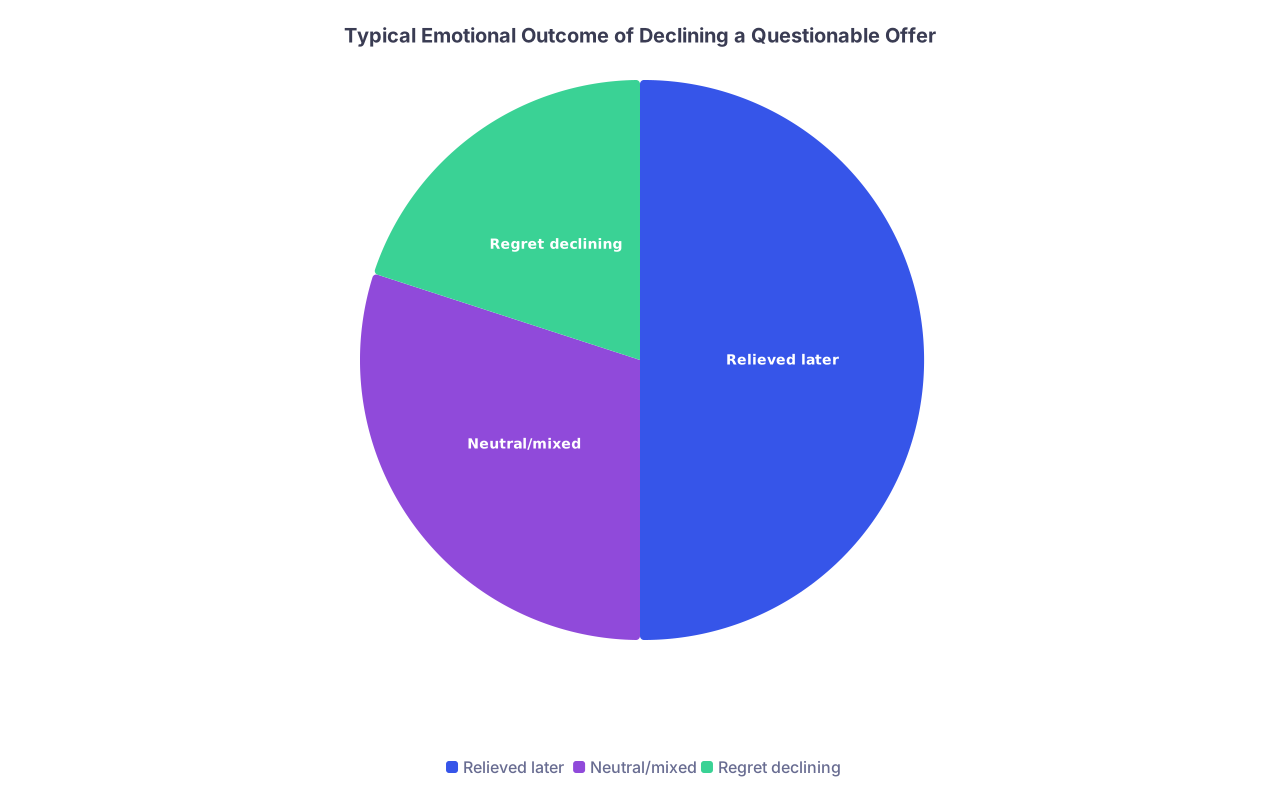
Here’s how this usually really works out in the wild:
| Category | Value |
|---|---|
| Relieved later | 50 |
| Neutral/mixed | 30 |
| Regret declining | 20 |
So about half the time, people are deeply relieved they said no. Around a fifth, they truly regret it. The rest land in “it was rough but I learned something.”
You’re trying to figure out which bucket you’re most likely to fall into, given your stats, specialty, and risk tolerance.
Step 4: Pressure-Test Your Own Situation with People Who Know You
This is where people screw up: they make this decision in a vacuum, at midnight, spiraling.
You need 2–4 reality checks:
- A trusted faculty advisor (ideally in your specialty)
- Your Dean of Students / career advising (they’ve seen this exact movie multiple times)
- A senior resident or fellow who knows your application & the field
- Maybe one brutally honest friend who isn’t going to tell you what you want to hear
What you ask them is not “What should I do?” That puts them on the hook.
Ask this instead:
- “Given my stats and interviews, how risky do you think it would be to turn this down?”
- “If I were your own kid/sibling in my exact situation, would you tell me to take it?”
- “Do you think I’m underestimating or overestimating my chances of matching elsewhere?”
If three different people say, “I’d probably take it in your shoes,” pay attention.
If multiple advisors tell you, “You are likely to match somewhere better,” that’s strong signal.
Step 5: Decide Your Red Lines Before You Negotiate with Yourself
Before you talk to the program. Before you start justifying. You write down your non-negotiables.
Examples:
- “I will not train at a place where retaliation for reporting duty hours is common.”
- “I will not accept a position where multiple residents told me they wish they’d never matched there.”
- “I will accept if the malignancy seems overblown and the main issue is ‘it’s just hard.’”
And one more important line:
- “If I had to repeat intern year or reapply because I did not match, would I regret turning this down more than I’d regret going there?”
This is crude but powerful: If your worst fear is not matching and you know that would crush you more than three tough years, you lean toward accepting.
If your worst fear is ending up in a psychologically unsafe environment with a history of resident harm, you lean toward declining — and accepting the risk.
Step 6: Use a Simple Decision Framework (Not Vibes)
You’re emotionally flooded. So put this into structure.
Create a 10-point scale for both “desirability” and “risk” for this pre-match and for your “field as a whole this cycle.”
Very roughly:
- Desirability 1–10: 1 = “I dread waking up every day,” 10 = “Dream program”
- Risk 1–10: 1 = “Almost guaranteed match safely,” 10 = “Very likely not to match”
Now do this:
For the pre-match program:
- Desirability: ___ /10
- Risk if you accept: ___ /10 (usually low risk of not being a resident, but maybe high risk to well-being)
For this cycle without that program:
- Desirability: average realistic program you might match: ___ /10
- Risk of not matching if you decline: ___ /10
You’re basically comparing:
- Security + bad fit versus
- Uncertain outcome + potential better fit
This isn’t math. It just forces you to see the tradeoffs clearly.
Step 7: If You Are Leaning Toward ACCEPTING
You decided: job security matters more than avoiding a malignant culture given your specific risks. Fine. Then do it strategically.
A. Clarify the terms in writing
Before enthusiastically jumping:
- Is this a legally binding contract or a “letter of intent”?
- Is it NRMP-participating specialty or outside-match (e.g., early match, some prelims, etc.)?
- Are there penalties if you back out? (Some systems get nasty.)
If anything is vague, ask:
“Can you please confirm in writing whether this is a binding offer that would preclude me from entering the Match, or if this is a non-binding pre-match agreement?”
Do not sign what you do not understand.
B. Protect your mental health from day 1
You’re going in eyes open. That’s already better than 50% of incoming residents.
Game plan:
- Identify at least 1–2 mentors outside your program (alumni, former attendings, therapists).
- Set up mental health care before you start — find a therapist familiar with physicians.
- Accept that you may need to be more assertive about duty hours, sleep, and boundaries.
And decide in advance:
“At what point would I seriously consider transferring or leaving?”
That could be:
- Chronic unsafe conditions ignored by leadership
- Severe harassment or discrimination
- Persistent mental health deterioration despite seeking help
Have a line. It will be easier to see when it’s crossed.
Step 8: If You Are Leaning Toward DECLINING
You decided: you are not willing to spend 3–5 years in a place with a known malignant culture, given your perceived match chances.
Then you have to behave like someone who just took on more risk. Deliberately.
A. Double down on every remaining interview
No more coasting.
You:
- Over-prepare for each interview: read faculty bios, understand their patient population, know their selling points
- Clean up any awkward explanations in your story so you don’t look like a risk
- Look alive and engaged — programs smell desperation, but they also smell disengagement
And very practically, if your interview number is modest and it’s getting late in the season, you widen your net:
- Consider community programs, different regions, non-glamour options you previously dismissed
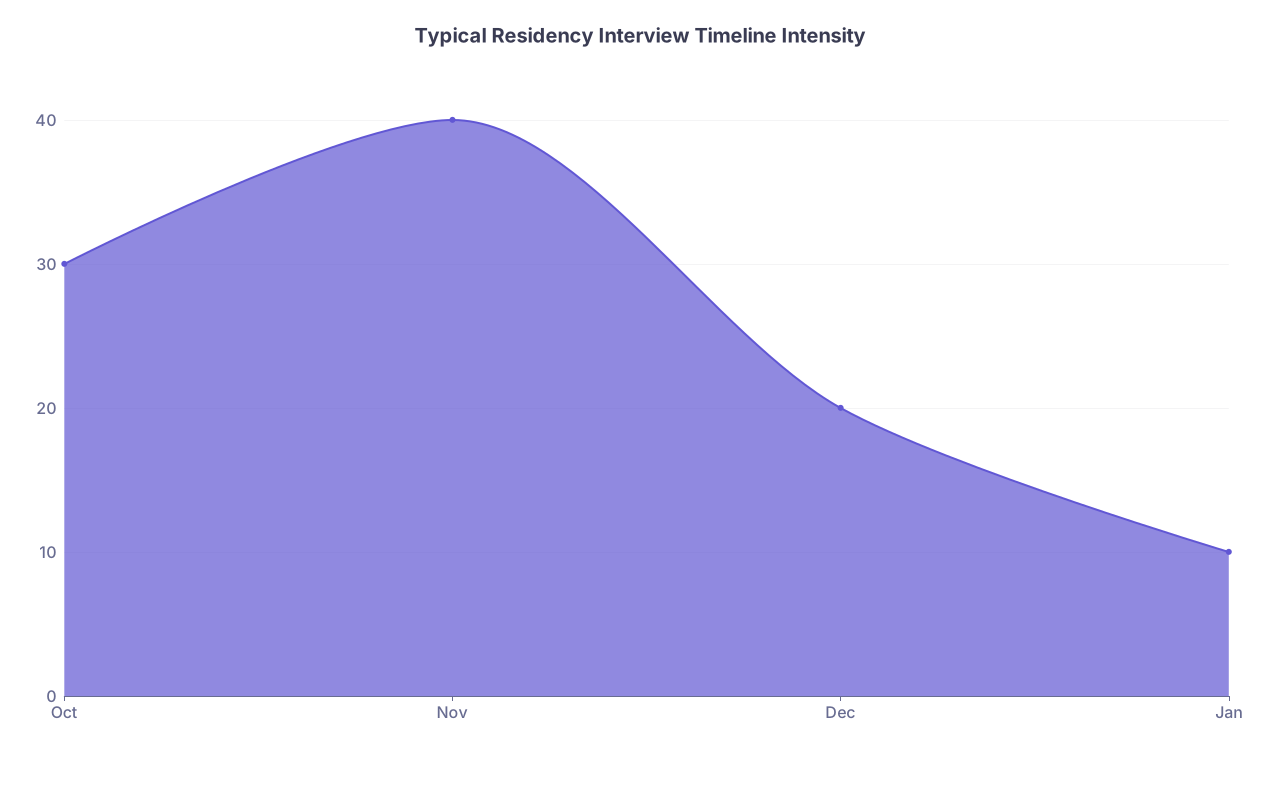
Here’s a quick mental check on where interviews usually cluster and how aggressive you should be with broadening:
| Category | Value |
|---|---|
| Oct | 30 |
| Nov | 40 |
| Dec | 20 |
| Jan | 10 |
If it’s late December and you have 3 total, you are not “being picky.” You are gambling.
B. Build a SOAP/backup strategy now, not on Match Week
If you decline this offer, you must be adult enough to say: “I might not match.” Then plan.
Ask your Dean’s office:
- “If I were to go unmatched, what are realistic SOAP options for me given my record?”
- “Are there transitional year or prelim options I should seriously consider as backup?”
You’re not manifesting doom by planning. You’re reducing the downside.
Step 9: Communicating with the Program
This part stresses people out more than it should.
If you ACCEPT
Keep it short, professional, and prompt once you decide:
“Dear Dr. [PD],
Thank you very much for the offer to join [Program Name] as a [specialty] resident. I would be happy to accept the pre-match offer. Please let me know the next steps and any paperwork I should complete.
Sincerely,
[Your Name]”
Do not gush. Do not overshare. Just confirm.
If you DECLINE
You’ll feel guilty, especially if you interviewed there and liked some of the people. Do it anyway, and don’t leave them hanging.
“Dear Dr. [PD],
Thank you very much for the pre-match offer to join [Program Name]. After careful consideration, I have decided to remain in the Match this year. I truly appreciate your time and the confidence you placed in me.
Sincerely,
[Your Name]”
That’s it. You don’t owe them a trauma dump about their culture or an essay on why.
Step 10: Watching Your Own Mind After the Decision
Once you decide, your brain will immediately start:
- Second-guessing
- Selectively remembering horror stories / success stories
- Comparing your choice to everyone else’s
You’ll see classmates posting “SIGNED MY CONTRACT!!” and feel like you did the wrong thing. Or you’ll see a Reddit horror thread about that program and panic that you accepted. This is normal.
What you do not do:
- Reopen the decision every 24 hours
- Call the PD again and waffle
- Try to keep them as a “backup” while also telling others you’re all in
Pick your path. Then commit to walking it well.
If you went with security: survive and extract value from a tough environment.
If you went with risk: attack the remaining cycle like it matters. Because it does.
Quick Reality Check: Some Situations Where I’d Almost Always Say “Take It”
I’m going to be blunt. In these scenarios, unless the program is truly abusive or dangerous, I’d strongly lean toward acceptance:
- You have Step 2 < 220 in a competitive specialty and only 2–3 interviews
- You have any exam failures and this is the only strong interest you’ve seen
- You’re changing specialties late with a weak track record in the new field
- You have significant life constraints (visa, geography, family) and very limited interviews
And some scenarios where I’d lean toward declining:
- 10+ interviews in IM/Peds/FM/Psych and strong application
- 8+ interviews in a mid-competitive specialty with no major red flags
- Multiple trusted mentors independently say, “You can do better. I would not send my own kid there.”
Is there gray area in the middle? Of course. That’s where you have to decide what kind of risk you can live with.
One More Move People Forget: Asking for a Short Decision Window
If the email doesn’t already specify a reply deadline, you can buy time. Reasonably.
Something like:
“Thank you very much for this generous offer. I’m honored by your consideration. Would it be possible to have until [date 5–7 days out] to provide you with a final decision? I want to be sure I consider this carefully.”
If they say no and push for 24–48 hours, that’s data on their style. But at least you tried.
Use that week. Not to spiral, but to get real intel.
A Simple Next Step You Can Take Today
Right now, before you answer anyone, do this:
Open a blank page and write two headings:
- “Why I would accept this pre-match”
- “Why I would decline this pre-match”
Under each, list at least 5 concrete reasons, including your competitiveness, specialty, mental health, family, and long-term goals.
Then pick one faculty advisor and one resident you trust and email them a brief summary of your situation and those two lists. Ask for a quick 15–20 minute call in the next 48 hours.
That’s your move today. Get out of your own head and get eyes on the problem from people who’ve watched this play out many times.