
It’s mid-December. Your classmates are trading stories about multiple pre-match offers, interviews, and backup plans. Your email inbox? One pre-match offer. Total. And you’re visa-restricted.
The program is… fine. Not a dream program. Maybe it’s in a city you never imagined living in. Maybe the residents looked tired on interview day. Maybe the call schedule sounded brutal. But it’s the only place that has said, “We will actually sponsor your visa and want you here.”
And now you’re stuck between two bad-feeling options:
- Sign it and feel like you’re locking yourself into something suboptimal or maybe even toxic.
- Don’t sign, go into the Match with a risky profile, and potentially end up unmatched—with all the visa complications on top.
This is where you are. Let’s deal with it.
Step 1: Get Completely Clear on Your Actual Risk
Before you do anything emotional, you need a cold, realistic risk assessment. Visa-restricted applicants do not get the same margin for error as citizens or green card holders.
Make a quick, honest snapshot of your competitiveness:
- USMLE: Step 1 (if numerical), Step 2 CK score and number of attempts
- YOG (year of graduation)
- Number and type of US clinical experiences (observership vs externship vs hands-on)
- Any red flags: failures, gaps, leaves of absence
- Specialty competitiveness + how many interviews you actually have
If you’re applying Internal Medicine and you have, say, 3–4 interviews total, and just one has offered a pre-match and is clearly willing to sponsor your visa—your risk of going unmatched is not small.
If you’re applying Family Medicine with 10+ interviews, all of which sponsor visas, and one rather weak community program is pushing hard for a pre-match, that’s a different situation.
Put your situation into something like this mental framework:
| Factor | Low Risk | Moderate Risk | High Risk |
|---|---|---|---|
| Step 2 CK | ≥ 245, no fails | 230–244 or 1 fail | < 230 or multiple fails |
| YOG | ≤ 3 years | 4–7 years | > 7 years |
| Interviews (visa) | ≥ 10 | 5–9 | ≤ 4 |
| US Clinical (hands-on) | ≥ 3 months | 1–2 months | None or just observerships |
| Red flags | None | Minor issues | Major / multiple |
If you’re mostly in the High Risk column and someone is offering you a contract with visa sponsorship, that pre-match is not “just another option.” It’s probably your lifeline.
If you’re mostly in Low Risk, you can afford to be much more selective.
Be brutally honest. Lying to yourself here is how people end up unmatched and scrambling in SOAP, begging for a visa-friendly program that doesn’t exist.
Step 2: Pressure-Test the Actual Program (Not the Marketing Version)
You cannot decide based only on your 6-hour interview day and their glossy slide deck. You need the real story.
Here’s how you pressure-test that single pre-match offer:
Email current residents directly.
Ask for 15 minutes on Zoom or phone. Ideally:- At least one PGY-1 (to see how they treat new people)
- One upper-level resident
- At least one other visa holder if possible
Questions you should actually ask (do not be shy):
- “How often do you feel unsafe asking for help on call?”
- “How many residents have left or been fired in the last 2–3 years?”
- “Any visa residents had issues with renewals or delays because of the program?”
- “How is the relationship between program leadership and residents—do they listen or just talk?”
- “If you could go back, would you match here again?”
- “What’s the worst part of this program that no one tells applicants?”
Check visa history.
This is non-negotiable for you.Ask the coordinator bluntly:
- “How many residents on visas currently?”
- “Have you ever failed to secure a visa for a matched resident?”
- “Do you use in-house immigration counsel or outside attorneys?”
- “What visa type do you prefer to sponsor? H-1B vs J-1?”
If they sound vague, confused, or annoyed by these questions, that’s a red flag. Programs that regularly handle visas know the answers.
Look at where graduates go.
Check their website. If you cannot find a single alum on a visa who got a fellowship or a decent job after residency, be cautious, especially if your long-term plan needs H-1B portability or waiver jobs.Ask about schedule and support.
Use specifics rather than vague “work-life balance” nonsense.- “How often do you exceed the 80-hour rule?”
- “How many admissions is a typical call night?”
- “Who covers you if you are sick?”
- “Is there a night float, or is it 24+ hour calls?”
If what you hear sounds rough but survivable, that’s one category. If what you hear sounds unsafe, abusive, or like a visa trap (e.g., they underpay and threaten your status), that’s a different decision.
Step 3: Understand What Signing Actually Means (Legally and Practically)
People romanticize the Match and misunderstand pre-match contracts. Let me be direct:
If this is an NRMP-participating program and they’re offering a genuine pre-match (outside the Match), they may not be NRMP-participating for that track, or they’re using an institutional policy. You need to be crystal-clear:
- Are they in the Match for this specialty and track?
- Or is this a non-NRMP position?
You must avoid violating NRMP rules. This is your responsibility too, not just the program’s.
Ask the program coordinator or PD:
- “Is this position part of the NRMP Match, or separate?”
- “If I sign this contract, will I still be allowed to participate in the Match for other programs?”
- “Are there any NRMP rules I should be aware of with this offer?”
If this is a non-NRMP contract that starts July 1 and is fully outside the Match, then once you sign, you’re committing to them. If you later also match somewhere, you could be in a very messy, possibly career-damaging situation.
Get it in writing: what type of position, what start date, and whether they will list it as filled outside the Match.
Also: read the contract. Don’t just scroll to the signature line. Watch for:
- Early termination clauses
- Penalties for leaving
- Obligations tied to visa or service time
- Any weird non-compete language (yes, some places do this)
If you don’t understand the contract, have a lawyer or at least someone who has been through this (senior resident, mentor) look at it.
Step 4: Decide Your Strategy — Commit, Delay, or Decline
Once you’ve done the homework, you have three real options: accept, stall (briefly), or walk away.
Option 1: Accept the Offer
You accept when:
- You’re objectively high risk to go unmatched.
- The program is not toxic/unsafe based on what you learned.
- Visa support is robust and documented.
- You can realistically survive there for 3 years, even if it’s not glamorous.
If this is you, stop fantasizing about a “perfect” program and lock in your seat. For many visa-restricted IMGs, the smartest move is taking the bird in hand rather than chasing the eagle in the sky.
Once you decide to accept:
- Tell them quickly and professionally.
- Ask for:
- Written contract
- Explicit visa sponsorship statement
- Timeline for visa processing paperwork
- Inform other programs only if it is proper to withdraw based on NRMP rules and your contract. Do not ghost programs; send a short, grateful withdrawal email once you’re committed.
Option 2: Ask for a Short Decision Window
Sometimes the program pressures you: “We need an answer in 48 hours.” That’s not always honest—they often have some flexibility.
You can reply with something like:
“Thank you very much for this offer. I’m very interested in your program and appreciate your willingness to sponsor my visa. This is a major life decision. Would it be possible to have until [specific date, usually 7–10 days] to review the contract and speak with my family?”
During that brief window, you:
- Talk to residents
- Confirm visa and contract specifics
- See if any other programs hint about ranking you highly or pre-match interest (rare, but sometimes happens)
Don’t drag this out. A week is reasonable. A month is not.
Option 3: Decline and Go All-In on the Match
You decline when:
- You’re relatively low risk to match elsewhere (good scores, many interviews, recent grad, multiple visa-sponsoring programs).
- The program has serious red flags: unsafe, consistently failing visas, abusive leadership, or clear resident exodus.
- The specialty and geography are not your only shot (e.g., FM in multiple states with many visa-friendly community programs).
If you decline, do it cleanly:
“Thank you for your offer and for considering me for your program. After careful thought, I have decided to continue with the Match process this year. I appreciate your time and the opportunity to interview with your team.”
You do not need to overshare your reasoning.
But if you decline, you accept the risk. On a visa, that risk is bigger than for others. Own that choice, don’t pretend it’s trivial.
Step 5: If You Accept, Shift Into “Make This Work” Mode
Once you sign, you stop second-guessing and start preparing. This is your program now. The goal is not to keep imagining “better” options; it’s to make yourself successful where you are.
Focus on:
Visa process
- Get your documents in order early: passport, diplomas, ECFMG cert, etc.
- Be annoyingly proactive with forms. Politely follow up if HR or GME drags their feet.
- Keep copies of everything.
Clinical prep
- Ask the PD or chief residents: “What are the top 3 resources you want incoming interns to study before July?”
- If IM: brush up on common inpatient scenarios—DKA, sepsis, chest pain, CHF, COPD, common antibiotics.
- Get familiar with US-style notes, orders, and communication if you’re coming from abroad.
Protecting yourself early
- Know duty hour rules cold.
- Be pleasant but not a doormat.
- Document anything clearly unsafe. If you’re being pushed into consistently illegal or unsafe work, you need a paper trail.
If this program is not perfect but functional, 3 years there with a solid reputation and strong letters will open better doors later. A mediocre residency is not the end of your story.
Step 6: If You Decline, You Need a Ruthless Match Strategy
If you decide to bet on the Match, you no longer have any room for casual mistakes. You go all in.
Here’s what that looks like:
- Rank every single visa-sponsoring program that interviewed you unless it is objectively abusive or dangerous. “Not my ideal city” is not a good enough reason to leave something off your list now.
- Follow up with programs that seemed genuinely enthusiastic. A short, professional interest email can help remind them you exist.
- If you’re dual-applying or open to similar specialties (IM/FM, Path/IM, etc.), make sure your rank list reflects all realistic paths.
- Be mentally prepared for SOAP if something goes wrong. Many SOAP spots will not sponsor visas, but occasionally you can find a match. Have a backup plan: research position? Reapplication? Home country training?
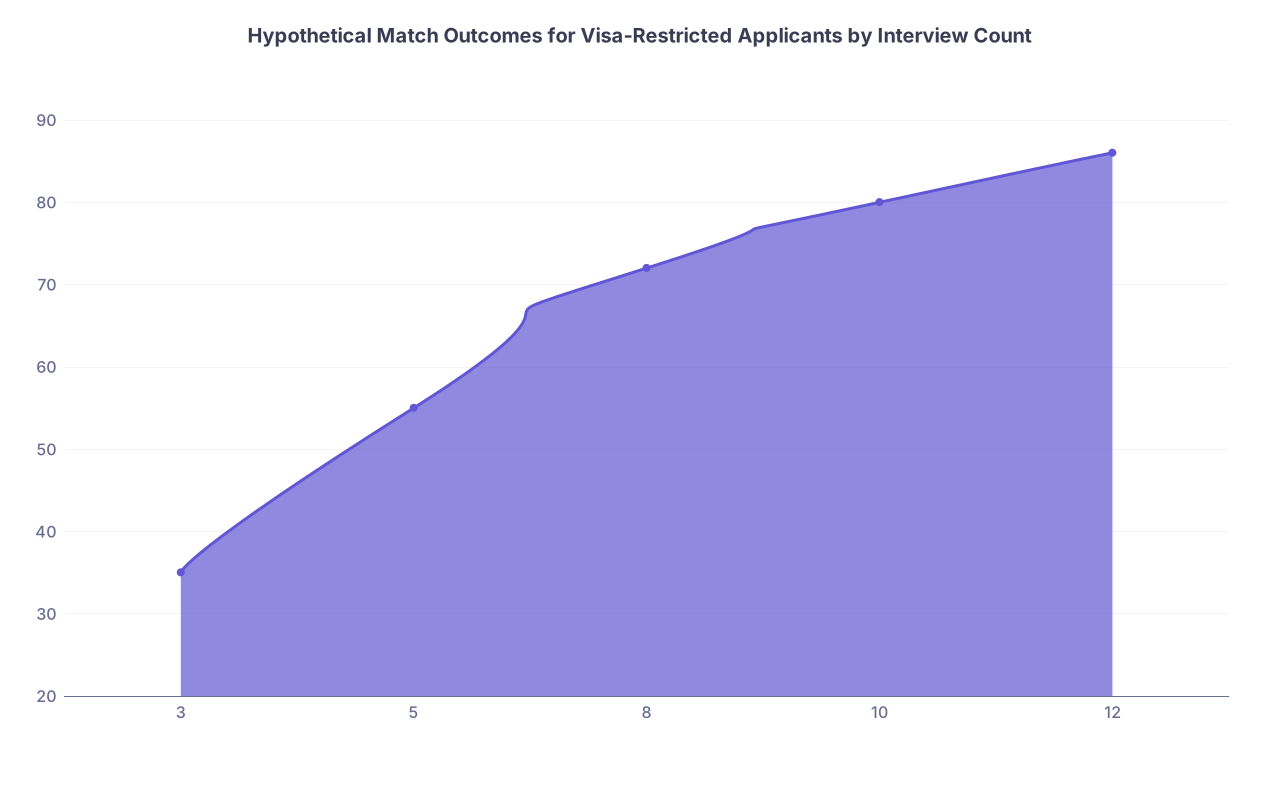
| Category | Value |
|---|---|
| 3 | 35 |
| 5 | 55 |
| 8 | 72 |
| 10 | 80 |
| 12 | 86 |
That rough, made-up curve is the pattern: more interviews, higher chance. With very few interviews, that single pre-match is often your major leverage point.
Step 7: Managing the Emotional Side Without Letting It Wreck You
You’re allowed to feel disappointed. Many IMGs with visas dream of academic places, big cities, big names. Then reality arrives: rural community program, heavy service load, basic resources.
A few things that help:
- Stop comparing to classmates who don’t have visa issues. Their game is easier. Comparing is like comparing someone playing on “easy mode” to your “expert mode.”
- Talk to residents or attendings who started at small community programs and ended up with strong careers. There are a lot of them.
- Give yourself a clear rule: once a decision is final (contract signed or offer declined), no more “what if I had…” mental torture. You move forward.

Quick Scenario Walkthroughs
Let’s run a couple of concrete setups so you can see how this plays out.
Scenario A: High Risk, Only One Offer
- Specialty: Internal Medicine
- Step 2 CK: 224, 1 fail on Step 1
- YOG: 2018
- USCE: 1 month observer, 1 month hands-on
- Interviews: 3 total, all community, only one offers pre-match, and they clearly sponsor visas.
You talk to residents. Program is busy, not cushy, but not toxic. Visa track record is stable.
My take: you accept that pre-match. This is the kind of profile that can absolutely go unmatched. You need a secured spot more than you need a “better brand name.”
Scenario B: Moderate/Low Risk, Pushy Weak Program
- Specialty: Family Medicine
- Step 2 CK: 245, no fails
- YOG: 2022
- USCE: 4 months hands-on
- Interviews: 11 total; 7 clearly sponsor visas
- Pre-match offer from a program where residents quietly say, “If you have another option, go there.”
Here, I’d seriously consider declining and going through the Match. You have multiple visa-friendly interviews and decent stats. I’d only accept if you’re extremely anxious and need 100% certainty and the program is at least safe.
Visual: Decision Flow for a Single Pre-Match Offer

| Step | Description |
|---|---|
| Step 1 | One pre-match offer |
| Step 2 | Assess risk profile |
| Step 3 | Pressure-test program |
| Step 4 | Pressure-test program |
| Step 5 | Accept offer |
| Step 6 | Consider declining and Match |
| Step 7 | Mostly high risk? |
| Step 8 | Program safe and visa solid? |
| Step 9 | Many visa interviews and good stats? |
FAQ (Exactly 5 Questions)
1. If I sign a pre-match, can I still participate in the regular Match?
Sometimes yes, sometimes no—it depends on whether the position is NRMP-participating. You must ask the program directly if the position is outside the Match and whether accepting it requires you to withdraw from the NRMP. Violating NRMP rules can get you barred from future Matches, so do not guess. Get their answer in writing.
2. How long is it reasonable to ask for before deciding on a pre-match offer?
About 7–10 days is a reasonable window. That gives you time to review the contract, talk to your family, and speak to current residents. Programs may push for 48 hours; you can politely request more time, but don’t drag it beyond two weeks unless they explicitly agree.
3. Should I tell other programs that I received a pre-match offer?
Generally, no. There’s no major advantage to broadcasting it, and it can backfire. The only people who must know are the program offering the pre-match and, if necessary, the NRMP if your status changes. Once you sign and are obligated to withdraw from the Match, then you should send short, professional withdrawal emails to programs that interviewed you.
4. What if the pre-match program has a bad reputation, but I’m scared of going unmatched because of my visa?
You weigh “bad reputation” against “no position + expiring chances due to YOG and visas.” If “bad” means less prestigious and overworked, many people still go and finish, then move on to better jobs or fellowships. If “bad” means unsafe, constantly losing residents, or mishandling visas, that’s a stronger reason to risk the Match and look for something else. Talk to multiple current residents before deciding.
5. If I go unmatched as a visa-restricted applicant, do I have any realistic backup options?
Yes, but they’re narrower. SOAP has very few visa-sponsoring positions, but you can still try. Outside that, people commonly do: research positions, additional US clinical experience, or non-ACGME fellowships while reapplying. Some return to their home country to train, then later re-enter via fellowship. None of these is easy. That’s why a solid pre-match offer, even at a less-than-ideal program, is often the safer path.
Key points:
- As a visa-restricted applicant with only one pre-match, you do not get to think like a citizen with 15 interviews. Your risk calculus is different.
- Pressure-test the program hard—visa history, resident experience, and contract terms—then either accept and commit fully or decline and accept the real risk of the Match.
- Once you make the decision, stop replaying alternate timelines. Put your energy into succeeding on the path you chose.