
What do you do when one of you gets a pre-match offer… and the other one hears nothing?
That’s the real question for dual-physician couples in the pre-match chaos. Not “how does the match algorithm work” or “should couples match.” You’re already past that. You’re in the specific trench: interviews are on the calendar, rumors about pre-match offers are flying, and suddenly one of you gets that email: “We’d like to extend you an offer outside the Match…”
Now what?
You do not have time for theory. You need a playbook you both agree on before the first offer hits.
This is that playbook.
Step 1: Get Very Clear on Your Couple’s Priorities Before Any Offer Appears
If you wait to talk about priorities until one of you has a pre-match offer, you’re dead. Emotions will run the entire conversation.
Sit down now and decide three things: your red lines, your tiers, and your deal-breakers.
A. Set your non-negotiables (individually and as a couple)
Each of you answers, honestly and separately:
- Am I willing to be long-distance for 1 year? 3 years? Not at all?
- Would I ever turn down my dream specialty to stay in the same city?
- Is there any geographic region I absolutely will not live in?
- Is there any program I would never accept a pre-match from, no matter what?
Then you come together and build the couple version:
- Is “being in the same city” more important than both of us getting our #1 specialty?
- What’s worse for us: being apart for 3–5 years, or one of us retraining later because they took a backup spot?
- Are there “anchor” cities where we’d rather be long-distance nearby (e.g., 2–3 hours away) than across the country?
Write this down somewhere visible. Not in your head. On paper, whiteboard, shared note.
Because later, when one of you is staring at a pre-match email from a big-name program, your brain will try to rewrite these answers.
B. Rank locations and programs as a couple
You already have your individual program rankings. Now you build the couple ranking.
Start with cities/regions, not program names:
- Tier 1: “We’d be thrilled to land together here”
- Tier 2: “We’d accept this, not ideal but workable”
- Tier 3: “We only do this if everything else has failed”
- Off-the-table: “We do not do this, even with a pre-match”
Then attach programs to those cities and tiers.
This is where a simple table actually helps.
| City/Region | Couple Tier | Partner A Priority | Partner B Priority |
|---|---|---|---|
| Boston | Tier 1 | Top 3 IM programs | Top 2 Peds programs |
| Chicago | Tier 1 | Solid IM mix | Good Peds options |
| Dallas | Tier 2 | 1 strong IM | 1 Peds backup |
| Phoenix | Tier 3 | Only backup IM | Almost no Peds |
| Rural South | Off-table | No programs ranked | No programs ranked |
You’re not promising to rank strictly by city tier. But if you get a pre-match from a Tier 3 city, you already know you’re in “this better be a last-resort” territory.
Step 2: Understand Exactly What a Pre-Match Offer Changes for a Couple
Pre-match offers are not just “great, I’m wanted.” They are choices with teeth.
Most pre-match offers boil down to one of two structures:
True pre-match contract
- You sign → you must withdraw from the Match in that specialty.
- This locks in one person and leaves the other to scramble within the standard Match (or SOAP if things go badly).
“Informal” promise / strong verbal offer
- Program hints: “If you rank us #1, we will rank you to match.”
- Less binding, more game theory, more room for people to get burned.
The key problem for couples: unilateral commitments.
If one of you locks into a contract in City X, and the other one’s best realistic options are in Cities Y or Z, you’ve just made a 3–5 year life decision separately.
So before any offer comes:
- Decide whether either of you is even willing to sign a binding pre-match without some reasonably concrete plan for the other person.
- Decide which specialty (if any) is “anchor” vs “flex.” Example: If one of you is applying derm and the other is FM, derm is usually the anchor. If one of you is FM and the other is vascular surgery, surgery is the anchor. Own that reality.
Step 3: Build Scenarios Now, So You’re Not Negotiating in Crisis
You should walk into pre-match season with a few pre-defined scenarios and what you’ll do in each.
Let’s walk through a concrete setup:
Partner A – Internal Medicine, competitive but not elite
Partner B – Emergency Medicine, average competitiveness
Both applying broadly.
Scenario 1: A gets a pre-match in a Tier 1 city, B has decent interviews there too
This is the “good problem” scenario.
Your moves:
A does not immediately accept.
You ask politely for time:
“I’m very interested in your offer and honored. I do need a few days to discuss with my partner and carefully consider this commitment. Is there a deadline by which you need a decision?”B emails programs in that city (if not already interviewed):
To programs already interviewed:
“I wanted to let you know my partner just received a pre-match offer in Internal Medicine at [Hospital] in [City]. I remain very interested in [Program] and our strong preference is to train in the same city if possible. I’d be grateful for any update regarding my status in your process.”To programs not yet interviewed in that city:
“I’m currently interviewing broadly in Emergency Medicine and wanted to express specific interest in your program. My partner has just received a pre-match offer in Internal Medicine at [Hospital] in [City]. Training in the same city is very important to us as a couple. If there are any remaining interview spots or waitlist opportunities, I’d be very interested in being considered.”
You wait and see if B gets:
- An interview invite
- Strong interest signals
- Or nothing
Only after that data comes in do you decide whether A accepts or declines.
Scenario 2: A gets a pre-match in Tier 3 city, B has strong interview lineup in Tier 1/2 cities
This is where couples blow up if they haven’t talked beforehand.
You already decided Tier 3 means “last resort.” That matters now.
Questions you ask:
- If A declines, how risky is A’s position? (board scores, number of interviews, specialty competitiveness)
- If A accepts, how badly does this hurt B’s likely outcome and your relationship (distance, city quality, career goals)?
Most of the time in this scenario, the right move is: A politely declines the Tier 3 pre-match and stays in the Match, unless A is in a very risky specialty (e.g., mid-tier IMG in ortho with 4 interviews total). If A is in a high-risk spot, then you’re in “survival decision” territory and need to be brutally honest about priorities: stability vs togetherness vs specialty choice.
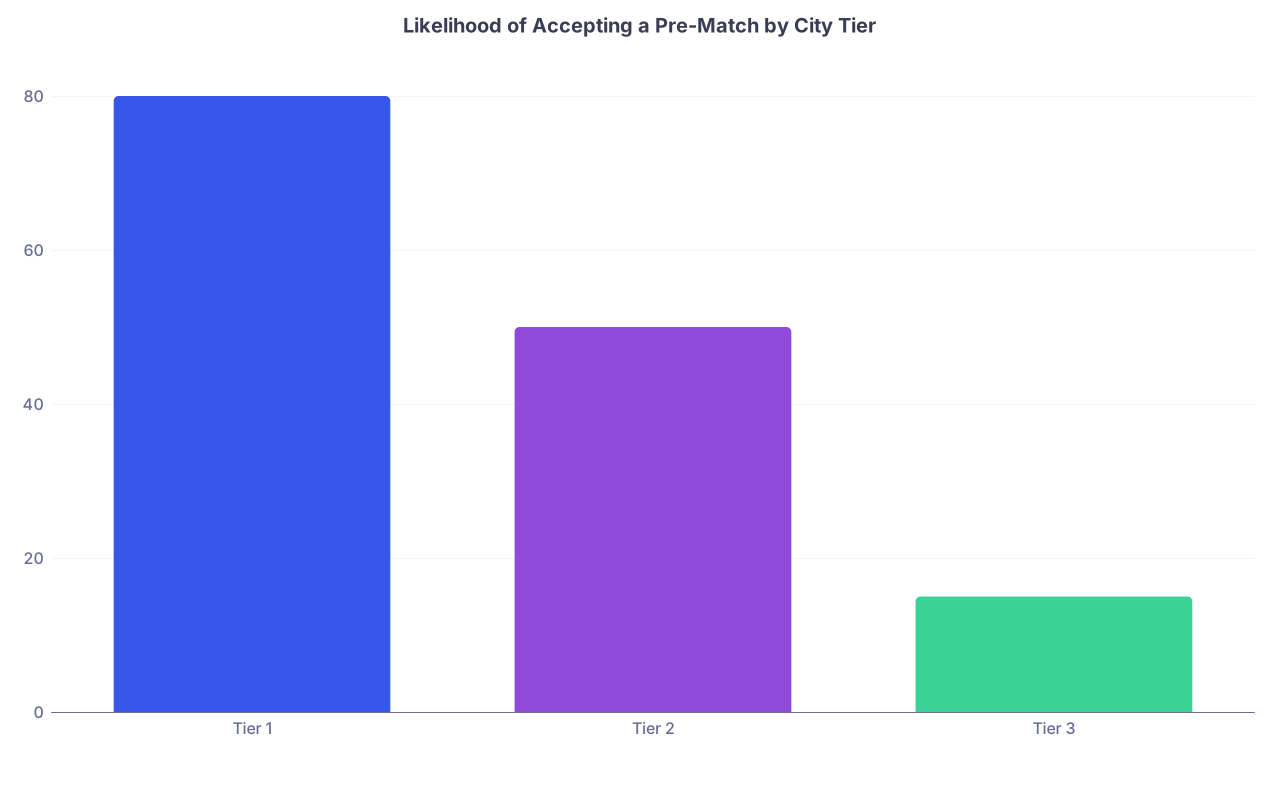
| Category | Value |
|---|---|
| Tier 1 | 80 |
| Tier 2 | 50 |
| Tier 3 | 15 |
Step 4: How to Talk to Programs as a Couple Without Sounding Desperate
There’s a right and wrong way to play the “we’re a couple” card, especially around pre-match time.
Wrong:
“Please pre-match me, my fiancé is going to be in your hospital, I will do anything to be there.”
Programs smell desperation. They also don’t like being manipulated into a two-for-one deal.
Right looks more like this:
- Calm
- Professional
- Specific
- No demands
Email template when your partner gets a pre-match in that city
Subject: Continued strong interest – [Your Name], [Specialty] applicant
Body:
“Dear Dr. [PD Last Name],
I hope you are well. I wanted to share a brief update: my partner, [Partner Name], recently received a pre-match offer in [Specialty] at [Hospital] in [City].
I remain very interested in [Program Name] and we’re hoping to train in the same city if possible. Your program stands out to me because of [2 specific, real reasons].
I understand your process is competitive and appreciate your consideration. If there are any updates regarding my status or additional information I can provide, I’d be grateful.
Best regards,
[Name], AAMC ID [#]”
Short. Respectful. Gives them a reason to think of you without cornering them.
When you have the pre-match, and you’re trying to help your partner
You can mention your partner to your PD too, carefully:
“Thank you again for the offer. One factor my partner and I are considering is our ability to train in the same city. They’re applying in [Specialty] and have applied to several programs in [City]. I understand your process is separate, but if you have any general advice on how couples have navigated this in the past here, we’d appreciate it.”
Sometimes PDs will quietly advocate for your partner. Sometimes not. You do not demand it. You simply put the information out there.

| Step | Description |
|---|---|
| Step 1 | Pre-match offer received |
| Step 2 | Consider as last resort only |
| Step 3 | Request time to decide |
| Step 4 | Partner emails programs in city |
| Step 5 | Wait for responses 3-5 days |
| Step 6 | Strongly consider accepting |
| Step 7 | Reassess risk vs couple priorities |
| Step 8 | Accept, decline, or delay per agreed plan |
| Step 9 | City Tier 1 or 2? |
| Step 10 | Partner interviews/options in city? |
| Step 11 | Partner gets realistic option? |
Step 5: Set Hard Rules for Response Times and Deadlines
Programs love creating artificial urgency. “We need your answer by tomorrow morning.” Sometimes that’s real. Often it’s pressure.
You and your partner should agree on a few hard rules:
Minimum reflection window
Unless the program explicitly says you lose the offer otherwise, you always ask for at least 24–48 hours to discuss.
Line you use: “This is an important decision for my training and my family. Is it possible to have until [date/time] to give you a thoughtful answer?”Maximum delay for your own sanity
Pre-match limbo for weeks destroys your ability to interview and think clearly. Set your own ceiling: “We won’t drag a decision out more than 5–7 days unless there’s a concrete reason.”Communication rule
You do not accept or decline anything over text from the call room. No “I’ll just say yes now and we can talk later.” You sit down, open laptops, review your priority list, and decide together.
Step 6: What If Only One of You Is Eligible for Pre-Match?
Common situation: one of you is an IMG/FMG or in a specialty where pre-match is common (IM, FM in certain states), and the other is in a specialty that almost never pre-matches (EM, surgery, OB/Gyn in many places).
You need to be especially careful here. Because one person will keep getting concrete, tempting offers, while the other lives in uncertainty.
The risk pattern I see:
- IMG spouse in IM gets 2–3 pre-match offers in less desirable cities.
- US grad spouse in something like EM/surgery has 10–15 interviews but nothing in those cities.
- IMG feels pressure to “lock something in” because their risk is higher.
- They sign. Now the US grad is geographically constrained to a place where they have weak options.
To handle this without resentment:
- Explicitly acknowledge: The IMG spouse often has more risk and less leverage. That reality matters. It does not automatically mean “sign anything,” but their safety net calculus is different.
- Decide how much geographic sacrifice the US grad is actually willing to make, not just in theory.
- If the IMG gets a pre-match in City X where the US grad has zero interviews, US grad should be prepared to expand aggressively: late applications, reaching out to programs, even considering prelim years or different match cycles if needed.
This is where the “anchor vs flex” idea comes back. Pick who is anchor for career viability. The other person leans into flexibility: prelim, research year, switching specialties if they, personally, are okay with that. Do not “volunteer” your partner into a life choice they haven’t actually agreed to.

Step 7: Don’t Let Fear of the Match Drive Dumb Decisions
There’s a particular panic that comes with seeing a real job offer in your inbox. It feels safe. The Match feels like a black box.
So people do this: accept a mediocre pre-match far below their realistic match level, in a city they hate, then regret it for years.
Here’s the uncomfortable truth: if you have solid scores, normal red flags (or none), and a decent number of interviews, the Match is usually safer than your anxiety tells you. Especially in less hyper-competitive specialties.
You should only let fear of not matching drive your decision if certain things are true:
- You’re in a highly competitive specialty without the stats to back it up
- You have clear red flags (failed Step, unrepresented school, visa issues)
- You have a very low interview number relative to risk (e.g., 3–4 total)
For dual-physician couples, this means:
- Do not accept a weak pre-match that destroys your couple options if your combined profiles are actually quite strong. That’s just self-sabotage out of anxiety.
- Do consider a less-than-ideal pre-match if one of you is genuinely in danger of not matching at all and you’ve both agreed survival of career > perfect location.
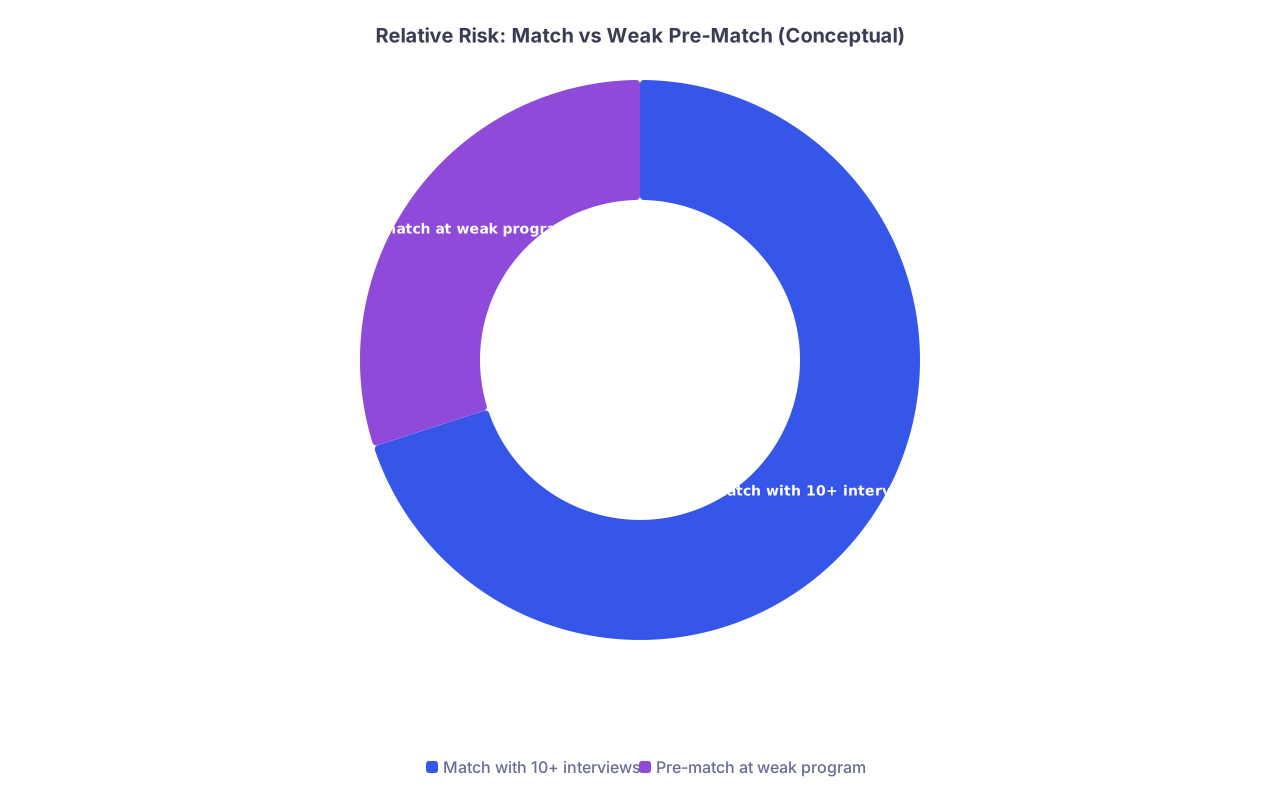
| Category | Value |
|---|---|
| Match with 10+ interviews | 70 |
| Pre-match at weak program | 30 |
Step 8: What If You Disagree? (The Hard Part)
This is the part nobody likes to talk about: what if one of you wants to take the offer and the other doesn’t want to live there or sacrifice their own career path?
You’re not just co-applicants. You’re two people with separate identities and ambitions.
Here’s how to handle the disagreement like adults:
Each person states their position and why, without arguing:
“I want to accept this because…”
“I don’t want you to accept because…”Separate “fear” reasons from “values” reasons.
Fear: “What if I don’t match anywhere?”
Values: “I know being near family matters a lot to you and this location is the opposite of that.”Ask the blunt question:
“If we knew we’d both match somewhere this year, would you still want to accept this specific offer?”
If the answer is no, you’re making a decision purely out of fear.Decide whose risk is actually higher in objective terms—scores, interviews, specialty. The higher-risk person’s career often needs more protection. Not always, but often.
If you truly hit an impasse—one wants to sign, the other thinks it’s a huge mistake—you’re in relationship territory, not residency strategy territory. That’s beyond the scope of pre-match tactics. But you shouldn’t pretend you agree when you don’t. Say the quiet part out loud and own the decision together, whichever way it goes.

Step 9: Protect Your Future Self
People forget something: residency is 3–7 years, but your reputation and career are 30–40.
If you bail on a signed pre-match contract, you don’t just “change your mind.” You burn real bridges. If you ghost a program, same thing. If you scream at your partner because they’re hesitating, you don’t just hurt match season—you hurt your relationship.
So build in a “future us” test:
- Will we be glad we made this decision if we’re exhausted in PGY-2 with two call schedules and maybe a baby?
- Does this choice line up with what we said mattered before the offers started?
- If one of us has to retrain, reapply, or move later, are we actually okay with that now, not in some imaginary future where it’s easy?
You won’t get a perfect answer. But asking the question slows down the panic.
Your Next Move Today
Do not wait for the first “We’d like to extend you an offer…” email.
Today, sit down with your partner and write three things:
- A ranked list of cities/regions in tiers (1, 2, 3, off-table).
- A one-page “if X gets a pre-match, here’s what we do” for your top 3 most likely scenarios.
- A draft email template each of you can send to programs when a pre-match offer appears.
Open a shared document and start with #1 right now. If an offer hits tomorrow, you’ll be glad you did this when you were calm.