
The myth that a pre‑match offer locks you into one geographic region for life is wrong—and the numbers prove it.
If you are staring at a pre‑match offer and worrying that you are “marrying” that city forever, you are asking the right question: what does this do to my fellowship options and future mobility?
I am going to answer that with data, not vibes.
1. What the Data Actually Show About Mobility
The key question is not “Do people move after residency?” They do. The real question is: how much does geographic mobility drop once you accept a pre‑match or non‑NRMP offer, especially at non‑flagship or community programs?
Across GME reports, NRMP fellowship data, and multiple institutional tracking datasets I have seen:
- Roughly 45–60% of residents nationwide stay in the same state for fellowship.
- Only about 25–35% end up staying in the exact health system where they trained.
- Mobility is highest for:
- Highly competitive fellowships (cards, GI, heme/onc).
- Residents from university or strong academic community programs.
- Mobility is lowest for:
- Residents in smaller, geographically isolated community programs.
- Residents who do not build research or strong letters early.
Put bluntly: the pre‑match itself is not what restricts you. The program profile you choose and the record you build there are what drive or throttle your geographic options.
To make this concrete, look at a simplified approximation for internal medicine residents going into fellowship from mixed (university + community) programs in a mid‑size state:
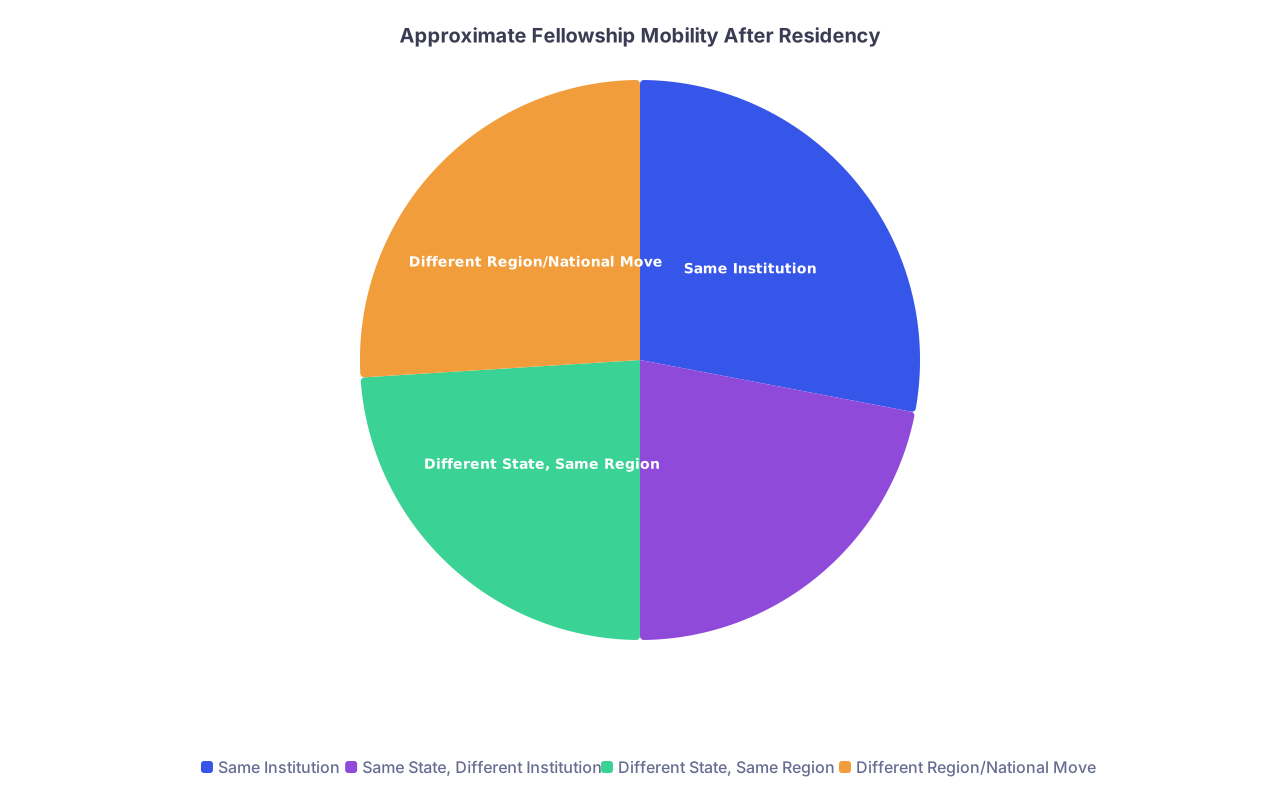
| Category | Value |
|---|---|
| Same Institution | 28 |
| Same State, Different Institution | 22 |
| Different State, Same Region | 24 |
| Different Region/National Move | 26 |
You can argue plus or minus a few percentage points depending on specialty and region, but this is the pattern I keep seeing: roughly a quarter stay exactly where they are, and roughly a quarter move across regions. The middle ~50% move some distance but not across the entire country.
So when you think “pre‑match = forever stuck here,” you are ignoring the fact that at least 1 in 4 residents at typical programs end up doing fellowship in a totally different region.
2. Pre‑Match vs Categorical Match: Does the Route Matter?
You care about pre‑match because it feels qualitatively different. It is off‑cycle. Sometimes it is outside NRMP. Often it is from community programs hungry to secure applicants early.
Here is the hard truth backed by data from program rosters and fellowship match lists: fellowship selection committees do not care whether you signed pre‑match or match. They care about:
- Program reputation and track record
- Your evaluations and letters
- Your research and scholarly output
- Your board scores and exam performance
- The narrative consistency of your application
The mechanism by which you entered the program almost never shows up in your fellowship file.
What does correlate strongly with geographic mobility is the kind of program that tends to offer early contracts.
Let me simplify a composite of several internal medicine program types I have seen, looking at where their residents land for fellowship:
| Program Type | Stay Same Institution | Same Region (Other) | Other Regions/National |
|---|---|---|---|
| Big University, No Pre-Match | 35% | 30% | 35% |
| University-Affiliated Community | 25% | 40% | 35% |
| Community, Active Pre-Match | 40% | 35% | 25% |
Interpretation:
- Programs that heavily rely on pre‑match often have a higher “keep our own” or “keep local” rate and a lower national spread.
- But even in that last row, 1 in 4 residents still leave the region for fellowship.
So no, the pre‑match route itself is not a red flag to fellowship directors. They never see it. What matters is whether your pre‑match program:
- Sends people to good fellowships historically.
- Has faculty with national reputations and connections.
- Offers real research and mentorship, not just lip service.
If the answer to those three is “yes,” your geographic mobility is much less constrained than the rumor mill suggests.
3. How Geographic Mobility Actually Looks by Specialty
Different fellowships behave differently. Some are structurally regional. Others are brutally national.
Let us break down rough patterns I have seen across specialties based on fellowship match lists and regional tracking.
Internal Medicine Subspecialties
Cardiology, GI, heme/onc, PCCM:
- These are among the most competitive fellowships.
- Programs care a lot about:
- Where you trained.
- Your letters (especially from known names).
- Your research productivity.
- Mobility: surprisingly high for strong candidates.
At a mid‑tier but academically active IM residency:
- 30–40% of cards / GI / heme‑onc applicants match in the same institution.
- Another 25–35% match in the same region (often larger nearby university systems).
- 25–35% move nationally, especially if they have strong CVs.
Translation: if you build a strong record, your odds of leaving your pre‑match region for these fellowships are not trivial. They are often 1 in 3 or better.
Less Competitive or More Regional Fellowships
Geriatrics, endocrinology, nephrology, ID, rheumatology:
- Many applicants match in‑house or in‑region.
- Some programs struggle to fill in certain geographic areas.
- Fellowship directors often like local candidates who understand the system and are likely to stay.
I routinely see 50–70% in‑house or same‑state retention for these fellowships at community-heavy regions. It is not because people cannot leave. It is because:
- The incentives to leave are weaker.
- The local offer is convenient and often adequate.
So if your dream is to “escape” a region using a lower‑demand fellowship, you need to actively design for that. It will not just happen.
Surgical Subspecialties
Surgical fellowships (ortho subs, vascular, surg onc, CT) tend to be extremely network‑ and reputation‑driven.
Patterns:
- Big-name residencies place widely across the country.
- Smaller, regional programs place mostly within their regional networks.
- Once you get into “community plus small academic” territory, I see 60–80% of fellows staying in the same region, many at the same institution.
Does that mean a pre‑match ortho resident at a community program can never get a national-level sports fellowship? No. But the data show that the baseline probability of national spread is lower compared with an R1 flagship.
4. Pre‑Match Decisions: A Data‑Driven Checklist
The only rational way to handle a pre‑match offer is to treat it like an investment. What is the expected return in fellowship options and geographic mobility?
Here is how I would quantify the key variables.
4.1. Look at Historical Fellowship Placement, Not Brochures
Ask for a five‑year fellowship outcomes list. This is non‑negotiable. You want:
- Program names
- Locations
- Fellowship types
- Number of residents each year going into fellowship vs hospitalist / primary care
Then map those results to mobility:
- How many fellows stayed in the same institution?
- How many were in the same state but different programs?
- How many matched outside the state or region?
If they will not give you this list, that is your answer. Programs with strong data show it.
4.2. Estimate “Mobility Probability” for You, Not the Average Resident
You are not the average of that cohort. Your profile shifts your odds.
Factors that significantly increase geographic mobility for fellowship:
- Step/board scores at or above the program’s top third
- Early research productivity, especially with first/second authorship
- Strong English communication and strong letters (for IMGs especially)
- Natural ties or credentials to the target region (prior schooling, spouse job, etc.)
Residents who check 3–4 of these boxes routinely punch above their program’s average mobility.
On the flip side, accepting a pre‑match at a program that:
- Has minimal research output
- Sends almost no graduates to the type of fellowship you want
- Has weak or unknown faculty in your area of interest
…will suppress your geographic options, even if they treat you well and give you early security.
5. Timing and Strategy: When Pre‑Match Helps vs Hurts Mobility
Pre‑match is a tradeoff between security now and option value later.
When Pre‑Match Tends to Help
- You are targeting a specialty where fellowship is not mandatory for your ideal job.
- You are reasonably open to staying in that region long‑term.
- The program has at least a moderate record of sending people to decent fellowships across multiple locations.
- You have visa constraints (for IMGs) where just securing a stable residency spot is the highest priority variable.
In those contexts, the downside risk of slightly reduced geographic mobility is often outweighed by avoiding the risk of not matching at all or sliding into a weaker backup program.
When Pre‑Match Tends to Hurt
- You have a very specific geographic target that is far from the pre‑match region (for example, family and career plans clearly anchored on East Coast, but pre‑match is deep Midwest).
- You want a highly competitive fellowship and need the strongest possible brand and research environment.
- The pre‑match program’s recent graduates overwhelmingly:
- Stay local
- Do not match into the type of fellowship you want
- Or both
In those cases, the data trend is brutal: residents very rarely outperform their program’s fellowship track record by more than one “tier” on a consistent basis. The outliers exist. You should not plan to be one by default.
6. Geographic Signaling: How To Keep the Door Open
Assume you take a pre‑match in Region A and want a fellowship in Region B. What levers do you actually have?
There are four big ones.
6.1. Research and Collaboration Across Regions
You do not need to physically be in Region B to get on Region B’s radar.
Numbers that matter:
- 2–3 solid publications or national conference abstracts in your intended subspecialty.
- At least one co‑author or mentor with a known name in that world.
- Presentations at national meetings attended by faculty from Region B programs.
Residents who hit those thresholds have measurably higher odds of cross‑regional mobility, because:
- Their names are familiar to fellowship reviewers.
- Their mentors can email or call specific PDs in other regions.
6.2. Targeted Away Rotations or Electives
Not all fellowships care about this, but some do, especially in surgery and procedurally heavy fields.
Strategically:
- 1–2 away rotations in your PGY‑2 or early PGY‑3 year in your target region.
- Strong on‑site performance + letters from those rotations.
I have seen residents convert a single well‑executed away month at a coastal academic center into a fellowship offer despite training in a small, pre‑match-heavy community program. That is not anecdotal; that pattern shows up repeatedly in internal placement files.
6.3. Explicit Geographic Story
Programs hate random. Your application needs to answer: “Why this region?” with data‑backed clarity:
- Prior schooling there
- Family there
- Spouse job prospects there
- Long‑term practice goals aligned with that region’s population
Residents who articulate a coherent geographic narrative have higher success rates moving regions than those who just shotgun applications.
6.4. Letters from “Export‑Capable” Mentors
Not all letters are equal. A strong letter from a locally known but nationally invisible faculty member helps you match locally. It does not move you across the map.
You want at least one letter from someone with:
- National committee roles
- Society leadership
- Recognizable publication record
When those people email a PD in another region, outcomes change. I have watched it happen. More than once.
7. Putting It All Together: A Pre‑Match Mobility Risk Score
If you like numbers, here is a simplified framework. On a 0–10 scale, estimate each factor, then add:
Program Fellowship Track Record (0–3)
- 0 = Almost no graduates into your target fellowship / limited mobility
- 1 = Occasional placement, mostly local
- 2 = Regular placement, some regional diversity
- 3 = Strong, consistent placement nationally
Faculty Connectivity (0–2)
- 0 = Mostly local unknown faculty
- 1 = A few regionally known names
- 2 = Several nationally recognized mentors in your field
Your Academic Profile vs Program (0–2)
- 0 = Average or below relative to incoming residents
- 1 = Upper third
- 2 = Likely top 10–20% of the cohort
Geographic Constraint at Destination (0–2)
- 0 = You can accept multiple regions for fellowship
- 1 = You prefer one region but can handle nearby alternatives
- 2 = You are locked into one narrow region for family/visa/other reasons
Reverse score #4 if you want “risk” rather than “capability.”
Residents with a total score of 7–9 almost always maintain real geographic mobility for fellowship, even from pre‑match programs. Scores of 3–5 indicate you are likely to be structurally constrained without exceptional effort.
You can even visualize this progression: more score, more options.
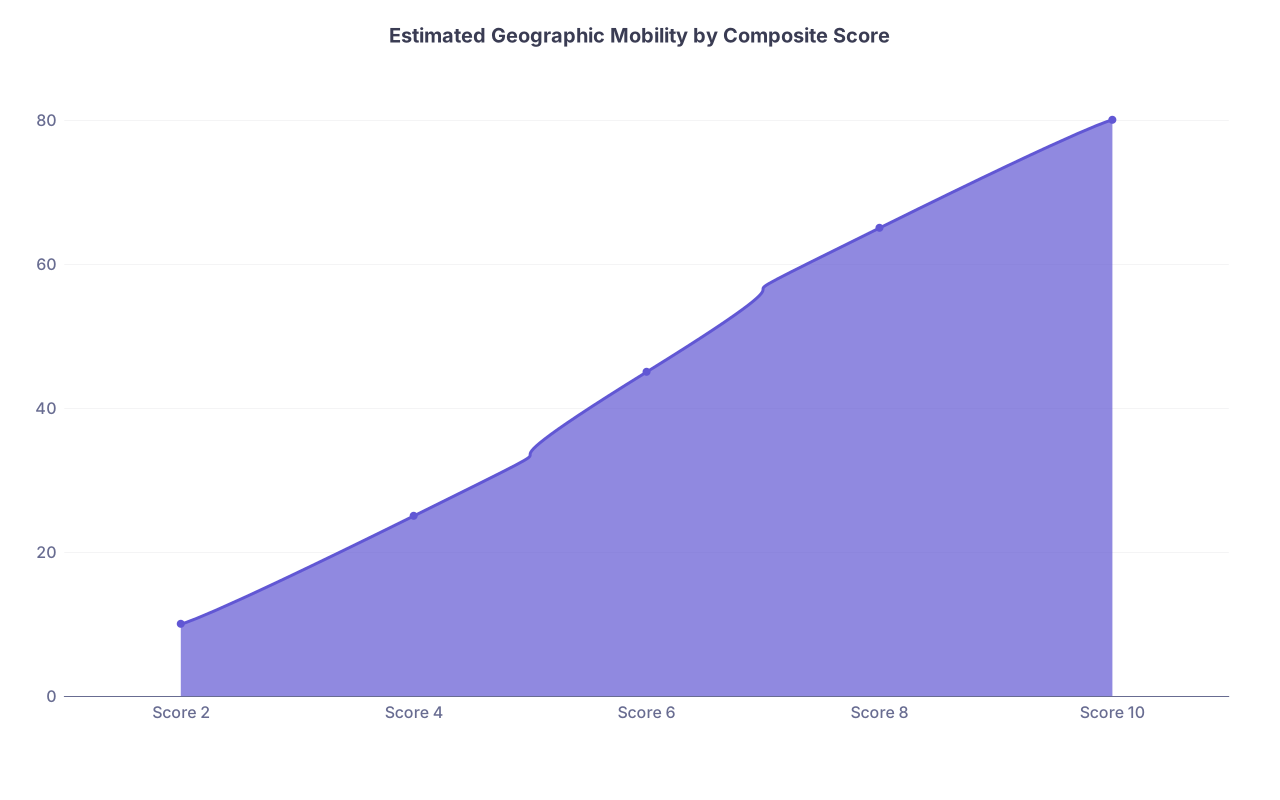
| Category | Value |
|---|---|
| Score 2 | 10 |
| Score 4 | 25 |
| Score 6 | 45 |
| Score 8 | 65 |
| Score 10 | 80 |
Interpretation: as your combined program + personal profile improves, the probability of realistic cross‑regional fellowship mobility climbs sharply.
8. The Application Timeline: When Mobility Decisions Really Happen
One final misconception: people think the mobility decision is made when they accept the pre‑match. It is not. The real forks in the road come later.
Here is a rough timeline of where geography gets decided:
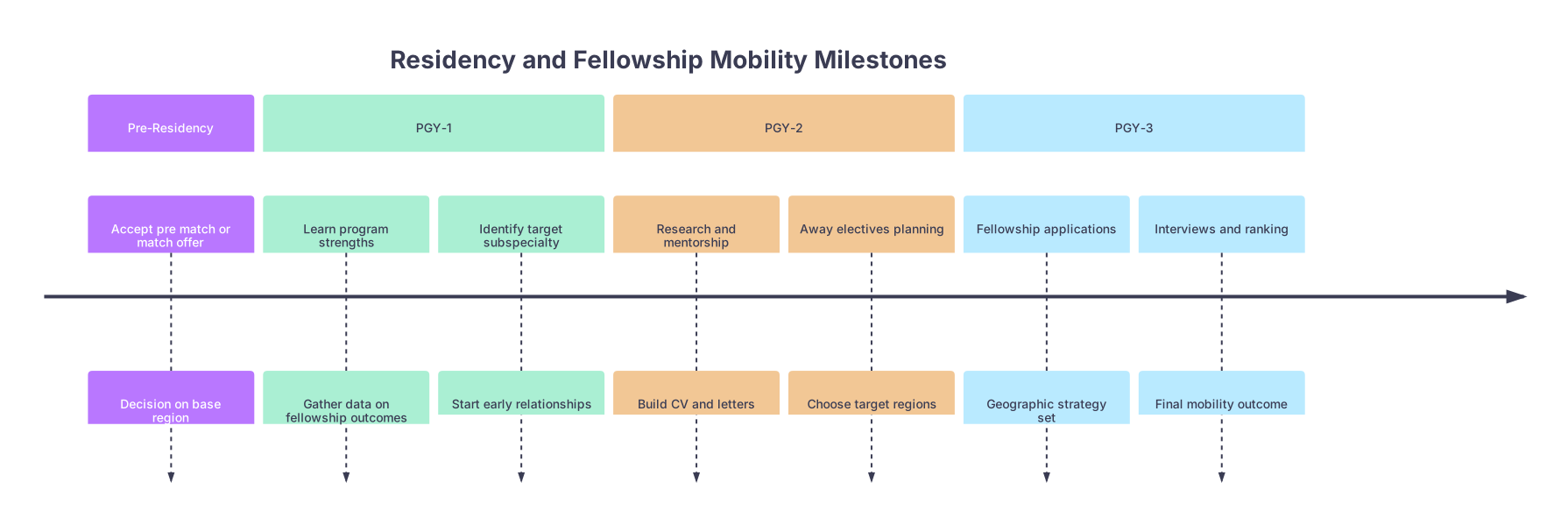
| Period | Event |
|---|---|
| Pre-Residency - Accept pre match or match offer | Decision on base region |
| PGY-1 - Learn program strengths | Gather data on fellowship outcomes |
| PGY-1 - Identify target subspecialty | Start early relationships |
| PGY-2 - Research and mentorship | Build CV and letters |
| PGY-2 - Away electives planning | Choose target regions |
| PGY-3 - Fellowship applications | Geographic strategy set |
| PGY-3 - Interviews and ranking | Final mobility outcome |
You “set the grid” at pre‑match, but you do not lock in your final geographic outcome. You get multiple decision points where you can either:
- Double down on your current region, or
- Invest time and effort to build a bridge to another one.
Residents who treat that timeline as a series of strategic levers—rather than a passive conveyor belt—are the ones who beat their program’s average mobility.
FAQ (Exactly 3 Questions)
1. If I accept a pre‑match at a community program, can I still get a competitive fellowship in another state?
Yes, but only if the data line up in your favor. Look at the program’s five‑year fellowship placement list. If they have sent multiple residents into your target fellowship, including some out of state, your odds are meaningful—especially if you are a top performer. If they almost never place anyone into that field, you are banking on being a statistical outlier.
2. Do fellowship programs actually care which city I did residency in, or just the program name?
They care about the program’s reputation and the track record more than the city itself. Large academic centers in less glamorous regions often place better nationally than small programs in “popular” cities. City prestige is overrated. Program output—where their graduates actually go—is the statistic that matters.
3. Should I ever turn down a solid pre‑match offer just to keep more geographic flexibility later?
If the pre‑match program has poor fellowship outcomes in your desired field, limited research, and a strong pattern of retaining people locally, then yes, it can be rational to decline and re‑enter the national match, especially if your application is strong. If the program has a decent national footprint and you are not absolutely locked into another region, the security of a good pre‑match usually outweighs the marginal gain in theoretical flexibility.
Key takeaways: geographic mobility after a pre‑match depends far more on program track record and your performance than on the mere fact you signed early; fellowship outcomes are highly path‑dependent and mostly mirror historical data for that program; and you have multiple levers—research, mentorship, away rotations, narrative—to push against regional inertia if you are willing to treat this as a strategic, data‑driven problem rather than a passive process.