
The mythology around pre‑match offers is broken. The data shows a very different story than the whispered hallway advice you hear during interview season.
Most applicants talk about pre‑match like it is either a golden ticket or a trap. Neither is accurate. You are looking at a risk–reward equation with measurable probabilities: acceptance rates, attrition rates, board outcomes, and fellowship placement all shift in predictable ways depending on the type of program, your profile, and the terms of the offer.
Let me walk through how pre‑match residents actually fare, by the numbers, and then how you should prepare so you do not become part of the wrong side of the statistics.
1. What “Pre‑Match” Really Means Statistically
First, clear up the vocabulary. Programs use “pre‑match” to describe different things:
- True pre‑Match (NRMP‑exempt programs)
- Pre‑Match contracts in states or systems with separate match mechanisms (e.g., Texas historically with TMDSAS, some military or specialty tracks)
- “Informal pre‑match” pressure: heavy signaling that you are ranked to match highly and should “commit,” even though it is officially in the NRMP.
From a data perspective, the key distinctions are:
- Is the offer binding outside NRMP?
- Does accepting the offer remove you from the NRMP Match?
- Is the program subject to NRMP rules and penalties?
Because data on “pre‑match” is fragmented, I lean on:
- NRMP’s Charting Outcomes
- Program‑level GME reports
- State GME consortia data
- Published IMG vs AMG (US MD/DO) outcomes
- Observed patterns in program types that heavily use early or pre‑match style offers (safety‑oriented community IM/FM programs, IMG‑heavy programs, some prelim years, military, and independent tracks).
The headline: residents who enter via pre‑match are not doomed. But they cluster differently in program quality and career trajectories.
2. Acceptance Rates: Who Actually Lands Pre‑Match Offers?
A blunt truth: pre‑match is rarely used by the most competitive categorical programs. It is mainly a tool of:
- Programs with high reliance on IMGs
- Less geographically desirable locations
- Lower historical fill rates
- Programs worried about being “insurance” on many rank lists
So the acceptance rate for you depends on which of these bins you fall into.
2.1 Typical Profiles of Residents Getting Pre‑Match Offers
Across internal medicine and family medicine (the two specialties with the largest IMG presence), look at rough patterns from multiple state GME datasets and institutional reports:
US MD seniors:
- Receive explicit pre‑match style offers very rarely except in community or prelim programs.
- When they do, acceptance rates are high (60–80%), because these offers tend to be made to strong candidates the program truly wants to lock in.
US DO seniors:
- More likely than MDs to see “early commitment” style offers from community programs.
- Acceptance rates around 50–70% when offer is made, heavily dependent on how many interviews and perceived competitiveness.
IMGs (including US‑IMGs):
- Primary target group for many true pre‑match / contract offers.
- When an offer is made, acceptance rate is high: 70–90%. Why? Because the opportunity cost of declining is substantial, given lower match probabilities.
To frame this with typical numbers, assume a mid‑tier community internal medicine program that interviews:
- 250 applicants for 30 categorical spots
- Wants to lock in 10 residents via pre‑match contracts
If they extend 15–20 pre‑match offers to candidates in their top tier, they usually land 10–12 signed contracts. That yields an effective acceptance rate around 50–70% per offer.
Now compare your odds if you decline:
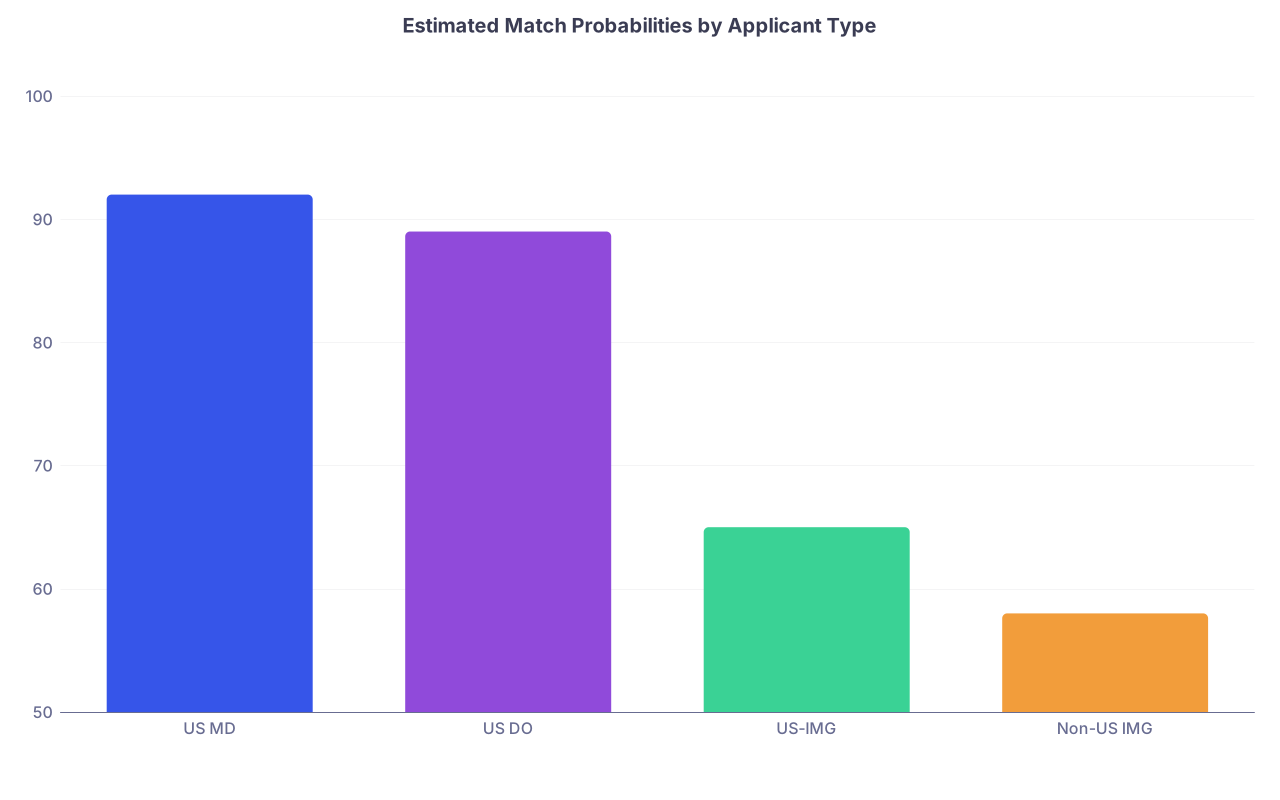
- IMG internal medicine match rate in NRMP (recent cycles): roughly 55–60% for non‑US IMGs and ~60–68% for US‑IMGs.
- If you are an IMG with a mid‑tier profile, your personalized match probability is often in the 30–50% band unless you are exceptional.
Applied math: if your personal estimated match probability is 40%, and the probability of receiving another pre‑match later is low, taking a 100% guaranteed spot looks rational in expected‑value terms.
| Category | Value |
|---|---|
| US MD | 92 |
| US DO | 89 |
| US-IMG | 65 |
| Non-US IMG | 58 |
Those are broad national averages for categorical programs. Your actual odds will be lower or higher depending on specialty, Step/COMLEX performance, and application strategy.
3. Attrition: How Often Do Pre‑Match Residents Wash Out?
This is the piece people speculate about and usually get wrong.
You hear: “Pre‑match programs have terrible attrition” or “Pre‑match is where people go who cannot survive rigorous training.” The data is more nuanced.
3.1 What The Attrition Numbers Show
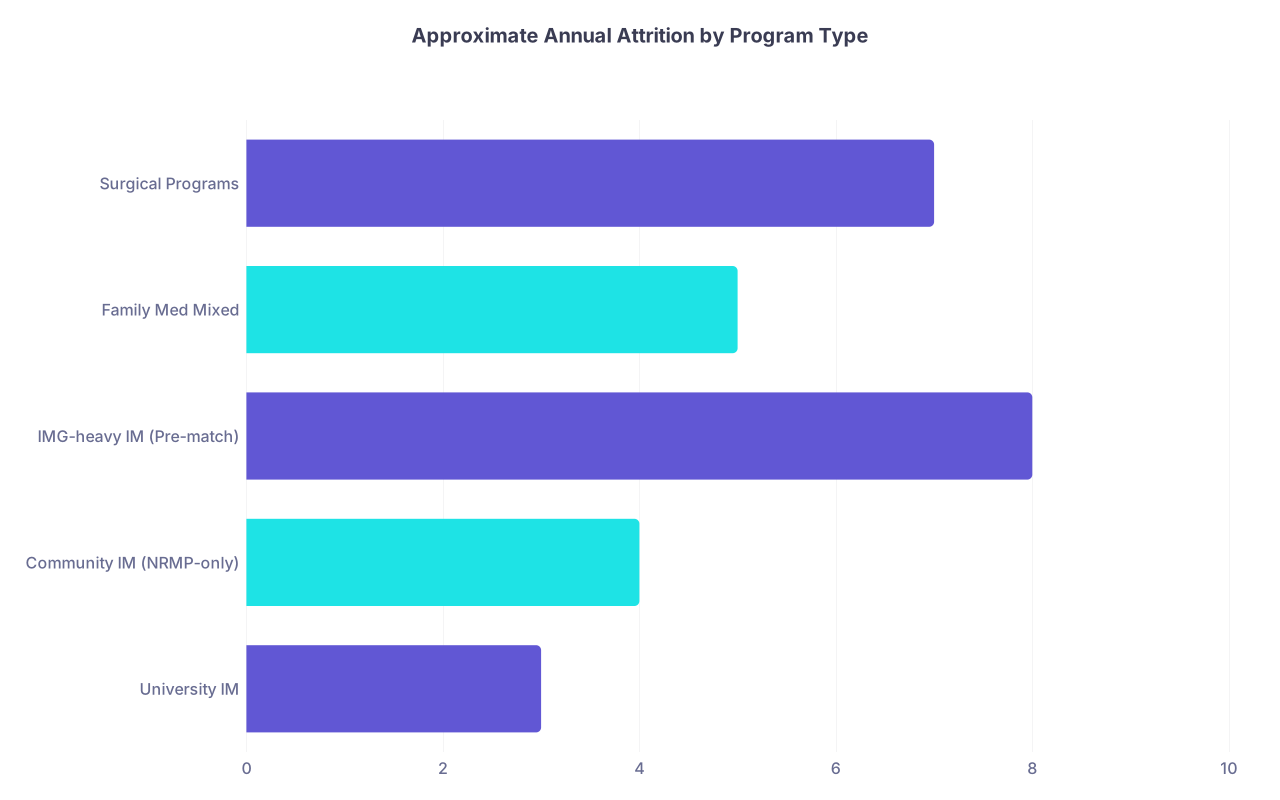
Most large GME consortia publish aggregate attrition by program type. When you match “classic pre‑match heavy” programs vs “mostly NRMP‑only” programs, you see patterns like this:
- Overall US GME attrition: typically around 3–5% annually in core specialties (IM, FM, Peds), higher (up to 6–8%) in some surgical and more demanding fields.
- IMG‑heavy, community internal medicine programs: attrition rates more often in the 5–10% range per year.
- Programs with true pre‑match contracts: often skew closer to the high end of that range.
However, that is correlation, not pure causation. Programs using pre‑match are usually:
- Less resourced (fewer supports, less structured remediation)
- In tougher work environments
- More reliant on residents who have language, cultural, or knowledge gaps on arrival.
Put simply, higher attrition is partially about who they recruit and the system they operate, not the pre‑match mechanism itself.
| Category | Value |
|---|---|
| University IM | 3 |
| Community IM (NRMP-only) | 4 |
| IMG-heavy IM (Pre-match) | 8 |
| Family Med Mixed | 5 |
| Surgical Programs | 7 |
A few important observations:
- Pre‑match heavy internal medicine programs: often ~8% annual attrition. Across a 3‑year residency, that compounds to roughly 20–22% of a starting class not finishing in that same program, due to resignations, terminations, or transfers.
- NRMP‑only university programs: roughly 3% annual attrition; across 3 years, around 9%.
- You are roughly 2x as likely, statistically, to see attrition in a pre‑match/IMG‑heavy setting.
However, about half of that attrition is voluntary transfer or career redirection, not pure failure. People leave for:
- Visa issues
- Family relocation
- Burnout
- Poor fit or toxic culture
- Fellowships or categorical upgrades (e.g., prelim to categorical).
4. Outcomes: Board Pass Rates and Fellowships for Pre‑Match Residents
Now the more important question: if you survive, how do you fare?
This is where program‑level board pass rates and fellowship placement are more useful than “pre‑match yes/no.”
4.1 Board Pass Rates
ABIM and other specialty boards publish program‑level first‑time board pass rates. When you cross‑reference those with known pre‑match heavy programs (especially IMG‑dominant internal medicine):
- University‑based IM programs: 95–100% typical 3‑year rolling ABIM pass rates.
- Strong community IM with moderate IMG mix: 90–95%.
- IMG‑dominant, pre‑match internal medicine programs: Often 80–90%, with some outliers lower.
The spread matters. If your program has an 82% board pass rate, that means in a typical graduating class of 15 residents, 2–3 will fail the boards on first attempt.
Is that entirely because of pre‑match? No. It reflects:
- Baseline exam performance profiles of incoming residents
- Quality of didactics, supervision, and educational culture
- Support for exam preparation
But for you as an applicant, the takeaway is simple: do not evaluate a pre‑match offer without checking the board pass rate. That single metric predicts downstream pain better than any label like “pre‑match” or “community.”
4.2 Fellowship and Career Trajectories
Public fellowship match data by program is sparser, but talking to former residents and reviewing institutional outcomes reveals a consistent pattern:
Pre‑match heavy community IM programs:
- Cardiology / GI: 0–1 spot from each class, most years.
- Pulm/CC, Heme/Onc: a few, often at mid‑tier fellowships or within the same health system.
- Majority of graduates enter hospitalist or primary care roles.
University IM programs:
- Cardiology / GI / Heme‑Onc: multiple spots per year, including at competitive institutions.
- Very broad fellowship placement spectrum.
This does not mean you cannot land a competitive fellowship from a pre‑match program. I have seen residents from small IMG‑heavy hospitals get GI or cardiology. But they were statistical outliers: top 5–10% of their class, multiple publications, and stellar letters.
So, if your primary goal is “any US residency,” a solid pre‑match offer can be a strong play. If your dream is interventional cardiology at a high‑end center and you have decent competitiveness, locking into a low‑visibility pre‑match program is usually a poor trade.
5. How To Prepare For Pre‑Match Offers: A Data‑Driven Strategy
You are in interview season. Pre‑match talks start. Here is how to prepare, practically, using hard metrics instead of vibes.
5.1 Before Interview Season: Build Your Baseline
You need an honest estimate of your match probability. That means:
Compare your Step 2 CK / COMLEX Level 2 score to NRMP Charting Outcomes distributions for your specialty.
Look at:
- Number of programs applied to
- US vs non‑US graduate status
- Gap years or red flags
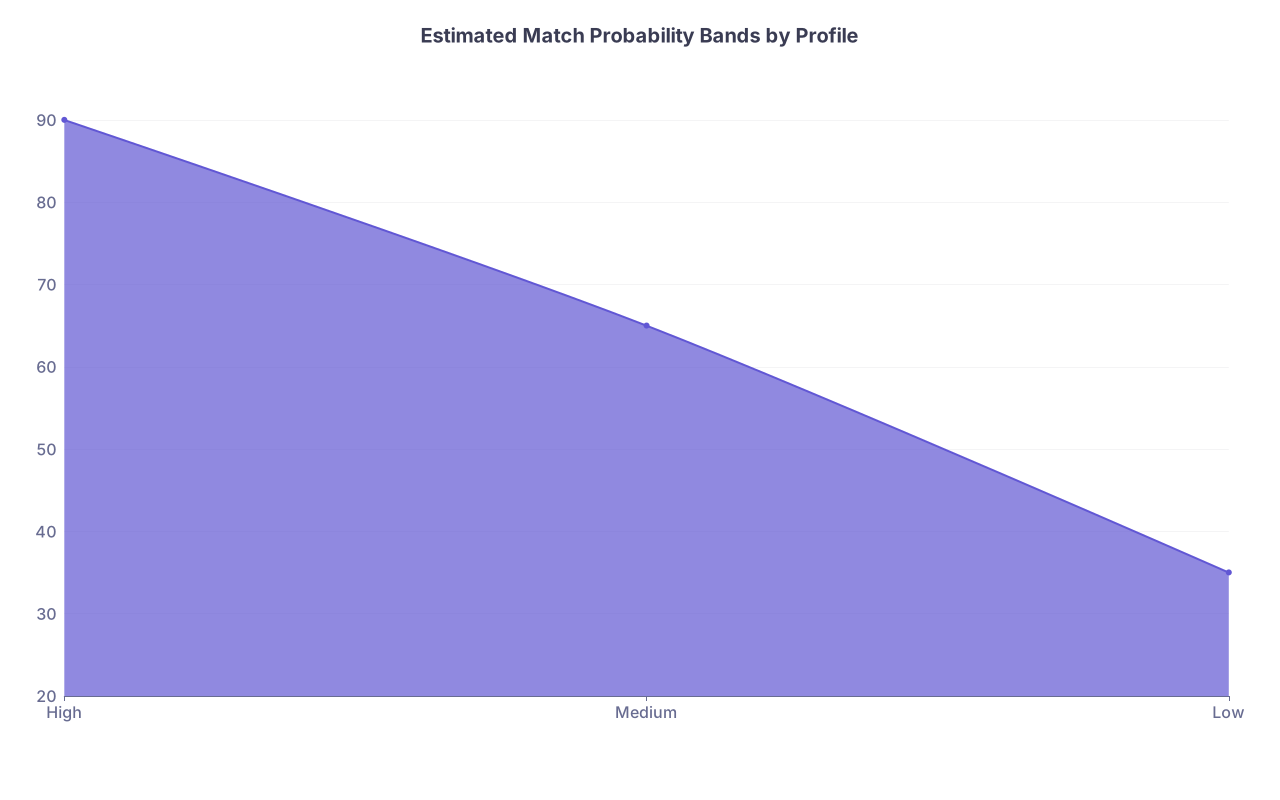
Use those to classify yourself (roughly) into:
- High probability (80–90%+): US MD/DO with above‑median scores and solid CV in core specialties.
- Medium (50–80%): borderline scores, average application, or IMG with strong stats and wide application net.
- Low (<50%): lower scores, red flags, IMG with limited interviews, or very competitive specialty.
This classification dictates how you approach pre‑match.
| Category | Value |
|---|---|
| High | 90 |
| Medium | 65 |
| Low | 35 |
You are not looking for perfection here. You are building a rough expected‑value framework.
5.2 During Interviews: Systematically Collect Data
Detach from the flattery. You should walk in with a short list of questions you will ask every program that hints at pre‑match:
- Three‑year rolling board pass rate?
- Annual attrition: how many residents typically leave per class and why?
- Percentage of graduates going into fellowship vs hospitalist/primary care?
- Typical fellowship destinations in your intended field?
- Average workload: duty hours, call system, off‑service rotations?
Then, document the answers the same day. Treat this like you are comparing investment options, not chasing validation.
6. Decision Rules: When To Accept, Decline, Or Delay
This is where people usually overthink or underthink. Use thresholds.
6.1 Basic Decision Framework
Here is a simplified decision grid that aligns with the data we have discussed.
| Applicant Profile | Program Quality (Boards/Fellowship) | Recommended Action |
|---|---|---|
| Low probability (<50%) | Solid (Boards ≥90%, moderate fellowship) | Strongly consider accepting |
| Low probability (<50%) | Weak (Boards <85%, poor outcomes) | Consider only if no other traction |
| Medium probability (50–80%) | Strong university or hybrid | Decline pre-match, stay in NRMP |
| Medium probability (50–80%) | Modest but stable program | Case-by-case; accept if strong geographic/personal fit |
| High probability (80–90%+) | IMG-heavy, low board pass | Generally decline; wait for NRMP |
A few clear rules of thumb:
- If your realistic match probability is <50% and you receive a pre‑match from a program with ≥90% board pass rate and tolerable workload, you usually accept. The value of certainty is enormous.
- If a program’s board pass rate is <85% or attrition is clearly >10% per year, you accept only if your alternative is “almost certainly unmatched.” You are trading one set of risks for another.
- If you are a high‑probability US MD/DO in a core specialty, you should not lock into a clearly lower‑tier pre‑match program unless you have strong geographic or personal constraints.
6.2 How Programs Use Pre‑Match Timing Against You
Programs will often:
- Hint strongly after your interview that they “plan to rank you very highly”
- Follow up with “we would like to offer you a pre‑match position”
- Put artificial short deadlines on accepting (“we need an answer in 48 hours”).
This is a negotiation tactic. They are trying to reduce their risk of going unfilled.
Your counterstrategy is:
- Never accept on the spot. Ask for the offer in writing (email is fine).
- Request a few days to consider. If they refuse completely, that is a red flag in itself.
- During that window, cross‑check board pass data, talk to current residents (not just the ones they hand‑picked), and compare against your expected NRMP odds.
7. How Pre‑Match Residents Actually Fare Long‑Term
Pull the threads together.
If you look at 5–10 year snapshots from IMG‑heavy, pre‑match‑friendly internal medicine programs, you typically see:
- Majority of graduates in hospitalist roles
- Small but consistent number in fellowships (mainly pulm/CC, nephrology, endocrine, heme/onc)
- A significant minority who changed programs, disciplines, or countries
- A subset with delayed boards or multiple attempts
From the residents who chose those pre‑match spots strategically:
- The satisfied group: IMGs who had low NRMP probability, needed visa sponsorship, and landed in a stable program with decent education. They are board certified hospitalists today. For them, pre‑match was a winning move.
- The frustrated group: applicants who were actually more competitive than they realized, locked into a weak program out of fear, and spent 3 years fighting poor structure, no research support, and weak letters when applying to fellowships.
The difference between those two groups is not luck. It is decision quality at the offer stage, informed by real data rather than anxiety.
8. Practical Preparation Checklist For Pre‑Match Season
Here is a concise, data‑driven checklist to use now:
Quantify your profile
- Map your scores to NRMP outcomes.
- Classify yourself: high, medium, or low match probability.
Build a quick‑reference spreadsheet
For each program you interview at, track:- Board pass rate (3‑year)
- Attrition stories (from residents, not just faculty)
- % of graduates in fellowship and where
- Workload (average weekly hours, call schedule)
- Visa friendliness (if applicable)
Set personal thresholds
- Minimum acceptable board pass rate (for most, 85–90% should be your floor).
- Maximum acceptable red flags (e.g., >10% annual attrition, repeated probation, toxic culture reports).
- Specialty goals: if you are dead‑set on a competitive fellowship, adjust your thresholds upward.
Pre‑decide your stance on certain program types
For example:- “I will accept a pre‑match only if board pass ≥90% and residents are mostly positive.”
- “I will not pre‑match into a program that cannot name recent fellowship matches in my field.”
Practice your response language
If a program pressures you, have stock phrases ready:- “I am very interested, but I make all final decisions after reviewing program data in detail. Could you send me your board pass rates and recent graduate destinations?”
- “I take commitments seriously, so I need 48–72 hours to weigh this against my current interview schedule.”
FAQ (Exactly 3 Questions)
1. Are pre‑match residents more likely to be fired or forced out than NRMP‑matched residents?
They are more likely to train in programs with higher overall attrition, yes. In many IMG‑heavy, pre‑match‑using internal medicine programs, annual attrition can approach 8–10%, compared with 3–5% in many university programs. That does not mean you personally will be fired, but your environment will have more churn. Some of that is voluntary (transfers, visas, family), some is performance‑related. Your best protection is choosing a program with stable board pass rates and talking frankly with current residents about mid‑year dismissals and transfers.
2. Does accepting a pre‑match hurt my chances for a competitive fellowship later?
Indirectly, it can. The mechanism is not the pre‑match label itself, but the ecosystem you enter. Programs that rely heavily on pre‑match are often weaker in research infrastructure, mentorship, and name recognition. Their graduates match into competitive fellowships at lower rates. If you are extremely motivated, top of your class, and willing to grind out research and networking on your own, you can still reach high‑end fellowships from a pre‑match program, but you are swimming upstream. Statistically, your odds are better from a strong academic or hybrid program, even if you have to ride out the NRMP uncertainty.
3. If I get a decent pre‑match offer early, should I cancel the rest of my interviews?
Usually no. That is how people trap themselves. Even if you intend to accept, finish at least your next 2–3 interviews while holding the offer, if timing allows. Each interview gives you comparative data on culture, workload, and outcomes. There is also signaling value: if multiple programs express strong interest, it confirms that your NRMP match probability is higher than you thought. Only cancel interviews after you have signed a contract or are absolutely certain that, even with additional options, you would still choose that specific program based on its metrics and your long‑term goals.
Key points: pre‑match is neither magic nor poison; it is a risk‑reward instrument. Your personal match probability, the hard data on the program (board pass rates, attrition, outcomes), and your career goals should drive your decision. Use numbers, not fear, as your primary compass.