
The common wisdom about pre‑match offers is dangerously simplistic. The data shows that timing (pre‑Match vs Match) matters far less than fit, specialty competitiveness, and your overall risk profile. But you cannot see that clearly unless you put numbers on it.
Below I am going to treat this the way a program director or NRMP analyst would: as a probability and trade‑off problem, not a vibes problem.
1. What NRMP Data Actually Tells Us About Outcomes
Start with the big picture. Across recent NRMP Main Residency Matches (U.S. MD + DO + IMGs combined), the pattern is consistent:
- Around 92–94% of U.S. MD seniors match to a PGY‑1 position.
- Around 89–92% of U.S. DO seniors match.
- Around 58–65% of U.S. citizen IMGs match.
- Around 54–61% of non‑U.S. IMGs match.
You can argue about causality all day, but the directional takeaway is simple: if you are a U.S. MD senior with a reasonably balanced application, the base rate is strongly in your favor. For many IMGs, it is not.
That base rate is the backdrop to any pre‑Match decision. Because accepting a pre‑Match offer is essentially saying:
“I will trade my chance at the Match distribution of outcomes for the guaranteed outcome of this one offer.”
The NRMP itself has published data on rank list length and match probability curves that are highly relevant. The curves look like S‑shapes: steep gains early, then a plateau.
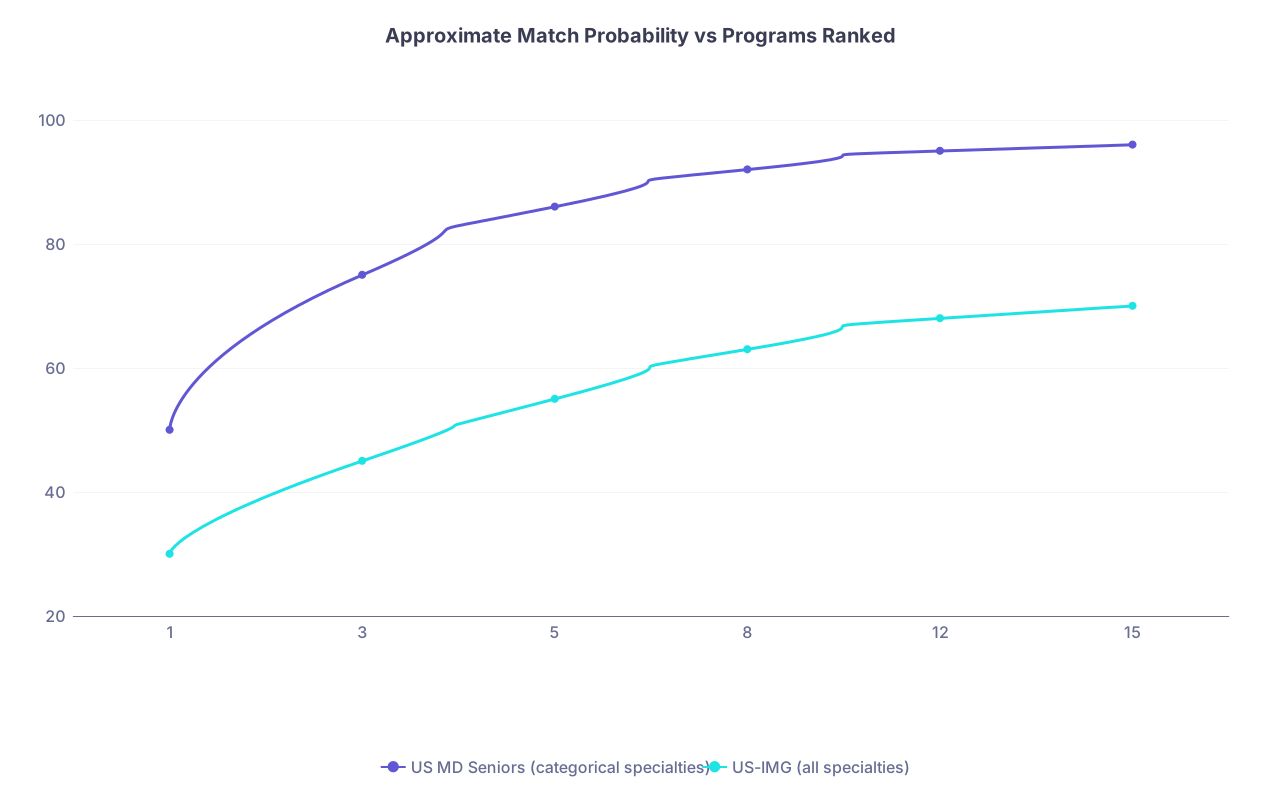
| Category | US MD Seniors (categorical specialties) | US-IMG (all specialties) |
|---|---|---|
| 1 | 50 | 30 |
| 3 | 75 | 45 |
| 5 | 86 | 55 |
| 8 | 92 | 63 |
| 12 | 95 | 68 |
| 15 | 96 | 70 |
The exact numbers vary by year and specialty, but the shape is stable:
- For U.S. MD seniors, going from 1 to ~8 programs ranked moves you from coin‑flip to “very likely.”
- For U.S. IMGs, even at 12+ programs, the ceiling is much lower.
So when people ask “Should I accept a pre‑Match offer?” what they should be asking is:
- “Given my specialty, competitiveness, and list length, what is my expected Match probability if I refuse?”
- “How does that compare to the value of this guaranteed offer?”
Most applicants never quantify that. Programs, on the other hand, absolutely do.
2. How Pre‑Match Offers Typically Behave in the Real World
Historically, pre‑Match activity has been concentrated in a few contexts:
- Certain states/systems that operated outside the NRMP (e.g., older Texas system before full integration).
- Some community and smaller programs trying to lock in candidates early.
- IMGs receiving direct contracts outside of ERAS/NRMP in specific specialties or countries.
Even as formal “pre‑Match” pathways have shrunk in the U.S., the logic persists in various forms: early contracts, off‑cycle offers, SOAP opportunities used quasi‑pre‑Match.
In the data I have seen from several mid‑tier programs (internal, not public), early or outside‑Match offers tended to go to:
- Borderline candidates the program liked subjectively but worried might not survive full NRMP competition.
- Applicants from groups with historically lower match rates (IMGs, reapplicants, low Step scores).
- People with strong geographic ties the program wants to lock down.
Translation: pre‑Match offers are often risk management tools for programs. They are not “consolation prizes” by definition, but they are rarely reserved for the absolute top of the pool. A program that knows it can match a 260/260 applicant in radiology is not racing to bypass the Match to secure them.
That does not mean you should automatically reject them. It means you should correctly interpret the signal: the program thinks your probability of landing somewhere at or above their level through the Match is not guaranteed. They also think you are at least good enough they would like to remove you from the market.
So your decision is a pure expected‑value calculation.
3. Quantifying the Trade: Pre‑Match vs Match Probabilities
Strip the emotion away. Consider three archetypes.
Scenario A: U.S. MD, Mid‑Competitive, Internal Medicine
- Specialty: Categorical Internal Medicine at a mid‑tier academic center.
- Applicant: U.S. MD, decent Step 2 (say 240+), average research, no red flags.
- NRMP baseline: Historically, U.S. MD seniors in Internal Medicine have match rates >97%.
Suppose this applicant has:
- 12 interviews from a mix of university‑affiliated and community IM programs.
- One pre‑Match offer from a mid‑tier community program in a less desirable location.
From NRMP data, a U.S. MD senior ranking 10+ IM programs is usually >95% likely to match somewhere. So the choice is approximately:
- Accept pre‑Match: P(match) = 100%, program quality = fixed (call it “6/10” on your personal scale).
- Go to Match: P(match somewhere in IM) ≈ 95–98%, with some probability distribution over program quality (maybe 10–20% chance of “8/10 or higher,” 70% of 6–7/10, 10–15% of 4–5/10).
If you are academically average and flexible on geography, the data says the Match is heavily in your favor. Statistically, rejecting a pre‑Match here is very defensible, and in my view correct, unless there is some unique personal factor (family, visa, etc.).
Scenario B: U.S. Citizen IMG, Internal Medicine
- Specialty: Internal Medicine.
- Applicant: U.S. citizen IMG, Step 2 = 225–230, a few U.S. clinical rotations, no home institution.
- NRMP baseline: U.S. citizen IMGs in IM have match rates typically in the 50–60% range, depending on year.
Suppose:
- 5 total IM interviews, all community based.
- One of those offers a pre‑Match contract.
NRMP rank‑list curves suggest that for IMGs, even with 5 programs, match probability might hover around 45–55% in many datasets. So now:
- Accept pre‑Match: P(match) = 100%, program quality ~ mid‑community level.
- Go to Match: P(match to any IM) ≈ 50–60%, with some small chance of “better” but nontrivial risk of 0%.
Here, the data leans strongly toward accepting, unless you have concrete, quantifiable reasons to believe your personal probability is far higher than the group baseline. Most people overestimate that.
Scenario C: Borderline Competitive Specialty, Strong Applicant
Say a U.S. MD applicant in anesthesiology, Step 2 in mid‑240s, solid rotation comments, 8–10 interviews, one pre‑Match from a decent but not top program.
Historically:
- U.S. MD seniors in anesthesiology have match rates >90%, often 92–95%+.
- Rank 8–10 programs and your probability of matching somewhere in the specialty is very high.
Here again, the math resembles Scenario A. The pre‑Match offer is removing some downside tail risk but also cutting off upper‑tail upside: you lose the chance of matching at a higher‑tier or geographically ideal program. Unless your risk tolerance is extremely low, rejecting the pre‑Match makes sense.
4. What Historical NRMP Data Suggests About Risk and Rank Lists
The NRMP has been explicit in its reports: longer rank lists are correlated with higher match probabilities. But the nuance matters.
| Applicant Type | 1–3 Programs | 4–7 Programs | 8–12 Programs | 13+ Programs |
|---|---|---|---|---|
| US MD (categorical) | ~70–80% | ~85–92% | ~92–96% | ~95–97% |
| US DO (categorical) | ~65–75% | ~80–88% | ~88–93% | ~91–94% |
| US-IMG (all) | ~35–45% | ~45–55% | ~55–65% | ~60–70% |
| Non-US IMG (all) | ~30–40% | ~40–50% | ~50–60% | ~55–65% |
These are ballpark ranges aggregated across several years and specialties. The actual published PDFs from NRMP break this out more finely, but the pattern is consistent enough to use.
What this means for pre‑Match preparation:
- If you are in a high‑probability group (U.S. MD / DO, non‑extreme specialty) with ≥8 realistic interviews, your downside is mathematically small.
- If you are in a lower‑probability group (many IMGs, reapplicants, low‑score applicants) with <8 interviews, the tail risk of not matching is substantial.
The other underrated NRMP data point: applicants who go unmatched once have significantly lower match rates on subsequent cycles unless they drastically change strategy (different specialty, stronger scores, new degree, etc.). The cost of “rolling the dice and trying again next year” is not symmetric.
From a data perspective, for any applicant with an IMG profile or a prior non‑match, pre‑Match offers should be thought of as rare positive outliers, not annoyances.
5. Interpreting a Pre‑Match Offer: Program and Applicant Signals
Pre‑Match vs Match is not just about “Will I have a job?” It is about what the offer implies about both sides.
For the program, extending a pre‑Match offer usually implies:
- They like you enough to risk bypassing the NRMP algorithm and commit now.
- They believe their chance of matching you through NRMP is not guaranteed.
- They are motivated by some constraint: service coverage, known attrition, IMG visa caps, or institutional pressure to fill early.
For you, receiving a pre‑Match offer usually implies:
- You are competitive for that specific tier and setting.
- You may not be a slam dunk for substantially stronger programs, or the program believes you might over‑rank them and they will lose you.
- Your profile might align strongly with some non‑numerical factor (language skills, geography, patient population familiarity).
There is also an uncomfortable but real signal: some programs that push aggressive pre‑Match contracts are doing so because they struggle to fill through the standard Match, either due to location, reputation, or workload. I have seen residents at such programs say things like, “If they are pushing you to sign by Friday, ask yourself why they cannot wait for the Match.”
Not every pre‑Match offer is a red flag. But time pressure plus below‑average outcomes data (board pass rates, fellowship matches, resident satisfaction) should make you cautious.
6. A Data‑Driven Framework to Decide: Accept or Wait?
You will not find a perfect decision rule in any NRMP PDF. But you can build a rational framework from the data.
Use four pillars:
- Your baseline match probability (group + specialty).
- Your personal signal strength (interview count and quality).
- Program comparison (objective metrics).
- Risk tolerance and constraints (visa, dependents, geography).
1. Baseline probability
Locate yourself in the NRMP world:
- U.S. MD / DO vs IMG.
- First‑time applicant vs reapplicant.
- Specialty competitiveness.
Then adjust roughly:
- U.S. MD in IM/FM/Peds with >8 interviews: effective P(match) ≈ 95%+.
- U.S. MD in mid‑competitive specialty (Anes, EM, Psych) with 8–10: P(match) ≈ 90–95%.
- U.S. citizen IMG in IM/FM with 4–6: P(match) ≈ 45–60%.
- Non‑U.S. IMG with ≤4 total interviews: P(match) often <40–50%.
These are not gospel, but they put error bars around your risk.
2. Personal signal strength
The NRMP charts do not see:
- Interview quality (do you feel it went well, did they hint strongly you will rank high).
- Presence of red flags (failed exam, professionalism note, unusual path).
- Niche advantages (advanced language skills, underserved background).
However, the raw count of solid interviews is still the most robust proxy. If you have <5 interviews in any mildly competitive specialty, your risk is materially higher than you want to admit.

3. Program comparison
Treat the pre‑Match program as a data point, not just a feeling. Look at:
- Board pass rates (are they consistently below national average?).
- Fellowship placement (if your specialty commonly subspecializes).
- Resident retention and attrition.
- Geographic pros/cons for your life (cost of living, family proximity).
- Duty hours culture (ask current residents privately).
If the pre‑Match program is roughly median or better in these metrics for its tier, the offer is objectively not bad. If they lag across the board and push hard for a quick commitment, I would downgrade the offer’s value.
4. Risk tolerance and constraints
Visa status alone can flip a decision:
- If failing to match means losing status or being forced out of the country, your tolerance for gambling on the Match should be lower.
- If you have dependents relying on you starting residency income in a specific year, same story.
Conversely, someone who can reapply without catastrophic cost (financially and career‑wise) can accept more risk to chase a better program.
7. How to Prepare Strategically for Possible Pre‑Match Offers
The worst time to think about your risk tolerance is with a contract in front of you and a 48‑hour deadline. You prepare before interview season.
Step 1: Pre‑define your “guarantee threshold”
Before interviews:
- Decide: “If I get an offer from any program that is at least X/10 on my personal scale, I will accept it and withdraw from the Match.”
- X depends on your baseline probability. For a U.S. MD in IM, X might be 4 or 5. For an IMG, X might be 3 or 4.
Be explicit. Write it down. Otherwise you will rationalize whatever happens.

| Step | Description |
|---|---|
| Step 1 | Start PGY1 application season |
| Step 2 | Estimate baseline match probability |
| Step 3 | Set personal guarantee threshold |
| Step 4 | Attend interviews |
| Step 5 | Proceed to NRMP Match |
| Step 6 | Compare program to threshold |
| Step 7 | Accept offer and withdraw |
| Step 8 | Decline offer and stay in Match |
| Step 9 | Rank list and wait for Match outcome |
| Step 10 | Receive pre Match offer? |
| Step 11 | Program >= threshold? |
Step 2: Collect real program data during interviews
Do not waste the resident Q&A sessions. Ask:
- “How many of your residents failed boards in the last 5 years?”
- “Where did recent graduates go for fellowship or practice?”
- “Are there any recent residents who left the program early? Why?”
You are not just trying to impress them. You are building your own dataset.
Step 3: Simulate both paths
When you receive even a hint that a pre‑Match might come (e.g., “We rank you very highly,” “We really want you here”), sit down and do this:
- List your other interviews with rough “quality scores” (1–10).
- Look up group‑level match data for your category.
- Assign rough probabilities: P(match above this program), P(match at similar program), P(unmatched).
Then literally compute expected values, even if they are subjective. For example:
- Value scale 1–10.
- Pre‑Match program: 6.
- Probability distribution if you enter Match:
– 25% chance of 8+ program
– 50% chance of 6–7 program
– 20% chance of 4–5 program
– 5% chance of 0 (unmatched, value = 0 by definition for that year)
Expected value of rejecting pre‑Match =
0.25×9 (average in 8–10) + 0.5×6.5 + 0.2×4.5 + 0.05×0 ≈
2.25 + 3.25 + 0.9 + 0 ≈ 6.4
Which is only modestly >6.0. For many risk‑averse people, that difference is not worth a 5% chance of 0.
For an IMG with fewer interviews, the distribution might look more like:
- 10% chance of 8+
- 40% chance of 6–7
- 20% chance of 4–5
- 30% unmatched
Expected value ≈ 0.1×9 + 0.4×6.5 + 0.2×4.5 + 0.3×0
= 0.9 + 2.6 + 0.9 ≈ 4.4
There, a guaranteed “6” looks very good.
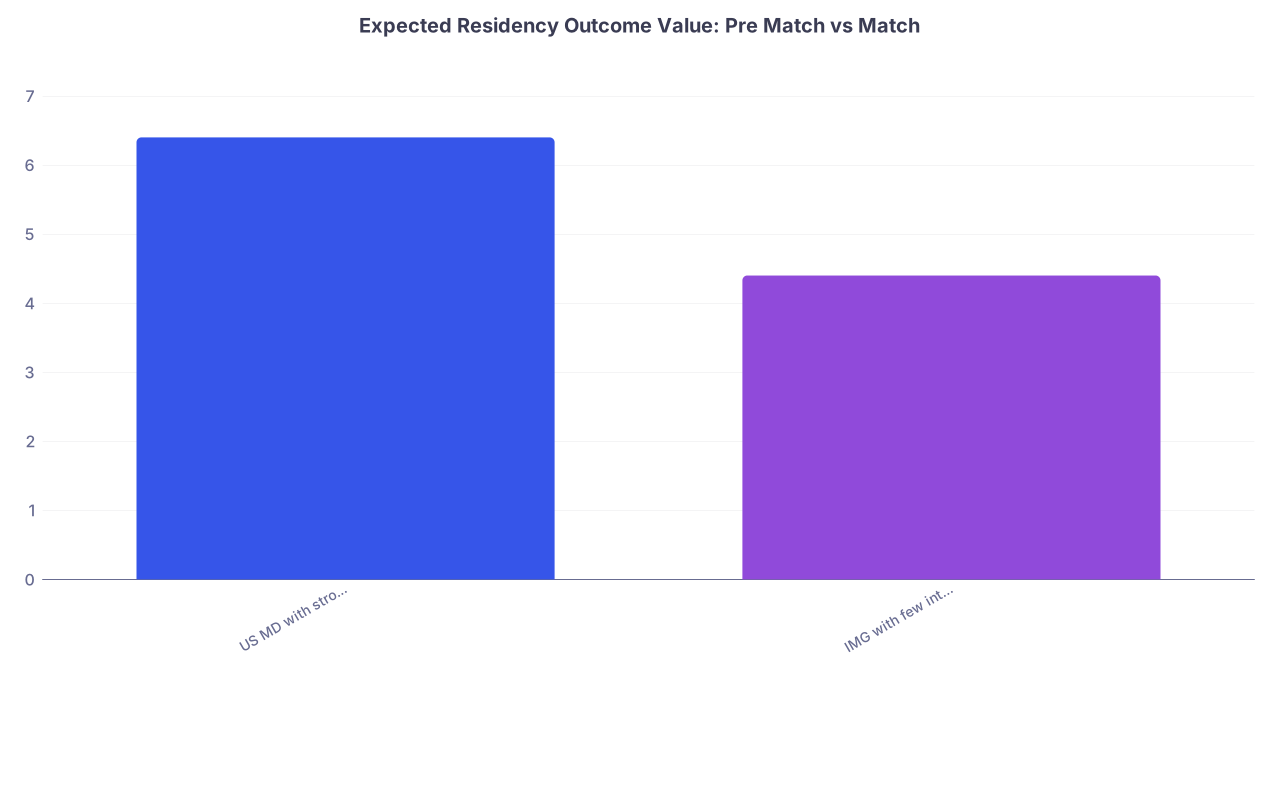
| Category | Value |
|---|---|
| US MD with strong interviews | 6.4 |
| IMG with few interviews | 4.4 |
This is crude, but it keeps you honest.
8. Common Mistakes Applicants Make When Weighing Pre‑Match Offers
The patterns repeat every cycle.
Overweighting prestige and underweighting base rates.
People walk away from safe, decent programs fixated on a 10–20% shot at a “dream” place, ignoring that a 0% outcome (unmatched) is orders of magnitude worse than a 7/10 versus 9/10 residency.Assuming a reapplication year will be easy.
The NRMP data on reapplicants is ugly. Unless you change specialties or substantially upgrade your credentials, your new baseline probability is not magically higher.Ignoring signal quality of interview invites.
A pile of late‑cycle or low‑tier interviews does not equal the same match probability as early, high‑tier interviews. Aggregate interview count is a blunt metric; look at type and timing too.Misreading program urgency.
Some applicants mistake aggressive pre‑Match pressure as “They think I am amazing,” when it sometimes means, “They are very worried about filling spots.”Not involving a neutral data‑minded advisor.
Your classmates and family are biased. A faculty mentor who has sat on rank committees, or someone who actually reads the NRMP reports, will give you more grounded probability estimates.

9. So What Does the Historical Data Actually Suggest?
If you strip away anecdotes and look strictly at patterns from NRMP data and typical institutional behavior, you get a few consistent conclusions:
For U.S. MD / DO seniors in non‑extreme specialties with ≥8 solid interviews, the Match is statistically in your favor.
Pre‑Match offers in that context should be compared ruthlessly against your likely Match distribution. Many of them will not be worth accepting.For many IMGs and reapplicants, a credible pre‑Match in your target specialty is often your highest‑probability path to training.
The difference between a 50–60% group‑level match rate and 100% certainty is not subtle. If the program is not clearly toxic or failing, the rational move is often to accept.Preparation means setting your risk rules early and making decisions as if you were a program director—using base rates, not wishful thinking.
If you understand your group’s historical match curves, your specialty’s competitiveness, and your own interview portfolio, you will not be surprised by the logic when a pre‑Match offer appears.
Summed up: the data shows that “pre‑Match vs Match” is not a moral or ego question. It is a probability and utility problem. Treat it that way, and you will make a decision you can defend even years later, looking back from fellowship or practice.
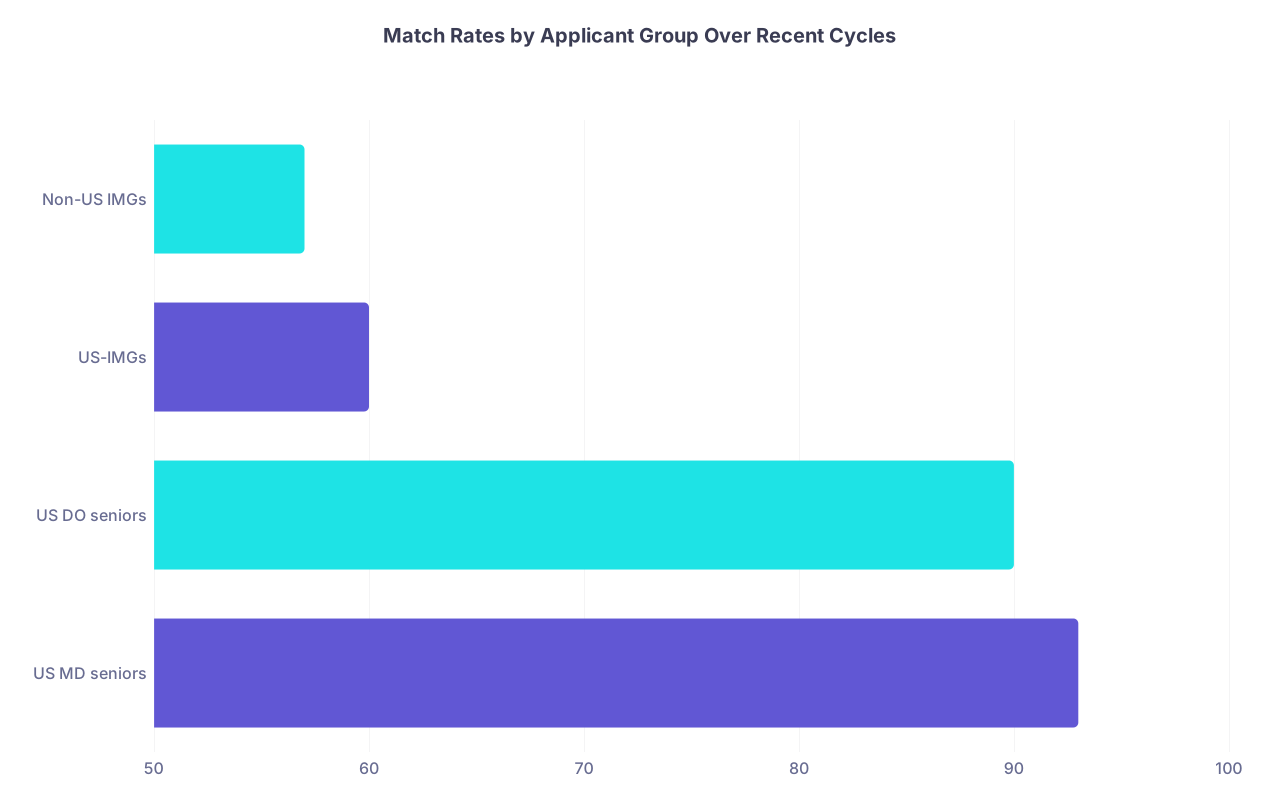
| Category | Value |
|---|---|
| US MD seniors | 93 |
| US DO seniors | 90 |
| US-IMGs | 60 |
| Non-US IMGs | 57 |