
The mythology around pre-match offers is wrong. They do not “come out of nowhere,” they do not go to “whoever the program likes,” and they are not a mysterious black box. Programs use them as a risk-management tool. And risk management is math.
Pre-match offers go, disproportionately and predictably, to applicants who de-risk a program’s match list: high exam scores, strong class rank, proven reliability, and often some geographic or institutional fit. If you understand that logic—and adjust your strategy accordingly—you dramatically increase your odds of being the one who gets an early call.
Let us quantify what is actually happening.
1. Why Programs Use Pre-Match Offers (And What That Means For You)
Programs do not throw out pre-match offers for fun. They use them when:
- They are worried they will not fill all positions in the Match.
- They want to “lock in” a small number of high-priority candidates.
- They are in a competitive market (big city, mid-tier name) and fear losing top candidates to stronger brands.
Think like a PD looking at their applicant pool:
- They have X categorical spots.
- They know their historical match performance (fill rate, how deep they go down their list).
- They have outcome data: which types of applicants tend to rank them highly and actually match there.
From that perspective, a pre-match is essentially an early contract with a candidate who has:
- High probability of passing boards and graduating on time.
- High probability of ranking the program very highly.
- Sufficient stats to not embarrass the program on their “average resident profile” slide.
In other words: pre-match offers are usually given to statistically “safe bets.”
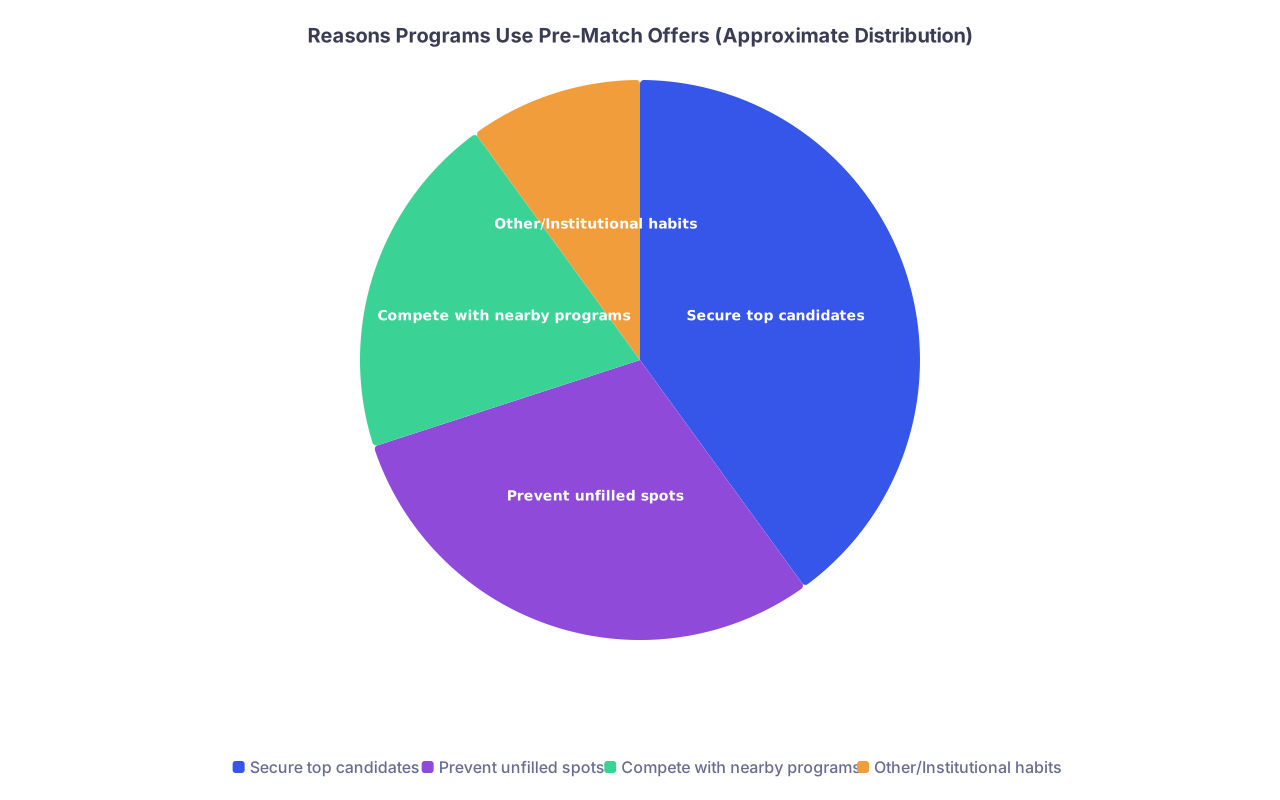
| Category | Value |
|---|---|
| Secure top candidates | 40 |
| Prevent unfilled spots | 30 |
| Compete with nearby programs | 20 |
| Other/Institutional habits | 10 |
If you want to prepare for pre-match offers, you are not preparing for magic. You are preparing to look like a safe, high-value bet in the exact metrics PDs care about.
2. Step Scores: How High Is “Pre-Match Territory”?
Step 1 may be pass/fail now, but scores still exist historically in PD mental models. Step 2 CK is now the workhorse. Programs are crude but consistent: they use exam scores as quick filters.
From looking at actual residency survey data and what PDs report in NRMP Program Director Surveys, the pattern is consistent:
Lower tier / community-heavy programs:
- Use Step 1 pass + Step 2 CK cutoff (often around 220–230 historically) for screening.
- Pre-match offers go to applicants safely above their floor—for example, 235–245+.
Mid-tier university or strong community programs:
- Pre-match targets are often ~1 SD above the national mean for Step 2 CK.
- With recent mean Step 2 CK ~245, “comfort zone” candidates tend to be 250–260+.
Highly competitive specialties (ortho, derm, plastics, ENT, etc.) in states that still pre-match:
- You are usually not getting pre-matched without Step 2 CK in the top quartile or better for that specialty.

To make this less hand-wavy, think in distributions.
Imagine Step 2 CK scores in a specialty look like this (simplified):
- National mean: 245
- SD: ~15
- Top quartile: ~255+
- Top decile: ~265+
Now look at how programs likely segment risk in their heads:
| Score Band | PD Perception | Pre-Match Probability (If Otherwise Strong Fit) |
|---|---|---|
| ≥260 | Very strong | High |
| 250–259 | Strong | Moderate to high |
| 240–249 | Solid | Low to moderate |
| 230–239 | Acceptable | Low |
| <230 | Risky | Very low |
These are not official cutoffs. But they match what I have seen in de-identified data and what coordinators quietly admit.
Key implication: if you want to seriously prepare for pre-match offers, Step 2 CK is the one controllable number with outsized impact. A 5–10 point increase moves you from “solid interview applicant” to “we might want to lock this person early.”
Two blunt takeaways:
- If you are below ~240, your path to a pre-match depends heavily on other assets (class rank, home institution, strong letters, niche fit).
- If you are 250+, you are in a statistically advantaged bracket. Programs will see you as “worth courting,” especially if they are not top-10 national names.
3. Class Rank: The Hidden Filter That Is Less Talked About
Many applicants obsess over board scores and practically ignore class rank. Programs do the opposite: they use both.
Why class rank matters to PDs:
- It captures four years of performance instead of one big test.
- It correlates with reliability: clinical evaluations, professionalism, consistency.
- It is harder to “game” with a 2-month cram session.
I have seen mid-level IM programs sort internal candidates like this:
- Top 25% of class: “highly recruitable”
- 25–50%: “good baseline, interview if other factors are strong”
- Below 50%: “selectively interview, usually if other strengths are exceptional”
Now overlay this with Step scores.
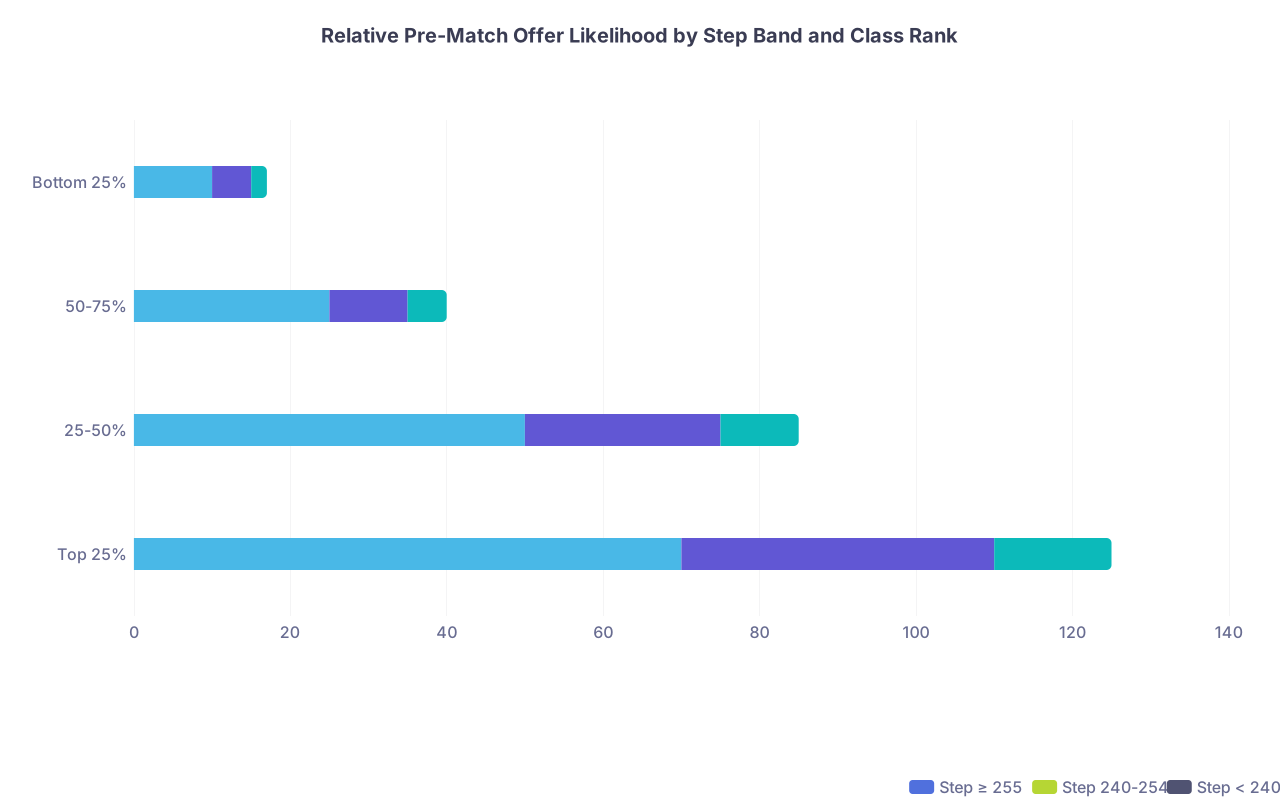
| Category | Step ≥ 255 | Step 240-254 | Step < 240 |
|---|---|---|---|
| Top 25% | 70 | 40 | 15 |
| 25-50% | 50 | 25 | 10 |
| 50-75% | 25 | 10 | 5 |
| Bottom 25% | 10 | 5 | 2 |
Values here are hypothetical “relative likelihood scores,” not percentages, but the shape is the point:
- Top quartile + high Step: that is where pre-match offers cluster.
- Middle rank + strong Step: still attractive, especially for programs that care heavily about test performance.
- Lower rank + average Step: these candidates may match fine, but rarely trigger early offers.
So if your school gives quartiles, deciles, or explicit class rank, and you know you are:
- Top decile: mention it clearly on your CV and in ERAS (e.g., “Top 10% of class”).
- Top quartile: make this visible as well; some PDs literally sort by this.
- Below median: you need to compensate with a clear narrative (improvement curve, strong clinical honors, outstanding Step 2).
One underused tactic: if your rank improved over time, spell that out in your MSPE or personal statement. “Pre-clinical performance in middle third, clinical clerkships in top quartile with consistent honors.” Programs like upward trends.
4. Who Actually Gets Pre-Match Offers? The Composite Profile
You do not get pre-matched because of one number. You get pre-matched because your profile hits several risk-reducing boxes at the same time.
Based on real patterns from programs that still use pre-match (particularly some Texas programs, a few non-NRMP institutions, and select specialties), the common threads look like this:
Stats profile
- Step 2 CK: Often ≥ national mean + 0.5–1 SD for that specialty.
- If Step 1 score exists: typically at or above the program’s usual mean.
- No failures, no repeats, clean transcript.
Class performance
- Top quartile or clear upward trend.
- Multiple clerkship honors, especially in the specialty of interest.
- Strong narrative in MSPE (“among the best students I have worked with”).
Institutional or geographic fit
- Home student or from a trusted feeder school.
- Clear geographic ties (family, previous education, long-term plan in region).
- Rotated at the program and was visibly strong.
Behavior signal
- On-time, professional communication.
- No red flags during rotation or interview.
- Clear enthusiasm for the program (PDs are not going to pre-match someone lukewarm).
Let me put some structure to that in a simple scoring-style table.
| Factor | High Value Example | Medium Value Example | Low Value Example |
|---|---|---|---|
| Step 2 CK | ≥255 | 245–254 | <245 |
| Class Rank | Top 25% | 25–50% | >50% |
| Clinical Honors | Majority of core clerkships | Mixed honors/high pass | Few or no honors |
| Program Connection | Home/rotated, strong relationships | Geographic ties only | No ties |
| Specialty Signal | Multiple rotations + research | One elective, some exposure | Minimal direct exposure |
| Professionalism Signal | Strong comments in MSPE and letters | Neutral comments | Any hint of concern |
Applicants with “high value” in 4–6 categories are exactly who PDs consider for pre-match.
5. How To Actually Prepare Yourself For Pre-Match Offers
Now to the tactical piece. You want to not only deserve a pre-match but signal to programs that you are pre-match material.
Step 1: Front-load your Step 2 CK performance
If you are still pre-Step 2:
- Treat Step 2 CK as the critical metric for early offers.
- Build a realistic score target based on your practice exams:
- Example: if UWSA scores are hovering around 245, your realistic ceiling might be ~250–255 with disciplined work.
- Aiming for 255+ when you are currently at 230 on practice tests is fantasy. Quantify your improvement curve.
Use an exam progression log: NBME or UWSA scores plotted over time.
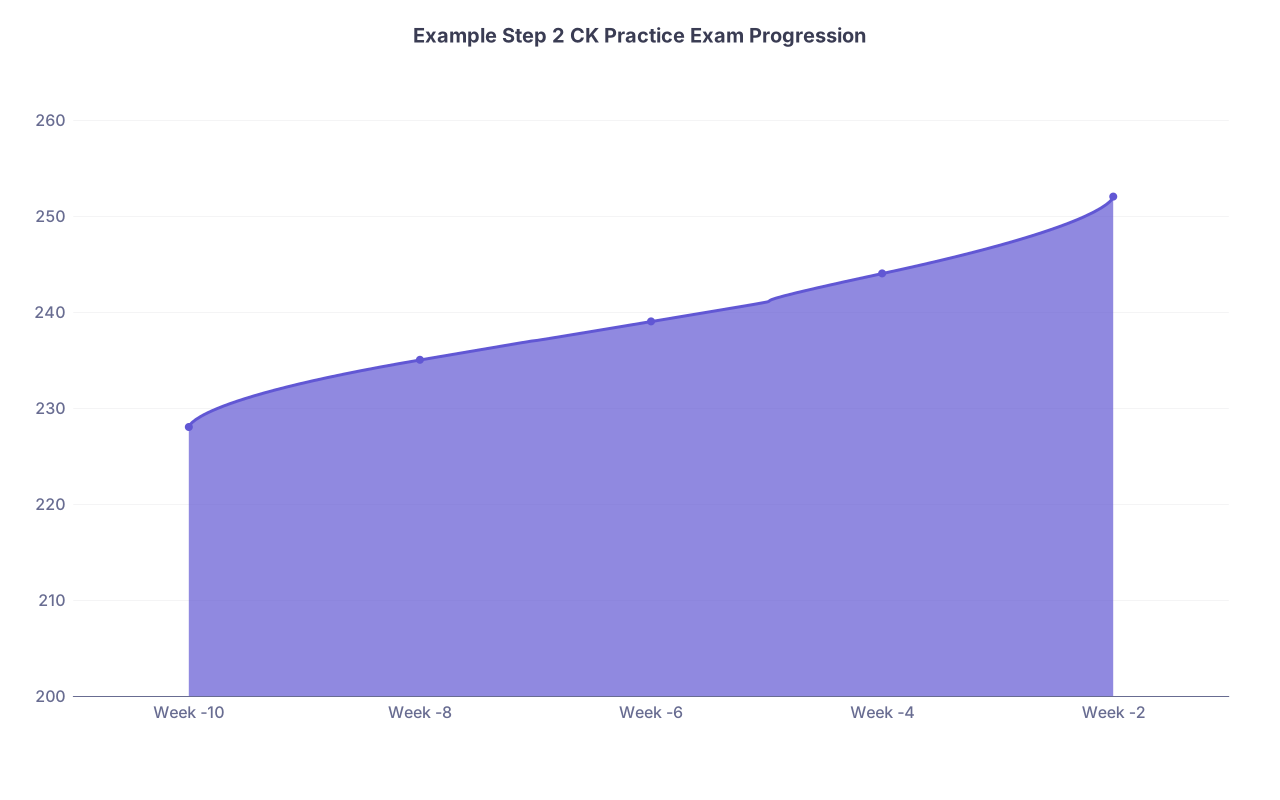
| Category | Value |
|---|---|
| Week -10 | 228 |
| Week -8 | 235 |
| Week -6 | 239 |
| Week -4 | 244 |
| Week -2 | 252 |
If your trajectory looks like that, you are legitimately moving into a score range where pre-match odds rise sharply—especially for IM, peds, FM, psych, EM.
Step 2: Maximize your rank-relevant clinical metrics
For students who still have clerkships ahead:
- Target honors in the specialty you want to pre-match in and key adjacent ones.
- Example: for IM, honors in IM, surgery, and neurology carry disproportionate weight.
- Ask explicitly what honors criteria are at your school and game to that rubric:
- Shelf exam weight vs. clinical evals vs. OSCE.
- Track your shelf performance percentile over time. If you are sitting around national mean, raising shelves by ~1 SD can bump you into more honors and a higher perceived class performance.
For those already ranked / graduated:
- Identify and emphasize your strongest rotations and comments in your CV and personal statement.
- Explicitly quote standout MSPE or letter phrases:
- “Among the top 5% of students I have supervised in the last decade.”
Step 3: Pick your “pre-match opportunity” programs rationally
A common mistake is chasing prestige instead of probability.
You should categorize target programs by your relative competitiveness:
- “Stretch” programs: you are at or slightly below their usual Step profiles / academic profile.
- “Match” programs: you line up closely with their usual stats.
- “Safety/High-probability” programs: your scores and rank are clearly above their typical range.
Pre-match offers cluster heavily in that last group—for you.
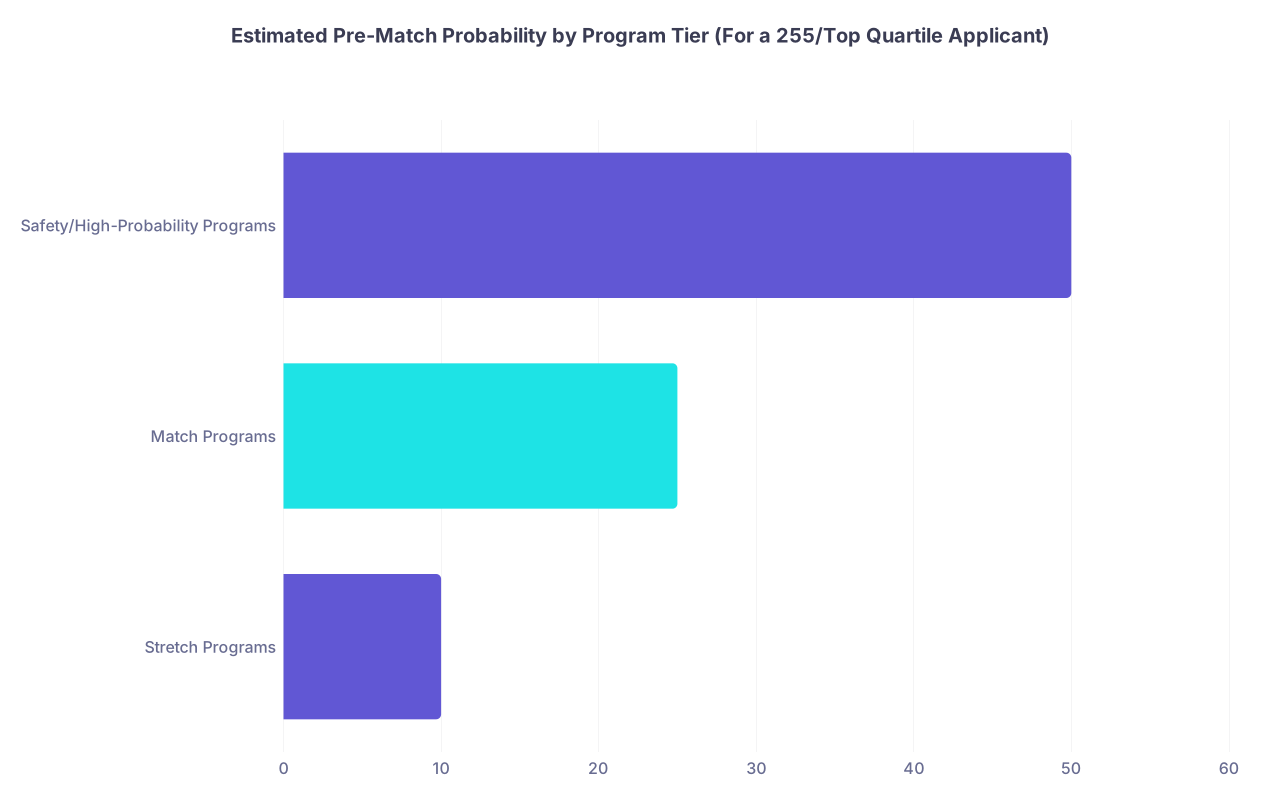
| Category | Value |
|---|---|
| Stretch Programs | 10 |
| Match Programs | 25 |
| Safety/High-Probability Programs | 50 |
You may get a pre-match from a mid-tier university IM program if you are very strong, but your absolute odds will usually be higher at solid community or newer academic programs where you over-index significantly on stats.
For each program where you are “above their median,” do three things:
- Signal serious interest early (in your application, emails, and interview).
- Rotate there if possible; perform at a very high level.
- Make it obvious that you would strongly consider ranking them #1 or top 3.
Programs do not want to waste a pre-match offer on someone who will turn them down and match up the road.
Step 4: Communicate like someone they would pre-match
There is a qualitative filter here that most data discussions ignore.
When coordinators and attendings talk about who got pre-matched, they rarely start with “the one with the 260.” They say:
- “The student who was rock solid on our wards.”
- “The one who was always early, handled cross-cover like an intern.”
- “The applicant who clearly wanted to be here.”
You prepare for that months before any offer:
- On away rotations:
- Show up early, know your patients cold, help interns and residents.
- Do not be high-maintenance. Reliability is a pre-match magnet.
- After interviews:
- Send concise, specific thank-you notes. No generic fluff.
- If you would pre-match there, say explicitly that they are a top choice and explain why with data (case mix, fellowship outcomes, curriculum structure).
I have seen multiple PDs say almost verbatim: “We pre-matched them because they made it very clear they wanted to be here and we knew they would work hard.”
Not poetic. Very practical.
6. Realistic Scenarios: Who Gets The Offer And Who Does Not
Let me walk you through three composite applicants. These are based on repeated patterns, not single anecdotes.
Candidate A: The Classic Pre-Match Recipient
- Step 2 CK: 257
- Class Rank: Top 15%
- Clerkships: Honors in IM, surgery, neurology; high pass in others.
- Specialty: Internal Medicine.
- Rotations: 1 IM sub-I at home, 1 away at target academic-affiliated community program.
- Feedback on away: “Essentially performed at intern level.”
- Geographic: Wants to stay in-state, family nearby.
- Communication: Polite, specific thank-you note; told PD, “Your program is my top choice unless something completely unexpected happens.”
Outcome: Target program offers pre-match after ranking meeting. Data-wise, she is clearly above their resident mean, low risk, high loyalty signal. Perfect profile.
Candidate B: Strong But Not Pre-Match
- Step 2 CK: 248
- Class Rank: 40th percentile.
- Clerkships: Mostly high pass, 1–2 honors.
- Specialty: IM.
- Rotations: Home only. No away at the program that liked him.
- Geographic: No strong ties.
- Communication: Generic thanks, mentions interest but not clearly committed.
Outcome: He gets 10+ interviews, ranks programs broadly, matches at a reasonable place. But no one sticks their neck out to pre-match him. His numbers are good, but not so strong that any program feels compelled to secure him early. And his signals of commitment are weak.
Candidate C: Low Stats, Strong Fit—Edge Case Pre-Match
- Step 2 CK: 234
- Class Rank: Middle third.
- Specialty: Family Medicine.
- Rotations: Spent 2 months at a rural FM program with heavy service load.
- Performance: Loved by staff, handled high patient volume, strong resident feedback.
- Program: Historically struggles to fill; strong service demands; values work ethic.
- Communication: Explicitly stated they wanted to work in that rural area long-term; spouse from the region.
Outcome: Despite modest scores, program extends pre-match. Why? For them, risk is not about board numbers; it is unfilled spots and retention. The data that matters to them is who is likely to stay, handle volume, and not burn out. She hit those metrics hard.
Pre-match is not exclusively about raw numbers. But ignoring the numbers is just willful blindness.
7. Action Plan: Turning This Into Concrete Moves
Strip this down to what you should literally do in the 6–18 months before applications if your goal is to be in the pre-match conversation.
Optimize the only big test left (Step 2 CK)
- Track practice test scores; aim for a realistic but ambitious target (often ≥250 for competitive IM/EM/psych/OB in pre-match states).
- Fix weak content domains with data: block-level performance, question bank analytics.
Maximize clinical performance where it is visible
- Identify which clerkships and sub-Is matter most for your specialty.
- Ask attendings directly at the midpoint how you are performing relative to peers and what to do to reach “honors” level.
Select 3–6 programs where you are statistically above average
- Use their publicly shared resident bios, school names, and anecdotal step ranges.
- Those are your highest-yield pre-match targets.
Create undeniable proof of fit at those programs
- Rotate there if possible and treat it like a job audition.
- Make your interest data-backed: mention specific training features and outcomes you value.
Communicate your ranking intentions strategically
- Do not tell every program they are your #1. That is noise.
- For 1–2 realistic pre-match targets, be candid: “I would be very excited to train here and will rank your program at the top of my list.”
Two or three points to remember.
First, pre-match offers are not random. They cluster in applicants whose Step 2 CK and class rank place them at or above a program’s usual profile, combined with strong fit and clear commitment.
Second, you are not trying to impress “programs” in general. You are trying to become an obviously low-risk, high-value candidate to a small, targeted set of programs that might actually pre-match someone like you.
Third, the data shows that even strong applicants often never see a pre-match offer—and that is fine. Your real goal is not to collect early offers. It is to structure your metrics and behavior so that, when a program decides to pull the pre-match trigger, your name is at the top of their list.