
The uncomfortable truth: pre-match contracts can lock you in harder than the NRMP Match—just in a completely different way.
If you do not understand that difference before you sign, you’re the perfect target for getting boxed into a bad deal.
Core Difference: NRMP Match vs Pre-Match Contracts
Let me lay it out cleanly.
The NRMP Match is a centralized, rules-based commitment system.
A pre-match contract is a private employment agreement. They’re both “binding,” but they bind you in different universes.
| Feature | NRMP Match | Pre-Match Contract |
|---|---|---|
| Source of obligation | NRMP rules / Match Participation Agreement | State contract/employment law |
| Who enforces it | NRMP (sanctions, bars from Match) | The program (HR, legal, possibly courts) |
| Typical remedy for breach | NRMP violation report, future participation limits | Termination, non-renewal, damages (rarely litigated but possible) |
| Can you sign others in parallel? | You rank multiple programs; no separate contracts | Usually no – contract often requires withdrawal from Match/other applications |
| Standardized terms? | Highly standardized rules, but not a contract of employment | Highly variable; depends on institution and state |
Here’s the key:
- The Match binds you by professional/regulatory consequences.
- A pre-match contract binds you by legal and employment consequences.
You can’t “compare binding-ness” like it’s a single scale. They operate in parallel.
How Binding Is the NRMP Match, Really?
Short answer: very. Not because a judge will drag you into residency, but because the NRMP can wreck your ability to get into ACGME programs if you violate it.
What you agree to with the NRMP
When you certify your rank list, you sign the Match Participation Agreement. That means:
- You agree that a match result is a binding commitment.
- Programs agree they will train you if they rank and match with you.
- You commit not to accept a position outside NRMP rules that would conflict with your matched position.
If you disregard that and walk away, NRMP can:
- Label it a match violation.
- Issue sanctions, which can include:
- Being barred from future NRMP Matches for a set number of years.
- Being listed as a violator in NRMP reports to programs.
- Programs not being allowed to rank or accept you during a sanction period.
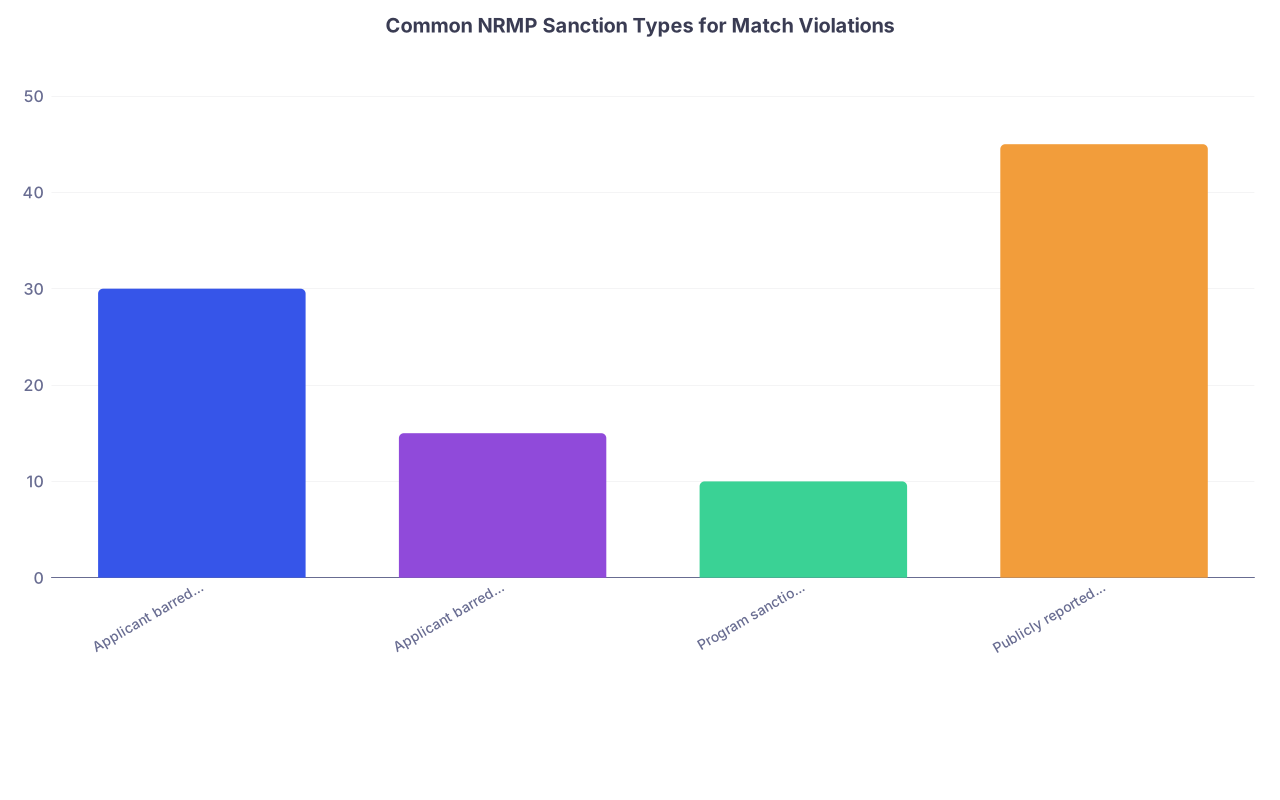
| Category | Value |
|---|---|
| Applicant barred 1 year | 30 |
| Applicant barred 3 years | 15 |
| Program sanctioned | 10 |
| Publicly reported violation | 45 |
Can NRMP physically force you to work at a program? No.
Can it make you radioactive for other residency programs for a while? Yes.
In practice, that’s what makes the Match “binding.”
How Binding Are Pre-Match Contracts?
Now let’s talk about the other side: pre-match or “outside-the-Match” offers and contracts.
These usually come up in:
- Some smaller community or prelim programs.
- Certain specialties in specific regions.
- Applicants with visas, prior training, or nontraditional paths.
- Programs that still prefer filling a few spots outside the NRMP process.
When you sign a pre-match contract, you’re usually signing some version of:
- An employment contract (PGY-1/PGY-2 appointment)
- A letter of intent that is drafted to be binding (sometimes deceptively short)
What’s typically in a pre-match contract?
Common pieces:
- Start date and position (e.g., “PGY-1 Internal Medicine, July 1, 2026”)
- Compensation, call expectations, benefits
- Term of appointment (often 1 year, sometimes 3+)
- Conditions: credentialing, visa approval, graduation, USMLE/COMLEX completion
- Termination/withdrawal clauses
- Sometimes: requirement you withdraw from the NRMP Match
Once signed, you’re not just “interested” in the program. You’ve likely formed a binding employment agreement under state law.
Is that “more binding” than the Match? Legally, yes. The program can:
- Decline to release you if you change your mind.
- Threaten breach-of-contract consequences.
- In rare but real cases, pursue damages (e.g., if your withdrawal causes them measurable losses).
In practice, most programs don’t sue residents. It’s messy, bad optics, and often not worth it.
But they absolutely can refuse to:
- Let you out of the contract.
- Provide a clean reference.
- Cooperate with a last-minute transfer.
So treat pre-match contracts as real contracts. Not “letters of interest.”
Direct Comparison: Which Is “More Binding”?
Here’s the answer you actually need:
The NRMP Match is binding inside the Match ecosystem.
If you violate it, you pay with your future options in ACGME programs and your reputation.A pre-match contract is binding in the legal/employment world.
If you violate it, you risk:- Losing that job.
- Having no other slot because you skipped the Match.
- Possible legal trouble, depending on the contract and state law.
So which should you fear more?
- If your career path depends on mainstream ACGME training → NRMP rules matter more.
- If you’re about to commit to a pre-match slot that removes you from the Match → that contract may be functionally more restrictive, because it removes optionality.
The worst scenario I’ve seen:
A student signs a pre-match contract in December, then gets unexpected strong interview interest in January from more competitive programs. Tries to back out, program refuses to release them, NRMP considers this an outside-the-rules position, and their whole application landscape gets tangled.
Common Situations and What Actually Happens
Let’s walk through real-world scenarios, because this is where people get burned.
1. You signed a pre-match contract, then matched elsewhere
This is where it gets ugly.
If:
- You signed a binding pre-match contract with Program A,
- You still went into the NRMP Match, ranked Program B, and matched there,
you’ve potentially violated:
- Your pre-match contract with Program A, and
- The NRMP rules, because you accepted/held a position outside the Match while participating.
Best case:
- You persuade Program A to release you in writing.
- You document that for NRMP and your new program.
- Everyone shrugs and moves on.
Worst case:
- Program A reports it to NRMP.
- NRMP treats it as a violation.
- You face sanctions that may hit you and/or Program B.
So no, you don’t get to “try both” and decide later. That’s how people get sanctioned.
2. You matched, then a pre-match-style offer appears
Sometimes a program outside the Match tries to recruit you late. If you’re already matched through NRMP:
- You are obligated to your matched program. Period.
- Jumping ship is a match violation, and NRMP takes that seriously.
The outside program should know this. If they encourage you to break your Match commitment, that’s a huge red flag.
3. You signed something “informal” before Match—does it bind you?
Programs sometimes send:
- “Letters of intent”
- “Offer letters”
- “We plan to rank you to match” type letters
Some are clearly nonbinding. Some are drafted ambiguously on purpose.
If it includes:
- Specific position
- Start date
- Salary/compensation
- Acceptance language (“You agree to accept this position and withdraw from the Match”)
…it might already be a contract under state law, even if it looks short and casual.
This is why you never, ever sign “just a quick letter” without reading all the words and asking questions.
How to Protect Yourself Before You Sign Anything
Here’s the practical checklist I’d use if you’re staring at a pre-match contract.

| Step | Description |
|---|---|
| Step 1 | Receive Pre Match Offer |
| Step 2 | Review Contract Carefully |
| Step 3 | Decide if this is your top choice |
| Step 4 | Clarify with NRMP and Program |
| Step 5 | If yes, sign and withdraw from Match |
| Step 6 | If no, decline and stay in Match |
| Step 7 | Consult mentor or lawyer if unsure |
| Step 8 | Already in NRMP Match? |
| Step 9 | Contract requires Match withdrawal? |
1. Clarify: Is this truly pre-match/outside the NRMP?
Ask bluntly:
- “Is this position being filled outside the NRMP Match?”
- “If I sign this, are you expecting me to withdraw from the Match?”
- “Will you also be submitting this position through NRMP?”
You want it in writing how this offer interacts with the Match.
2. Read the contract like a lawyer (or actually use one)
Pay attention to:
- Any statement about:
- Withdrawing from NRMP
- Not applying/accepting other positions
- Termination clauses:
- Can they easily back out?
- Can you?
- Start date and term:
- One year? Multi-year commitment?
- Contingencies (graduation, licensing exams, visa)
You don’t need a 10-page legal memo, but you do need to know what you’re giving up.
3. Check your priorities honestly
Ask yourself:
- If this were my only offer all season, would I be happy here?
- Am I willing to stop chasing other programs for this one?
- Does this program realistically match my competitiveness and goals?
If the honest answer is “I just want this as backup,” you shouldn’t be signing a binding pre-match contract. The Match is how you keep options open.
Practical Strategy: When Does a Pre-Match Contract Make Sense?
There are scenarios where a pre-match contract is completely rational.
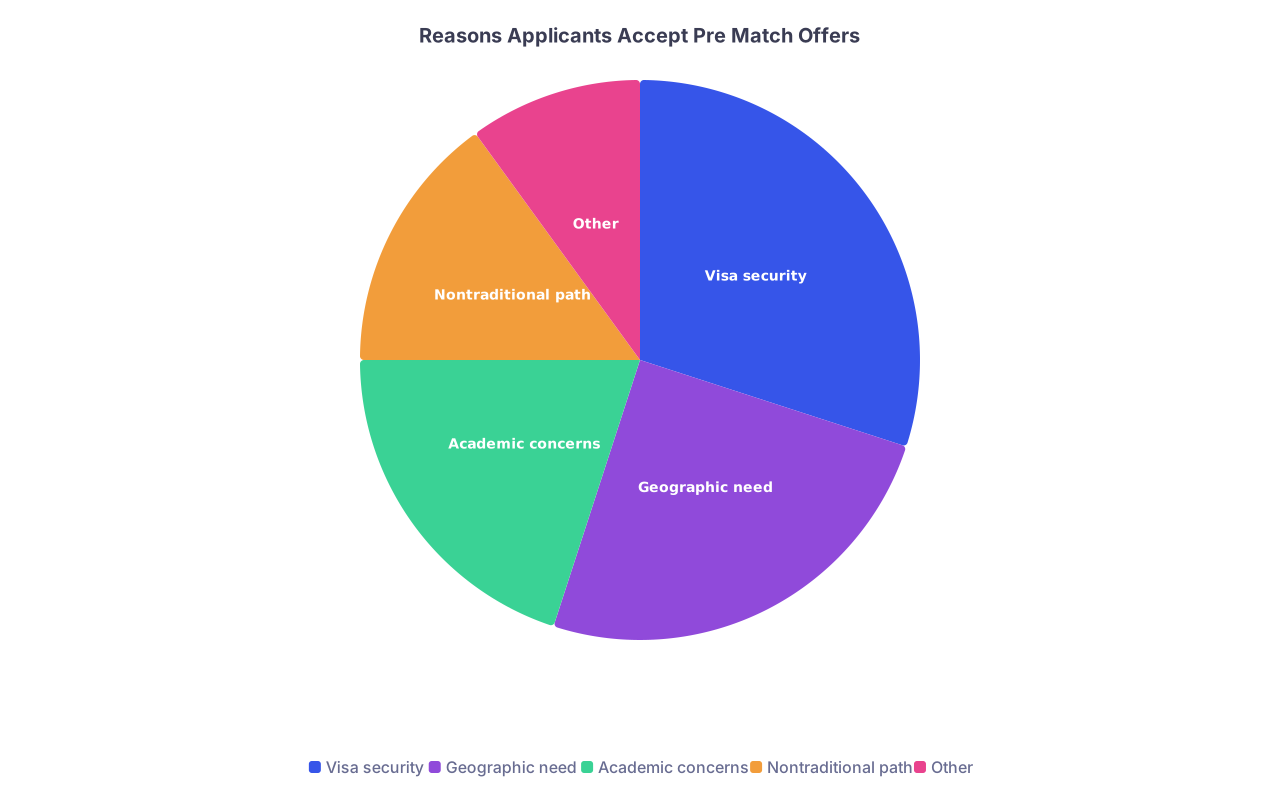
| Category | Value |
|---|---|
| Visa security | 30 |
| Geographic need | 25 |
| Academic concerns | 20 |
| Nontraditional path | 15 |
| Other | 10 |
It makes sense to strongly consider a pre-match contract when:
- You’re a visa-dependent applicant and the program is reliable and experienced with your visa type.
- You have significant academic risk (exam failures, gaps, prior residency) and this is a solid offer.
- You have hard constraints: partner’s job, kids in school, family caregiving, and this is the right geography.
- The program is actually your top realistic choice, not just “good enough.”
It’s a problem when:
- You’re reasonably competitive in the Match but panicking too early.
- You feel pressured by a fast-expiring offer (“24 hours or we move on”).
- You haven’t even finished interviewing or seen your full Match picture.
- You’re vaguely hoping you can “sign now and then decide later.” You can’t.
Red Flags in Pre-Match Offers
If you see any of this, slow down:
- Program strongly discourages you from asking questions or consulting anyone.
- Vague or missing details on salary, call, benefits, or expectations.
- They insist you immediately withdraw from NRMP before you’ve even read the full agreement.
- They refuse to put verbal assurances into written contract language.
- They won’t clarify how they’ll support visas, licensing, or board requirements.
A legitimate, learner-friendly program will expect you to take a few days, read carefully, and possibly show it to someone.
Simple Decision Framework
If you want it boiled down, use this mental flow:
Would I be happy here if nothing else worked out?
If no → decline. Don’t sign just to reduce anxiety.Is this clearly outside the NRMP Match, and do I understand those implications?
If no → get clarity before signing.Am I comfortable closing off other options for this single guarantee?
If no → stay in the Match and preserve flexibility.Have I gotten at least one outside opinion (mentor, advisor, or lawyer if needed)?
Especially if anything in the contract sounds confusing or one-sided.

FAQs
1. If I sign a pre-match contract, can I still go through the NRMP Match as a backup?
Usually no. If the contract states you’re committing to that program and/or must withdraw from the Match, trying to do both is playing with fire. You risk violating NRMP rules and breaching the contract. If you want a backup, don’t sign something binding.
2. Can a program or NRMP actually force me to work somewhere?
No one can physically force you to work. But NRMP can sanction you so that you lose access to future ACGME programs for a while. A program with a signed pre-match contract could, in theory, pursue legal remedies. Practically, the main risks are losing positions and damaging your reputation, not being dragged into a job.
3. Are letters of intent or “we intend to hire you” emails binding?
Sometimes they’re not. Sometimes they’re drafted in a way that does create a contract. If the document has concrete terms (position, start date, pay, mutual agreement language), it may be enforceable under state law. Don’t assume short = nonbinding. When in doubt, ask explicitly: “Is this a binding employment agreement?”
4. What happens if a program breaks a pre-match contract with me?
If the program rescinds the offer, your options depend on the contract and timing. In reality, most residents don’t sue; they scramble for another spot, possibly through SOAP or off-cycle positions. This is another reason not to sign with sketchy programs. A well-established institution is less likely to casually drop you.
5. Is a pre-match contract better than risking going unmatched?
If you’re at substantial risk of going unmatched—weak scores, red flags, prior attempts—then yes, a solid pre-match can be far better than rolling the dice. But that calculation depends on your risk profile, the quality of the program, and your long-term goals. For a strong or average applicant, jumping early often gives up upside for no real reason.
6. Who should I talk to before signing a pre-match contract?
At minimum: a trusted mentor or advisor who understands residency training. For anything unclear or highly restrictive, a lawyer familiar with physician employment contracts in that state is worth the money. At least one conversation with someone not emotionally tied to “just getting a spot” can save you from a bad commitment.
Bottom line:
- The NRMP Match binds you through rules and professional consequences; pre-match contracts bind you through actual employment law.
- You can’t safely “try both” at the same time—pick a lane and commit intentionally.
- Only sign a pre-match contract if you’d be genuinely satisfied there and you fully understand that you’re trading flexibility for security.