
It’s late November. You just finished a solid interview at a community internal medicine program. On your flight home, you get an email: “We’d like to extend you a pre-match offer. Please let us know your decision by Friday.”
It’s Tuesday.
You’re staring at the email thinking:
“How many days is reasonable to ask for?”
“Can I push back?”
“Will they pull the offer if I ask for more time?”
Here’s the answer you’re looking for.
The Short, Honest Answer
If you remember nothing else, remember this:
- 3–7 days is usually reasonable and commonly accepted.
- 10–14 days is sometimes possible, but starts to push it.
- 24 hours or “same day” deadlines are aggressive; you should push back.
Most programs that use pre-match offers know you need some time. The real game is figuring out:
- How much time you can reasonably ask for without annoying them.
- How to phrase the ask so they want to work with you.
- Whether this is a program you’d lock in now or one you’re using to buy time.
Let’s break it down properly.
What Programs Actually Expect (Not the Polite Version)
Programs are juggling three things when they give you a pre-match:
- They want you off the market.
- They don’t want to lose you to a more competitive program.
- They want to fill positions early so they can relax.
So they tend to give deadlines that are:
- Shorter for more competitive specialties/locations (e.g., ortho in a big city)
- Somewhat longer for less competitive ones (e.g., FM in a rural area)
- Often arbitrary and a bit pushy, because they know you’re anxious
Here’s what’s generally considered reasonable:
| Situation | Common Deadline Given | Reasonable Time to Ask For |
|---|---|---|
| Community IM/FM, less competitive | 3–7 days | 7–10 days |
| Mid-tier university / moderate pressure | 48–72 hours | 5–7 days |
| Highly competitive specialty/location | 24–48 hours | 3–5 days |
| International or visa-sensitive offers | 3–7 days | 7–14 days |
Notice the pattern: what they give you is often shorter than what’s reasonable to ask for. Your job is to nudge, not demand.
How Many Days You Should Ask For (By Scenario)
Scenario 1: You’d Be Happy to Train There, But Still Have Upcoming Interviews
This is the most common scenario.
You liked the program. You’d rank it somewhere on your list. But you still have 2–4 interviews lined up at places you might like more.
Reasonable ask: 5–7 days
If they gave you 48 hours, ask for 5–7 days. If they gave you 5 days, ask for 7–10, knowing they might say 5–7 max.
How to phrase it (steal this):
“Thank you so much for this offer – I really enjoyed meeting your team and can absolutely see myself training there. I do have a few previously scheduled interviews in the next week, and I want to be fair and thoughtful in my decision. Would it be possible to have until [specific date] to give you a final answer?”
You’re showing respect, enthusiasm, and giving a concrete date. That matters.
Scenario 2: This Is Your Safety Net, You’re Aiming Higher
You’re an IMG or lower-tier applicant. You just got a pre-match from a solid community program. You also have one or two “reach” interviews coming up at stronger university programs.
You don’t want to lose this offer. But you also don’t want to panic-accept if there’s a shot at something better.
Reasonable ask: 7–10 days (if the calendar allows)
You say almost the same thing as above, but you’re very careful not to sound ambivalent:
“I really appreciate this offer and I’m seriously considering it. I have a couple of long-scheduled interviews coming up over the next week. Out of respect for everyone involved, I’d like to complete those and then make an informed decision. Would it be possible to have until [date 7–10 days away] to respond?”
If they push back hard and say “We need an answer in 48 hours,” that tells you something about their culture and desperation level. Not always bad—but it’s data.
Scenario 3: You’d Take This Program Over Almost Anything Else
This is your top (or near-top) choice. The pre-match is essentially a dream outcome for you.
Reasonable ask: 2–3 days, max
You don’t need to drag this out. You mostly need:
- A day to breathe
- Time to discuss with family/mentors
- Maybe confirm there aren’t any major red flags
You might just say:
“Thank you so much for this offer, I’m very excited. I’d like to take 2–3 days to discuss with my family and mentors and then get back to you by [date].”
If you already know this is a yes: don’t play games. Accept and move on. Over-negotiating time when you’re already sold just stresses everyone out and can burn goodwill.
Scenario 4: You’re Unsure, And Also Actively Dislike Some Things You Saw
You got a pre-match from a place with red flags. Malignant vibe. Overworked residents. Bad board pass rates. You’re tempted because you’re scared of not matching—but it doesn’t feel right.
Here, more time actually matters. You need to:
- Talk to more residents (ideally privately)
- Run this by honest mentors
- Look at your match probability realistically
Reasonable ask: 7–14 days, but know they may say no
You can ask:
“Thank you very much for your confidence in me. I want to be respectful of your process and make a fully informed decision. There are a few people I’d like to speak with and logistics I need to sort out. Would it be possible to have until [date 10–14 days away] to provide a final answer?”
If they absolutely refuse any flexibility and pressure you hard, that’s another red flag.
How Your Competitiveness Changes the Equation
Let me be blunt.
If you’re:
- US MD with strong scores, normal specialty
- US DO with solid scores in a less competitive field
- Well-connected with lots of interviews already
You have leverage. Asking for 7 days is perfectly reasonable almost anywhere. You’re not easily replaceable.
If you’re:
- IMG with limited interviews
- Red flags (attempts, gaps, low scores)
- Applying in a more competitive metro area
You have less leverage. You can still ask for time, but you need to:
- Sound appreciative, not demanding
- Be prepared they might say “we can’t extend the deadline”
- Have a realistic backup plan if the offer disappears
Here’s what I’ve seen repeatedly: applicants with weak profiles who panic-reject an early offer because they’re chasing illusions. Then they don’t match. That’s not courage. That’s poor risk management.
So—your competitiveness doesn’t fully dictate what’s “reasonable,” but it absolutely affects what’s smart.
How to Ask for More Time Without Burning Bridges
The wording matters more than the number of days.
Key rules:
- Always lead with clear appreciation.
- Signal genuine interest (“I can see myself training there”).
- Give a specific date, not “whenever.”
- Tie your request to something concrete (other interviews, family discussion, visa, logistics).
Here’s a simple template you can adapt:
Dear Dr. [PD Last Name],
Thank you very much for extending a pre-match offer. I truly enjoyed my interview day and can see myself training at [Program Name].
I do have a couple of previously scheduled interviews in the coming [few days/week], and I want to be thoughtful and fair to everyone involved before making a final decision.
Would it be possible to have until [specific date] to let you know my decision?
Thank you again for your confidence in me.
Best regards,
[Your Name]
That’s calm, confident, and professional. No drama. No begging.
Time Pressure vs. Match Strategy: When to Say Yes Quickly
There’s a second question underneath “how many days is reasonable”:
“When should I just accept, even if I’d like more time?”
Here’s my blunt framework:
You should seriously consider accepting quickly (within 24–72 hours) if:
- You’re an IMG with few interviews (e.g., ≤4–5 total)
- You have prior failures, low scores, or other application risk
- The program is at least “acceptable” (not malignant, decent board pass rate, survivable location)
- You wouldn’t be devastated to train there for 3–5 years
You can afford to hold out longer (5–10 days or walk away) if:
- You have plenty of interviews lined up (8–12+ in IM/FM, 12–15+ in more competitive fields)
- You’ve already interviewed at places clearly better than the pre-match program
- The pre-match program has serious red flags you can’t ignore
Don’t fall into this trap: “I have one dream university interview next month; I’ll just decline this solid community pre-match and trust the universe.”
The universe doesn’t care. The match algorithm doesn’t care. Take the probabilities seriously.
Visual: How Interview Count Should Affect Your Risk Tolerance
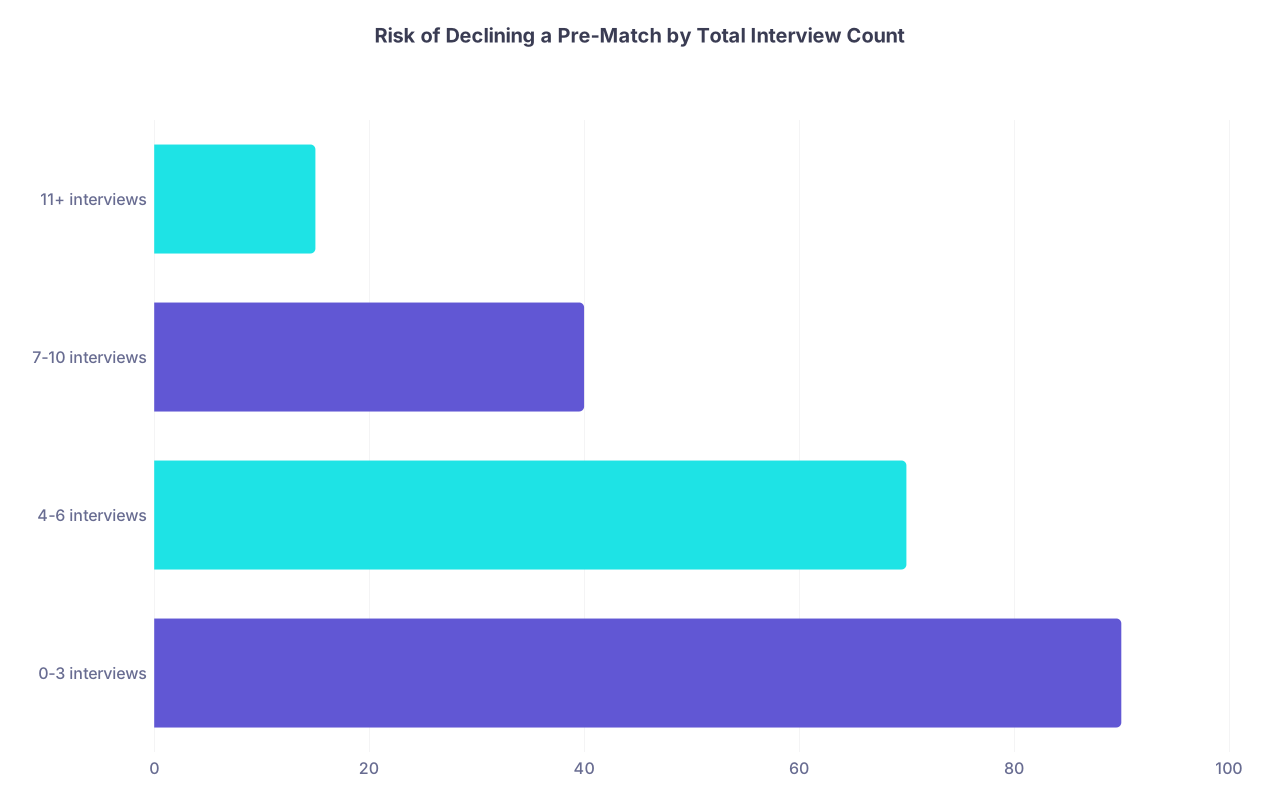
| Category | Value |
|---|---|
| 0-3 interviews | 90 |
| 4-6 interviews | 70 |
| 7-10 interviews | 40 |
| 11+ interviews | 15 |
Rough idea (not exact math, but directionally right): the fewer interviews you have, the more dangerous it is to decline a reasonable pre-match.
Program Culture Clues from Their Deadline Behavior
How they handle your request for more time tells you more than you think.
Red flags:
- “You have 24 hours and we won’t extend it.”
- “You need to withdraw from the Match immediately if you accept.” (Some places do this—very aggressive.)
- Guilt-tripping: “If you really cared about our program, you’d decide now.”
Neutral/normal:
- “We’d prefer an answer within 3–5 days, but can extend to [date].”
- “We understand you have other interviews; we can’t hold indefinitely, but let us know by [reasonable date].”
Green flags:
- Reasonable, friendly tone
- Flexibility within a week or so
- Willingness to connect you to a resident or chief to answer questions while you decide
If they’re already treating you like property before you even start, imagine what the culture looks like at 2 a.m. on wards.
Process Map: What To Do When You Get a Pre-Match Offer

| Step | Description |
|---|---|
| Step 1 | Receive pre match offer |
| Step 2 | Initial gut reaction |
| Step 3 | Politely decline |
| Step 4 | Count total interviews |
| Step 5 | Lean toward accepting |
| Step 6 | Check upcoming interviews |
| Step 7 | Ask for 3 to 5 days |
| Step 8 | Ask for 5 to 10 days |
| Step 9 | Discuss with mentor and family |
| Step 10 | Conservative choice - accept if acceptable |
| Step 11 | Communicate clear decision |
| Step 12 | Would you be OK training here |
| Step 13 | 4 or fewer interviews |
| Step 14 | Higher priority interviews booked |
| Step 15 | Still unsure by deadline |
Use this as a rough sanity check, not a strict rulebook.
FAQ: Pre-Match Decision Timing (7 Questions)
Is it rude to ask for more time to decide on a pre-match?
No. If you’re polite, appreciative, and give a specific date, it’s completely normal. Programs expect applicants to have multiple interviews and obligations. Rudeness is demanding or sounding entitled, not asking for 3–7 days.What if the program says they “can’t” extend the deadline?
Then you’re at a fork in the road: accept by their deadline or walk away. Take a cold look at your interview count, scores, and specialty competitiveness. If you’re a higher-risk applicant with few interviews, it’s often safer to accept. If you’re strong with lots of interviews, you can afford to pass.Can I accept a pre-match and still stay in the Match?
That depends on country and system. In some places (e.g., certain Texas programs in the old pre-match era; some international settings), accepting a pre-match means you’re contractually bound and must withdraw from the Match. Clarify this explicitly with the program: “If I accept this offer, will I still participate in the Match?” Get a clear answer in writing if possible.How long do most programs give by default?
Most I’ve seen give somewhere between 48 hours and 7 days, with 3–5 days being extremely common. But remember: their default deadline is usually aggressive. It’s a starting point, not a sacred rule. You’re allowed to ask for a bit more.What if I already have my dream program interview scheduled—should I still accept a pre-match elsewhere?
If it’s your true dream and you’re reasonably competitive for it, you can ask the pre-match program for more time that extends beyond that interview date. If they refuse and your overall interview count is low, you’re gambling. Sometimes that gamble pays off. Sometimes it doesn’t. Just don’t lie to yourself about the odds.Will asking for more time make the program like me less?
If you handle it professionally, no. Strong candidates do this all the time. If a program punishes you for asking for 5–7 days to make a major life decision, that says more about them than you. Programs that value maturity and thoughtfulness don’t mind a reasonable request.What’s the maximum time I should ever ask for?
In most cases, 7–10 days is the top end of “reasonable.” Pushing for 14 days is sometimes doable if there are specific, legitimate issues (visa, major travel, serious family logistics), but anything beyond 2 weeks is unusual and often unrealistic. You can want a month. You’re not going to get it.
Key takeaways:
- Asking for 3–7 days to decide on a pre-match is normal and reasonable; 7–10 days is sometimes fine if you’re careful.
- Your competitiveness and total interview count should drive how aggressive or conservative you are with accepting vs. waiting.
- How a program responds to your request for time is itself valuable data about their culture—pay attention to it.