
You can accept a pre‑match and still attend other interviews—legally. But if you do it without a clear plan and honest communication, you’re playing with fire ethically and professionally.
Let’s walk through exactly where the lines are: what’s allowed, what’s sketchy, and what’s flat-out wrong.
1. The Core Question: Is It Ethical To Accept a Pre‑Match and Keep Interviewing?
Short version:
- Legally/contractually: Often yes, at least initially.
- Professionally/ethically: Only if you’re transparent with yourself and (eventually) with programs, and you don’t drag things out.
Here’s the real tension:
- Pre‑match offers are usually binding contracts (outside the NRMP Match).
- NRMP Match participation involves explicit rules about commitments and withdrawals.
- Your professional reputation as a physician starts now, in residency applications.
Where people get into trouble is this scenario:
- You verbally or contractually accept a pre‑match.
- You keep interviewing “just in case.”
- You intend to break the pre‑match if something better appears.
- You don’t tell anyone until Match week.
That’s where the ethics go off the rails.
2. Know Which System You’re Playing In
The rules are very different depending on whether:
- You’re in the NRMP Match only (most US MD/DO grads).
- You’re in a state or specialty with pre‑match systems (e.g., some Texas programs, certain military systems, some non‑NRMP spots).
- You’re an IMG/FMG dealing with a mix of NRMP and non‑NRMP pre‑match contracts.
You have to be crystal clear on this before you accept anything.
| Context | Typical System | Pre-Match Common? | Binding Contract? |
|---|---|---|---|
| NRMP Categorical | NRMP Match | Rare | Match is binding |
| Texas (some) | NRMP + Pre | Yes | Pre-match contract |
| Military | Separate Match | Structured | Matching process |
| IMG non-NRMP | Direct offers | Very common | Employer contract |
If you’re not sure which rules apply to your specific programs, email or call the program coordinator and ask directly:
“Is this position participating in the NRMP Match, or is this a separate, pre‑match contract?”
3. Ethics vs Rules: Two Different Questions
Question 1: What do the formal rules say?
NRMP rules (for NRMP programs/positions):
- You must not sign or accept a position that conflicts with your Match commitment.
- Once you certify a rank list, you’re promising to honor your Match result.
- Programs can’t coerce you into violating NRMP rules (in theory, anyway).
Non‑NRMP pre‑match contracts:
- These are generally employment contracts.
- Legally, once you sign, you’re committed unless there’s:
- A clearly stated out-clause (e.g., contingent on visa, or on passing exams).
- A mutual agreement to release you.
So yes, you can technically accept a pre‑match and then withdraw later. But that may:
- Breach a contract.
- Burn that bridge permanently.
- Get you a bad reputation with other PDs in that region or specialty.
Question 2: What’s ethically reasonable?
Here’s where I draw the line, and I think most attendings would agree:
Ethically OK:
- You accept a pre‑match but haven’t signed anything yet, and you’re still clarifying details.
- You accept a time‑limited offer explicitly labeled as “contingent” or “non‑binding,” and both sides understand that.
- You accept a pre‑match as a backup while you wait on one remaining interview, and you’re prepared to cancel other interviews and/or inform programs quickly once you decide.
Ethically gray:
- You sign a binding pre‑match contract and still go to multiple interviews with a real intent to leave if something better appears, but you don’t disclose your signed contract.
- You use a signed pre‑match mostly as “leverage” to try to push other programs.
Ethically wrong:
- You sign and verbally commit, continue interviewing broadly, tell no one, and drop the pre‑match late in the cycle only when you secure a more desirable spot.
- You lie explicitly when asked: “Are you committed anywhere?” and you say “No” despite a signed contract or formal acceptance.
4. A Practical Framework: Should You Accept and Still Interview?
Use this decision tree before you say yes to anything:

| Step | Description |
|---|---|
| Step 1 | Pre match offer received |
| Step 2 | Cannot sign outside NRMP |
| Step 3 | Clarify terms in writing |
| Step 4 | Accept and cancel remaining low interest interviews |
| Step 5 | Politely decline or request more time |
| Step 6 | Is this NRMP or non NRMP? |
| Step 7 | Is contract binding? |
| Step 8 | Would you be satisfied here if no other offers? |
If you’re thinking, “I’ll accept but keep interviewing and see what happens,” pause. Ask:
- If this were my future resident doing this to me as a program director, would I think they were acting in good faith?
If the answer is no, that’s your ethical warning light.
5. How To Accept a Pre‑Match and Still Handle Other Interviews (The Right Way)
Let’s assume this situation:
- Non‑NRMP pre‑match offer.
- Contract is binding employment.
- You’re not 100% sure this is your dream program.
- You have other interviews scheduled.
Here’s how to handle it like an adult.
Step 1: Clarify the terms in writing
Before signing or verbally accepting:
- Ask: “Is this agreement binding if I sign? Are there any conditions under which either side can withdraw?”
- Ask for a deadline on the offer. 48–72 hours is common and reasonable.
- If they want an answer “right now,” that’s a red flag.
You can say:
“I’m very interested in your program and honored by the offer. I want to review the contract carefully and compare call schedules and benefits so I can commit fully. Could I have 48 hours to review and get back to you?”
Step 2: Decide your “floor”
Privately decide:
“If every other interview vanished tomorrow, would I be okay—genuinely okay—doing residency here?”
If the answer is yes, then:
- It’s reasonable to accept and then:
- Cancel interviews at places you’re clearly not going to rank above this.
- Keep only the few you might truly rank higher.
If the answer is no:
- Don’t accept. You’re using them as a safety net you don’t actually respect.
Step 3: Be selective with remaining interviews
After accepting a pre‑match, you should tighten your interview list:
- Cancel:
- Programs you know are clearly below this offer.
- Programs you took to “pad” your list.
- Keep:
- Only the small number (often 1–3) that you’d honestly choose over your pre‑match if accepted.
This minimizes wasted resources and avoids stringing along programs you’d never actually attend.
6. What Do You Tell Other Programs?
This is where people get nervous. Let’s talk scripts.
Do you have to proactively disclose your pre‑match?
Generally, no. Programs don’t always ask, and you’re not obligated to open with, “By the way, I accepted somewhere else.”
But the second they ask anything like:
- “Are you committed anywhere?”
- “Have you accepted a position outside the Match?”
- “If we rank you to match, will you come here?”
your honesty matters.
You have a few honest options:
- If your pre‑match is signed and binding, and you’d break it only in extraordinary circumstances (almost never):
“I’ve accepted a pre‑match offer at another institution and have signed a contract. I’m here because I respect your program deeply, but I would need to resolve that commitment before I could come here.”
- If your pre‑match is accepted but still in a review window:
“I’ve received and tentatively accepted a pre‑match offer, but I’m currently in the review period and haven’t finalized the contract. I’m still evaluating my options and would seriously consider an offer from your program.”
Is that risky? Yes. But it’s honest. And some programs will appreciate that.
How might programs react?
Realistically:
- Some will drop you lower on their list or off it entirely.
- Some will respect your transparency and still rank you competitively.
- A few might push you to “decide now.” That’s data about their culture.
If a program penalizes you for being honest about a commitment, you should ask whether that’s somewhere you really want to spend 3–7 years.
7. When Is It Okay To Walk Away From a Pre‑Match?
Sometimes backing out is justified. But it shouldn’t be casual.
Reasonable causes to renegotiate or withdraw (ideally early):
- Major new information:
- Significant misrepresentation discovered (e.g., call schedule wildly different from what they told you).
- Loss of accreditation or major PD/departmental instability announced.
- Serious personal or family change:
- Health crises.
- Family relocation needs that make the program unfeasible.
- Visa or legal barriers that make it impossible to start.
In all of these:
Communicate early, directly, and humbly.
You say something like:
“Since signing, a family situation has arisen that makes it extremely difficult for me to relocate to [city]. I understand the impact on your program and I’m truly sorry. I’d like to discuss whether there’s any possibility of being released from my contract.”
Don’t ghost. Don’t wait until May. Don’t send a one-line email and disappear.
8. How Programs Actually View This
Here’s the part you don’t see as an applicant.
Program directors talk. A lot.
I’ve sat in rooms where PDs said:
- “We’ll never interview anyone from that school again; their dean backed a resident who broke a contract last year.”
- “She was honest about having another offer, and we liked her enough that we still ranked her high.”
- “He lied when I asked him directly about other commitments. We pulled him off the list that afternoon.”
What they care about:
- Are you honest when asked a direct question?
- Do you understand that a contract is a serious commitment?
- Are you someone they’d trust as a colleague and ambassador of their program?
That matters more than whether you took two extra interviews after a pre‑match.
9. A Simple Ethical Rule of Thumb
If you remember nothing else, remember this:
You can accept a pre‑match and still attend some interviews, but don’t do anything you’d be embarrassed to explain, word‑for‑word, to your future PD on your first day of residency.
If you’d cringe saying it out loud, don’t do it.
10. Visual: Balancing Interviews After a Pre‑Match
Here’s roughly how people’s interview loads should shift once they accept a pre‑match, if they’re acting reasonably.
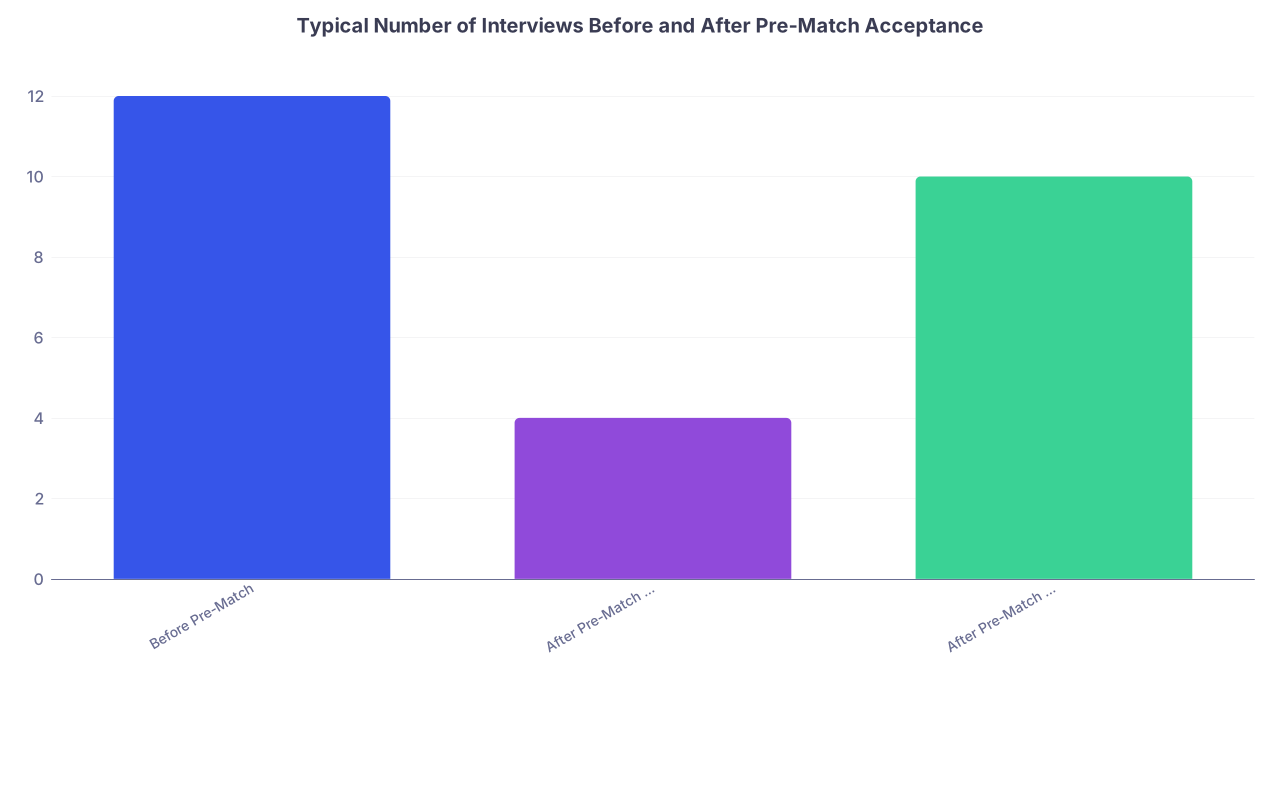
| Category | Value |
|---|---|
| Before Pre-Match | 12 |
| After Pre-Match (Ethical) | 4 |
| After Pre-Match (Risky) | 10 |
- Ethical scenario: you cut your list to just a handful of truly possible upgrades.
- Risky scenario: you carry almost your full schedule like nothing has changed.
11. Concrete Examples
Example 1: Ethically sound
- You’re an IMG with 8 interviews.
- Midway through, a solid community IM program offers a pre‑match. You’d genuinely be content there.
- You accept, sign the contract.
- You cancel 3 low‑tier interviews you were lukewarm about.
- You keep 2 university programs you’d really prefer, and at those interviews, if asked, you say you’ve already accepted a pre‑match and explain your situation honestly.
No one’s thrilled you might leave a pre‑match, but you’ve minimized harm and stayed honest.
Example 2: Ethically bad
- You accept a pre‑match at a community hospital you never intended to attend.
- You tell friends, “I just needed something on paper—of course I’ll ditch it if I get that coastal university spot.”
- You interview everywhere, never disclose the signed contract, rank others, and then email the pre‑match program in May saying “I matched somewhere else; please cancel my spot.”
That’s how you get remembered for all the wrong reasons.
12. How To Prepare Yourself Before Pre‑Match Season
A few practical moves:
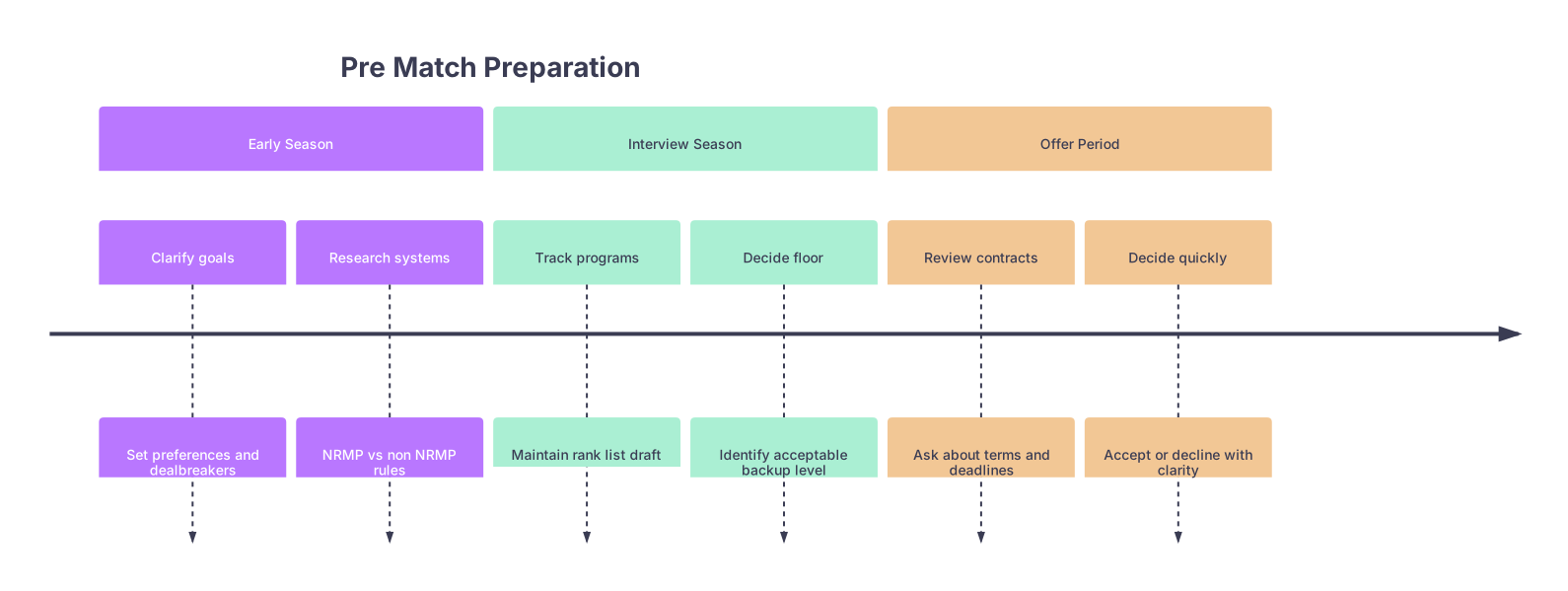
| Period | Event |
|---|---|
| Early Season - Clarify goals | Set preferences and dealbreakers |
| Early Season - Research systems | NRMP vs non NRMP rules |
| Interview Season - Track programs | Maintain rank list draft |
| Interview Season - Decide floor | Identify acceptable backup level |
| Offer Period - Review contracts | Ask about terms and deadlines |
| Offer Period - Decide quickly | Accept or decline with clarity |
And if you’re not comfortable reading contracts, ask:
- A trusted attending
- A recent graduate who went through the same path (often IMGs help each other)
- Your school’s career office or advisor
- In complicated cases, an attorney with experience in physician contracts
FAQ: Pre‑Match Ethics and Interviews
1. If I accept a pre‑match, am I required to cancel all remaining interviews?
No. You’re not required to cancel all of them, but you should cut down to only those programs you’d realistically pick over your pre‑match. Don’t hoard interviews you’d never actually take. That wastes everyone’s time and feels dishonest.
2. Can a program find out that I broke a pre‑match contract to go somewhere else?
Yes. Program directors talk to each other, especially within specialties and regions. If you break a contract late or without genuine cause, word can spread. It won’t end your career, but it can absolutely hurt your reputation and your home school’s credibility.
3. What if a program pressures me to accept a pre‑match immediately?
That’s a red flag. Ask for at least 24–48 hours to review the offer and contract. If they refuse and demand a same‑day answer, you’re seeing a preview of how they handle power and boundaries. I’d be very cautious about accepting in that situation.
4. Is a verbal acceptance of a pre‑match binding, or only a signed contract?
Legally, this varies by jurisdiction, but ethically, a verbal “yes” still means something. A signed contract is clearly binding; a verbal acceptance that’s immediately walked back looks flaky. If you’re not sure, don’t verbally accept. Ask to see the written offer first.
5. What should I do if I accepted a pre‑match but now realize it was a mistake?
Move quickly. Don’t wait months. Contact the program director or coordinator, explain honestly (without drama), and ask if there’s any way to be released. Take responsibility, acknowledge the inconvenience, and don’t argue if they’re upset. The earlier you do this, the more likely they are to work with you and the less damage you do.
Key takeaways:
- You can ethically accept a pre‑match and still attend a few interviews, but only if you’re selective, transparent when asked, and willing to honor your commitments.
- Don’t use a pre‑match as a disposable safety net—treat contracts and verbal acceptances like the real commitments they are.
- If you’d be ashamed explaining your behavior to your future program director, change the plan now.