
It’s late January. You’ve got an email open with “Residency Offer” in the subject line, contract attached. You said yes. You signed. You exhaled.
Now ERAS/NRMP is buzzing in your group chats and everyone’s obsessing over their rank lists. And you’re sitting there thinking:
“Wait… do I still need to submit a rank list if I already accepted a pre‑match offer? Am I even allowed to? And what happens if I do?”
Let me cut through the noise for you.
Step 1: Figure Out Which System You’re Actually In
Before you decide what to do, you need to know which universe you’re living in. Because “pre‑match” means very different things depending on the system.

There are three big buckets:
- NRMP Main Match programs (standard US match)
- Programs outside the Match / early or “pre‑match” contracts
- Special systems (e.g., Texas/TTUHSC contracts, some military, some IMG-only pathways)
Here’s the simple rule:
If the program you signed with participates in the NRMP Main Match for your specialty and year, and they expect you to show up in the Match as “secure,” then what you do with your rank list can get messy ethically and contractually.
If the program you signed with is completely outside NRMP (truly independent, no match participation at all), then the Rank Order List (ROL) question is basically: “Are you still actually in the Match or not?”
To make this clearer:
| Scenario | In NRMP? | Submit Rank List? |
|---|---|---|
| Signed with non-NRMP program (fully outside Match) | No | Usually no need; often withdrawn |
| Signed a binding contract with NRMP-participating program | Yes | Ethically you should rank them #1 or withdraw |
| Verbal “offer” only, no contract | Maybe | Yes, you should still rank normally |
| Military match + civilian NRMP backup | Mixed | Yes, but follow your specific guidelines |
| Texas pre-match (independent system) | Separate | Follow state/system rules |
If you’re not sure which category you’re in, don’t guess. Email or call the program coordinator and explicitly ask:
“Does this contract take me out of the NRMP Match, or will I still appear in the NRMP system and submit a rank list?”
That one question clears up 80% of confusion.
Step 2: Understand What “Pre‑Match” Really Means In Your Case
People throw “pre‑match” around loosely. Let’s break down the flavors, because your options depend on which you actually have.
1. True Independent Contract (Outside NRMP)
Example: A community internal medicine program that doesn’t participate in NRMP at all. They just offer you a PGY‑1 contract, you sign, and that’s that.
In this case:
- If you sign a binding contract, most people:
- Withdraw from NRMP and don’t submit a rank list.
- If you had an NRMP registration but then signed this:
- You should formally withdraw from the Match in your NRMP portal. Don’t just “ghost” it.
In practice, once you accept a fully independent PGY‑1/PGY‑2 training position, that’s your spot. Submitting a rank list to chase something else while holding a binding contract is playing with fire.
2. Pre‑Match / Early Offer Within NRMP-Participating Program
Example: An internal medicine program that also participates in the Match invites you as an IMG, tells you they’d like to offer you a contract early, potentially as part of an “out of Match” track, or on an institutional contract.
Here’s the ethical/logical breakdown:
- If the contract clearly states that this is an out‑of‑Match, binding position and you’ll be removed from their NRMP quota:
- You should either:
- Withdraw from NRMP, or
- If you stay registered, you should ethically rank them #1 and not play games.
- You should either:
- If they say, “We’ll rank you very highly; we’d love you to come, but it’s still through the Match”:
- That’s not a pre‑match contract. That’s just enthusiasm.
- You absolutely should submit a full, honest rank list.
3. Verbal “Offer” Without a Real Contract
I’ve seen this: applicant hears “We’ll take you for sure if you want to come,” or “We consider this a pre‑match,” but there’s no written, signed contract.
That is not binding. Period.
You must:
- Keep participating in the Match.
- Submit a rank list based on your true preferences.
- Treat their “offer” as a strong signal, not a guarantee.
If they’re not willing to put it in writing, you shouldn’t treat it like guaranteed employment.
Step 3: So, Should You Actually Submit a Rank List?
Let’s walk through the concrete situations.
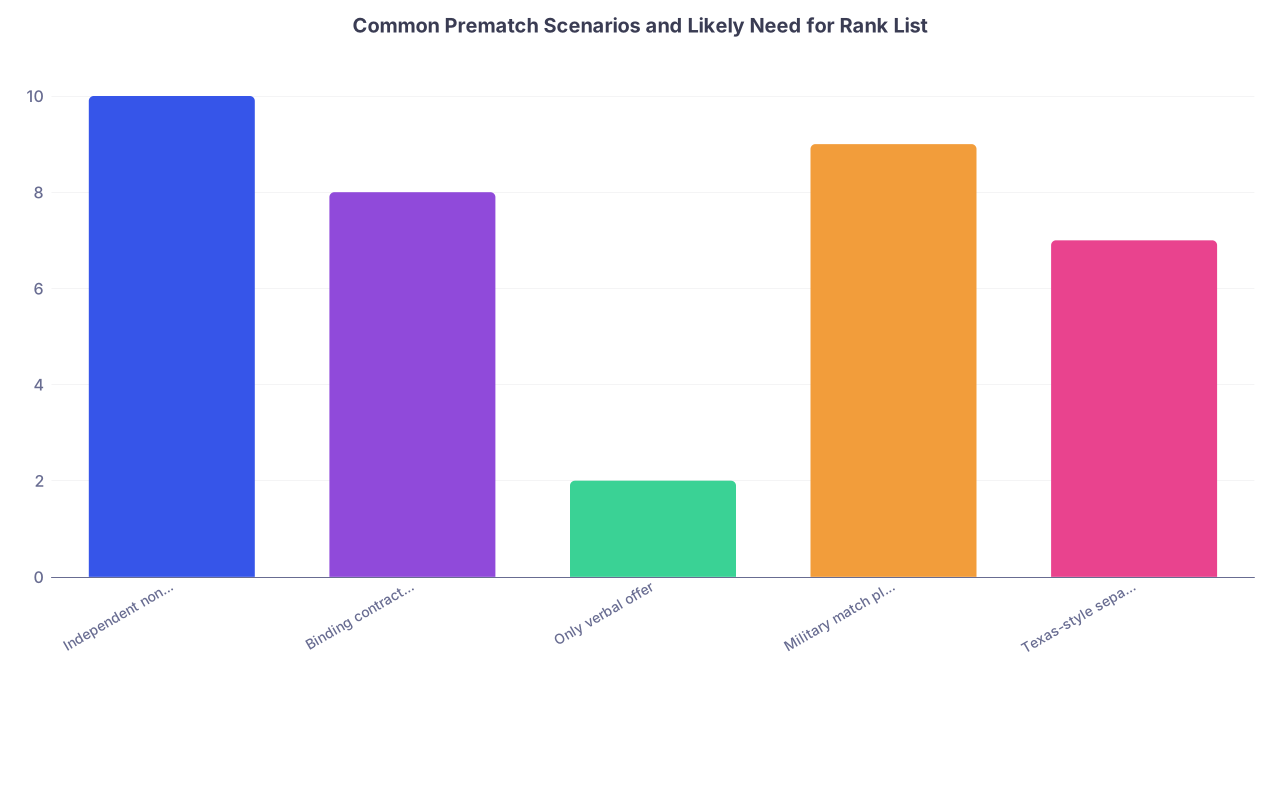
| Category | Value |
|---|---|
| Independent non-NRMP contract | 10 |
| Binding contract with NRMP hospital | 8 |
| Only verbal offer | 2 |
| Military match plus civilian backup | 9 |
| Texas-style separate system | 7 |
(Think of higher numbers here as "more likely you still submit a rank list." This is conceptual, not literal.)
Case 1: You Signed a Binding Contract Outside NRMP
Should you still submit a rank list?
Usually: No.
What you should do:
- Log in to NRMP.
- Withdraw from the Match.
- Notify any programs honestly if they ask: you’ve accepted a position elsewhere.
Submitting a rank list while holding a binding, non‑NRMP contract and hoping to “upgrade” is risky and, in my view, unethical. You’re agreeing to show up, then quietly trying to bail.
Case 2: You Signed a Binding Contract With an NRMP-Participating Program
Here’s where people get sneaky.
If the contract says you’re committed to that program for the PGY‑1 year (or categorical spot) and the institution will adjust their NRMP quota or list accordingly:
- Ethically, if you stay in the NRMP system, that program should be ranked #1.
- Realistically, many programs expect you to withdraw from NRMP for that specialty.
So should you still submit a rank list?
- If the institution tells you: “You’ll still show up in NRMP, but your spot is secured here,” then:
- Submit a rank list with them #1.
- Do not rank anywhere else above them.
- If your gut plan is “I’ll put them #3 and try for something better” while holding a signed contract, you’re setting yourself up for a professionalism and possibly legal disaster if you match somewhere else.
Case 3: You Only Have a Verbal or Non‑Binding “Offer”
No contract. No official institutional paperwork. Just words.
Should you still submit a rank list?
- Yes. 100% yes.
- Rank programs in your true order of preference.
- Include that program where you honestly want them.
Verbal promises are famous for evaporating on rank day. The Match is what counts.
Case 4: Military Match or Separate System + Civilian NRMP Backup
Military match (e.g., HPSP, USUHS) or another early system that runs before NRMP, with NRMP as a backup.
Typical pattern:
- You go through the military match.
- If you match there, you’re essentially committed and often withdrawn from NRMP or expected not to pursue civilian spots.
- If you don’t match there, you fall back to NRMP.
Should you still submit an NRMP rank list?
- If your system explicitly tells you to keep NRMP as backup: Yes.
- If you already matched militarily and are contractually bound: your NRMP registration should be canceled or left empty. Don’t try to double dip.
Case 5: Texas / State-Specific or IMG-Only Prematch Systems
Some states and some IMG-heavy countries have their own weird hybrids: internal pre‑match offers, local contracts, plus NRMP participation for some specialties.
You can’t generic‑answer those. You need to:
- Read your contract.
- Ask explicitly: “Does this remove me from NRMP for this specialty/year?”
- Follow the written rules, not what other applicants speculate on Facebook.
Step 4: Ethics vs. “What Can I Get Away With?”
Here’s the question under your question:
“Can I accept this pre‑match and still rank other places higher, just in case?”
Mechanically? Sometimes yes. Ethically and practically? Usually a bad idea.

Real talk:
- A signed contract is not a suggestion. Programs budget, schedule, and plan staffing around it.
- If NRMP or licensing boards catch wind that you’re breaching contracts or playing both sides, this can follow you.
- Word travels in academic medicine. Quietly, but it travels.
My rule:
- If it’s binding and you’re not willing to live with that outcome as your reality, don’t sign it.
- If it’s non‑binding, protect yourself via the Match and rank list.
Step 5: Concrete Actions – What To Do Right Now
Let’s make this brutally practical. Here’s your simple flow:

| Step | Description |
|---|---|
| Step 1 | Got prematch offer |
| Step 2 | Submit full rank list based on true preferences |
| Step 3 | Withdraw from NRMP and skip rank list |
| Step 4 | Rank them #1 or withdraw from Match |
| Step 5 | Contact PD/NRMP for clarification then decide |
| Step 6 | Signed written contract? |
| Step 7 | Program in NRMP main match? |
| Step 8 | Contract says out of Match spot? |
Then, do these:
Pull out the contract
Look for words like “binding,” “out of Match,” “NRMP,” “obligation,” “PGY‑1 year,” “categorical,” and any mention of penalties for non‑fulfillment.Email the program coordinator
Something like:“I want to make sure I’m compliant with NRMP rules. With this signed contract, will I still be in the NRMP system, and if so, how should I handle my rank list?”
Decide your comfort level
If the answer is “yes, you’ll still appear, but your spot is secure,” ask:- “Do you expect me to rank the program first?”
If your honest preference is elsewhere, you need to either: - Not sign this contract, or
- Live with this program as your destination.
- “Do you expect me to rank the program first?”
If there’s no contract
Stop calling it a pre‑match. It’s a strong signal, nothing more. Rank normally.If you’re clearly outside NRMP
Withdraw from the Match and move on. Focus on onboarding, visas, licensing, and Step 3 instead of fantasy rank lists.
Common Pitfalls I See Every Year
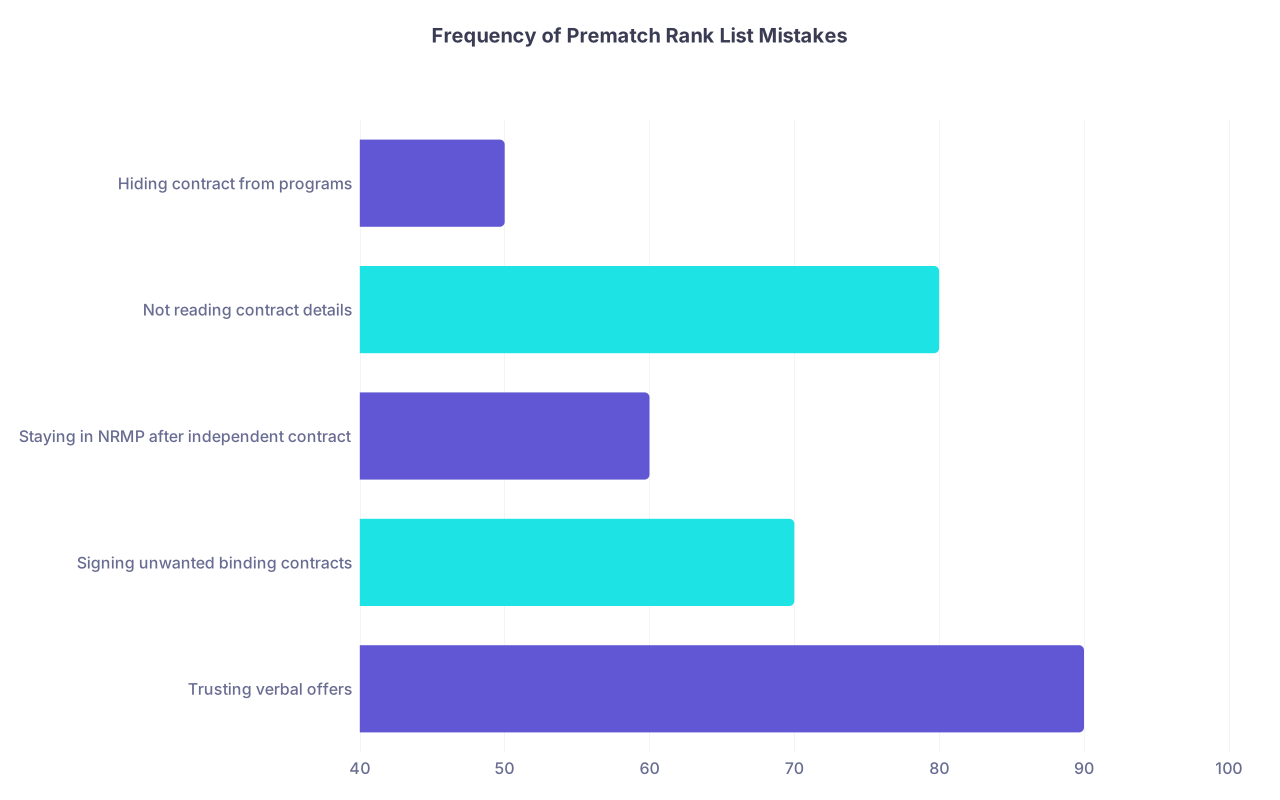
| Category | Value |
|---|---|
| Trusting verbal offers | 90 |
| Signing unwanted binding contracts | 70 |
| Staying in NRMP after independent contract | 60 |
| Not reading contract details | 80 |
| Hiding contract from programs | 50 |
Stuff I’ve seen blow up on people:
- They “pre‑match” verbally, don’t rank widely, program ghosts or under‑ranks them, and they end up unmatched.
- They sign an out‑of‑Match contract and still submit a rank list trying to hop to a more prestigious name. They match elsewhere, break contract, and spend months dealing with fallout and bad references.
- They assume “everyone does this” based on anonymous Reddit posts. They’re wrong.
You don’t want drama your PGY‑1 year. You want a clean start.
Quick Summary: Answering Your Exact Question
“Should I still submit a rank list after accepting a pre‑match offer?”
Here’s the stripped‑down answer:
If your pre‑match is a signed, binding contract with a program that is completely outside NRMP
→ You usually do NOT submit a rank list. Withdraw from the Match.If your pre‑match is a signed, binding contract with a program that participates in NRMP but has carved your spot out of the Match
→ Either:- Withdraw from NRMP, or
- Submit a rank list with that program clearly ranked #1.
If your pre‑match is verbal only, or non‑binding, or the program still plans to rank you through NRMP
→ Yes, you submit a rank list.
→ Rank all programs in your true order of preference, including that one.
When in doubt, you ask in writing:
“Does this contract remove me from the Match, and how should I handle my NRMP rank list?”
If they can’t answer that clearly, that’s a red flag about how they handle residents.
FAQ (Exactly 7 Questions)
1. Can I accept a pre‑match offer and still rank other programs higher?
Mechanically, sometimes yes. But if you signed a binding contract that commits you to that program, ranking others higher is basically planning to breach a contract. If it’s not binding or not truly out‑of‑Match, then yes, you can and should rank programs in your real preference order. The key is whether you’re actually contractually committed.
2. What happens if I match somewhere else after signing a pre‑match contract?
Worst case: you’ve got a contract with one program and an NRMP match obligation to another. That’s a mess. Programs can involve GME leadership, attorneys, and sometimes boards. Even if you get out of one contract, your reputation takes a hit. Don’t assume you can just “choose later.” Decide before you sign.
3. How do I know if my pre‑match contract is binding?
Look for explicit language: “This is a binding employment contract,” “The resident agrees to commence training on [date],” “breach,” “termination,” “liquidated damages,” etc. If the document feels like a real job contract with start date, salary, benefits, and obligations, it’s probably binding. If you’re not sure, ask GME or a lawyer; don’t rely on classmates.
4. The program told me they “always get their top choices” and I’m “basically in” – should I skip ranking other places?
No. That’s not a pre‑match. That’s flattery. You rank all programs in the exact order you’d like to attend them. If they want you, they’ll rank you highly. Trust the algorithm and protect yourself, not verbal promises.
5. If I withdraw from NRMP after signing an independent pre‑match, does it hurt me later for fellowship?
No. Fellowship PDs won’t care that you trained at a non‑NRMP program or accepted an out‑of‑Match spot, as long as the program is accredited and your training is solid. What hurts you is drama: contract issues, professionalism questions, or stories about you breaching agreements.
6. Can a program force me to withdraw from NRMP after a pre‑match?
They can strongly “expect” it and write that expectation into a contract. If the contract says you’ll not participate in other PGY‑1 positions or you’ll withdraw from the Match, and you sign it, then you’ve agreed to that. If you’re uncomfortable withdrawing, don’t sign something that requires it. Say so before you commit.
7. What if I already signed and now regret it—can I back out before Match day?
You can always ask to be released from a contract, but they don’t have to agree. Do it early, in writing, and professionally. Understand that this may burn a bridge and potentially raise flags with future programs if handled badly. If you’re even half unsure about a pre‑match contract, pause and get advice before signing, not after.
Open your contract (or email) right now and read the section that talks about NRMP, Match participation, and termination. If you can’t find clear language tying this to the Match, send a short email to the coordinator today asking, “Will I still be in NRMP, and how should I handle my rank list?” Don’t guess. Get a written answer.