
Most residents ask the wrong person to review their pre-match contract—and it costs them.
You do not need more opinions. You need the right eyes on that contract before you sign something that controls your next 1–3 years (or more, if there’s a payback clause or non-compete).
Here’s the answer you’re looking for: you should ask a healthcare/physician employment attorney to review a pre‑match contract first, then selectively loop in others depending on what you’re worried about—money, visa, career trajectory, or red flags in the program’s behavior.
Let’s break that down so you know exactly who to ask, in what order, and what each person is actually useful for.
1. Start with the only non‑negotiable: a healthcare/physician attorney
If you remember only one thing from this article, remember this: do not sign a pre‑match contract without an independent attorney reviewing it.
Not your uncle who “does real estate law.” Not your friend in corporate M&A. A healthcare/physician employment attorney. Ideally one who routinely reviews residency and fellow employment agreements.
Why? Because pre‑match contracts can include:
- Early commitment language that affects your NRMP participation
- Penalties for withdrawal (repayment of bonuses, relocation, stipends)
- Non-compete or geographic restriction clauses (yes, even some GME contracts try it)
- Work-hour expectations that quietly blow past ACGME norms in practice
- Moonlighting restrictions (important if you’re counting on extra income)
- Malpractice coverage details that affect you after you leave
A generalist lawyer may understand contract structure but miss how these pieces play out in GME and licensure.
Here’s what a good healthcare attorney will actually do for you:
Translate legalese into normal language:
“This paragraph means if you back out, you owe them $15,000 plus relocation costs.”Flag high‑risk clauses:
- Automatic renewal without clear exit
- One-sided termination (they can fire you easily, you can’t leave easily)
- Liquidated damages that are essentially a financial trap
Check for conflicts with NRMP rules:
Some pre‑match offers exist outside the Match (e.g., military, some prelims, certain specialties). Others can create NRMP violations if handled incorrectly. You want someone who knows that terrain.Tell you what’s normal vs predatory:
I’ve seen residents think a clause is “standard” because a PD said so. It wasn’t. It was just standard for that exploitative hospital system.
Cost: typically $250–$600 for a contract review, depending on region and complexity. That feels painful when you’re a student or intern. It’s cheap compared to:
- A year in a toxic program you can’t easily leave
- Paying back a “signing bonus” plus moving costs
- Being blocked from working in a region because of a non‑compete
Bottom line: First ask a healthcare/physician employment attorney. Everything else is optional; this is not.
2. Who else is useful—and who isn’t
After you have legal eyes on it, you can selectively add other reviewers depending on what you need.
| Reviewer Type | Primary Use |
|---|---|
| Healthcare/Physician Attorney | Legal risk, enforceability |
| Trusted Senior Resident/Fellow | Reality check on workflow |
| Specialty Mentor/Program Director | Career & training implications |
| Financial Professional (CPA/Planner) | Taxes, benefits, loan strategy |
| Immigration Attorney (if on visa) | Visa and status implications |
A. Trusted senior resident or fellow (in that program or similar)
You’re not asking them to “review the contract” legally. You’re using them as a truth serum.
They can tell you:
- Whether the call schedule in the contract matches reality
- If “typical” clinical hours are actually 80+ every week
- If people get the promised OR time, clinic volume, or subspecialty exposure
- How the program handles pregnant residents, illness, remediation
How to use them effectively:
- Send them the schedule/call/rotation portions only
- Ask specific questions:
- “Does this look realistic?”
- “Anything here that doesn’t match what actually happens?”
- “Would you sign this again knowing what you know now?”
What they cannot do: protect you legally. Do not let “the chief said it’s fine” substitute for an attorney.
B. Specialty mentor or external program director
This is about career implications, not clauses.
Ask an attending or PD you trust, preferably not affiliated with the offering program, to look at:
- Duration and type of commitment (e.g., 1-year prelim vs 3-year categorical vs integrated program)
- Training structure: enough volume, case mix, supervision, research exposure
- Board eligibility and reputation: “If I train here, will this hurt or help me for [X] fellowship/job?”
Questions to ask them:
- “If I take this pre-match, does it close doors later?”
- “Would this be a red flag to fellowship directors?”
- “Compared to typical contracts in this specialty, anything concerning?”
They’re not lawyers, but they do know how certain arrangements look on a CV and in fellowship discussions.
C. Financial professional: CPA or fee-only financial planner
Most residents underestimate the money side because they’re just grateful to have an offer. That’s how they get stuck in terrible deals.
A financial professional can help you:
Analyze the real value of:
- “Signing bonuses” (often with strings attached)
- Loan repayment promises
- Relocation money and clawback terms
Understand tax impact:
- Bonus all in one year vs distributed
- State tax differences if you’re moving
- Whether any benefits are actually taxable income
Check cash flow reality:
- Salary vs cost of living in that city
- Whether moonlighting restrictions kill your backup plan
You do not need a long-term advisor just to review one offer, but a one-time consult can be useful if:
- You’re supporting a family
- You’re comparing multiple pre-match offers in different cities
- There are complex benefits or loan pieces attached
D. Immigration attorney (if you’re on a visa)
If you’re on J‑1, H‑1B, or anything not straightforward, do not guess. Do not rely on the program’s “international office” only.
An immigration attorney should specifically check:
- Whether the position and employer can sponsor your specific visa type
- Timing issues: will there be gaps in status between med school and residency start?
- Two-year home residency implications (for J‑1) and future waiver options
- Whether geographic limitations in the contract could hurt a future waiver job
Immigration is one of those areas where residents routinely get burned because they trusted verbal assurances from HR.
3. Who you should not rely on for actual contract review
Some people are good for emotional support, but not for binding commitments.
Be cautious relying on:
Medical students or co‑interns
They mean well but usually have no clue what’s enforceable or normal. Comparing notes with classmates is fine; using them as authority is not.Family or friends who are lawyers but not in healthcare/employment
Corporate, real estate, criminal defense, patent—these are not the same as GME/employment law. They might miss key risk points unique to physician contracts.Hospital HR or GME office
They work for the institution, not you. They’re useful for clarifying wording, but not for giving you objective advice on whether you should sign.The program director or coordinator
You can ask questions, but don’t treat their answers as protection. If it’s not in writing in the contract (or an official addendum), it basically does not exist.
4. How to sequence the review process (step-by-step)
You don’t need 12 people in the loop. You need the right 3–4, in the right order.

| Step | Description |
|---|---|
| Step 1 | Receive Pre-match Contract |
| Step 2 | Initial Read Yourself |
| Step 3 | Healthcare Attorney Review |
| Step 4 | Immigration or Financial Review |
| Step 5 | Trusted Resident/Fellow Input |
| Step 6 | External Mentor or PD Input |
| Step 7 | Clarify Terms with Program |
| Step 8 | Decide to Sign or Decline |
| Step 9 | Visa or Complex Money? |
Here’s the practical timeline:
Day 0–1: Your own read-through
Mark anything you don’t understand or that feels off (hours, penalties, vague language).Day 1–5: Attorney review
Send it to a healthcare/physician attorney. Many can turn it around in a few business days. Ask them for:- A summary in plain English
- A list of suggested edits or questions to send back to the program
Day 4–7: Resident/fellow reality check
While attorney work is in process or just after, send the call/rotation portions to a trusted resident or recent grad.Day 5–10: Mentor/fellowship PD perspective
Send the cleaned version (with your highlights) to a mentor: “Would you sign this if you were me?”Any time in parallel: Immigration/financial if applicable
Before deadline: Clarify with program
Go back to the program with specific questions or requested changes. Example:- “Can we remove or cap the repayment obligation to X months of salary?”
- “Can we clarify that call will not exceed X per month except in emergencies?”
Document everything by email.
5. What to prioritize if you can only involve 1–2 people
Reality: some of you will be short on time, money, or both. Here’s the triage:
Absolute minimum:
- Healthcare/physician employment attorney.
If you can add one more:
- Senior resident/fellow in that program (for ground truth).
If visa-dependent:
Swap the resident for immigration attorney if you absolutely must choose. Legal status > schedule annoyance.
If your situation is:
First match attempt, normal USMD/DO, no visa issues:
Attorney + resident/fellow is usually enough.Re-applicant, SOAP trauma in the past, desperate to secure a spot:
You’re at higher risk of signing something bad out of fear. Attorney is non-negotiable; add a mentor who will be brutally honest with you.Early pre‑match from a less-than-stellar program while you’re still waiting for interviews:
You especially need an external mentor/PD to tell you whether you’re selling yourself short.
6. Red flags that should push you to get even more scrutiny
If you see any of these in your pre-match contract, stop and make sure a qualified attorney has eyes on it:
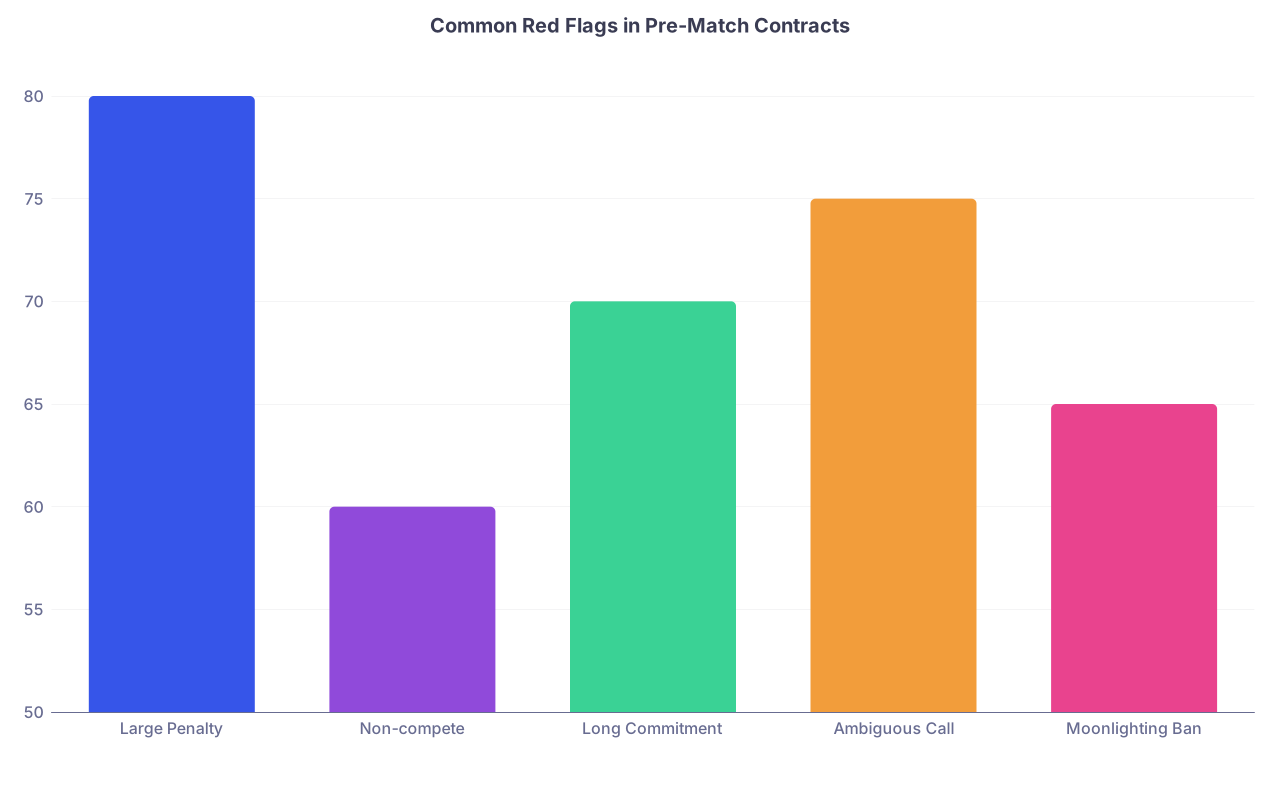
| Category | Value |
|---|---|
| Large Penalty | 80 |
| Non-compete | 60 |
| Long Commitment | 70 |
| Ambiguous Call | 75 |
| Moonlighting Ban | 65 |
- Large penalty or “liquidated damages” if you withdraw or fail to start
- Non‑compete language, especially with specific mileage radiuses
- Commitment > 1 year with no clear resident-initiated termination clause
- Extremely vague language about hours, call, or rotation sites
- Moonlighting banned without reason in a setting where others can moonlight
- Anything that seems to pressure you not to participate in NRMP when you are supposed to
The more of these you see, the more you need someone experienced on your side.
7. Quick comparison: who does what for you
| Reviewer | Legal Protection | Reality Check | Career Impact | Money/Taxes | Visa Status |
|---|---|---|---|---|---|
| Healthcare Attorney | Strong | Moderate | Low | Moderate | Sometimes |
| Senior Resident/Fellow | None | Strong | Moderate | Low | None |
| Mentor/External PD | None | Moderate | Strong | Low | None |
| Financial Professional | None | Low | Low | Strong | None |
| Immigration Attorney | Some | Low | Moderate | Low | Strong |
FAQs
1. Is it really necessary to pay for an attorney for a residency pre-match contract?
Yes. You’re committing years of your life and potentially thousands in penalties if you back out. A few hundred dollars up front to avoid a bad deal is rational, not excessive. I’ve seen residents spend more on a single weekend trip than on someone protecting their entire training.
2. Can I ask the program for time to have the contract reviewed?
Absolutely. A reasonable program expects this. Say something like, “I’m very interested and would like to have this reviewed by an attorney. Could I have until [date] to get back to you?” If they pressure you to sign immediately, that’s a red flag in itself.
3. My friend who’s a lawyer offered to look at it for free. Is that enough?
If they’re not experienced in physician/employment/healthcare law, it’s risky to rely on them alone. Best case: they catch some generic contract issues. Worst case: they reassure you about something that’s standard in, say, corporate work but toxic in GME. You can combine their free review with a shorter paid consult from a specialist.
4. Should I let my parents or partner read the contract too?
Sure, but for values and lifestyle, not legal advice. They can help you think about hours, location, safety, and family planning. They can’t tell you if a clause is enforceable or whether it’s normal in your specialty.
5. What if the contract looks “standard” and similar to what friends got?
“Standard” doesn’t mean safe, and it definitely doesn’t mean optimal. Hospitals often reuse templates that are tilted in their favor. Friends may also not know what’s problematic. Treat “it looks standard” as a starting point, not a green light to skip professional review.
Key points to leave with:
- A healthcare/physician employment attorney is the one person you should always ask to review a pre‑match contract before signing.
- Layer in a trusted resident/fellow and an external mentor/PD for reality and career impact, plus immigration/financial experts if relevant.
- Do not confuse verbal reassurance or “standard language” with protection. If it matters, it needs to be in writing—and reviewed by someone whose job is to protect you, not the program.