
It’s late November. You’re post-call from an away rotation, scrolling through your email in a daze, and there it is: “We are pleased to extend you a categorical pre-match offer…”
Your stomach drops. Then races. You’ve got at least three interviews still coming up — including one at your dream program — and now you’re stuck on one brutal question:
Should you tell other programs you’ve received a pre-match offer?
Here’s the answer you’re looking for:
You can tell them. Sometimes you should tell them. But you need to be very intentional about why, when, and how you do it — or you can absolutely hurt yourself.
Let’s walk through this the way I’d do it with a student in my office.
Step 1: Get Clear On What Kind of Offer You Actually Have
Before you email anyone, you need to know exactly what you’re holding.
Programs and regions play games with language. I’ve seen all of these:
- “Pre-match offer”
- “Intent to rank you to match”
- “We intend to rank you to match if you rank us #1”
- “We are likely to rank you highly”
- A verbal “We love you, you’ll be fine here” on interview day
These are not the same thing.
Here’s the hard rule:
If it’s not a formal, written, contract-level offer in a system that exists outside NRMP (like many Texas programs via the old pre-match or SOAP-style direct contracts), then it’s not truly a binding “pre-match.” It’s just a strong signal.
| Type of Message | Strength | Counts as True Pre-Match? |
|---|---|---|
| Signed contract / formal non-NRMP spot | Very High | Yes |
| Written “pre-match offer” with terms | High | Usually |
| Email “We will rank you to match” | Medium | No |
| Email “We intend to rank you highly” | Low | No |
| Verbal “You’ll be fine here” | Very Low | No |
Why this matters:
The more concrete the offer, the more leverage you might have with other programs — but also the more risk you take by playing games with it.
If you’re not sure how binding your offer is, email the program coordinator and ask directly:
“Is this a formal pre-match position outside the NRMP Match that would require me to withdraw from the Match if I accept?”
Get that cleared up first.
Step 2: Understand What You’re Actually Trying to Accomplish
Before asking “Should I tell them?”, ask “What do I want from telling them?”
There are really only four rational goals:
- To see if a preferred program would like to “compete” — i.e., offer you something comparable or reassure you.
- To nudge a program that’s on the fence into offering you an interview or moving you up their rank list.
- To be transparent with a program you genuinely like and don’t want to blindside if you might withdraw.
- To buy time / get clarity from the offering program by honestly saying, “I’m still actively interviewing elsewhere.”
Everything else — ego, trying to “flex,” fishing for compliments — is noise and can backfire.
If your goal isn’t one of those four, you probably don’t need to tell anyone.
Step 3: When Telling Other Programs Helps You
Here’s where being strategic pays off. There are a few situations where sharing a pre-match offer can be smart.
Scenario A: You Have an Offer, But a Clearly Preferred Program Is Coming Up
Example: You got a formal pre-match from a solid community IM program. Next week, you’re interviewing at your dream academic IM program that doesn’t do pre-match.
In this case, you can use the offer as a gentle, factual signal of competitiveness and interest — after you’ve had your interview and know you still want them.
How to do it:
- Wait until you’ve interviewed.
- Decide that, if they ranked you highly enough to match, you’d take them over the pre-match.
- Send a short, professional email to the program director or coordinator.
Sample language:
Subject: Update on Application Status – Pre-match Offer
Dear Dr. [Name],
Thank you again for the opportunity to interview with [Program Name] on [date]; the visit confirmed my strong interest in training at your program.
I wanted to update you that I have since received a pre-match offer from another institution. While I have not made any final decisions, [Program Name] remains my top choice for residency due to [1–2 specific, concrete reasons].
I understand the constraints of the Match process and do not expect any special consideration, but I thought it appropriate to keep you informed.
Sincerely,
[Your Name], AAMC ID [#######]
What this does:
- Signals you’re competitive enough to get offers elsewhere.
- Signals they’re still your first choice.
- Does not demand anything or put them in an ethical corner.
The good programs will file this as “interested and competitive” and, if they were on the fence about rank position, it can help. I’ve seen this move someone from mid-list to safer territory.
Scenario B: You’re Waiting on Interviews From a Region or Specialty You Strongly Prefer
Say you got a pre-match offer in a smaller city, but you grew up in Chicago and would rather be at a Chicago program if possible. You’ve applied, but you haven’t heard from some of them.
You can email a program once, briefly, and mention the offer as context, not as a threat.
Example:
Dear Dr. [Name],
I remain very interested in the opportunity to train at [Program Name]. I wanted to share that I have recently received a pre-match offer from another institution and will need to make a decision regarding that position in the coming weeks.
If my application is still under consideration for an interview, I would be grateful for the opportunity to visit your program before making any final decisions.
Thank you for your time and consideration.
Sincerely,
[Name]
They may ignore it. They may say no. They may pull your application for review and give you an interview you were borderline for. I’ve seen all three.
It’s reasonable, and it’s not unethical, as long as:
- You’re not lying about timing (“in the coming weeks” when the offer expires tomorrow).
- You’re genuinely interested in them.
- You don’t send a version of this to 20 programs.
Pick 2–4 you realistically would choose over your pre-match. That’s it.
Step 4: When Telling Other Programs Hurts You
There are times where telling other programs you “have an offer elsewhere” makes you look bad or even gets you quietly deprioritized.
Red flags I’ve seen:
- Mass emails to a long CC list of PDs/coordinators.
- Messages that sound like ultimatums: “I have an offer and need to know if you plan to rank me.”
- Vague flexing: “I’ve received multiple offers” with no clear purpose.
- Over-sharing when the “offer” is just a friendly email: “They said they would rank me highly.”
Why programs don’t love this:
- They can’t promise anything concrete back without violating NRMP rules.
- They don’t want to get dragged into a negotiation they can’t control.
- If you sound like you’re shopping around or playing hardball, some will just move on. There are plenty of good candidates who don’t create drama.
So as a rule:
If the only real goal of telling them is to boost your ego or pressure them — do not send that email.
Step 5: Ethics, NRMP Rules, and What’s Actually Allowed
Let’s clean up a big misconception:
You are allowed to tell programs factual information about your situation. You are not allowed to ask them how they will rank you, and they are not allowed to tell you your exact rank position.
What you can ethically do:
- Say you’ve received an offer elsewhere.
- Say they are your top choice / would be ranked highly.
- Ask about timelines (“When do you anticipate finalizing your rank list?”).
What you should not do:
- Ask directly, “If I rank you #1, will I match?”
- Pressure them: “I will only decline this offer if you confirm I’ll match at your program.”
- Misrepresent anything (“I have several offers” when you don’t).
What they can do (and often will):
- Say they’re enthusiastic about you.
- Say they plan to rank you highly (vague).
- Thank you for the update and offer no specifics at all.
That’s normal. Do not read too much into polite but content-light replies.
Step 6: Deciding Whether to Accept the Pre-Match Before You Start Emailing
This part gets skipped way too often.
If the pre-match is from a program you’d honestly be very happy at — solid training, reasonable location, fits your career goals — there is nothing weak about just accepting it and being done.
Some questions to force yourself to answer honestly:
- If the Match gave me exactly this program, would I be satisfied? Not ecstatic, maybe, but content to train there.
- What realistically are my chances of doing clearly better? Based on my scores, letters, and interview invites — not fantasies.
- How much stress is it worth to gamble this away?
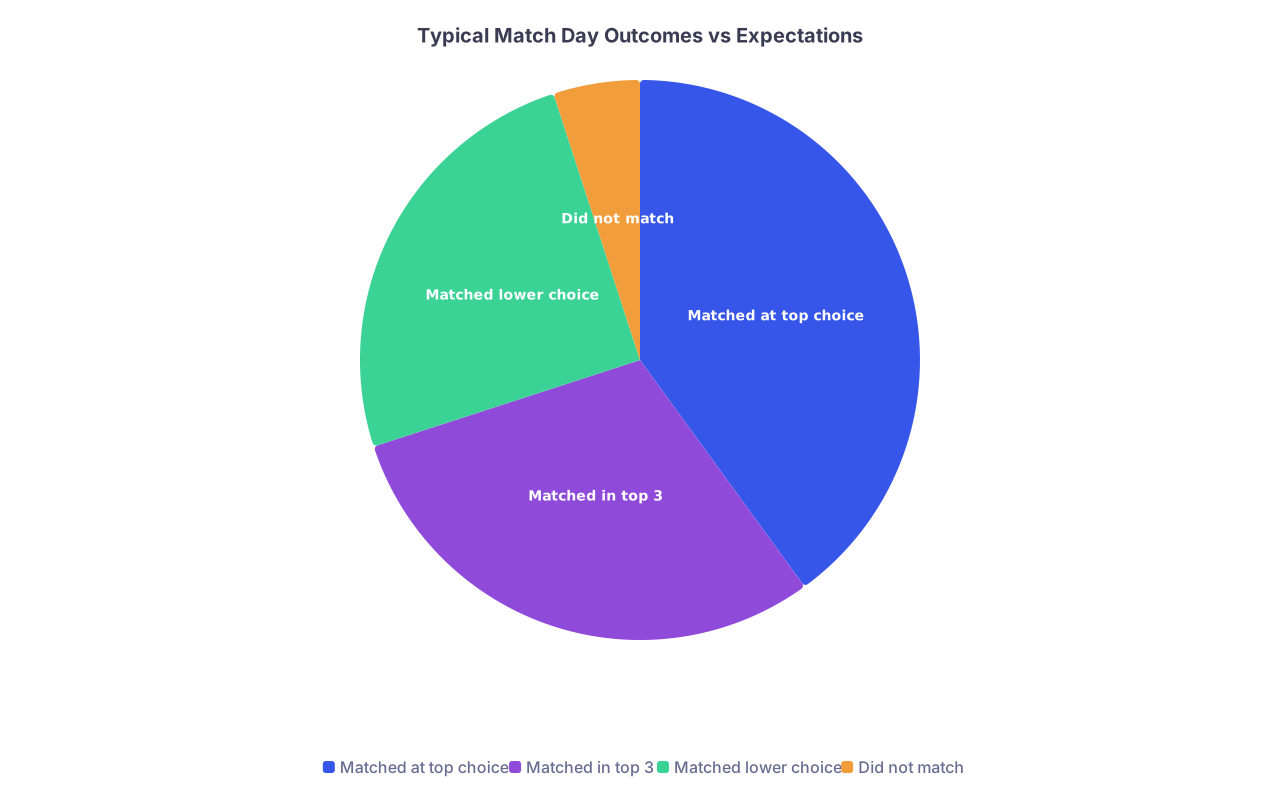
| Category | Value |
|---|---|
| Matched at top choice | 40 |
| Matched in top 3 | 30 |
| Matched lower choice | 25 |
| Did not match | 5 |
That 5–10% “did not match” risk is not theoretical. I’ve seen people walk away from secure pre-match spots because they were chasing prestige and then end up scrambling.
If you’re leaning heavily toward accepting, I’d be very conservative with “shopping” the offer around. Maybe you tell your single, true #1. Maybe. Then you decide.
If you’re genuinely not sure, you can:
- Ask the offering program for a specific decision deadline.
- Clarify whether accepting requires you to withdraw from the Match.
- Use that window sparingly to explore 1–3 other top options.
But set an internal date where you stop games and commit, even if nobody else bites.
Step 7: What to Say to the Offering Program While You’re Thinking
You don’t need to ghost them, and you don’t need to immediately say yes.
Reasonable reply:
Dear Dr. [Name],
Thank you very much for extending this pre-match offer. I’m honored by your confidence and remain very interested in [Program Name].
I am currently in the middle of my scheduled interviews and would like to carefully consider my options before making a final decision. Could you let me know by what date you would need a response from me?
Sincerely,
[Name]
That buys you time, signals respect, and doesn’t commit you to anything yet.
Just don’t drag them along past their stated deadline. That’s how you burn bridges.
Step 8: Practical Decision Framework – Who To Tell, Who Not To Tell
If you want a simple rule set, use this:
You consider telling a program about your pre-match offer if:
- You have already interviewed there,
- You would honestly choose them over your pre-match if you matched, and
- You can communicate it once, briefly, without sounding demanding.
You might tell a program you haven’t interviewed at only if:
- You strongly prefer their region/specialty,
- You’re waiting on an interview decision, and
- You have a narrowing deadline on your pre-match.
You do not tell:
- Every program on your list “to increase your chances.”
- Programs that are obvious reaches where the note will come off as posturing.
- Programs you’re lukewarm about and would likely rank below the pre-match anyway.
Keep a simple tracking note for yourself:
| Program | Interviewed? | Would rank above pre-match? | Told about offer? |
|---|---|---|---|
| Pre-match A | Yes | N/A | N/A |
| Dream Program X | Yes | Yes | Yes |
| Regional Y | No | Maybe | Yes |
| Backup Z | Yes | No | No |
One more thing: every communication you send can be forwarded and saved in your file. Write accordingly.
Step 9: What If You Already Told Multiple Programs and Now Regret It?
If you’ve already been a little too loud about your offer, don’t spiral.
You don’t need a big cleanup campaign. Just stop sending more of those emails. For any program that actually responds and seems engaged, stay polite and straightforward.
If someone pushes you (rare), you can always say:
I wanted to be transparent about my situation while I was considering all my options. I remain very interested in your program and will finalize my decision within the agreed timelines.
Then move on.
Quick Reality Check
Let me be blunt.
- Most programs care more about your interview performance, letters, and fit than about whether some other mid-tier program pre-matched you.
- A pre-match offer is helpful leverage only in a narrow band of cases — where you’re realistically competitive, and they’re on the fence, and you’re actually willing to commit to them if it works out.
- Overplaying your hand makes you look naive at best and arrogant at worst.
Used well, sharing a pre-match offer is a scalpel. Not a hammer.
Bottom Line
Three key points and you’re done:
- Only tell other programs about a pre-match offer when you have a clear goal, you’d genuinely choose them over the offer, and you can say it once, concisely, without pressure.
- Do not confuse “We’ll rank you highly” with a real pre-match; treat anything non-contractual as a signal, not a guarantee, and don’t brag about it.
- If your pre-match is somewhere you’d be satisfied training, it’s perfectly reasonable — and often smart — to accept it and walk into Match season with your spot secured instead of trying to play master negotiator.